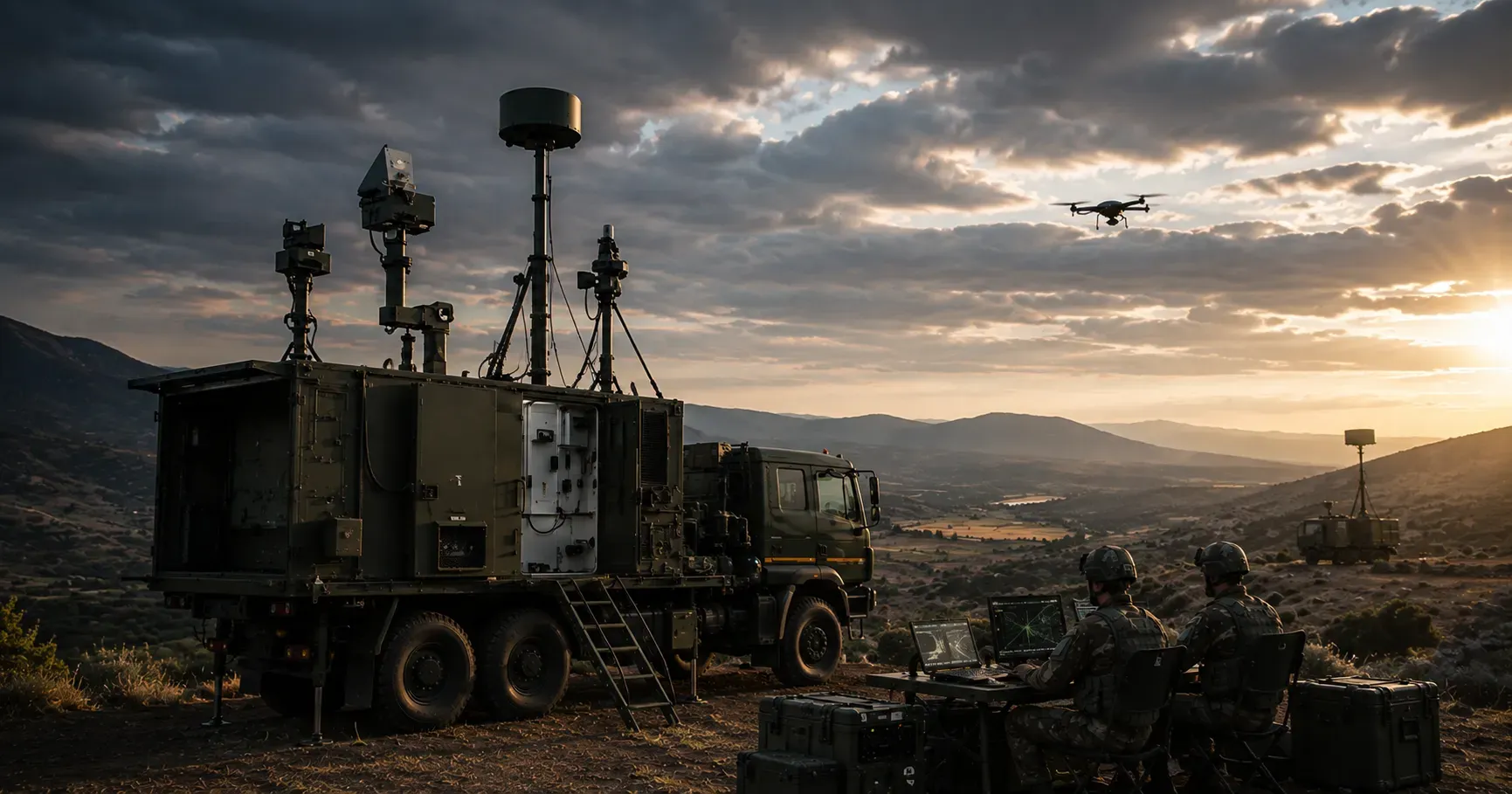
India's Integrated Counter-UAS Grid defended Northern and Western India on the night of 7 to 8 May 2025 (Ministry of Defence, 12 May 2025). The grid runs on four sensor layers. Radar sees the airframe. Radio-frequency receivers see the controller link. Electro-optical and infrared sensors see the body and heat signature. Acoustic arrays hear the rotor noise. The AI fusion layer separates a rogue UAV from a passing bird.
What a rogue UAV actually is, and why detection is hard
A rogue UAV is any drone operating inside a protected airspace without authorisation. It may be a hobbyist who skipped the flight plan, a smuggler running a payload, or a hostile platform launched against a military target. The category is defined by the absence of permission.
Detection is the hard part. Drones are small, slow, and low-flying. Many use plastic and composite materials that reflect almost no radar energy. A large share use commercial control links that blend into ambient RF traffic.
The Drone Federation India represents over 550 drone companies and 5,500 pilots (Drone Federation India, 2025). The Drone Rules 2021 framework notified on 25 August 2021 expanded legal flight volume sharply (Ministry of Civil Aviation, 25 August 2021). Anti-drone systems in India must now separate authorised flights logged under India's drone laws and the NPNT permission system from rogue intrusions in real time. The article explains how detection works once the legal layer has done its job.
The detect-track-classify-mitigate chain explained
Every modern anti-drone system runs the same four-stage chain. Detection sees something in the sky. Tracking follows it. Classification decides whether it is a drone, a bird, an aircraft, or a balloon. Mitigation is the response. Soft kill jams the control link or spoofs the navigation signal. Hard kill uses a kinetic interceptor or a directed-energy strike.
The chain is not a sequential checklist. Each stage feeds back into the others. A classification score sharpens the tracking filter. A tracking history sharpens the next classification. The fusion engine runs all four stages continuously across every sensor input.
The DRDO-developed and BEL-manufactured D-4 counter drone system is the canonical Indian example of this architecture (Press Information Bureau, 28 July 2021). It combines radar, RF, and electro-optical sensors with soft-kill and hard-kill mitigation, and has been inducted across the Army, Navy, and Air Force. DRDO completed full system development by January 2024 and transferred the technology to BEL and to private partners including Adani, L&T, and Icom (DRDO, 8 January 2024).
Drone detection radar systems: the long-range workhorse
Drone detection radar India is procuring remains the primary long-range sensor in counter-UAS deployments. Radar emits electromagnetic pulses, listens for reflected returns, and measures distance, direction, and Doppler shift. Modern anti-drone radars use frequency-modulated continuous-wave techniques and millimetre-wave bands to catch small UAVs.
The Indian Air Force issued Requests for Information in January 2026 for new counter-drone systems. The specifications require detecting drones with a radar cross-section of 0.02 square metres and below (Indian Air Force, January 2026). Anti-drone radar range India is now procuring sits in the 15 to 20 kilometre band for early warning around vital areas and vital points.
Radar performs well across wide-area surveillance at airbases, oil refineries, and border infrastructure. It holds up during darkness and poor weather where optical systems lose visibility.
The limit is clutter. Urban terrain produces reflections from buildings, power lines, vehicles, and communication towers. Plastic drones below 50 metres can disappear into background noise. Bird signatures overlap with small UAV profiles. Indian counter-drone systems therefore integrate RF and optical confirmation layers before any engagement decision. Radar never works alone.
RF detection drone systems: catching the controller, not just the airframe
Radio-frequency sensors listen for the communication link between the drone and its pilot. RF detection drone systems do not track the airframe directly. They monitor the frequencies used by command-and-control transmissions, telemetry streams, and video downlinks.
Indian counter-drone systems scan a wideband range covering 70 megahertz to 12 gigahertz (industry technical disclosures, May 2026). That sweep covers almost every consumer and commercial drone control protocol. The receiver fingerprints the protocol, identifies the manufacturer class, and triangulates the pilot's position from multi-antenna direction-finding.
This is the only sensor that can pinpoint the operator behind a hostile flight. Security teams can isolate the aircraft and the controller at the same time. RF mapping also distinguishes a DigitalSky-registered flight from a rogue intrusion.
The limit is autonomy. A pre-programmed drone with no active RF link becomes invisible mid-flight. Dense spectrum environments add a second problem. Telecom infrastructure, Wi-Fi, and civilian devices generate overlapping signals. The fusion engine must filter background traffic before elevating a target, which is why RF is paired with radar and optical confirmation.
[Image insertion point: anti-drone radar deployment graphic] [ALT TEXT: Drone detection radar integrated into anti-drone systems in India for low-altitude UAV surveillance around vital areas.]
Electro-optical drone detection: the visual confirmation layer
Electro-optical drone detection and infrared sensors form the visual confirmation layer of every modern Indian counter-UAS platform. Daylight cameras identify shape and flight behaviour. Infrared payloads pick up heat signatures at night and in low visibility.
This stage matters because radar and RF systems produce probability estimates, not visual certainty. An electro-optical payload confirms whether the flagged track is a UAV, a bird, a balloon, or environmental interference. The Indian Air Force RFI specifies passive electro-optical systems modelled on aircraft-grade sensors of the kind used on the Rafale and Su-30MKI (Indian Air Force, January 2026). Passive sensors detect without emitting, which keeps the counter-UAS site hidden from the threat.
Modern Indian platforms pair optical payloads with automated cueing. When radar or RF flags a track, the camera slews to the threat bearing and compares the image against stored drone signatures.
The limit is weather. Fog, dust, smoke, and heavy rainfall degrade optical sensors faster than they degrade radar. Electro-optical drone detection therefore works as a confirmation layer fused with radar and RF, not as a standalone mode.
[Image insertion point: electro-optical tracking turret] [ALT TEXT: Electro-optical and infrared sensors used in anti-drone systems in India for UAV identification and tracking.]
Acoustic drone detection: the underrated fourth sensor
Acoustic drone detection arrays listen for the rotor noise that every multirotor drone produces. They work at short range, typically under 500 metres. They perform best in dense urban environments where radar reflections become unreliable. Acoustic is the only sensor in the stack that gets stronger as the urban clutter problem gets worse.
The technique uses an array of microphones to triangulate the sound source by time-of-arrival differences. The processing layer matches the captured signature against a library of rotor profiles. Different airframes produce different blade-pass frequencies, and the match resolves detection and class identification in one step.
Acoustic detection is rarely the primary sensor. It serves as a confirmation layer for the smallest, slowest, and lowest-altitude drones that defeat radar entirely. Stadium security, public-event protection, and prison perimeter defence are the contexts where acoustic arrays carry the heaviest weight. As Indian operators move toward layered urban coverage, acoustic confirmation is shifting from accessory to core sensor.
Sensor type | Primary strength | Main limitation | Best deployment environment |
|---|---|---|---|
Radar | Long-range detection | Urban clutter | Airbases and open terrain |
RF sensing | Pilot localisation | Autonomous drones | Urban and industrial zones |
EO/IR sensors | Visual confirmation | Weather degradation | Short-range identification |
Acoustic arrays | Low-altitude detection | Limited range | Dense urban environments |
Sensor fusion: where the AI counter-drone system India is going
The defining shift in 2024 to 2026 anti-drone systems is not in any single sensor. It is in the AI fusion engine that combines all four detection streams in real time. Modern Indian platforms can track more than one hundred simultaneous drone targets across the sensor stack (industry technical disclosures, May 2026). The fusion engine ranks each track by threat priority.
Without fusion, a four-sensor system produces four uncorrelated alarm streams. Radar flags an aerial object. RF flags a communication source. Optical flags a movement. Acoustic flags a rotor signature. The operator has to correlate all four under time pressure. With fusion, the system delivers one ranked threat list with a confidence score on every track.
This is also where the swarm problem gets solved. A fusion engine hands one operator a coherent picture of a hundred-drone attack. No single-sensor system can do that. The capability matters in the post-Sindoor threat environment, where kamikaze loitering munitions and coordinated swarm vectors are the core operational risk facing vital points.
What detection looked like during Operation Sindoor
The night of 7 to 8 May 2025 was the largest live-fire test of India's counter-drone architecture. The Integrated Counter-UAS Grid defeated coordinated drone and missile attacks across the north and west of the country (Ministry of Defence, 12 May 2025). Protected sites named in the official briefing include Awantipura, Srinagar, Jammu, Pathankot, Amritsar, Adampur, Bhatinda, Chandigarh, Nal, Phalodi, Uttarlai, and Bhuj.
The grid combined Integrated Air Defence radars with the D-4 counter drone system inducted across all three services. Soft-kill mitigation through RF jamming and GNSS disruption paired with hard-kill kinetic options. Air-defence guns and loitering interceptors completed the engagement chain. The strikes were defeated without loss of Indian assets.
Three detection lessons emerged. Layered sensor stacks held up under saturation. Sensor fusion held up under combat load. The soft-kill RF and GNSS jamming layer worked at engagement ranges that allowed kinetic backup to follow. The Indian Air Force RFI of January 2026 reflects that shift directly (Indian Air Force, January 2026).
Where the indigenous DRDO anti-drone system stack stands in 2026
India's counter-UAS inventory in May 2026 is anchored by the DRDO counter-drone system BEL produces under transfer-of-technology arrangements. The Naval Anti-Drone System was the first inducted variant, contracted to BEL on 31 August 2021 for static and mobile configurations (Press Information Bureau, 31 August 2021). The wider D-4 programme followed across Army, Navy, and Air Force deployments with 360-degree coverage and combined soft-kill and hard-kill capability.
In January 2024, DRDO confirmed completion of the full integrated counter-drone system. Transfer of technology was extended beyond BEL to private partners including Adani, L&T, and Icom (DRDO, 8 January 2024). That step shifted indigenous counter-UAS from a single-vendor pipeline to a multi-vendor industrial base.
The forward edge sits in directed-energy. DRDO disclosed in April 2026 that its High-Power Microwave anti-drone India programme targets a five-kilometre engagement range against drone swarms (DRDO, April 2026). The system disables drone electronics with a wideband electromagnetic pulse rather than a kinetic round. The capability sits alongside India's indigenous military drone fleet as a Tier 1 asset under DGCA type certification.
What anti-drone systems still cannot reliably catch
Four categories of drone remain hard for current Indian C-UAS systems to detect.
Very small plastic micro-drones with no active RF link defeat radar and RF at the same time. The airframe reflects almost nothing. The link emits almost nothing. Only acoustic and optical sensors at close range produce a detection.
Tethered drones operate on wired control links that emit no RF signature. They must be caught visually or acoustically, or identified by the tether itself.
Drones flying nap-of-the-earth below 50 metres in urban canyons or forested terrain hide inside radar clutter. The fusion engine has to lean on RF and acoustic confirmation, which carries its own range and false-positive problems.
Pre-programmed autonomous drones with GNSS-denied navigation are immune to GNSS-spoofing countermeasures. They must be killed kinetically once detected, which is the engagement-cost problem that High-Power Microwave systems are being built to solve.
These four gaps define the procurement frontier. They also explain why India's UTM framework and the drone airspace zone map matter. Legal-layer compliance reduces the volume of ambiguous tracks the sensor stack has to resolve.
What comes next for India's counter-drone grid
Three trends will define the next twelve to twenty-four months for anti-drone system for critical infrastructure deployments in India.
The Indian Air Force RFI process from January 2026 will translate into procurement contracts inside this fiscal year. Coverage will expand across Vital Areas and Vital Points. The drone weight categories under the Drone Rules 2021 shape the threat-class assumptions baked into each contract.
The DRDO HPM programme will move from demonstrator to field trial. Directed-energy weapons collapse the per-shot cost of counter-swarm engagement. The five-kilometre range target opens a layer of defence between kinetic interception and missile-based air defence (DRDO, April 2026).
The AI fusion layer will become the procurement differentiator. Indigenous design, development, and manufacturing under the IDDM framework is the gating criterion for defence procurement.
India's counter-UAS strategy is moving toward persistent layered sensing. The speed of sensor fusion decides whether a rogue UAV becomes a manageable threat or a successful intrusion.