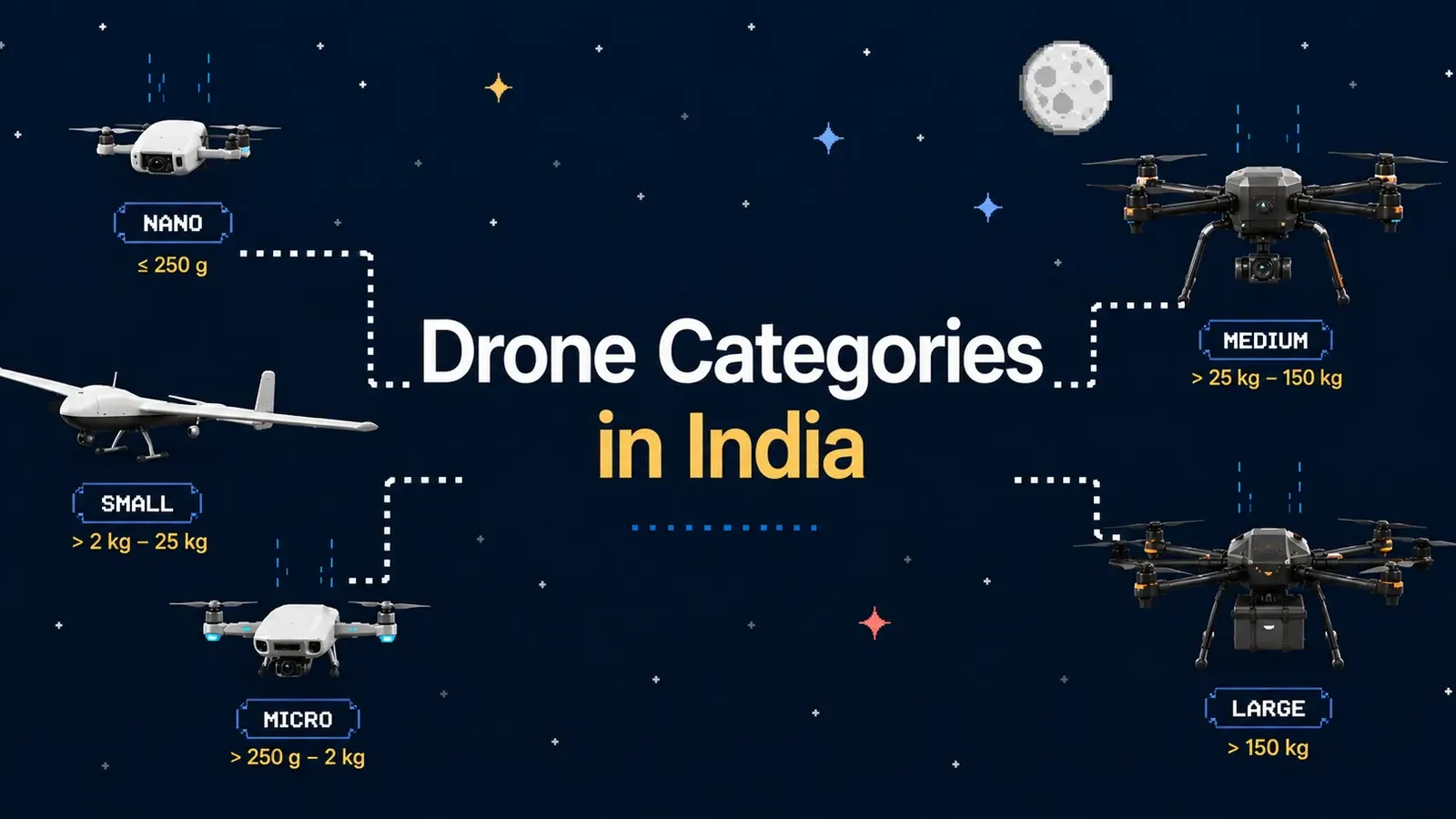
Drone categories in India by weight decide nearly every compliance rule attached to an unmanned aircraft system. Registration, pilot certification, type approval, insurance and altitude limits all depend on one number: maximum all-up weight (MAUW). The most important threshold is 250 grams. Drones at or below that limit fall into the Nano category, while drones above it move into the Micro category with additional compliance obligations under the Drone Rules 2021 (Ministry of Civil Aviation, 25 August 2021). The same framework applies to consumer drones, agricultural spraying platforms and defence unmanned aircraft. Operators who miscalculate MAUW often violate registration or insurance rules without realising it, and penalties can reach ₹1 lakh under Rule 50. This guide explains each drone category, the compliance triggers attached to it, the 250 g and 500 kg thresholds that matter most in 2026, and the MAUW mistakes that create the most regulatory and insurance disputes.
Why drone weight categories define every DGCA rule in India
India introduced the Drone Rules 2021 on 25 August 2021 under the Aircraft Act 1934 (Ministry of Civil Aviation, 25 August 2021). The rules replaced earlier approval-heavy systems with a classification model built around the five types of drones in India by weight.
The Directorate General of Civil Aviation (DGCA) uses MAUW because weight directly affects operational risk, payload capacity and crash impact. A 249 gram drone creates a different operational profile than a 90 kilogram agricultural spraying platform. That gap is why a 5-tier classification, rather than a flat rulebook, became the foundation of Indian drone law.
The framework changed again on 11 February 2022. The Drone (Amendment) Rules 2022 replaced the Remote Pilot Licence structure with the Remote Pilot Certificate system. The certificate, sometimes still called the drone license in India, is issued through authorised Remote Pilot Training Organisations (Ministry of Civil Aviation, 11 February 2022). This shift simplified pilot credentialing for commercial operators across all categories above Nano.
The Bharatiya Vayuyan Adhiniyam 2024 then replaced the Aircraft Act 1934 from January 2025 onward. The draft Civil Drone (Promotion and Regulation) Bill 2025, released for public consultation on 16 September 2025, also preserves the same five-category structure for drone classification in India (Ministry of Civil Aviation, 16 September 2025). Procurement teams and operators therefore continue working with the same MAUW thresholds in 2026.
Category | Weight (MAUW) | UIN registration | Remote Pilot Certificate | Type Certificate | Max altitude (Green Zone) | Common examples |
|---|---|---|---|---|---|---|
Nano | ≤ 250 g | No | No | No | 15 m / 50 ft AGL | DJI Mini 3, DJI Mini 4 Pro |
Micro | > 250 g and ≤ 2 kg | Yes | Commercial use only | Yes | 120 m | DJI Air 3, DJI Mavic 3, Garuda Droni |
Small | > 2 kg and ≤ 25 kg | Yes | Yes | Yes | 120 m | DJI Inspire 3, Matrice 350 RTK, ideaForge SWITCH |
Medium | > 25 kg and ≤ 150 kg | Yes | Yes | Yes | 120 m | DJI Agras T40, Marut AG365H |
Large | > 150 kg | Yes | Yes | Yes | DGCA approval | DRDO TAPAS-BH, HAL CATS Warrior |
Nano drone category in India (≤250 g)
The Nano category includes drones with a maximum all-up weight of 250 grams or less under Rule 5 of the Drone Rules 2021 (Ministry of Civil Aviation, 25 August 2021). These light drone systems sit at the lightest compliance tier in India.
Popular Nano drones include the DJI Mini 3 at 248 grams, DJI Mini 3 Pro at 249 grams and DJI Mini 4 Pro at 249 grams with the standard battery configuration. These platforms remain inside the Nano threshold only in their approved lightweight setup. A heavier battery or accessory can push them into the Micro category.
Rule 13 exempts Nano drones from Type Certificate requirements (Ministry of Civil Aviation, 25 August 2021). Rule 36 also removes the Remote Pilot Certificate requirement for Nano operations. Nano operators do not need a Unique Identification Number (UIN) for non-commercial flying below 15 m AGL in Green Zones. Commercial Nano use may still require eGCA registration depending on the operational profile.
Nano drones can operate in Green Zones below 15 m AGL without prior airspace permission. Rule 44 also exempts Nano drones from mandatory third-party insurance (Ministry of Civil Aviation, 25 August 2021).
Most first-time hobby drone operators, photography drone freelancers, and cinematography teams use Nano drones because compliance requirements remain comparatively limited.
Micro drone category in India (250 g–2 kg)
The Micro category includes drones above 250 grams and up to 2 kilograms MAUW under Rule 5 (Ministry of Civil Aviation, 25 August 2021). Most commercial drones operating in India fall into this category.
Popular Micro drone India platforms include the DJI Air 3 at 720 grams, DJI Avata 2 at 377 grams, DJI Mavic 3 Classic at 895 grams and DJI Mavic 3 Enterprise at 1,050 grams. The Indian-made Garuda Aerospace Droni also falls into this segment.
Micro drones trigger more compliance obligations than Nano. Operators need UIN registration, Type Certification and third-party insurance under Rule 44. A Remote Pilot Certificate is also required for commercial operations under Rule 36(b), but not for purely non-commercial use - an exemption frequently misstated online. Micro and above drones must also comply with NPNT (No Permission, No Takeoff) — the digital permission system that locks the drone until Digital Sky clears the flight. Micro drones can operate up to 120 m AGL in Green Zones with NPNT permission.
The standard government UIN registration fee on the eGCA portal remains ₹100, although total operator-side compliance costs increase once documentation, insurance and training are added.
Documents needed for UIN registration:
- Aadhaar of the registered owner
- PAN of the registered owner
- Drone serial number issued by the manufacturer
- Type Certificate proof for the drone model
- Address proof (passport or driving licence accepted as alternates)
This DGCA drone category now supports most mapping companies, industrial inspection operators, cinematography teams and infrastructure survey providers across India.
Small drone category in India (2–25 kg)
The Small category includes drones above 2 kilograms and up to 25 kilograms MAUW under Rule 5 (Ministry of Civil Aviation, 25 August 2021). These systems support enterprise inspection, industrial mapping and tactical operations.
Representative platforms include the DJI Inspire 3 at 3,990 grams, DJI Matrice 30T at 3,770 grams, DJI Matrice 350 RTK at 6,470 grams and the Indian-made ideaForge SWITCH UAV.
Small drone India operations require UIN registration, Type Certification, Remote Pilot Certification and third-party insurance coverage. This is the category where survey drone, mapping drone, and LiDAR drone deployments concentrate. Payload configuration matters more here because operators often attach thermal cameras, LiDAR sensors, or communication equipment.
Common payload attachments in the Small category:
- Thermal imaging cameras for inspection and surveillance
- LiDAR modules for corridor mapping and survey work
- RGB / multispectral cameras for agriculture and GIS
- Communication relays for tactical and emergency response
- Cargo pods for short-range delivery trials
Insurance disputes commonly emerge when declared MAUW differs from operational MAUW. Payload values in this tier often exceed several lakh rupees. A mismatch between declared and operational MAUW can therefore void coverage after an incident. Operators should calculate drone weight using the heaviest approved operational configuration.
Most professional drone operators, including industrial drone inspection firms, infrastructure survey companies, and defence integrators, operate in the Small category.
Medium drone category in India (25–150 kg)
The Medium category includes drones above 25 kilograms and up to 150 kilograms MAUW under Rule 5 (Ministry of Civil Aviation, 25 August 2021). These systems support agricultural spraying, heavy-lift logistics and specialised industrial operations. The DJI Agras T40, priced between ₹18 lakh and ₹25 lakh depending on kit configuration, weighs about 38 kilograms empty. It reaches roughly 90 kilograms maximum takeoff weight during spraying operations.
The DJI Agras T50 follows a similar profile with approximately 92 kilograms loaded MAUW. The Indian-made Marut AG365H, launched in October 2024, is India's first DGCA Type-Certified medium-category agricultural drone with a 10-litre tank and 23-minute flight time.
Drone | Empty weight | Loaded MAUW / MTOW | Category |
|---|---|---|---|
DJI Agras T40 | ~38 kg | ~90 kg | Medium |
DJI Agras T50 | ~40 kg | ~92 kg | Medium |
Marut AG365H | — | Up to ~50 kg loaded | Medium |
Medium-category drones require full compliance coverage. Operators need registration, insurance, Type Certification and a valid Remote Pilot Certificate.
Agricultural drone operators also work within pesticide and aviation guidance frameworks issued by multiple ministries. This category expanded rapidly after the government's Kisan Drone scheme push for precision agriculture. The agriculture drone segment now spans imported systems and Indian-made platforms. Agriculture drone price ranges span ₹5 lakh for entry-level Indian units to over ₹18 lakh for imported spraying drones.
Large drone category in India (>150 kg)
The Large category covers unmanned aircraft systems above 150 kilograms MAUW under Rule 5 (Ministry of Civil Aviation, 25 August 2021). This category includes aviation-grade unmanned platforms used in defence and long-range surveillance programmes.
Examples include the DRDO TAPAS-BH programme and the HAL CATS Warrior platform. These systems operate closer to conventional aviation environments than consumer drone ecosystems.
The 500 kilogram threshold matters most in this category.
Rule 2(2) states that the Aircraft Rules 1937 framework applies when drone MAUW exceeds 500 kilograms (Ministry of Civil Aviation, 25 August 2021). Since January 2025, this structure operates under the Bharatiya Vayuyan Adhiniyam 2024. In practice this means a UAS above 500 kg is treated closer to conventional manned aviation than consumer drone operations, with airworthiness, operational approval and airspace coordination handled under the BVA framework.
Large drone India operations require coordinated airspace approval, aviation-grade oversight and higher operational controls. Defence organisations, aerospace manufacturers and strategic surveillance programmes primarily operate within this category.
How to find your drone category in 30 seconds
Maximum all-up weight determines how much weight a drone can carry within its declared category. It includes the airframe, battery, propellers, payload, and accessories attached during operations under Rule 5 of the Drone Rules 2021. The formula is straightforward.
Drone weight + Battery + Camera + Payload + Sprayer = MAUW
Weigh the drone in its heaviest approved operational configuration, then match the result against the five thresholds below.
Threshold | Category | What crossing it triggers |
|---|---|---|
At or below 250 g | Nano | Compliance floor. No UIN, no RPC, no insurance mandate |
250 g to 2 kg | Micro | UIN, Type Certificate, insurance, NPNT, RPC for commercial use |
2 kg to 25 kg | Small | Full compliance including RPC for all operations |
25 kg to 150 kg | Medium | Same as Small with expanded operational oversight |
Above 150 kg | Large | DGCA operational approval for every flight |
Above 500 kg | Aviation-grade | Bharatiya Vayuyan Adhiniyam 2024 framework applies |
The DJI Mini 4 Pro demonstrates why MAUW matters. The drone weighs 249 grams with the standard battery and remains inside the Nano category with drones under 250 grams. With the Intelligent Flight Battery Plus installed, the operational weight exceeds 250 grams and moves into the Micro category. That single battery change alters compliance requirements around registration, certification and insurance.
Agricultural drones create a larger version of the same issue. The DJI Agras T40 weighs about 38 kilograms empty but reaches nearly 90 kilograms during spraying operations. Regulators classify it using loaded operational MAUW, not transport weight.
Operators should calculate MAUW using the heaviest approved operational configuration. Drone payload always counts toward the total.
Common MAUW mistakes that trigger penalties
Most misclassification cases stem from four recurring errors. The table below sets out the correct approach against each mistake.
Mistake | Correct approach |
|---|---|
Using empty drone weight | Use operational MAUW with battery and payload attached |
Ignoring the heavier optional battery | Include the heaviest approved battery configuration |
Excluding drone payload from the calculation | Payload always counts. Sensors, cameras, and cargo included |
Using manufacturer marketing weight | Use the legal MAUW, measured or officially declared |
Each mistake creates the same risk. A drone declared as Nano but operated at Micro weight loses insurance validity, exposes the operator to Rule 44 penalties, and can void a UIN registration under the 12 August 2025 DGCA Public Notice on false declaration.
Can a drone change category between flights?
Yes. The category is set by operational MAUW at each flight, not by manufacturer weight. Any change that increases MAUW can push the drone into a heavier category with different compliance requirements.
Four common configuration changes shift category:
Change | Effect on MAUW | Category consequence |
|---|---|---|
Swapping in a larger battery | Increases MAUW | Can push Nano into Micro |
Adding a spraying tank | Substantial MAUW increase | Micro or Small into Medium |
Attaching thermal or LiDAR payload | Moderate MAUW increase | Micro into Small |
Adding cargo for delivery trials | Depends on cargo weight | Small into Medium |
The DJI Mini 4 Pro is the most common example. The same airframe operates as Nano with the standard battery and as Micro with the Intelligent Flight Battery Plus. Operators must recalculate MAUW and re-verify compliance every time the configuration changes.
Frequently misclassified drones in India
Some drones are commonly assumed to belong to a different category than their actual classification. The table below covers the most frequent misclassifications flagged on the DGCA compliance track.
Drone | Common assumption | Actual category |
|---|---|---|
DJI Mini 4 Pro | Always Nano | Nano with standard battery, Micro with Plus battery |
DJI Mini 3 Pro | Always Nano | Nano at 249 g in standard configuration only |
DJI Air 3 | Nano | Micro at 720 g |
DJI Mavic 3 Classic | Nano | Micro at 895 g |
DJI Inspire 3 | Micro | Small at 3,990 g |
DJI Matrice 350 RTK | Small | Small at 6,470 g |
DJI Agras T40 | Small | Medium at loaded MAUW around 90 kg |
DJI Agras T50 | Small | Medium at loaded MAUW around 92 kg |
Marut AG365H | Micro | Medium at loaded operational MAUW |
Verifying the actual category against manufacturer specifications and the operational payload matters because the misclassification consequences - registration, insurance, penalties - all sit on the operator, not the manufacturer.
How weight category, use-case and airspace zone interact
Drone categories in India by weight do not work alone. Compliance also depends on operational use-case and airspace classification.
Compliance layer | What it controls | Example impact |
|---|---|---|
Weight category | Registration, RPC and insurance | A 249 gram drone remains Nano |
Operational use-case | Commercial versus non-commercial obligations | A recreational Micro drone may not require RPC |
Airspace zone | Flight permission requirements | Green, Yellow and Red Zones affect where drones can fly |
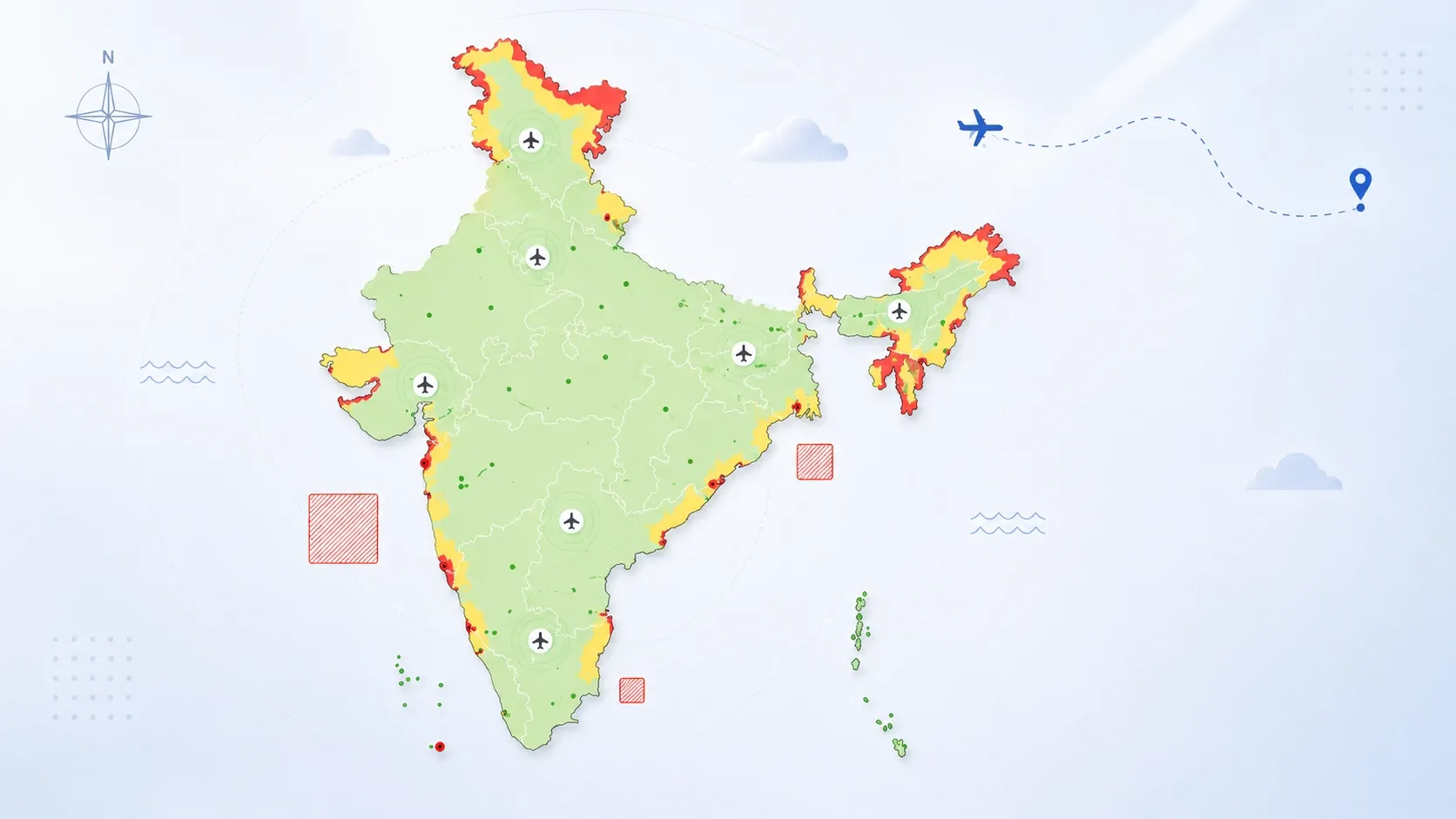
Rule 19 divides Indian airspace into Green, Yellow and Red Zones (Ministry of Civil Aviation, 25 August 2021). A compliant drone can still violate regulations if operated in restricted airspace. The same drone may therefore face different compliance obligations depending on operational purpose and location.
Drone misclassification in India: penalties and insurance gaps
Misclassifying drone categories in India by weight creates regulatory and financial exposure for operators. Rule 50 permits penalties up to ₹1 lakh under the Drone Rules 2021 (Ministry of Civil Aviation, 25 August 2021).
Some violations carry stricter consequences. Rule 49(2) states that flights violating Rule 22 airspace restrictions or Rule 27 arms restrictions are cognizable and non-compoundable offences meaning police can act without a warrant and the offence cannot be settled out of court.
Insurance disputes create another operational risk. Rule 44 requires third-party insurance for categories above Nano. If declared MAUW differs from operational MAUW, insurers may challenge claims after an incident.
The draft Civil Drone (Promotion and Regulation) Bill 2025 signals tighter integration between registration systems, enforcement databases and operational compliance workflows. The draft also expands enforcement authority including drone detention for up to seven days on suspicion of violations and introduces a no-fault compensation framework of ₹2.5 lakh for death and ₹1 lakh for grievous injury under Motor Accident Claims Tribunal jurisdiction.
DGCA drone categories in 2026: what's changing and what isn't
The most important regulatory reality in 2026 is continuity, not disruption. The five-category structure under Rule 5 of the Drone Rules 2021 carries forward across the Bharatiya Vayuyan Adhiniyam 2024 transition and the draft Civil Drone Bill 2025.
Registration workflows did move. India shifted core drone registration functions from Digital Sky to the eGCA system in July 2025. eGCA now handles UIN issuance, type certification workflows and Remote Pilot Certificate management. Digital Sky still handles airspace permissions and NPNT authorisation.
The draft Civil Drone Bill 2025 also signals stronger enforcement integration once enacted, but the underlying weight thresholds - 250 g, 2 kg, 25 kg, 150 kg and 500 kg remain the same. Procurement teams and operators planning 2026 fleet purchases therefore continue evaluating compliance through the same five-category framework.
India's drone ecosystem will continue scaling around a simple principle: the legal meaning of a drone begins with its operational weight.