At a purely technical level, industrial drones and defence drones can look almost indistinguishable. They may use similar composite airframes, electric or hybrid propulsion systems, satellite navigation, inertial sensors, and high-resolution imaging payloads. In some cases, they are even produced by the same manufacturers, assembled on the same factory floors, and differentiated only at the software or payload level.
Yet in practice, industrial and defence drones occupy fundamentally different domains of authority, regulation, and consequence. The line separating them is not drawn by wingspan, endurance, or sensor quality. It is drawn by purpose, legal mandate, and the acceptable outcomes of failure.
Understanding this distinction is essential for making sense of how modern states, including India, are expanding drone use at scale without allowing civilian innovation to slide into unregulated militarisation. As unmanned aviation becomes more capable and more autonomous, this divide is no longer academic. It is foundational to airspace governance, national security, and public trust.
Why the Industrial–Defence Divide Exists
Unmanned aircraft did not evolve along neatly separated civilian and military tracks. From their earliest forms, drones were conceived as tools of conflict. Military research drove advances in remote control, autonomous navigation, endurance, and sensor integration long before commercial markets existed. Only later did these technologies migrate into civilian and industrial use, where they proved transformative for mapping, inspection, agriculture, and logistics.
This historical inheritance created a regulatory challenge. If all drones were treated as potential weapons, civilian adoption would be choked by excessive restriction. If all drones were treated as benign tools, airspace security would erode, and the potential for misuse would rise sharply.
The solution adopted by most mature aviation systems, including India’s, was not to regulate drones by technical sophistication alone but to classify them by mission intent and legal authority. Industrial drones exist to serve economic and public-interest functions within a civilian framework. Defence drones exist to serve sovereign objectives, including intelligence gathering, deterrence, and, when authorised, the application of force.
This distinction allows innovation to flourish without collapsing the boundary between civil aviation and military power.
Industrial Drones as Civil Aviation Assets
Industrial drones, also commonly referred to as commercial unmanned aerial vehicles, are designed to operate as extensions of civilian infrastructure rather than instruments of coercion. Their value lies in efficiency, repeatability, and risk reduction. They replace scaffolding, helicopters, ground survey teams, and manual inspection processes, often delivering better data at lower cost and with reduced human exposure to danger.
In India, industrial drones are now embedded across multiple sectors. They map highways and rail corridors, inspect power transmission lines, monitor crop health, assess flood damage, and support urban planning. Their operations are governed by civil aviation rules, requiring registration, pilot certification, and compliance with defined airspace permissions.
Crucially, industrial drones are non-kinetic systems. Even when equipped with advanced sensors, their legitimacy depends on transparency, traceability, and accountability. They operate with consent, under civilian oversight, and within clearly defined operational envelopes.
Industrial Drone Categories Explained
The categorisation of industrial drones reflects aerodynamic design choices that prioritise stability, endurance, payload capacity, and operational efficiency rather than survivability or combat effectiveness. These categories explain why different drone architectures dominate different industries and why regulation scales with operational complexity.
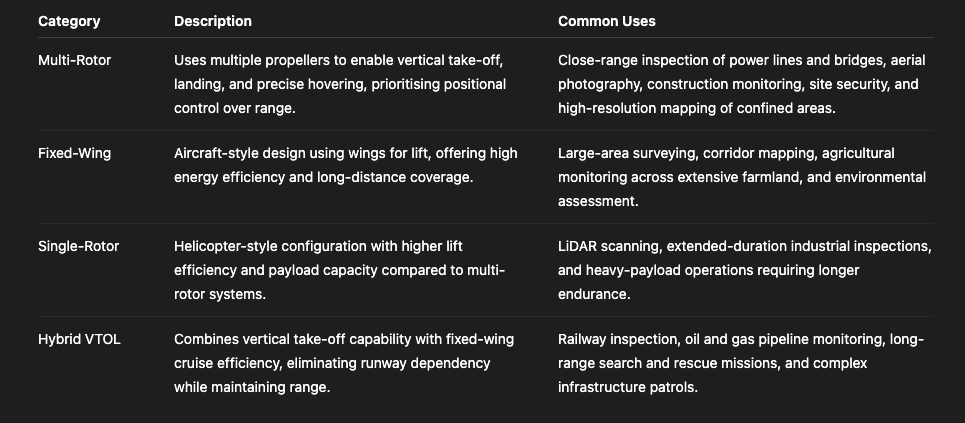
These categories illustrate why industrial drone regulation focuses on airworthiness standards, pilot competence, and mission context. Each design solves a specific operational problem, and regulation adapts accordingly rather than treating all commercial drones as interchangeable tools.
Defence Drones as Instruments of Sovereign Power
Defence drones operate under an entirely different logic. They are not civil aviation assets, and they are not governed by civilian permission systems. Their authority flows directly from the state’s sovereign right to defend territory, collect intelligence, and conduct military operations.
In the Indian context, defence drones support border surveillance across difficult terrain, maritime domain awareness in the Indian Ocean region, electronic intelligence collection, logistics resupply to forward posts, and increasingly autonomous combat roles. Their operations are authorised through military command structures and governed by rules of engagement rather than civil aviation law.
The defining characteristic of a defence drone is not its size or sophistication, but its legal right to operate without civilian consent and, when authorised, to impose effects that civilian systems cannot.
Defence Drone Categories Explained
Unlike industrial drones, defence drones are categorised primarily by operational role rather than airframe architecture. Their defining features include encrypted communications, beyond visual line-of-sight operation, resilience to electronic interference, and integration into military command-and-control networks.
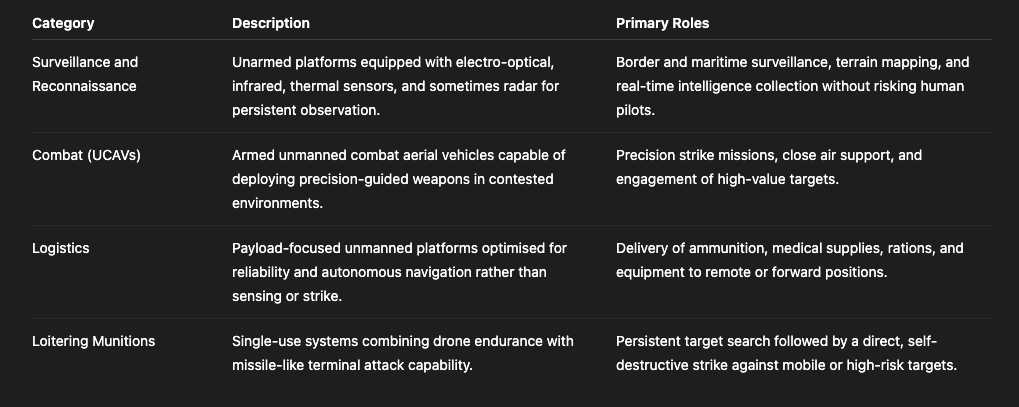
This classification makes clear that defence drones are defined not by how they fly, but by the authority under which they operate and the consequences they are designed to impose.
Regulatory Separation in the Indian System
India has deliberately maintained a hard regulatory separation between industrial and defence drones. Civilian drone rules explicitly exempt military, naval, and air force operations, recognising that civilian authorities cannot govern sovereign military activity.
At the same time, civilian regulation is designed to prevent industrial drones from drifting into quasi-military use. Registration requirements, pilot licensing, airspace permissions, and payload constraints collectively preserve the boundary between civilian utility and military power.
This dual structure allows India to encourage a rapidly growing drone economy while retaining strict control over systems capable of surveillance or coercion beyond civilian norms.
Strategic and Social Implications
From a defence perspective, this separation reduces ambiguity in the airspace. Legitimate civilian drone activity becomes predictable and identifiable, making hostile or unauthorised systems easier to detect and classify.
From a societal perspective, it preserves trust. Public acceptance of drones depends on confidence that civilian airspace is not being quietly militarised. Clear categorisation reassures citizens that drones flying overhead are tools of industry and governance, not instruments of covert surveillance or force.
Final Perspective
The distinction between industrial and defence drone categories is not a technical footnote. It is a foundational governance decision that shapes innovation, security, and public legitimacy.
By anchoring classification in mission authority rather than hardware alone, India has created a framework that allows industrial drone adoption to scale without diluting military control over sovereign airspace. As unmanned systems become more capable and autonomous, maintaining this separation will only become more critical.
The future of drones will not be determined solely by what the technology can do, but by who controls it, under what authority, and for what purpose.

