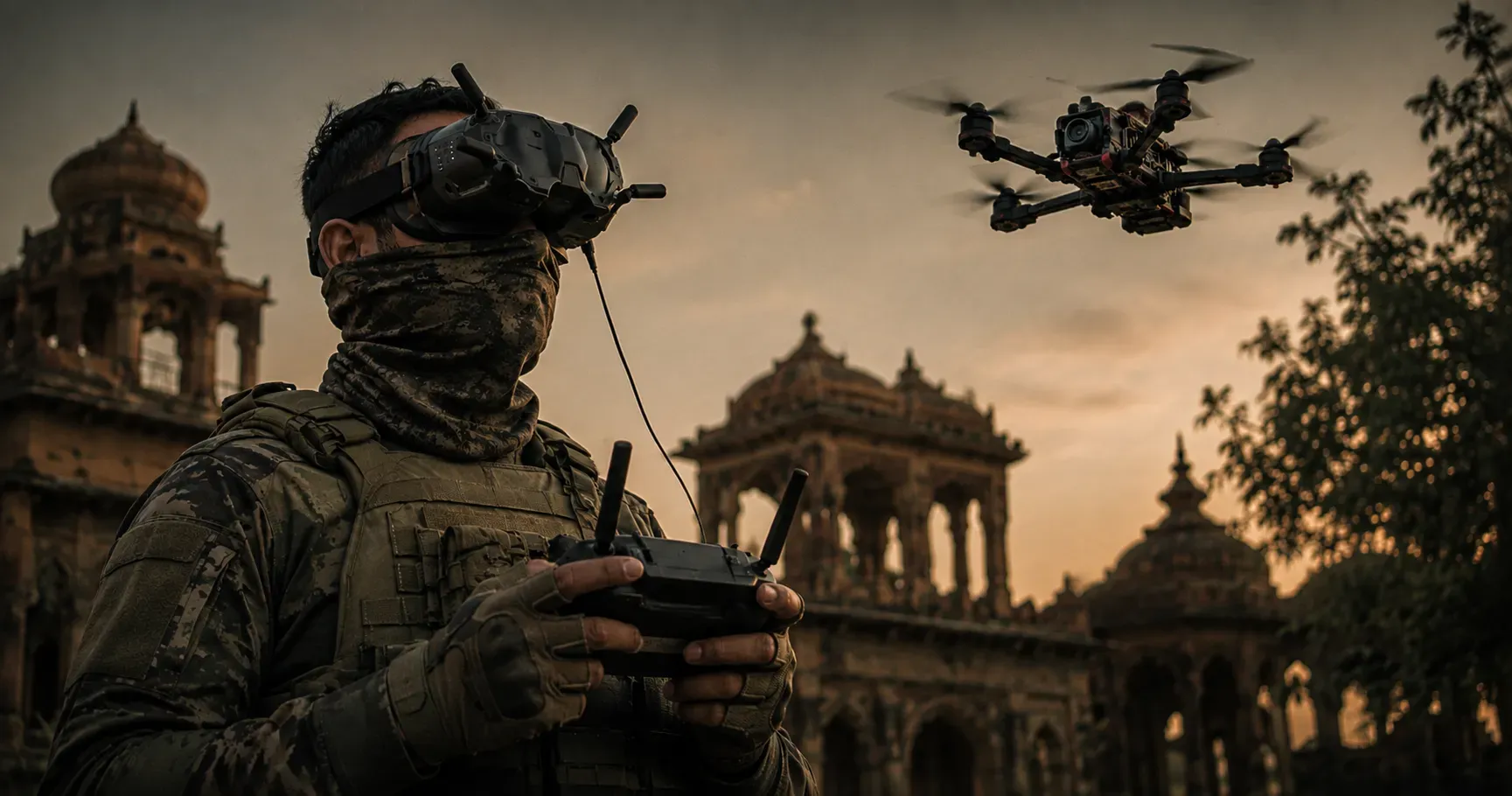
An FPV drone streams live video from an onboard camera directly to the pilot through goggles or a display screen. The technology gained global attention after the Russia-Ukraine war accelerated the military use of low-cost FPV strike drones during 2022 and 2023 (RUSI, October 2023). India also expanded indigenous FPV programmes after Operation Sindoor in May 2025 and subsequent drone-platoon integration exercises by the Indian Army (Press Information Bureau, 14 May 2025). This article explains how FPV drones work, the systems inside them, the shift from racing to warfare, and the rules governing FPV operations in India. For the wider battlefield context on one-way strike systems, see our companion analysis on kamikaze drones and loitering munitions.
What is an FPV drone? Definition and origin
The FPV full form is First-Person View, and the FPV drone meaning follows directly from it: an FPV drone allows the operator to see live footage from the aircraft instead of flying by visual observation from the ground. The pilot experiences the flight from the drone's perspective through FPV goggles or a monitor connected to the video receiver. The meaning of FPV applies to any first person view drone platform, from small indoor quadcopters to military-grade combat aircraft.
The concept emerged during the mid-2000s inside the radio-controlled aircraft community. Early FPV pilots modified hobby aircraft with a lightweight FPV camera and analogue video transmitters operating on 5.8 GHz frequencies, carried by carbon-fibre fpv drone frames small enough to fit inside a backpack. The aircraft carried live video feeds to ground receivers with limited range and frequent signal interference.
FPV systems changed drone flying behaviour completely. Conventional pilots usually maintain direct visual line-of-sight while controlling stable aircraft assisted by GPS systems. FPV pilots instead navigate aggressively through tight spaces, sharp turns, and high-speed manoeuvres because they fly from the aircraft's viewpoint rather than from the ground.
The global perception of FPV drones changed after 2022. Ukrainian and Russian forces adapted hobby-style FPV quadcopters into low-cost loitering munition platforms capable of damaging armoured vehicles and fixed positions (IISS, February 2025). That transition pushed FPV technology from niche racing communities into mainstream defence discussions.
How does an FPV drone work? The video and control loop
An FPV drone works through two simultaneous communication systems: the live-video transmission loop and the radio-control loop.
The aircraft carries a forward-facing FPV camera mounted near the nose of the frame. That camera continuously captures live footage during flight operations. A video transmitter, commonly called a VTX, sends the footage wirelessly to the pilot's goggles or display receiver.
Most modern FPV systems operate on analogue or digital transmission architectures. Analogue systems remain popular in competitive racing because they maintain low latency during weak-signal conditions. Digital systems such as DJI O4, HDZero, and Walksnail provide clearer video quality and improved signal stability.
The second communication path controls aircraft movement. The pilot's radio transmitter sends throttle, roll, pitch, and yaw commands to the onboard flight controller. Most modern FPV aircraft use ExpressLRS or Crossfire communication protocols because they improve range and reduce packet loss during aggressive manoeuvres.
Latency remains critical in FPV operations. Analogue systems often maintain latency below 20 milliseconds, while digital systems generally operate below 30 milliseconds depending on transmission settings. Lower latency improves pilot reaction time during high-speed flight.
FPV flight controllers usually offer three flight modes. Angle mode limits aircraft attitude automatically and suits beginners. Horizon mode allows flips and rolls with partial self-levelling and suits intermediate pilots. Acro mode removes attitude limits entirely and gives the pilot full manual control over roll, pitch, and yaw rates. Acro mode is the standard flight mode for racing, freestyle, and combat FPV operations because it allows the aggressive manoeuvres that self-levelling modes prevent.
FPV drone parts - the 8 components inside every build
Most FPV drones follow a modular architecture, and FPV drone parts are sourced and replaced individually rather than as a full aircraft. Operators can replace damaged components without rebuilding the entire aircraft, which is why the fpv drone kit market in India and globally sells frames, motors, ESCs, and radio hardware as separate line items.
Component | Purpose | Typical configuration |
|---|---|---|
Frame | Structural airframe | Carbon fibre, 3-inch to 10-inch sizes |
Flight controller | Stabilises aircraft movement | Betaflight-compatible boards |
ESC | Controls motor speed | 4-in-1 electronic speed controller |
Brushless motors | Generate thrust | KV-rated high-speed motors |
Propellers | Convert motor power into lift | Bi-blade or tri-blade propellers |
LiPo battery | Powers the aircraft | 4S to 6S lithium-polymer packs |
FPV camera and VTX | Streams live video | Analogue or digital systems |
Radio receiver and goggles | Receives commands and displays video | ExpressLRS and digital FPV goggles |
Frame size determines the aircraft's intended role. Tiny indoor FPV drones often use ducted frames smaller than 3 inches, while long-range systems can exceed 10 inches. Most FPV drone motor selections are matched to frame size, with high-KV brushless motor drone builds paired with smaller propellers for racing frames and lower-KV motors paired with larger propellers for endurance builds.
Battery configuration also changes aircraft behaviour. Smaller FPV systems commonly operate on 1S or 2S FPV drone battery packs, while freestyle and combat platforms usually use 4S or 6S lithium-polymer batteries with high discharge ratings. The FPV transmitter and receiver pairing is chosen alongside the battery, because the radio protocol determines both range and latency during flight.
The modular design explains why FPV systems adapted quickly for battlefield use after 2022. Operators could modify civilian aircraft with alternative antennas, payloads, or communication systems without redesigning the full platform.
FPV drone vs regular drone - the core differences
FPV drones differ fundamentally from conventional GPS-assisted consumer drones.
Consumer drones prioritise stability, automation, and aerial photography. FPV drones prioritise speed, manual control, and manoeuvrability. The pilot manually controls nearly every movement instead of relying on automated flight assistance.
Attribute | FPV drone | Regular consumer drone |
|---|---|---|
Control mode | Manual first-person control | GPS-assisted stabilised control |
Flight style | Aggressive and agile | Stable and automated |
Primary use | Racing, freestyle, combat, inspection | Photography and mapping |
Learning curve | High | Moderate |
Typical speed | 100–180 km/h possible | Usually lower |
GPS dependency | Optional | High |
FPV drones also tolerate tighter operational environments. Pilots routinely fly through buildings, industrial corridors, forest trails, and narrow infrastructure gaps that conventional photography drones cannot safely navigate.
The trade-off is operational complexity. Beginner FPV pilots usually train inside flight simulators before attempting outdoor operations. Most crashes occur during early throttle and orientation training because FPV aircraft respond much faster than standard camera drones.
Types of FPV drones by purpose
FPV drones exist in multiple configurations depending on operational requirements. The types of FPV drones in the Indian market divide across recreational, cinematic, competitive, and defence use, and frame size and weight class also map to India's drone-categories framework, which the drone categories pillar covers in detail.
Tiny Whoop drones are lightweight indoor FPV aircraft using ducted propellers and sub-50 gram frames. These systems are the standard beginner FPV drone for indoor training because they reduce crash damage during early throttle and orientation practice, and they pair well with a low-power FPV drone simulator setup for pre-flight practice.
Cinewhoop drones carry stabilised action cameras for cinematic filming. Production companies adopted cinewhoop systems after 2021 for indoor tracking shots and close-range motion sequences previously difficult for helicopters or cranes.
Freestyle FPV drones usually use 5-inch carbon-fibre frames with powerful brushless motors and 6S battery systems. These aircraft dominate hobbyist FPV communities because they balance speed, durability, and manoeuvrability.
Long-range FPV drones use larger 7-inch or 10-inch frames with GPS modules and high-capacity batteries. These systems prioritise endurance rather than rapid manoeuvres and are commonly used for terrain exploration or industrial inspection.
Racing drones prioritise acceleration and low weight. Competitive pilots optimise these aircraft for sharp turns, rapid throttle response, and minimal latency during closed-circuit races.
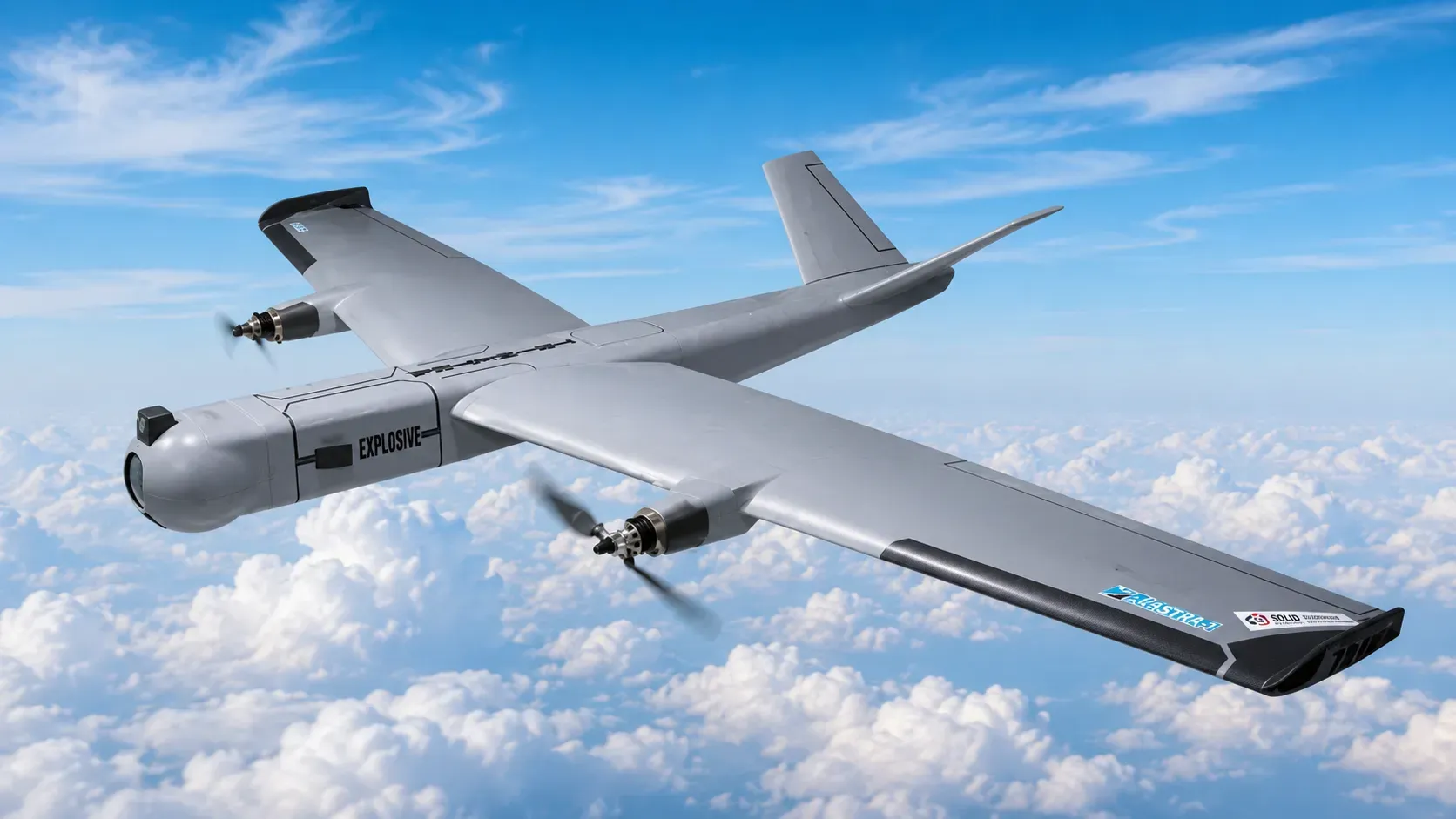
Combat FPV drones emerged as a distinct category after 2022. These aircraft often modify freestyle FPV designs with payload-carrying systems, anti-jamming antennas, and loitering munition configurations used during frontline strike operations.
The comparison below summarises the six FPV drone types by frame size, primary objective, and defining characteristic, so operators comparing FPV drone types can move from category to purchase decision without re-reading each subsection.
FPV type | Typical frame size | Primary objective | Defining characteristic |
|---|---|---|---|
Tiny Whoop | Under 3-inch | Indoor training | Small, ducted, low crash damage |
Cinewhoop | 2.5 to 3.5-inch | Cinematography | Stable camera platform |
Racing | 3 to 5-inch | Competition | Acceleration and low latency |
Freestyle | Around 5-inch | Acrobatic flying | Power and durability |
Long-range | 7 to 10-inch | Endurance missions | Efficiency and GPS support |
Combat FPV | Mission-specific | Military strike | Payload capacity and survivability |
Where FPV drones are used today
FPV drones now operate across civilian, industrial, and military sectors.
Drone racing remains one of the largest civilian FPV applications. Organisations such as the Drone Racing League and MultiGP established structured racing ecosystems using standardised FPV aircraft and low-latency video systems.
Film production companies expanded FPV usage after 2021 because the aircraft can navigate complex indoor environments and dynamic camera paths. FPV footage became common in sports broadcasting, automotive cinematography, and action sequences.
Industrial operators also adopted FPV systems for infrastructure inspection. Pilots inspect bridges, power lines, turbines, pipelines, and confined industrial structures where larger aircraft struggle to manoeuvre safely.
Search-and-rescue agencies use FPV drones for low-altitude terrain scanning and structural assessment during emergency operations. Agricultural operators also use smaller FPV systems for orchard inspection and crop-condition monitoring.
The defence sector remains the fastest-moving FPV segment. Battlefield operators use FPV aircraft for reconnaissance, artillery correction, close-range strike missions, and electronic warfare adaptation.
FPV drones in modern warfare - Russia-Ukraine and Operation Sindoor
The Russia-Ukraine conflict transformed FPV drones from hobbyist aircraft into mass-deployed battlefield systems, and set the template for how Indian Army drone doctrine now approaches FPV integration. The conflict became the first major war where modified racing quadcopters were used at scale as one-way strike weapons and kamikaze drone platforms against tanks, trench positions, and logistics columns, and it established the FPV airframe as a viable loitering munition for state and non-state actors alike.
Military operators adapted commercial FPV quadcopters into low-cost loitering munition platforms carrying anti-armour payloads during 2022 and 2023. Research published by the Royal United Services Institute documented widespread use of modified FPV systems against tanks, logistics vehicles, and trench positions (RUSI, October 2023).
The operational logic was economic. A modified FPV drone costing roughly $400 to $500 to assemble has demonstrated the ability to disable armoured vehicles worth millions of dollars (Reuters, 2024; RUSI, October 2023). Battlefield footage from 2023 and 2024 also showed how small FPV aircraft reduced radar visibility while operating below traditional air-defence coverage.
Electronic warfare then changed FPV development priorities. Russian and Ukrainian forces deployed signal jammers against conventional radio-frequency control systems, forcing rapid adoption of frequency-hopping communication protocols and fibre-optic FPV systems.
India accelerated domestic FPV development after observing these battlefield lessons. During Operation Sindoor in May 2025, Indian forces deployed indigenous loitering munitions and counter-UAS systems against terror infrastructure and Pakistani military assets across an 88-hour campaign (Press Information Bureau, 14 May 2025). The operation was India's first large-scale combat use of homegrown unmanned strike systems.
In October 2025, the Indian Army confirmed it had equipped 380 infantry battalions with Ashney (Fire) drone platoons. Each platoon operates at least four surveillance drones and six armed drones, including kamikaze and precision-ammunition-dropping UAVs (Lt Gen Ajay Kumar, DG Infantry, 22 October 2025). The Army also indicated similar drone platoons will be embedded inside the newly raised Bhairav special-operations battalions.
Indian defence trials also explored fibre-optic tethered FPV systems capable of operating under heavy electronic interference. These systems physically spool optical cable during flight, allowing communication continuity even during aggressive radio-frequency jamming conditions.
Are FPV drones legal in India? DGCA, Drone Rules 2021, and NPNT
FPV drone operations in India fall under the Drone Rules 2021 issued by the Ministry of Civil Aviation. For the full compliance map, see our Drone Laws in India pillar.
Drone classification depends on maximum all-up weight. Nano-category drones below 250 grams carry lighter compliance requirements, while larger systems require formal registration and a Unique Identification Number.
India's drone-governance architecture changed in July 2025 when DGCA migrated drone registration, type certification, and Remote Pilot Certificate workflows from DigitalSky to the eGCA portal (DGCA Public Notice, 3 July 2025). DigitalSky retained airspace permissions, flight authorisation, and NPNT compliance. FPV operators must now register their drone and pilot credentials on eGCA, then request flight permissions through DigitalSky.
FPV operations create additional regulatory complexity because pilots often rely entirely on goggles during flight. Most aviation authorities therefore require a visual observer to maintain direct situational awareness during FPV operations.
Most civilian FPV flights remain restricted below 120 metres above ground level unless additional authorisation exists. Operators must also avoid red-zone airspace, restricted defence installations, and controlled airport corridors.
Commercial FPV operators conducting industrial inspection or survey operations must maintain operational permissions under applicable DGCA rules and airspace procedures (DGCA, 2025).
How much does an FPV drone cost in India?
FPV drone price in India is not a single number, because a complete build depends on frame size, video system, battery configuration, and radio hardware, and the fpv drone cost varies across beginner, intermediate, and professional tiers. Tiny Whoop beginner kits generally cost between ₹6,000 and ₹15,000 depending on the included goggles and transmitter quality. Beginner-ready freestyle systems using analogue video commonly range between ₹25,000 and ₹50,000.
Digital FPV systems using DJI O4 or equivalent transmission hardware usually cost more because they require premium goggles and onboard video modules. Fully configured digital freestyle systems can exceed ₹90,000.
Long-range FPV aircraft with GPS modules, larger frames, and high-capacity batteries generally cost more than standard freestyle builds because endurance-focused systems require heavier hardware. Radio transmitters using ExpressLRS communication protocols usually cost between ₹8,000 and ₹35,000 depending on channel count and build quality. FPV goggles range from basic analogue box goggles to premium digital systems costing more than ₹1 lakh.
How to start with FPV drones - beginner pathway
Most beginner FPV pilots start inside flight simulators before flying physical aircraft.
- Begin with FPV simulators such as Liftoff, Velocidrone, or Tryp using a real radio transmitter.
- Move to Tiny Whoop indoor drones for low-risk throttle and orientation training.
- Upgrade to a beginner-ready 5-inch freestyle FPV system after consistent simulator control.
- Register applicable drones and pilot credentials through eGCA, then request airspace permission through DigitalSky before outdoor flights.
Simulator training matters because FPV aircraft respond much faster than GPS-assisted consumer drones. Pilots who skip simulator practice usually damage aircraft during early throttle-control attempts.
What's next for FPV drones - AI, swarms, and 2026-2030 trajectory
FPV drone development is moving toward anti-jamming communication systems, swarm coordination, and assisted navigation architectures.
Battlefield operators now prioritise survivability against electronic warfare systems rather than pure flight speed. Frequency-hopping radios, fibre-optic control systems, and hardened communication modules became major development priorities after 2024 conflict observations.
India's defence ecosystem is also exploring swarm-drone coordination and AI-assisted navigation support during military trials and indigenous unmanned-system programmes.
Civilian FPV systems will likely inherit some of these developments through improved industrial inspection platforms, lower-latency communication systems, and more stable digital-video architectures over the next five years.
FPV drones now sit at the intersection of cinematography, industrial inspection, and modern infantry doctrine. The same airframe that flies a 5-inch racing circuit on Sunday can carry a 1-kilogram payload across 5 kilometres of contested airspace on Monday. That dual-use reality is what now shapes Indian procurement priorities, regulatory thinking, and the next generation of indigenous unmanned systems.