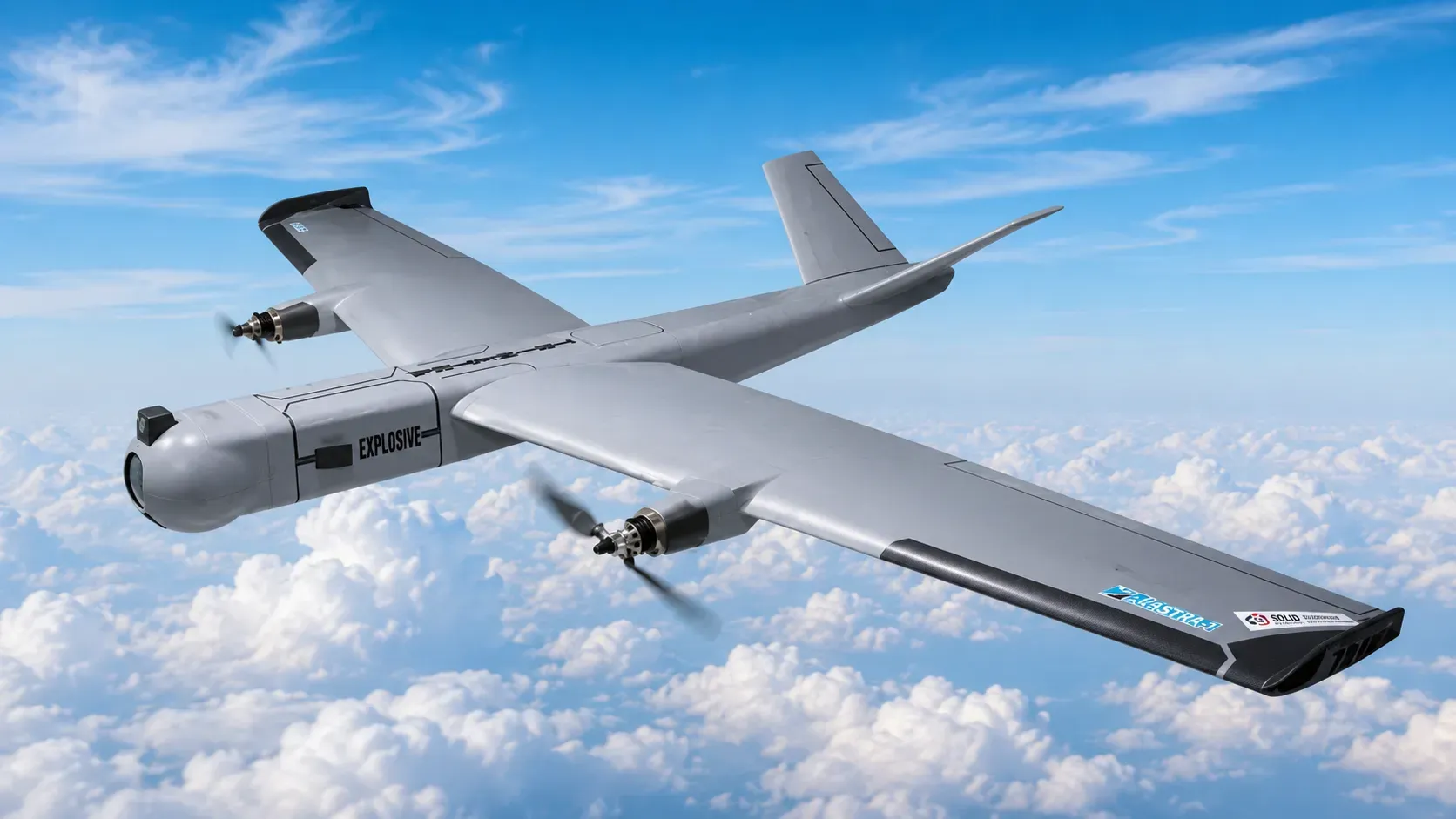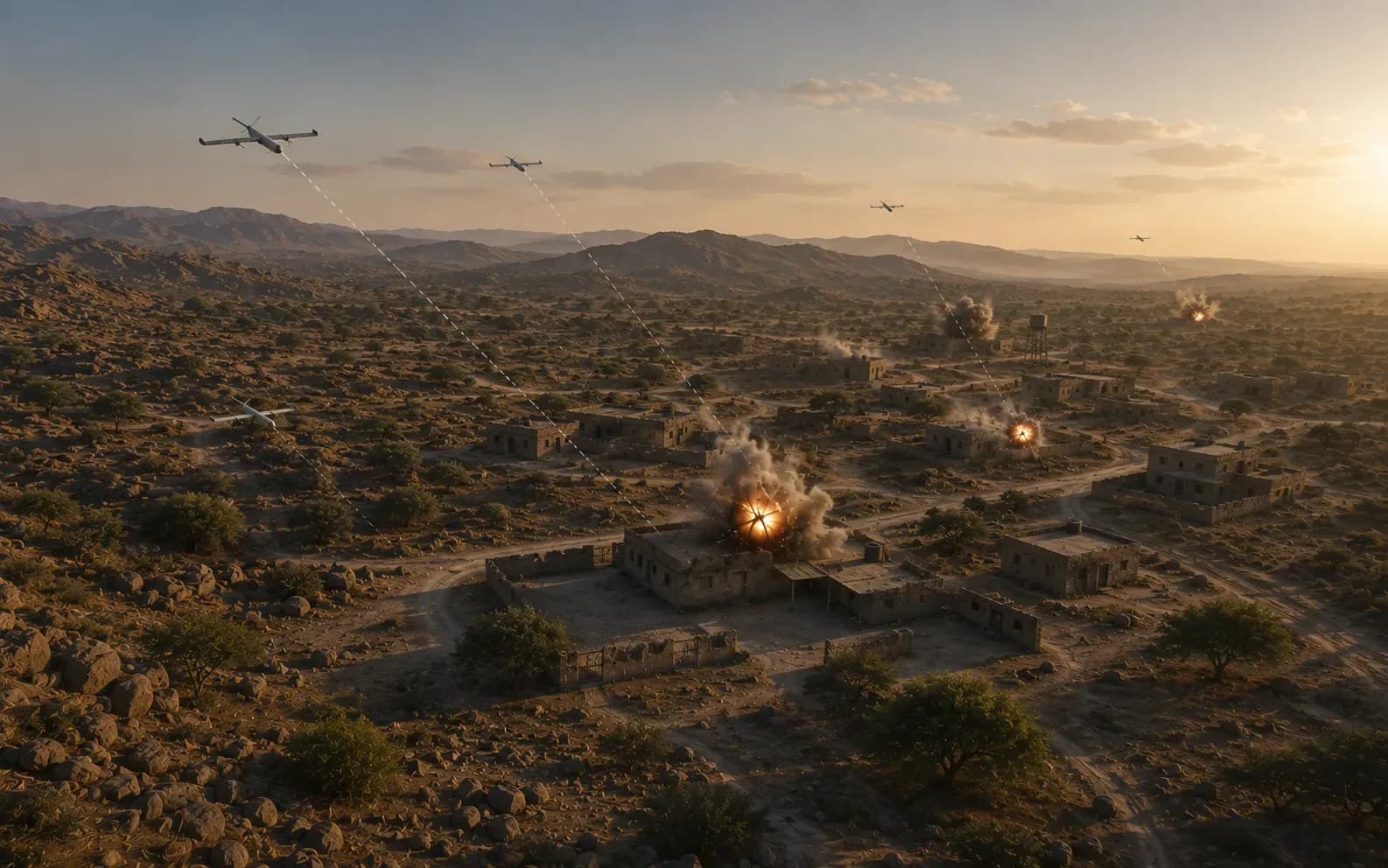
A kamikaze drone combines surveillance, target tracking, and strike capability into one unmanned system. Unlike conventional UAVs that return after completing reconnaissance missions, a loitering munition carries an onboard warhead and destroys itself during impact. The system can remain airborne above a battlefield, monitor targets in real time, and strike after operator authorisation.
Interest in these systems rose sharply after the 2020 Nagorno-Karabakh conflict and the Russia-Ukraine war demonstrated their operational effectiveness. In India, public attention expanded further during Operation Sindoor in May 2025, when the Indian Armed Forces used indigenous loitering munitions during precision strike operations against terror-linked infrastructure (Press Information Bureau, 14 May 2025). Defence planners now treat loitering munitions as a critical part of modern stand-off strike doctrine. For a wider view of India's loitering munition strategy, see our companion analysis on the indigenous loitering munition push.
What is a kamikaze drone? Definition and origin
The term kamikaze drone is widely used in public discussions, but the formal military term is loitering munition. The phrase kamikaze comes from the Japanese words for "divine wind," associated with suicide aircraft missions during World War II. Modern loitering munitions are unmanned systems designed for one-way precision strike missions rather than manned aircraft attacks.
A loitering munition combines three functions into one platform. It acts as a surveillance drone, a target acquisition system, and a precision-guided weapon. Unlike artillery shells or cruise missiles that travel directly toward fixed coordinates, loitering munitions can remain airborne over a designated area before selecting or confirming a target.
Several interchangeable terms now appear across defence reporting. Kamikaze drone, suicide drone, loitering munition, and one-way attack drone all describe the same broad category of system. Military organisations generally prefer loitering munition because it describes the operational behaviour of the weapon. Media organisations and public discussions often use kamikaze drone because the term is easier to recognise.
These systems now operate across tactical, operational, and strategic mission categories. Lightweight infantry systems may weigh under 5 kilograms, while long-range infrastructure-strike systems can exceed 200 kilograms.
How does a kamikaze drone work? The 5-stage strike sequence
Loitering munition operations usually follow a structured five-stage engagement cycle. The exact process changes between systems, but the operational logic remains broadly similar across military platforms.
Stage 1: Launch
Launch methods depend on system size and mission profile. Small tactical systems often use portable launch tubes or pneumatic catapults carried by infantry units. Larger systems launch from vehicles, rail platforms, or aircraft.
Portable launch systems allow rapid deployment during frontline operations. Some infantry-class systems can become operational within minutes of setup.
Stage 2: Loiter
After launch, the munition enters a holding pattern above the target zone. This loiter phase allows operators to monitor enemy movement before strike approval.
Short-range electric systems may remain airborne for 15 to 40 minutes. Larger fuel-powered systems can loiter for several hours, depending on propulsion type and payload weight.
Stage 3: Target acquisition
The system identifies targets using electro-optical cameras, infrared sensors, radar seekers, or anti-radiation sensors. Some loitering munitions transmit live video to operators through encrypted communication links.
Modern systems may include automated target tracking after operator designation. Most operational systems still require human strike authorisation before engagement.
Stage 4: Terminal dive
After strike approval, the munition enters a high-speed terminal approach toward the target. Guidance systems use GPS, optical lock, inertial navigation, or terrain-matching methods during this phase.
Strike accuracy often falls within a few metres, depending on environmental conditions and sensor quality.
Stage 5: Impact and detonation
The warhead detonates during impact or at near-target proximity. Different missions require different warhead configurations, as shown below.
Warhead type | Primary target | Operational effect |
|---|---|---|
High explosive | Buildings and infrastructure | Blast damage |
Fragmentation | Personnel and light vehicles | Area effect |
Shaped charge | Armoured vehicles | Armour penetration |
Thermobaric | Enclosed structures | Pressure-wave damage |
This integration of reconnaissance and strike capability allows one system to perform missions that previously required separate UAVs and artillery assets.
The four core components of a kamikaze drone
Every loitering munition relies on four major subsystems that determine range, survivability, and strike effectiveness.
Airframe
Most systems use lightweight composite airframes to reduce radar visibility and improve endurance. Tactical systems often use foldable wings for portability.
Fixed-wing designs dominate long-range systems because they provide better endurance and fuel efficiency. Rotary-wing systems prioritise manoeuvrability in urban environments.
Propulsion system
Electric propulsion reduces acoustic signatures and thermal visibility. Small tactical systems become harder to detect during short-range missions as a result.
Internal combustion engines provide longer endurance for operational and strategic systems. Some high-speed systems use turbojet propulsion for rapid terminal attack profiles.
Sensor suite
The sensor package determines target detection capability. Most systems use electro-optical and infrared cameras for day and night operations.
Advanced systems may include GPS and inertial navigation, laser target designation, anti-radiation seekers, and AI-assisted object recognition algorithms. Sensor quality directly affects strike accuracy and operational survivability.
Warhead
Warhead size depends on mission objectives. Infantry-support systems may carry warheads under 2 kilograms. Strategic systems designed for infrastructure targets can carry payloads of 50 kilograms or more.
Modern warheads include fragmentation, anti-armour, thermobaric, and bunker-penetration variants.
Kamikaze drone vs cruise missile vs conventional UAV
Loitering munitions occupy a middle category between cruise missiles and reusable UAVs. Their flexibility explains why militaries continue expanding procurement programmes. The table below sets out the operational differences.
Capability | Loitering munition | Cruise missile | Conventional UAV |
|---|---|---|---|
Reusable | No | No | Yes |
Can loiter above target area | Yes | Limited | Yes |
Carries onboard warhead | Yes | Yes | Sometimes |
Operator can abort strike | Often | Rarely | Yes |
Typical mission | Precision strike | Long-range strike | Surveillance |
Cost per unit | Lower | Very high | High |
Target flexibility | High | Moderate | High |
A Tomahawk cruise missile costs over 1.4 million US dollars per round (Congressional Research Service, 2024). Tactical loitering munitions cost below 10,000 US dollars per unit. This cost difference matters during prolonged conflicts, where militaries require large volumes of precision strike systems.
How kamikaze drones navigate without GPS
Modern battlefields rely on electronic warfare systems designed to jam or spoof satellite navigation signals. Loitering munition manufacturers now integrate alternative navigation methods to handle that environment.
Inertial navigation systems
An inertial navigation system uses gyroscopes and accelerometers to estimate movement without external satellite signals. Accuracy decreases gradually over distance, but INS allows systems to continue operating during GPS disruption.
Terrain matching
Some long-range systems use terrain contour matching technology, often shortened to TERCOM. The onboard computer compares real-time terrain imagery against stored map data to maintain navigation accuracy. The method works best in regions with distinctive geographical features.
Visual odometry
Visual odometry systems analyse camera imagery and track environmental movement patterns. The method helps systems estimate location inside GPS-denied environments.
Controlled reception pattern antennas
Controlled Reception Pattern Antennas, or CRPA systems, reduce vulnerability to jamming and spoofing attacks. These antennas filter signal interference during navigation and remain effective against multiple simultaneous jammers.
Optical terminal guidance
Advanced loitering munitions may use optical scene matching during the final attack phase. The onboard system compares target imagery against stored reference patterns before terminal impact.
Electronic warfare resilience has become one of the most important operational requirements in modern drone warfare.
Types of kamikaze drones by mission profile
Loitering munitions exist across several operational categories based on range, payload, and mission role. Tactical systems support frontline infantry operations and short-range precision strikes. Systems such as the Switchblade 300 fall into this category. Tactical systems prioritise portability and rapid deployment.
Operational systems target armoured vehicles, logistics convoys, and command posts. They typically carry larger warheads and remain airborne longer than tactical variants. The Switchblade 600 and ZALA Lancet sit in this band.Strategic systems focus on long-range infrastructure strikes. Platforms such as the Shahed-136 became widely discussed during long-range strike operations in Ukraine after 2022.
Anti-radiation systems specialise in destroying radar and air-defence assets. The IAI Harpy drone is one of the best-known examples of an anti-radiation loitering munition in this category. FPV kamikaze drones form a fifth operational category. FPV drone pilots fly one-way strike missions in real time through video goggles, and the format now dominates tactical drone warfare in Ukraine.
Several countries now research swarm-capable systems, where multiple loitering munitions coordinate attacks at the same time. Swarm tactics attempt to overwhelm defensive systems through mass deployment.
India's indigenous kamikaze drone push
India accelerated indigenous loitering munition development after repeated security concerns along its western and northern borders. The shift expanded further under the Atmanirbhar Bharat defence manufacturing framework.
The Ministry of Defence approved multiple indigenous unmanned system procurement programmes between 2023 and 2025 (Ministry of Defence, 2025). Indian defence planners now view loitering munitions as essential for stand-off precision strike capability in contested environments. Loitering munitions also align with the country's broader effort to reduce import dependence on critical defence systems.
Public awareness rose sharply during Operation Sindoor in May 2025. Government statements described precision strike operations against terror-linked infrastructure using indigenous systems (Press Information Bureau, 14 May 2025). The deployment demonstrated the integration of domestically developed unmanned strike systems into operational use by the Indian Armed Forces.
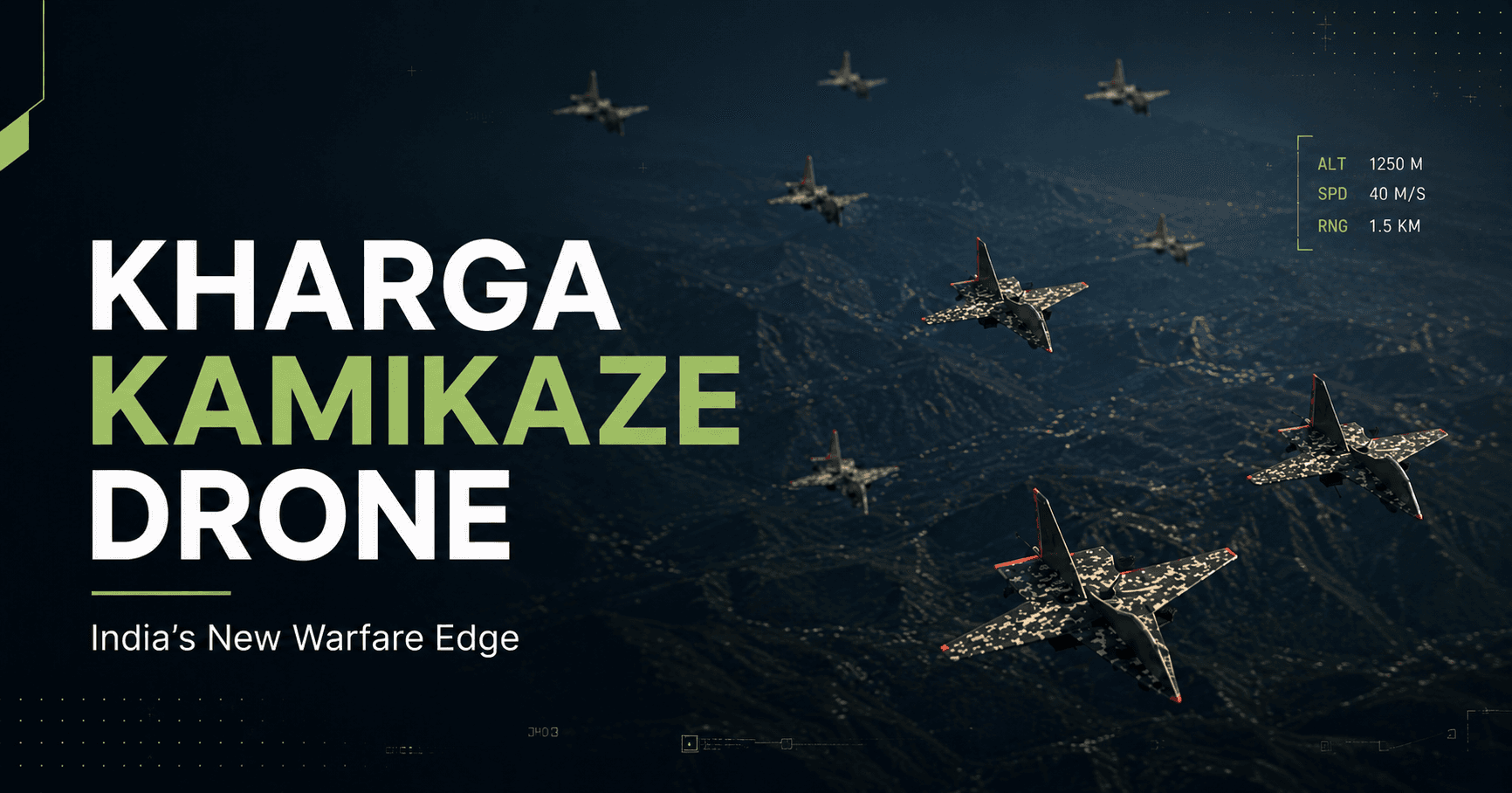
India's ongoing programmes now span tactical loitering munitions for infantry deployment, long-range stand-off strike systems, swarm coordination research, air-launched unmanned strike concepts, and counter-drone integration efforts. The Defence Research and Development Organisation leads the next generation of DRDO drone platforms. Its research focuses on longer endurance, improved navigation resilience, and AI-assisted swarm coordination. The Indian Air Force already operates several imported and co-developed loitering munition fleets. The Harop drone anchors the imported line, while the Nagastra loitering munition leads the indigenous stack, supplemented by newer platforms like the Kharga.
The Department of Defence Production has signalled second- and third-generation systems with extended range, larger payloads, and AI-driven swarm capability for the rest of the decade. The classification of these systems under domestic regulation is covered in our drone weight categories analysis.
How much does a kamikaze drone cost?
Kamikaze drone cost remains one of the biggest reasons militaries continue expanding loitering munition inventories. These systems deliver precision strike capability at significantly lower cost than cruise missiles or manned aircraft operations.
System | Estimated cost (USD) | Category | Source |
|---|---|---|---|
Switchblade 300 | ~6,000 | Tactical | CSIS, 2024 |
Switchblade 600 | ~70,000 to 80,000 | Operational | Congressional Research Service, 2024 |
ZALA Lancet | ~35,000 | Operational | RUSI, 2023 |
Shahed-136 | ~20,000 to 50,000 | Strategic | RUSI, 2023 |
Tomahawk cruise missile | 1,400,000+ | Cruise missile | Congressional Research Service, 2024 |
This economic asymmetry has become central to modern warfare planning. Air-defence systems may use interceptor missiles worth hundreds of thousands of dollars against unmanned systems that cost a fraction as much. Defence ministries across the world now treat unit-cost economics as a primary design constraint rather than an afterthought.
Where kamikaze drones changed modern warfare
Several conflicts during the last decade demonstrated the operational effectiveness of loitering munitions.
The 2020 Nagorno-Karabakh conflict demonstrated the effectiveness of loitering munitions against armoured formations and air-defence systems (IISS Military Balance, 2021). Battlefield footage from the conflict accelerated global procurement interest.
The Russia-Ukraine war transformed loitering munitions into high-volume battlefield systems. Both sides used tactical FPV drones and long-range loitering munitions extensively after 2022 (RUSI, 2023). The conflict produced more loitering munition data than any previous war in history.
India's Operation Sindoor in May 2025 marked one of the country's most visible operational deployments of indigenous loitering munition capability (Press Information Bureau, 14 May 2025). The operation highlighted India's expanding domestic unmanned warfare ecosystem.
Several Middle Eastern operations also demonstrated the effectiveness of low-cost one-way attack systems against infrastructure and air-defence targets. Together, these conflicts reshaped military planning around persistence, mass deployment, and lower-cost precision strike capability. The use of drones in war has moved from tactical experiment to strategic doctrine.
Countermeasures: how do you stop a kamikaze drone?
The expansion of loitering munition warfare accelerated investment in counter-drone systems, also called anti-drone systems or drone defence systems in Indian and civilian procurement contexts. Most modern counter-UAS doctrine combines four layers.
The first layer is electronic warfare. Counter-UAS systems jam GPS signals, disrupt communication links, or spoof navigation systems. Jamming remains one of the most common counter-UAS techniques because it defeats most low-cost drones at low operational cost.
The second layer is kinetic interception. Air-defence guns, missile interceptors, and directed-energy systems destroy incoming drones physically before impact. Programmable air-burst munitions such as AHEAD ammunition are now deployed by several armies for short-range counter-drone work.
The third layer is interceptor drones. Some countries deploy drone-on-drone interception systems that physically collide with or disable hostile UAVs. The approach reduces the cost-per-defeat ratio compared with kinetic missile interception.
The fourth layer is camouflage and dispersal. Military units disperse equipment and reduce radar visibility to limit targeting opportunities for loitering munitions. Logistics hubs and command posts now relocate more often than in earlier conflicts.
A major operational challenge remains economic asymmetry. Defending against a 20,000 dollar drone with a 2 million dollar interceptor missile creates sustainability concerns during prolonged conflicts. Defence budgets across NATO, India, and the broader Indo-Pacific are now actively redesigning air-defence procurement around this gap.
Are kamikaze drones legal under international law?
Loitering munitions themselves are not prohibited under international law. Most currently fielded systems operate under human supervision during strike authorisation.
International legal discussions focus primarily on autonomous lethal targeting systems that could select and attack targets without human approval. These debates continue within the United Nations Convention on Certain Conventional Weapons framework, including the work of the Group of Governmental Experts on Lethal Autonomous Weapon Systems.
International Humanitarian Law requires distinction, proportionality, and military necessity during armed conflict. Loitering munitions operated with human oversight generally fall within existing legal frameworks if deployed according to those principles. Several governments and policy groups continue discussing future regulations around fully autonomous lethal systems.
For a fuller view of how Indian regulation treats unmanned systems, see our Drone Laws in India pillar.
What's next for AI, swarms, and autonomous warfare
The next generation of loitering munitions will focus on swarm coordination, AI-assisted navigation, and electronic warfare resilience. The next generation of AI drones will combine AI-assisted target recognition, collaborative swarm coordination, extended endurance profiles, higher-speed turbojet propulsion, and improved anti-jamming navigation.
Research organisations worldwide now focus on systems capable of operating inside GPS-denied environments using optical guidance and terrain matching. The next-generation Russian Geran-3 turbojet variant, with reported speeds near 600 km/h, signals where the high-end of the category is heading.
India's domestic unmanned warfare programmes are also moving toward larger swarm coordination experiments and extended-range strike concepts under ongoing defence research initiatives. DRDO's published roadmap points to second-generation Indian systems with extended range and swarm capability before the end of the decade.
Kamikaze drones are no longer a niche category of battlefield equipment. They are becoming a central part of modern precision warfare doctrine shaped by persistence, production scale, and electronic warfare resilience. The next decade will be defined less by who owns the weapon than by who masters the swarm.