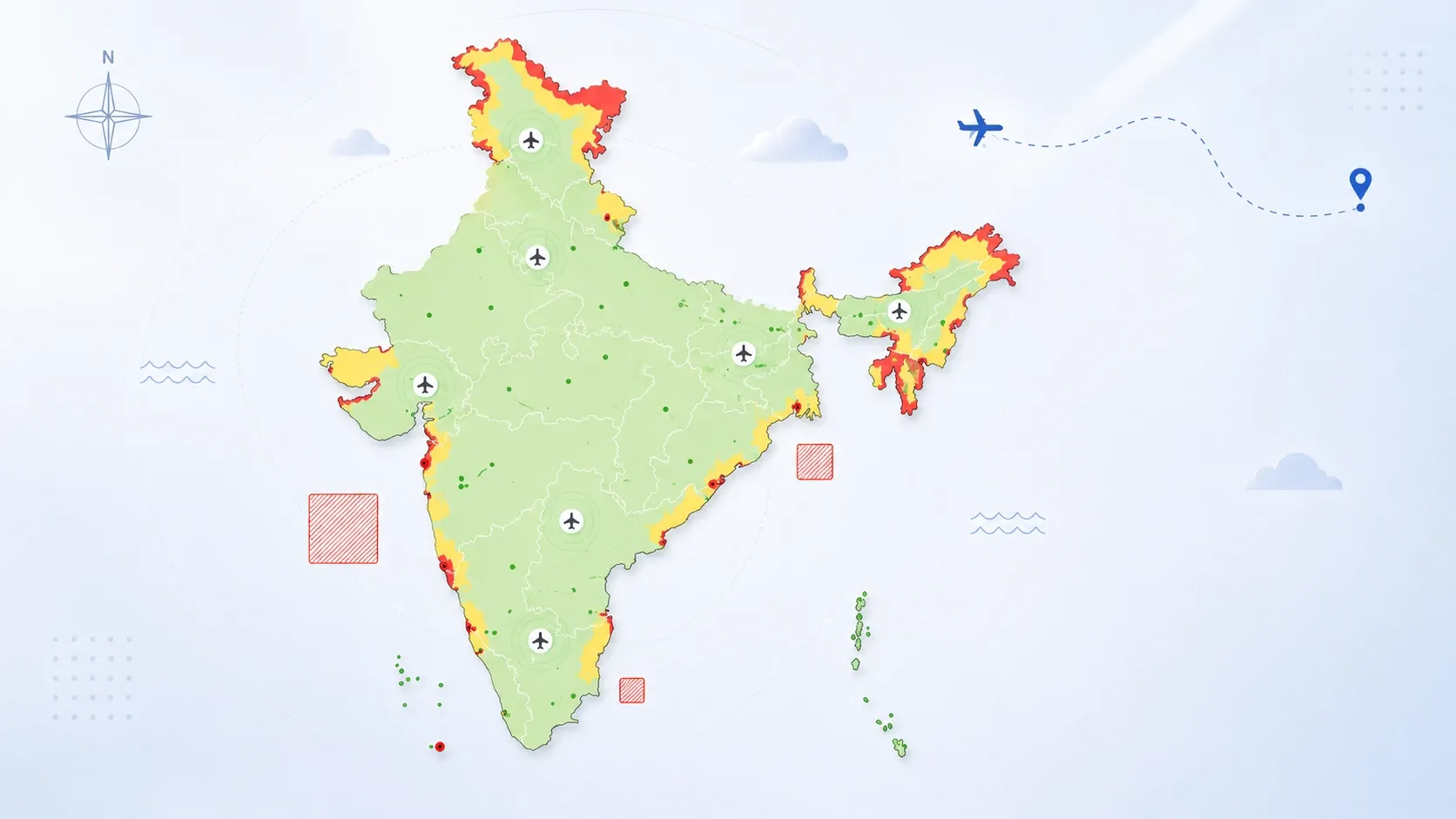
India's drone sector crossed a structural threshold after the National UTM Policy Framework 2021 formalised how unmanned aircraft would operate in very low-level airspace below 1,000 feet. The framework shifted drone regulation away from isolated permissions and toward coordinated traffic management across commercial fleets, regulators, and airspace authorities. By September 2025, BVLOS cargo trials in Bengaluru demonstrated live coordination between unmanned aircraft operators, regulators, and air traffic systems during dense urban operations. (Ministry of Civil Aviation, 24 October 2021)
The framework matters because commercial drone operations cannot scale through manual approvals alone. Infrastructure inspection, agriculture mapping, emergency logistics, and drone delivery all depend on continuous coordination between aircraft sharing the same low-altitude airspace. India's approach combines DigitalSky, NPNT enforcement, UTMSPs, and regulatory oversight into a single operational structure designed for that environment.
What is UTM (Unmanned Traffic Management)
UTM is an automated, software-driven system that manages drone traffic in low-altitude airspace where conventional air traffic control voice communication does not scale. ICAO defines Unmanned Aircraft System Traffic Management as a specific aspect of air traffic management that handles UAS operations safely, economically, and efficiently. The Indian framework adopts this definition while adding the country's own enforcement and coordination layers. (Ministry of Civil Aviation, 24 October 2021)
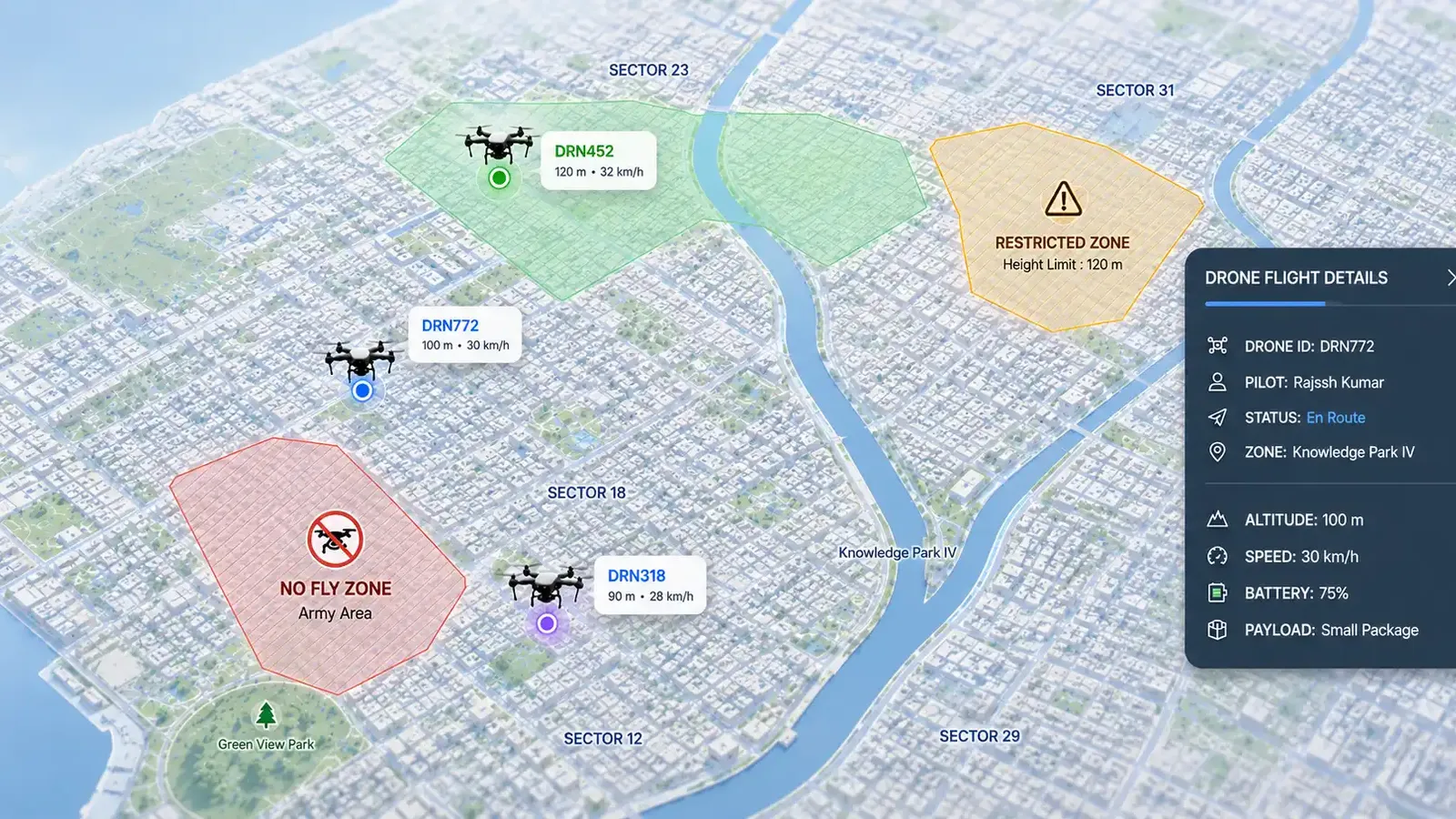
UTM does three things that conventional ATM cannot. It handles thousands of simultaneous low-altitude flights instead of hundreds. It communicates through APIs and telemetry rather than radio voice. It provides dynamic geofencing and automated deconfliction in real time rather than relying on a controller's verbal direction.
The coverage scope is Very Low Level airspace, defined as ground level to 1,000 feet above ground level. This is the band where most commercial drone missions occur, and it is the band the National UTM Policy Framework 2021 explicitly carved out from conventional ATM responsibility. UTM operates below this ceiling. ATM continues to govern controlled airspace above it. The transition between the two is managed through interoperable protocols between UTMSPs and ATC.
Why India needs UTM
Before 2021, drones in India operated under reactive enforcement. Police filed FIRs after incidents. There was no real-time coordination between unmanned aircraft and manned aviation, no network-level situational awareness, and no automated mechanism to prevent two drones from converging on the same airspace volume.
Three pressures forced UTM into national policy between 2019 and 2021. First, drone delivery trials including Medicine From The Sky in Telangana demonstrated the need for coordinated BVLOS routing across commercial fleets. (World Economic Forum India, October 2021) Second, cross-border drone incidents in Punjab and Jammu raised pressure for persistent low-altitude airspace awareness. (Ministry of Home Affairs, 2021) Third, the Drone Rules 2021 simplified commercial drone permissions and accelerated enterprise adoption to a scale that manual approvals could not handle. (DGCA, 25 August 2021)
The economic case is straightforward. BVLOS is what makes drone delivery, infrastructure inspection, and precision agriculture commercially viable. BVLOS at scale is impossible without a UTM service layer to coordinate flights, manage conflicts, and integrate with conventional aviation. The security case is equally direct. Hostile drone incursions require situational awareness that only a network-level system can deliver, and that system has to be live before it is needed.
The National UTM Policy Framework 2021
The Ministry of Civil Aviation notified the National UTM Policy Framework on 24 October 2021. The framework is the foundational document for drone traffic management in Indian airspace, and every subsequent UTM trial, UTMSP onboarding, and BVLOS deployment traces back to its provisions.
The scope is VLL airspace up to 1,000 feet AGL. The architecture is hybrid rather than centralised. Multiple UTMSPs are permitted to operate within the same airspace, which avoids single point of failure and lets smaller providers serve segregated operations such as rural delivery corridors. (Ministry of Civil Aviation, 24 October 2021) This contrasts with the FAA's federated USS model coordinated through a single Flight Information Management System and EASA's U-space single Common Information Service per airspace volume.
The framework draws from ICAO's Unmanned Aircraft Systems Traffic Management Common Framework Edition 2, which has since been updated to Edition 4. India's adaptation aligns with the ICAO core principles while adding the NPNT firmware-lock layer that no other major UTM regime has built into its enforcement floor.
The policy permits three UTMSP pricing models: subscription-based, pay-per-use, and hybrid. A portion of UTMSP service fees is shared with the Airports Authority of India. This is the commercial structure that allows private-sector service layers to integrate with government systems while keeping AAI inside the revenue loop.
The 6-block UTM architecture
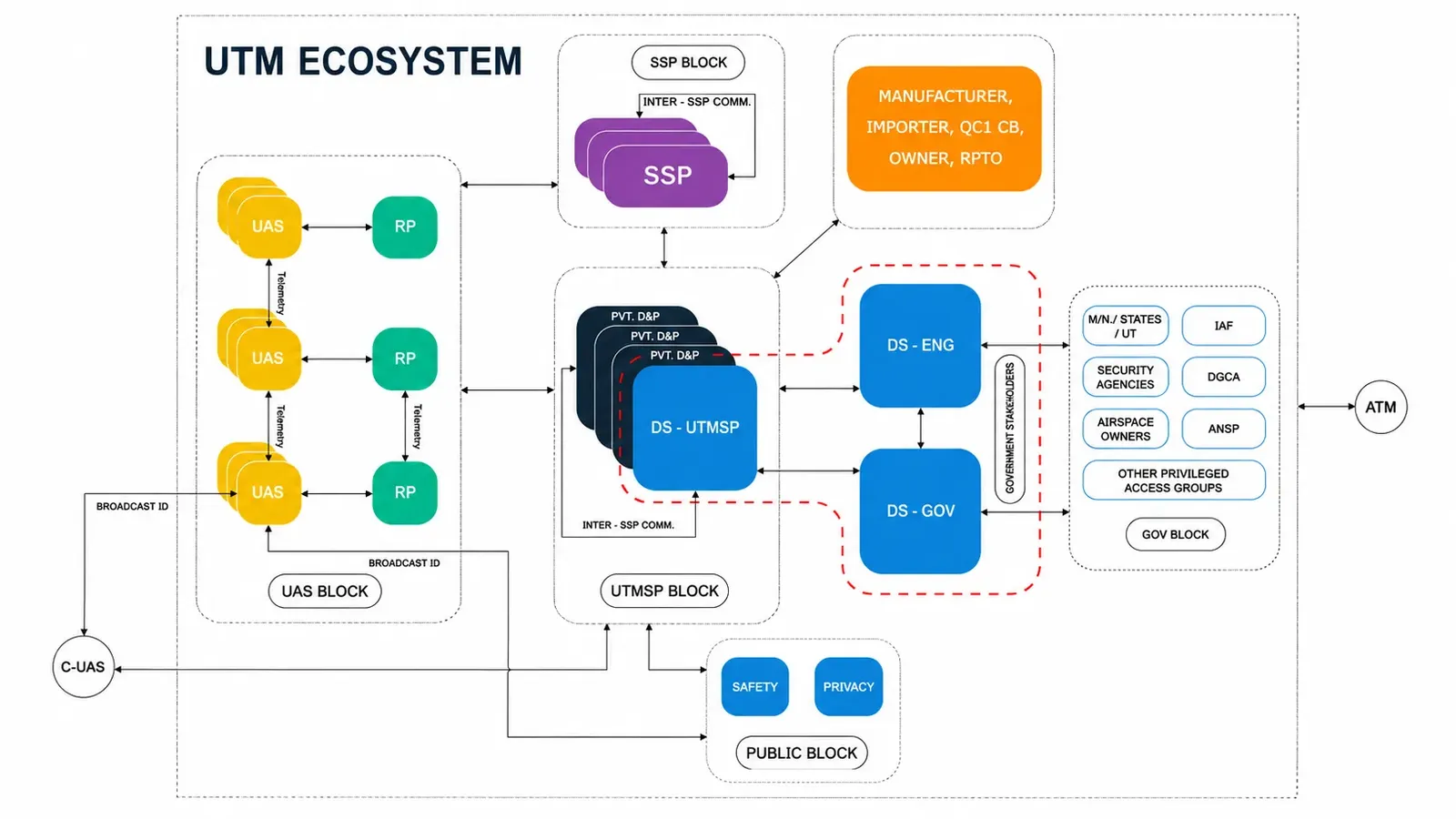
India's UTM ecosystem is organised around six interconnected operational blocks. Each block manages a separate function and communicates with the others through standardised APIs.
UTM block | Primary role | Operational responsibility |
|---|---|---|
DigitalSky block | Regulatory coordination | Flight permissions, NPNT enforcement, airspace data |
UTMSP block | Traffic management | Route planning, deconfliction, monitoring |
SSP block | Supplementary services | Weather, terrain, surveillance, data feeds |
UAS block | Aircraft operations | Drone telemetry and pilot communications |
Government block | Oversight and enforcement | DGCA, MoCA, BCAS, AAI coordination |
Public block | Public visibility layer | Violation reporting and awareness |
The DigitalSky block remains the regulatory anchor. The framework subdivides it into DigitalSky Engine, DigitalSky Government, and DigitalSky UTMSP modules, each handling a different layer of the platform's interaction with the broader ecosystem.
The UTMSP block is the operational coordination network. UTMSPs build technical capability on top of DigitalSky APIs and synchronise data with each other on a need-to-know basis. When two UTMSPs operate in the same volume of airspace, they share active flight intent so neither approves a route that conflicts with the other's traffic.
The SSP block, or Supplementary Service Providers, supplies the data layer underneath UTM operations. SSPs feed weather intelligence, terrain and obstacle databases, surveillance feeds, insurance data, and fleet management telemetry into the ecosystem so UTMSPs can plan and monitor flights against accurate real-world inputs.
The UAS block represents the drones and remote pilots themselves. Information exchange happens UAS-to-UAS, pilot-to-pilot, and pilot-to-UTMSP. The Government block, comprising DGCA, MoCA, BCAS, AAI, and the Air Defence Clearance authority, issues licences, approves permissions, defines airspace, and monitors traffic. The Public block adds a transparency layer where citizens can report visible UAS airspace violations through UTMSP-exposed APIs.
The architecture depends on continuous information exchange between all six blocks rather than isolated approvals before take-off.
What a UTMSP actually delivers
UTMSP services map closely to ICAO's framework and EASA's U1 through U4 service maturity model. Every UTMSP operating in Indian airspace must provide the following functions:
Registration assistance and identification management. Pre-flight operation planning and 4D airspace volume reservation, where the fourth dimension is time. Strategic deconfliction, which resolves conflicts between flight plans before launch. Tactical deconfliction, which resolves conflicts between aircraft in flight. Dynamic geofencing and airspace updates. Flight authorisation and Permission Artefact issuance, interfacing with NPNT for firmware-level enforcement. Conformance monitoring, which tracks whether the drone is actually where its approved plan said it would be. Remote ID broadcast and network handling. Weather, terrain, and surveillance data integration through SSPs. ATM coordination handoffs at controlled-airspace boundaries. Emergency and contingency management.
The integration with NPNT is the layer that distinguishes the Indian framework. UTM handles the network-level airspace coordination. NPNT handles the firmware-level enforcement on the drone itself. A Permission Artefact issued by a UTMSP is cryptographically signed and validated by the drone's Registered Flight Module before motors arm. This combination is unique to India.
UTM vs ATM: how they differ and where they connect
The distinction between UTM and traditional ATM is operational, not conceptual. Both manage airspace. They diverge on volume, communication, altitude, and conflict-resolution model.
Factor | UTM | ATM |
|---|---|---|
Aircraft type | Unmanned aircraft systems | Manned aviation |
Communication mode | API and telemetry driven | Voice communication |
Altitude focus | 0–1,000 ft AGL | Controlled airspace above VLL |
Traffic density | High-volume simultaneous operations | Lower-density routing |
Conflict management | Algorithmic and automated | Controller-directed |
Authorisation | Digital Permission Artefact | ATC clearance |
Primary users | Commercial drone operators | Airlines and general aviation |
The two systems connect at controlled-airspace boundaries. A delivery drone climbing into airspace near an airport is handed off from its UTMSP to conventional ATC through interoperable digital protocols. The framework specifies that this handoff has to be seamless in both directions, which is why interoperability standards sit at the core of the policy rather than being treated as an integration afterthought.
How UTM works after the July 2025 eGCA migration
The Directorate General of Civil Aviation issued a Public Notice dated 3 July 2025 migrating drone regulatory services under Forms D-1 through D-5 from the DigitalSky platform to the eGCA portal. The migration moved in two phases: Type Certificate applications under Form D-1 transitioned on 4 July 2025, and UIN issuance, transfer, and de-registration under Forms D-2 and D-3, Remote Pilot Certificate generation under Form D-4, and RPTO authorisation under Form D-5 transitioned on 15 July 2025. (DGCA Public Notice, 3 July 2025)
After the migration, eGCA handles registration, UIN issuance, RPC generation, and Type Certification. DigitalSky retained responsibility for flight permissions, the airspace map, and NPNT enforcement. The UTM functions stayed on DigitalSky. The certification and credentialing functions moved to eGCA.
The split matters operationally. A commercial operator now manages registration and certification through eGCA while routing operational permissions through DigitalSky-linked systems. Two compliance trails. Two logins. UTMSPs integrating with Indian government systems pull from both APIs to deliver a complete operational picture, a structural shift that no Indian-language UTM blog has documented.
For UTMSP onboarding in 2026, the practical effect is that integration scope has widened. A UTMSP serving an enterprise drone fleet now interfaces with eGCA for the operator's RPC and UIN status while interfacing with DigitalSky for the airspace map, the active permission stream, and NPNT artefact issuance. Operators planning multi-year deployments treat eGCA-DigitalSky API maturity as a procurement variable.
Indian UTM in practice: BVLOS trials and 2025 deployments
India's early UTM phase focused on regulatory structure and pilot programmes. Between 2020 and 2022, multiple BVLOS consortia tested operational concepts under DGCA supervision. Altitude Angel's GuardianUTM Enterprise platform powered four of the eight consortia approved by the Ministry of Civil Aviation. AirMap and Asteria Aerospace integrated UTM services for controlled BVLOS trials. Honeywell and Dhaksha Unmanned Systems participated in adjacent BVLOS experimentation. The Medicine From The Sky logistics operations in Telangana delivered vaccines and emergency medical supplies during this phase. (DGCA BVLOS Experiment Assessment, 2022)
The transition from trials to operational deployment accelerated during 2025.
In September 2025, Bengaluru hosted a commercial BVLOS cargo trial involving CorePeelers, Unifly, and the Amberwings ATVA-1 hybrid cargo drone. The trial demonstrated coordinated low-altitude operations within dense urban airspace while integrating live regulatory oversight, real-time flight monitoring, and multi-stakeholder traffic coordination. The programme also validated regulatory-compliant night operations under DGCA supervision. (Unmanned Airspace, 25 September 2025)
In early 2026, the ATVA-1 platform secured DGCA Type Certification. That progression mattered because it linked UTM operations with a certified commercial aircraft platform rather than an experimental airframe. (DGCA Type Certificate Notifications, 2026)
The same period saw discussion around 5G-enabled airspace coordination. Platforms such as the IG Drones Skyhawk demonstrated how continuous network connectivity could support dynamic route updates instead of fixed pre-flight envelopes.
This is a structural shift in how Indian drone operations are managed. Early drone regulation focused on permission control. The current phase focuses on continuous airspace coordination across registered fleets.
How UTM compares globally: NASA, FAA, EASA U-space
UTM as a discipline originated in the United States. NASA ran the Unmanned Aircraft System Traffic Management research project from 2015 to 2019, executing four Technical Capability Levels. TCL1 in 2015 covered visual-line-of-sight operations in remote areas. TCL2 in 2016 tested BVLOS in sparsely populated areas. TCL3 in 2018 added moderate-density suburban operations with detect-and-avoid technology. TCL4 in 2019 demonstrated dense urban BVLOS in Reno and Texas. The TCL programme defined the UAS Service Supplier architecture that subsequent regimes adapted. (NASA Aeronautics Mission Directorate, 2019)
The FAA built on NASA's research with its UTM Concept of Operations v2.0 published in April 2020. The FAA model is a federated USS ecosystem coordinated through a Flight Information Management System, with broadcast Remote ID rather than network Remote ID for security reasons.
EASA designed U-space as Europe's UTM equivalent. The U-space regulatory framework defines four progressive service maturity tiers. U1 covers electronic registration, electronic identification, and geo-awareness. U2 introduces initial conflict management, tracking, and flight authorisation. U3 adds advanced services including dynamic capacity management and assistance for conflict detection. U4 represents full integration with manned aviation and autonomous routing. U1 services are live across EU member states. U2 and U3 are rolling out between 2025 and 2027. (EASA U-space Regulatory Framework, January 2023)
India's hybrid model draws from the NASA federated architecture while adopting EASA's service-maturity logic for phased rollout. Where India is genuinely ahead is the firmware-lock layer below the UTM service layer. NPNT enforces compliance at the drone itself, regardless of whether the UTMSP correctly authorised the flight. No other major UTM regime has integrated this depth of enforcement into its baseline architecture.
The Operation Sindoor lesson: when UTM meets national security
India's UTM evolution cannot be separated from national security realities.
Between 7 and 10 May 2025, Operation Sindoor triggered emergency NOTAMs and Temporary Flight Restrictions across northern airspace. Large sections of the affected region shifted under restricted operational controls within hours. Civil UTM systems had to absorb cascading restrictions overnight. (Press Information Bureau, May 2025)
Commercial UTM systems handled the transition through dynamic airspace updates. Registered and compliant aircraft operating through DigitalSky-linked ecosystems received updated restrictions digitally before launch. The framework's design assumption, that airspace is dynamic rather than static, held up under live operational pressure.
The incident also exposed a structural gap. Non-compliant drones operating outside registered NPNT ecosystems remained outside automated revocation systems. That distinction reinforced why India treats UTM and NPNT as complementary layers rather than interchangeable mechanisms.
UTM manages visible airspace activity and operational coordination. NPNT controls whether compliant aircraft can take off in the first place. The challenge for regulators between 2026 and 2030 will be managing higher drone density while reducing the operational space available to unregistered, modified, or consumer-imported aircraft outside the procurement-gated fleet.
The 5G and U-space future of Indian UTM
The current Indian UTM model issues a pre-approved Permission Artefact valid for a fixed envelope and a fixed time window. The next generation moves toward continuous network authorisation, where drones maintain a live connection to the UTM platform throughout the mission rather than validating an artefact once at takeoff.
5G network slicing is the technical enabler. Network slicing allows aviation regulators to allocate dedicated low-latency channels for drone telemetry, separate from consumer mobile traffic. A dynamic UTM coordinator can adjust permission boundaries in real time based on weather, manned-aviation movements, temporary no-fly orders, and evolving airspace congestion. The IG Drones Skyhawk demonstrated India's first 5G-enabled drone in 2024, a platform built around continuous connectivity rather than pre-validated envelopes.
The convergence pulls Indian UTM toward EASA's U3 and U4 maturity, where 4D dynamic airspace and autonomous routing become practical at scale. The procurement implication is straightforward. Operators planning multi-year deployments standardise on 5G-capable Registered Flight Module hardware now rather than retrofitting later.
The operational objective is not simply more drones in the air. The objective is predictable, monitorable, and coordinated low-altitude airspace where commercial operations can scale without creating uncontrolled traffic conditions.
India's low-altitude airspace will function as a managed digital network rather than an open operational layer for isolated drone flights. Whether the country reaches that endpoint by 2028 or 2030 will depend less on policy ambition than on UTMSP onboarding velocity, eGCA-DigitalSky API maturity, and the rate at which non-compliant aircraft are pulled inside the registered ecosystem.