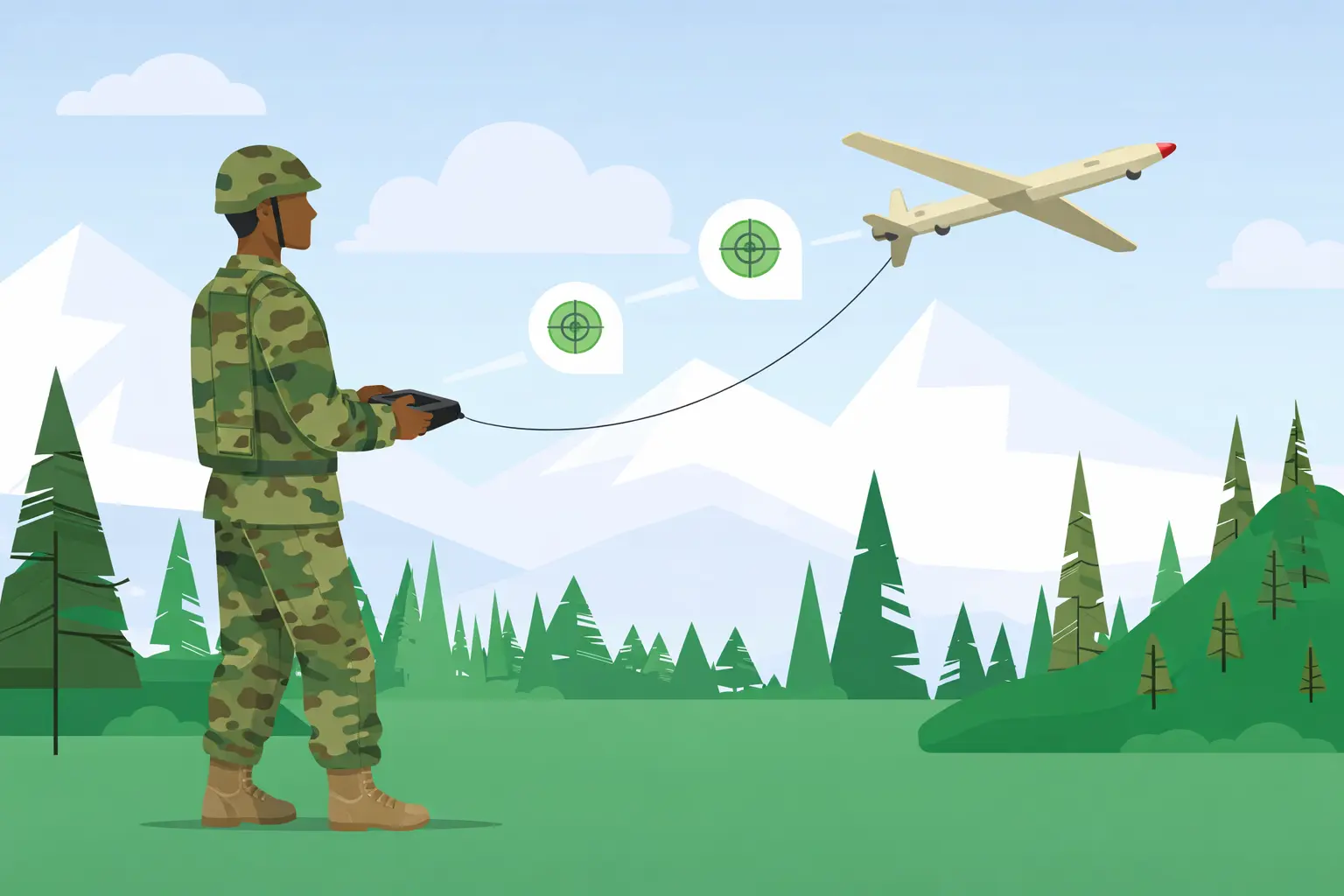

How Mission Context, Doctrine, and Cost-Exchange Logic Define Effectiveness
Selecting the right kamikaze drone is no longer a question of acquiring a new weapon system. It is a question of aligning technology with doctrine, terrain, escalation thresholds, and long-term force design. Loitering munitions, often described as kamikaze drones, sit at the intersection of surveillance and strike. They are not missiles in the traditional sense, and they are not conventional drones either. Their value emerges only when they are chosen and deployed with a clear understanding of what problem they are meant to solve.
Modern conflicts have demonstrated that the effectiveness of kamikaze drones does not depend on headline specifications alone. Range, speed, or payload matter, but they matter far less than persistence, decision timing, and cost-exchange advantage. A loitering munition that perfectly matches the operational environment can reshape tactical outcomes. One that does not becomes an expensive, expendable asset with limited strategic impact.
For India, this distinction is critical. The country’s defence requirements span mountains, deserts, dense urban regions, maritime approaches, and contested borders. No single kamikaze drone design can dominate across all these contexts. The right choice depends on how defence planners understand the role these systems play within a larger operational ecosystem.
Kamikaze Drones as a Capability, Not a Category
The first mistake often made in evaluating kamikaze drones is treating them as a single category of weapon. In reality, loitering munitions vary widely in size, endurance, guidance philosophy, and intended use. Some are designed for platoon-level portability. Others are meant for vehicle or ship-based launch. Some emphasise autonomy and networked operation. Others rely heavily on human-in-the-loop control.
The correct way to approach selection is not by asking which drone is most advanced, but by asking what role it must perform. Is the requirement to eliminate a fleeting target of opportunity. Is it to suppress air defences. Is it to provide persistent overwatch in a sensitive area where escalation must be carefully managed. Each of these roles implies a different balance of endurance, payload, and control.
This is why the “right” kamikaze drone is always contextual. Capability without doctrinal fit leads to underutilisation or misuse.
Persistence and the Power of Waiting
One of the defining advantages of kamikaze drones over traditional missiles is persistence. The ability to loiter, observe, and wait fundamentally changes how force is applied.
In many defence scenarios, the most valuable moment to strike is not immediately available. Targets move. Situations evolve. Political and tactical conditions shift. A loitering munition allows commanders to delay commitment while maintaining pressure.
In mountainous or forested terrain, such as parts of India’s northern borders, this persistence is especially valuable. Targets may appear briefly and then disappear. A system that can remain airborne, quietly observing, increases the probability of successful engagement without requiring repeated launches.
Choosing the right kamikaze drone therefore requires careful assessment of loiter time versus payload. More endurance often means less explosive mass, but the trade-off may be worthwhile if it enables precision and timing.
Human Control, Autonomy, and Accountability
Another central consideration is the balance between autonomy and human control. Modern kamikaze drones increasingly incorporate autonomous navigation, target recognition, and flight management. However, the extent to which decision authority is delegated to the machine varies significantly.
For India, where rules of engagement and escalation control are tightly governed, human-in-the-loop or human-on-the-loop control remains a priority. This ensures accountability and reduces the risk of unintended consequences.
The right kamikaze drone in this context is not the one with maximum autonomy, but the one whose autonomy is predictable, auditable, and aligned with command intent. Systems that allow operators to observe, validate, and intervene provide flexibility without sacrificing speed.
Autonomy should compress decision timelines, not obscure responsibility.
Cost-Exchange Logic and Strategic Sustainability
Perhaps the most misunderstood aspect of kamikaze drones is cost. Loitering munitions are often described as “cheap” weapons. This description is misleading. They are cheaper than many missiles, but they are still expendable systems that must justify their cost through favourable exchange ratios.
The true metric is not unit price, but cost-effectiveness in achieving operational objectives. If a kamikaze drone forces an adversary to activate air defences, reveal positions, or expend expensive interceptors, its value exceeds the cost of the target it destroys.
For India, this cost-exchange logic is central. Defence planning must consider sustainability over time. A system that can be produced, maintained, and deployed at scale without excessive financial strain is far more valuable than a highly sophisticated but limited capability.
Choosing the right kamikaze drone therefore involves industrial considerations as much as tactical ones. Indigenous production, supply chain resilience, and upgradeability all factor into long-term effectiveness.
Terrain and Launch Flexibility
India’s geography imposes unique constraints on drone operations. High-altitude regions demand performance in thin air and extreme weather. Dense urban environments demand precision and minimal collateral risk. Maritime zones demand resistance to corrosion and extended range.
The right kamikaze drone must match its launch environment. Man-portable systems offer flexibility for infantry units but sacrifice payload and range. Vehicle-launched systems provide greater capability but reduce deployment agility.
In border areas where infrastructure is limited, launch simplicity becomes critical. Systems that can be deployed quickly, without extensive support equipment, offer a decisive advantage.
This is why there is no universal solution. Defence forces benefit from a layered approach, where different kamikaze drones serve different echelons and missions.
Intelligence Integration and Networked Warfare
Kamikaze drones do not operate in isolation. Their effectiveness depends heavily on how well they integrate with intelligence, surveillance, and reconnaissance systems.
A loitering munition that can receive target cues from ground sensors, UAVs, or command networks multiplies its effectiveness. Conversely, a system that relies solely on organic sensors may miss opportunities or duplicate effort.
The right kamikaze drone is therefore one that fits seamlessly into existing command-and-control architectures. For India, this means compatibility with indigenous ISR platforms and secure communication networks.
Networked integration also supports escalation management. Commanders can observe effects, reassess intent, and retask assets dynamically rather than committing blindly.
Case Patterns from Indian Defence Planning
India’s recent focus on loitering munitions reflects practical lessons rather than abstract theory. The emphasis has been on systems that balance portability, precision, and control rather than pursuing extreme range or autonomy.
Trials and deployments have highlighted the importance of operator training, sensor reliability, and secure communications. Systems that perform well in controlled demonstrations but degrade under field conditions are quickly exposed.
The emerging pattern suggests a preference for kamikaze drones that are robust, adaptable, and maintainable rather than those optimised for narrow performance envelopes.
Deterrence Without Provocation
One of the subtle advantages of kamikaze drones is their deterrent value. The knowledge that a force can observe persistently and strike precisely without warning imposes psychological pressure.
However, deterrence only works when capability is credible and controlled. An indiscriminate or unreliable system undermines trust and increases escalation risk.
The right kamikaze drone for defence needs therefore supports deterrence by being visible enough to matter, but restrained enough to avoid provocation. This balance aligns closely with India’s strategic culture.
Future-Proofing the Choice
Defence systems are long-term investments. The right kamikaze drone today must remain relevant tomorrow.
This means modularity, software upgradability, and the ability to incorporate improved sensors or guidance algorithms. Systems locked into fixed configurations risk obsolescence as countermeasures evolve.
For India’s defence ecosystem, future-proofing also means indigenous control over upgrades and data. A system that cannot be adapted domestically becomes a liability in rapidly changing threat environments.
The Ethical and Legal Dimension
Kamikaze drones raise legitimate ethical questions, particularly as autonomy increases. India’s approach emphasises human oversight, legal clarity, and proportionality.
Choosing the right system therefore involves ethical design choices. Transparency in how targets are selected, how decisions are logged, and how accountability is maintained matters as much as performance.
These considerations are not external constraints. They shape trust in the system and determine how widely it can be deployed.
Conclusion: Precision Through Fit, Not Excess
The right kamikaze drone is not the most powerful, the most autonomous, or the most technologically complex. It is the one that fits seamlessly into defence doctrine, operational reality, and strategic intent.
For India, loitering munitions represent a way to apply force with precision, persistence, and control. Their value lies in timing, integration, and sustainability rather than spectacle.
Choosing wisely means resisting one-size-fits-all solutions and embracing a portfolio approach that matches system characteristics to mission needs. In modern defence planning, effectiveness comes not from excess capability, but from alignment.
The future of kamikaze drones will belong to those who understand that restraint, clarity, and adaptability are as decisive as firepower.

