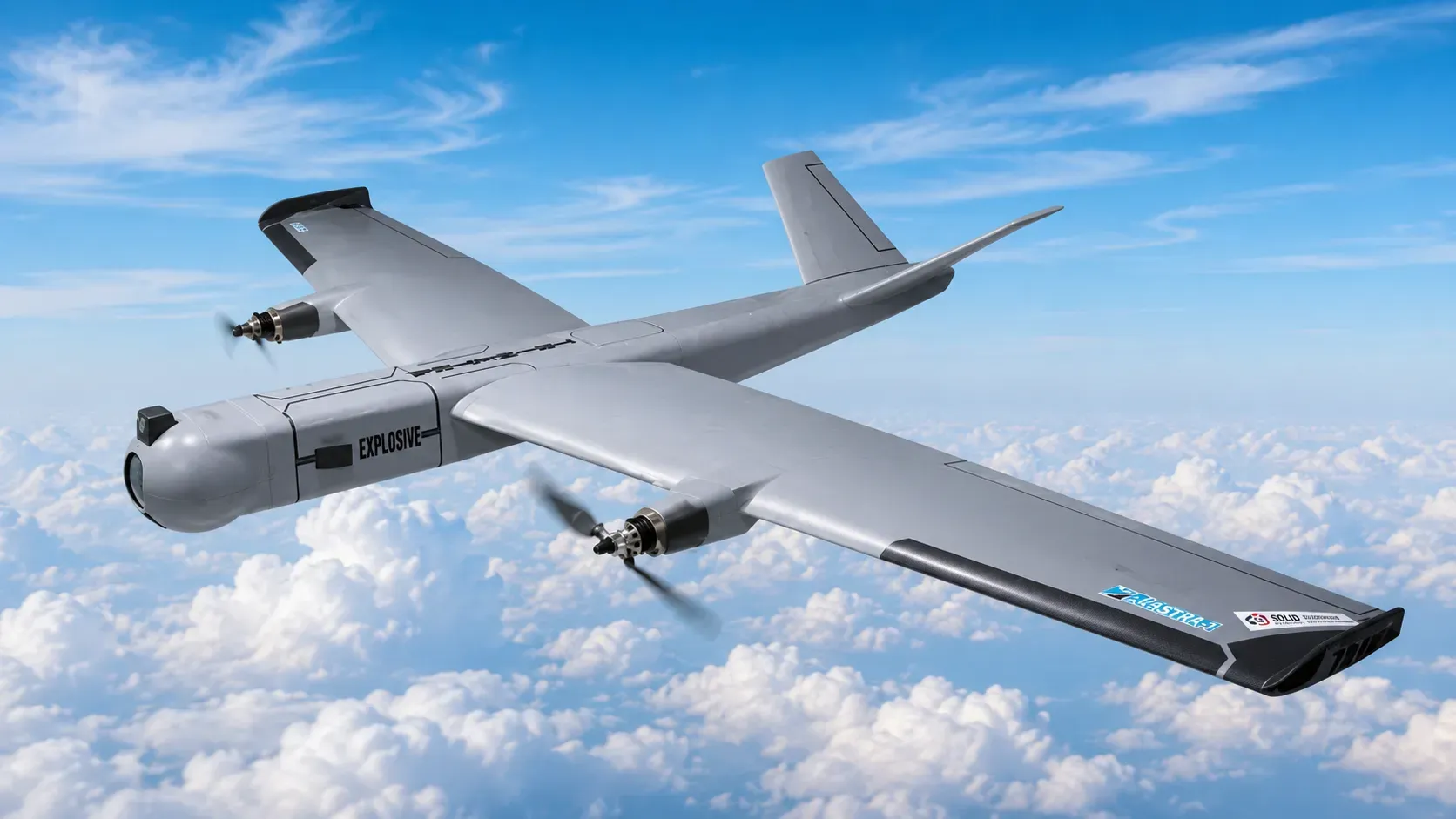
A self-reliant drone industry in India is no longer an aspiration but a measurable industrial programme built around the policy-capital-capability triad. The National Defence Industries Conclave on 19 March 2026 framed the brief as a mission-mode target and released SAMARTHYA 2026 as the roadmap. Latest disclosures show 676 start-ups and MSMEs engaged through iDEX, with 58 prototypes worth ₹3,853 crore cleared for procurement (Press Information Bureau, 19 March 2026). Policy has opened the market, capital must flow more efficiently, and capability must scale beyond assembly.
Tracing how the self-reliant drone industry brief took shape
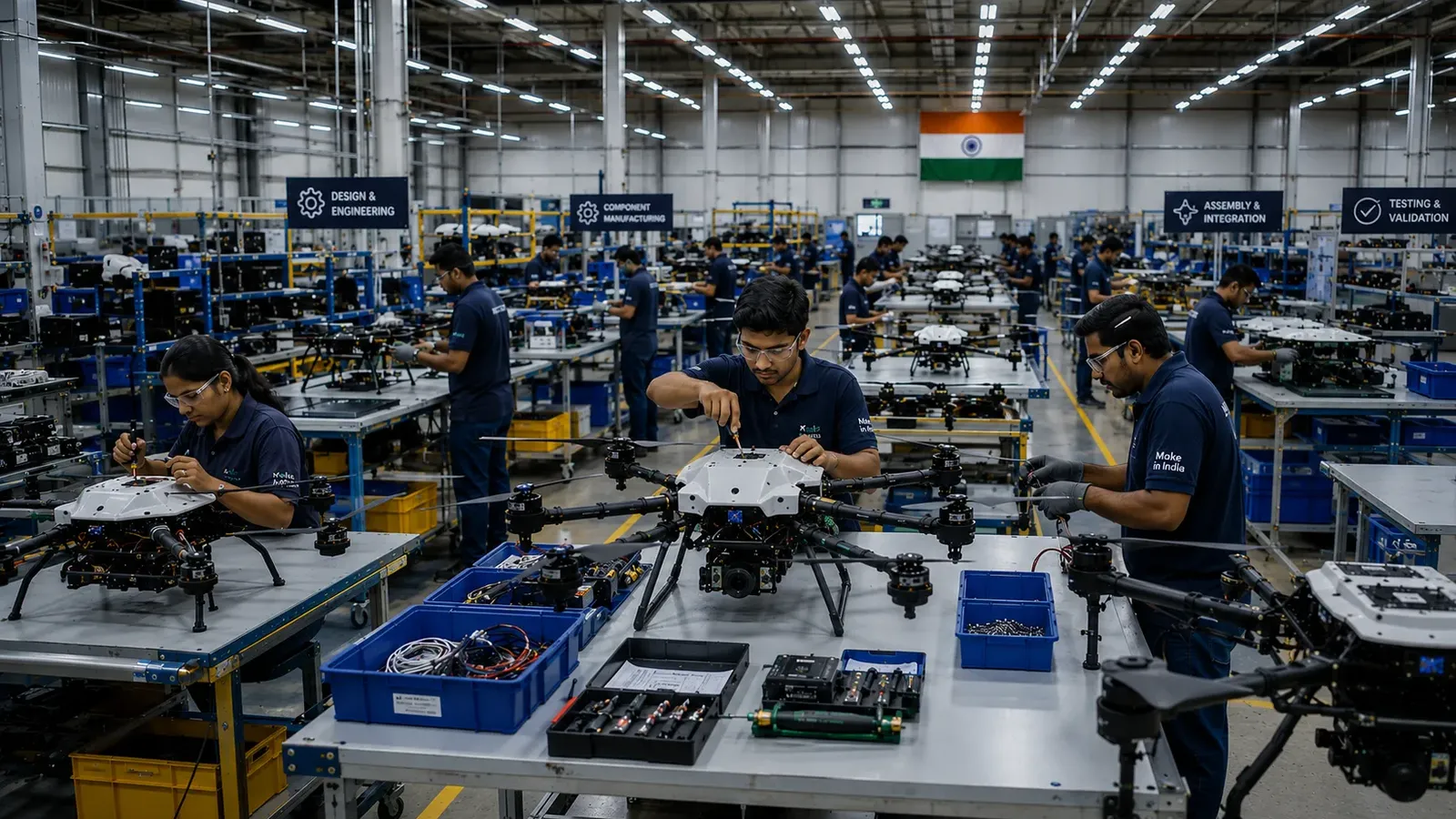
A self-reliant drone industry is an industrial ecosystem capable of designing, manufacturing, certifying, deploying, and sustaining unmanned systems domestically. The objective extends beyond assembling airframes to sensors, communications, flight-control software, payloads, batteries, and the AI stack that handles computer vision, route planning, and mission autonomy.
India's drone manufacturing ecosystem has evolved through successive reforms. The Ministry of Civil Aviation introduced Drone Rules, 2021, replacing a more restrictive framework. The reforms cut approval requirements from 72 to 4 and shrank forms from 25 to 5 (Ministry of Civil Aviation, 25 August 2021). The shift moved policy from permission-heavy administration toward industry enablement, and the four-amendment-cycle breakdown of the Drone Rules traces every revision since.
The case for building a self-reliant drone industry in India also draws from the Atmanirbhar Bharat drones agenda, defence procurement reforms, and domestic manufacturing incentives. The National Defence Industries Conclave elevated that brief from a sector objective into a national industrial target through SAMARTHYA 2026 (Press Information Bureau, 19 March 2026).
The scale of the ecosystem is now visible. India had 38,575 registered drones and 39,890 Remote Pilot Certificates issued as of February 2026. The DGCA also approved 244 Remote Pilot Training Organisations in that window (Press Information Bureau, 17 February 2026).
Those figures point to a functioning market. The remaining task is converting that market into a complete production base, anchored by India's drone laws and downstream incentives.
Mapping the policy leg from Drone Rules to statute
Policy creates the operating environment in which manufacturers, operators, and investors make decisions. A self-reliant drone industry cannot emerge without regulatory certainty.
Drone Rules, 2021 simplified approvals and expanded green zones to cover roughly 90 percent of Indian airspace. The framework also raised the permissible weight threshold to 500 kilograms (Ministry of Civil Aviation, 25 August 2021). Together, those changes lowered barriers for indigenous drone manufacturing across both airframe and component segments.
The Directorate General of Foreign Trade strengthened that base through Notification 54/2015-2020 on 9 February 2022 (Directorate General of Foreign Trade, 9 February 2022). The DGFT drone import ban covers CBU, SKD, and CKD form, while drone components stay on the Free list. The drone import ban India introduced this way protects domestic assembly without choking the global supply chain. How the DGFT import ban reshaped the domestic assembly question sits downstream of this notification.
Policy modernisation continued with the Bharatiya Vayuyan Adhiniyam, which came into force on 1 January 2025 (Ministry of Civil Aviation, 1 January 2025). The statute replaced the Aircraft Act framework that had governed civil aviation since 1934. It carries the drone-rule body into a modern primary law and gives future amendments a cleaner legal foundation.
As drone missions become more complex, regulatory systems must also govern computer vision payloads, sensor fusion, and on-board autonomy. Policy now needs to govern not only the aircraft but also the software stack inside them.
Reading the capital leg through PLI disbursements and tax reform
Capital determines whether industrial ambition becomes manufacturing capacity. This is the area where the industry's structural contradiction appears.
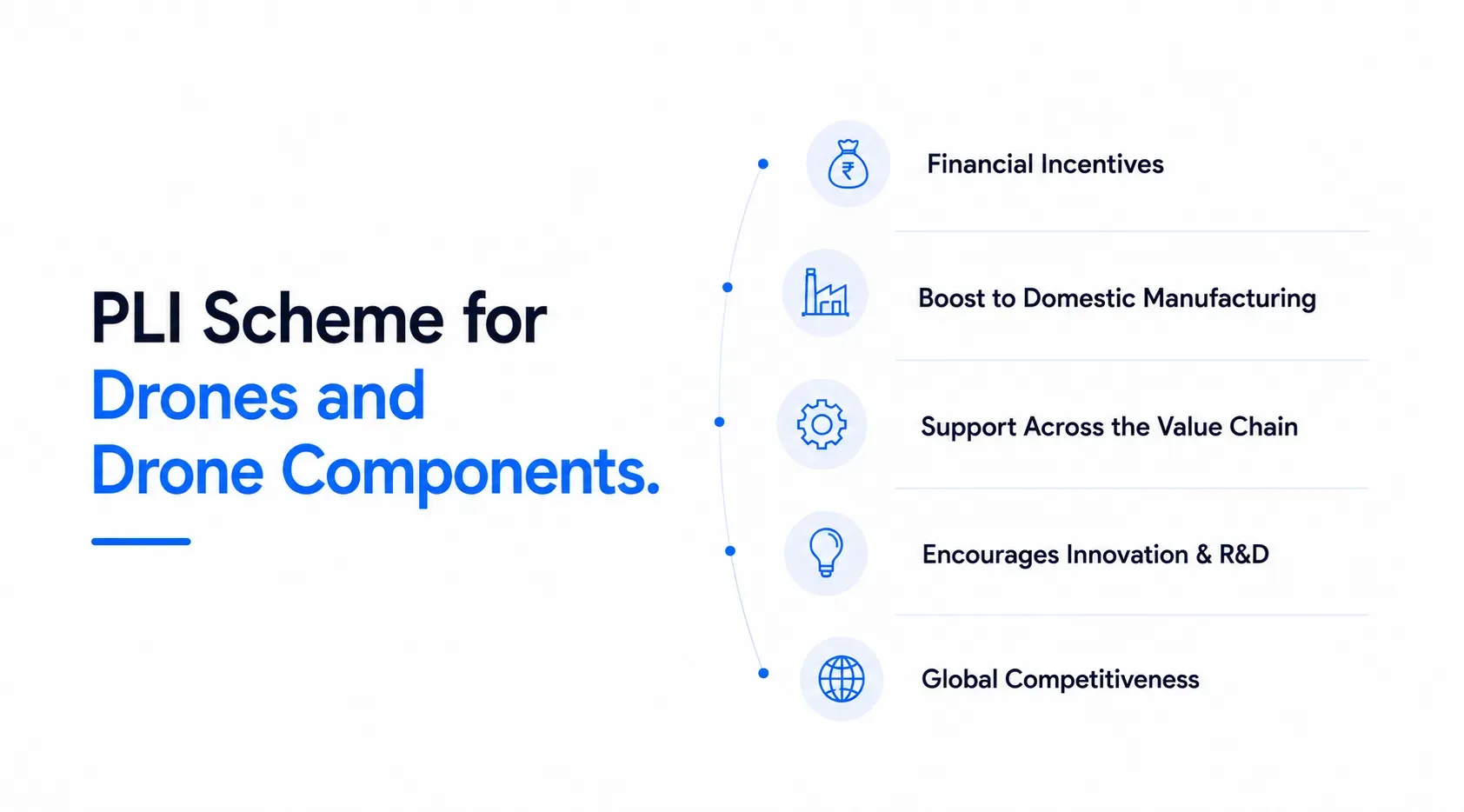
The drone PLI scheme launched with a total outlay of ₹120 crore distributed across three financial years (Ministry of Civil Aviation, 30 September 2021). The scheme aimed to stimulate domestic manufacturing, component production, and value addition across the supply chain. Fourteen firms were selected as beneficiaries in the first round, including five drone manufacturers and nine component manufacturers (Ministry of Civil Aviation, March 2022). The operator-side reading of the drone PLI scheme architecture carries the beneficiary list in detail.
However, actual disbursement tells a different story across the three financial years. ₹29.43 crore went out during FY23, ₹28.76 crore during FY24, and ₹2.43 crore during FY25 (Murlidhar Mohol, MoS Civil Aviation, Rajya Sabha, 16 December 2024). The combined total reached ₹60.62 crore, half the ₹120 crore allocation. The gap between allocation and utilisation is the structural indicator in the sector.
Measure | Amount |
|---|---|
PLI allocation | ₹120 crore |
FY23 disbursement | ₹29.43 crore |
FY24 disbursement | ₹28.76 crore |
FY25 disbursement | ₹2.43 crore |
Total disbursed | ₹60.62 crore |
The proposed drone PLI 2.0 scheme is structured to address those limitations. Government briefings indicate a larger incentive pool with expanded support for localisation, software services, and leasing models. Final approvals sit with Cabinet at the time of writing (Ministry of Civil Aviation briefings, early 2026).
Tax reform also lifted capital efficiency. GST on drones was standardised at 5 percent, replacing the earlier 18 and 28 percent slabs and lowering acquisition costs across categories (Ministry of Finance, September 2025). Capital policy works when incentives, taxation, and procurement reinforce each other rather than operate independently.
Sharpening capability via certification and procurement routes
Capability is the ability to design, certify, manufacture, field, and sustain systems at scale. Incentives alone cannot create capability.
The Quality Council of India Certification Scheme for Unmanned Aircraft Systems set a pathway for drone type certification. Certification matters because procurement agencies, commercial operators, and financial institutions require assurance that systems meet defined technical standards.
Capability also gets stronger via procurement policy. The Department of Defence Production has built the positive indigenisation lists into a capability lever for drones and other systems.
The first five lists together cover 4,666 items. Of these, 2,972 have already been indigenised, delivering import substitution value of around ₹3,400 crore (Department of Defence Production, July 2024). Contracts worth roughly ₹2.5 lakh crore have moved to domestic players through these five lists (Indian Air Force briefing at Aero Tech India, September 2025).
The Defence Acquisition Procedure 2020 also raised the weight of domestic procurement categories. The framework differs from incentive programmes because procurement generates predictable demand. Manufacturers invest with more confidence when future orders become visible.
The Defence Acquisition Council approved drone acquisitions worth around ₹3,000 crore in late 2025. A planned ₹20,000 crore fast-track procurement window is set for 2026 (Ministry of Defence, late 2025).
Modern drone capability depends on software as much as hardware. Computer vision, target classification, edge inference, route planning, and mission autonomy shape operational effectiveness. A country that imports those software stacks remains dependent even when the airframe is built domestically.
Pulling iDEX, MSMEs, and start-ups into the production base
Innovation ecosystems convert research into deployable capability. India's innovation architecture has expanded through Innovations for Defence Excellence, the umbrella the Ministry of Defence built on top of its older programmes.
The Ministry of Defence reported that iDEX has engaged 676 start-ups and MSMEs since the programme launched in 2018. The umbrella has signed 548 contracts and launched 566 challenges. Of these, 58 prototypes worth ₹3,853 crore have received clearance for procurement. A further 45 procurement contracts have been signed worth ₹2,326 crore (Press Information Bureau, 19 March 2026).
Those figures matter because the prototype-to-procurement gap is the structural failure mode of innovation programmes. The iDEX defence drone procurement pipeline shows that transition happening at scale. The iDEX drone challenges window keeps that pipeline open across phases.
The launch of DISC-14 and ADITI Challenges 4.0 at the National Defence Industries Conclave added another demand-generation layer (Press Information Bureau, 19 March 2026). These programmes direct innovation toward specific operational requirements rather than open-ended technology development. The defence-drone landscape these iDEX-cleared prototypes are feeding into sits one layer below the industrial brief.
For drone manufacturers, the objective is not simply to build aircraft. The objective is to create complete mission systems that integrate sensors, communications, autonomy software, payload management, and sustainment support. Capability becomes durable when production, certification, procurement, and innovation reinforce one another.
Anchoring rural demand across SVAMITVA and farmer-services drone schemes
Demand creates the pull that incentives alone cannot manufacture. Civilian schemes give domestic drone manufacturers a base order book that scales beyond defence contracts.
The SVAMITVA Scheme is the largest civilian drone deployment in India. The scheme has surveyed 3.28 lakh villages, covering 95 percent of its target of 3.44 lakh villages (Press Information Bureau, 17 February 2026). Property cards numbering 2.76 crore have been issued for 1.82 lakh villages across 31 states and union territories.
The Drone Shakti Mission was announced in the Union Budget 2022-23 on 1 February 2022. Finance Minister Nirmala Sitharaman framed Drone-as-a-Service as a startup vehicle (Ministry of Finance, 1 February 2022). The Drone Shakti Mission Union Budget framing pulled the civilian-services side into the same incentive architecture as manufacturing.
The Namo Drone Didi scheme extended demand into agricultural Self Help Groups. The Cabinet approved Namo Drone Didi on 28 November 2023 with a ₹1,261 crore outlay. The scheme funds 15,000 women SHGs over two years (Press Information Bureau, 28 November 2023). By February 2026, 1,094 drones had been distributed to women SHGs, of which 500-plus came through the Namo Drone Didi initiative (Press Information Bureau, 17 February 2026).
Civilian demand expands the order book and pulls component manufacturers down the value-addition curve. The schemes function as procurement signals at scale, with regular cadence and tracked deliverables.
Closing the component dependency gap by raising value addition
Self-reliance at the airframe level still leaves the component layer exposed. Sensors, batteries, motors, flight controllers, and a range of radio modules continue to come from foreign sources, mainly China.
The Make in India drones framework treats this gap as the structural bottleneck. The DGFT import ban kept components on the Free list to enable assembly, but full self-reliance demands indigenous component manufacture (Directorate General of Foreign Trade, 9 February 2022).
Defence Minister Rajnath Singh framed the gap at the National Defence Industries Conclave in direct terms (Press Information Bureau, 19 March 2026). Every input, from moulds to software, engines, and batteries, must be manufactured in India. The Make in India track for drones and supply chains traces the policy architecture below the ban.
Value-addition rules under the PLI scheme apply only to domestic production, which makes the scheme a structural lever for component depth. The proposed PLI 2.0 raises localisation targets, expanding the share of total drone value that must originate in India. The QCI Certification Scheme adds another lever by requiring type-certified inputs across the bill of materials.
Watching the eighteen months that will test the hub mission
The next eighteen months will decide whether the self-reliant drone industry mission survives execution risk. Three signals will carry the answer.
The first signal is the Cabinet decision on PLI 2.0. The architecture is on the table, but the scheme moves from proposed to operational only after Cabinet clears the note. The PLI 1.0 disbursement gap of ₹60.62 crore against ₹120 crore makes the design specifics of PLI 2.0 the test of intent.
The second signal is the next Positive Indigenisation List. Each release moves component categories from foreign supply onto the domestic procurement schedule. The release tempo of list cycles determines how fast the component dependency gap closes.
The third signal is the ₹20,000 crore fast-track drone procurement window set for 2026. Conversion of that pipeline into signed contracts will tell domestic manufacturers whether demand visibility is durable or episodic.
The Atmanirbhar Bharat drones mission turns on execution alongside announcement. Whether India's global drone hub ambition translates into measurable output will show in three places. The cadence of PLI 2.0, the next indigenisation list, and the SAMARTHYA 2026 procurement pipeline carry that signal.