Counter-drone systems in India moved from point-defence equipment to a layered national grid after Operation Sindoor in May 2025 (Ministry of Defence, 12 May 2025). This article walks the integrated counter-UAS grid layer by layer. It names the indigenous platforms by function. It explains how AI compresses the engagement cycle from minutes to seconds. It covers the Operation Sindoor lessons and the May 2025 IDDIS contract. It surfaces the January 2026 Indian Air Force RFI and the February 2026 Indian Army RFI for 95 interception and catcher systems.
What a counter-drone stack actually is: India counter-UAS stack layers explained
A counter-drone stack is not a single product. It is a layered architecture where each rung does one job and hands the threat up to the next. The Indian model runs six layers: detect, fuse, decide, soft-kill, hard-kill, directed-energy. The umbrella programme is the Integrated Counter-UAS Grid (Press Information Bureau, 12 May 2025).
Soft-kill mitigates a drone without destroying it. The system jams the command link, denies GNSS, or takes over the protocol. Hard-kill destroys the drone with a kinetic interceptor or a directed-energy beam. Indian doctrine treats soft-kill as the first response. The cost per engagement is a fraction of a missile. Hard-kill is the escalation layer reserved for autonomous threats and confirmed hostile tracks.
This frame matters for procurement officers and infrastructure security leads. A consumer-class quadcopter falls to an RF jammer. A pre-programmed loitering munition with no live link does not. The same logic shapes how drones are certified for Indian airspace under the type certification framework, and feeds into the friendly-airspace picture the stack reconciles against. India's military drone inventory operates inside that same cooperative airspace.
The Atmanirbhar counter-UAS frame is structural, not slogan. The Defence Acquisition Council has cleared indigenous integration over imported point-systems through every counter-UAS procurement window since May 2025 (Press Information Bureau, 12 May 2025). That is the spine of counter-drone systems in India explained at the architectural level.
Layer one: detection, the sensor chain in one paragraph
The detection layer uses four sensor types in combination. Radar provides first contact at range. Active electronically scanned array units now appear on indigenous vehicle-mounted platforms (Manohar Parrikar Institute for Defence Studies and Analyses, September 2025). RF scanning fingerprints the drone's command and video link. Electro-optical and infrared sensors confirm the target visually and in thermal. Acoustic arrays handle the last hundred metres in cluttered urban environments where radar struggles.
The indigenous D-4 counter drone system combines these sensors in one platform. The detection envelope sits between 5 and 8 km depending on configuration (Bharat Electronics Limited, official product page). The system has been inducted across the Indian Army, Indian Navy, and Indian Air Force. It was integrated with the Akashteer command layer under the May 2025 IDDIS contract (Bharat Electronics Limited, 16 May 2025).
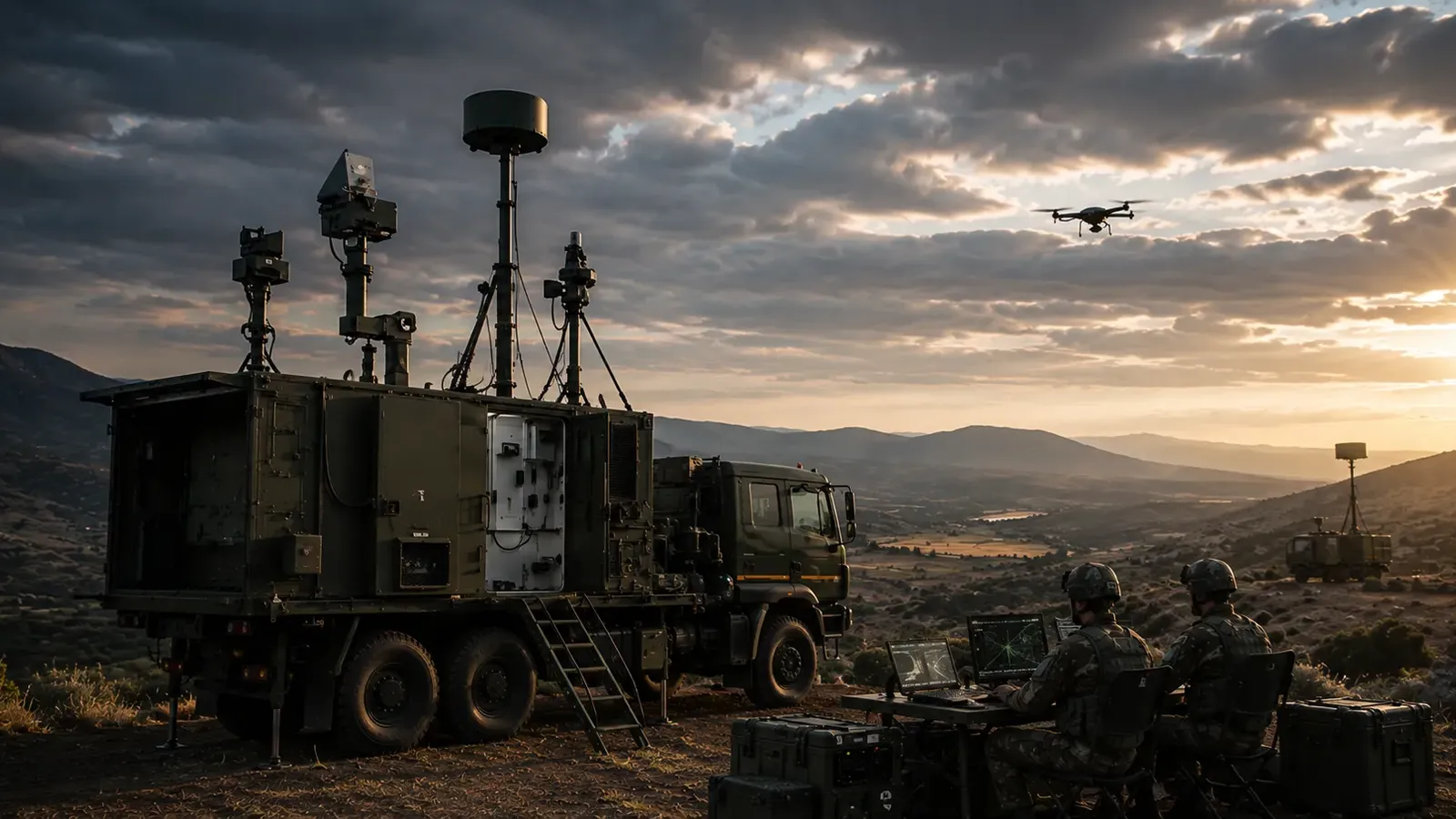
AESA radar counter-drone India deployments became operationally important during Operation Sindoor. The vehicle-mounted C-UAS platforms combined AESA radar, RF jammers, EO sensors, and laser hard-kill in one unit. They were validated against sustained drone incursions in May 2025 (Defence Research and Development Organisation, 17 April 2025). DGCA drone weight classes inform the detection envelope. Micro and small UAVs sit at the lower edge of what radar alone can resolve, which is why multi-sensor fusion is mandatory.
The detection layer is one rung. The full sensor chain, including the four-sensor architecture and the false-positive challenge, is covered in how anti-drone systems in India detect rogue UAVs. Layer two: AI counter-drone fusion and the operating picture
Detection alone is not enough. The operator does not need four conflicting feeds. The operator needs one trustable air picture.
An AI fusion engine correlates radar tracks with RF emitter signatures and visual confirmation into one classified object. It suppresses false positives from birds, balloons, and weather. It classifies the drone class: rotary, fixed-wing, or loitering munition. It infers intent from movement pattern: transit, loiter, or dive. The output is one track, one classification, one recommended response. The human operator sees a single decision card, not four sensor consoles.
The Akashteer Integrated Air Defence Control System is the indigenous fusion-and-command backbone for the Army air-defence layer (Bharat Electronics Limited, 16 May 2025). It is the network the Integrated Drone Detection and Interdiction System wires into. A second indigenous fusion approach is the SkyOS command platform. It was contracted in January 2026 for naval and Army deployment (Ministry of Defence procurement disclosure via Jane's, 9 January 2026). Both treat fusion as an edge-computed function, not a cloud round-trip.
AI counter-drone fusion also has to reconcile against the friendly-airspace picture. India's unmanned traffic management framework supplies the cooperative tracks from authorised civilian operators. The fusion engine subtracts those. The operator sees only the unknown remainder.
That remainder is what the decision layer engages.
Layer three: how India's counter-drone grid works at the command layer
The command layer is where AI hands off to a human commander. Indian doctrine holds kinetic engagement authority with a human operator. AI proposes the response. The commander approves it. This is the structural difference between Indian C-UAS doctrine and the fully autonomous engagement model that some foreign systems advertise.
Rules of engagement scale across two operating bands. In peace-time critical-infrastructure protection at airports, refineries, ports, and nuclear sites, the default response is soft-kill with strict collateral limits. In active-conflict border defence, the rules open up to hard-kill against confirmed hostile tracks. The same hardware operates in both bands. The command layer toggles the authority envelope.
The Integrated Counter-UAS Grid threads multiple sites into one operating picture for theatre-level coordination (Press Information Bureau, 12 May 2025). A drone crossing the western border can be tracked across sector boundaries without losing custody. Akashteer ties the Army air-defence layer to the Air Force air-defence layer. India's airspace zone map defines which authorities own which sectors at which times.
The command layer also carries the audit trail. Every engagement decision is logged with sensor inputs, AI recommendation, operator approval, and post-engagement assessment. That record is what feeds the next round of doctrinal refinement.
Layer four: soft-kill, the first line of mitigation in indigenous counter-drone systems India
Soft-kill systems remain the first operational response because electronic warfare costs less than kinetic interception by an order of magnitude. A jammer engagement costs in the low thousands of rupees. A micro-missile costs in the lakhs. A laser shot costs less but the system cost is far higher.
Indigenous counter-drone systems India deployments now combine four soft-kill modes. RF jamming breaks the command link between the drone and its operator. GNSS denial cuts the navigation feed. GNSS spoofing rewrites the navigation feed and walks the drone to a designated containment area. Protocol takeover, where the link is decrypted and the drone is steered home, is the cleanest outcome when feasible.
The D-4 counter drone system demonstrated RF and GNSS disruption against hostile UAVs during Operation Sindoor (Defence Research and Development Organisation, 17 April 2025). The cost-exchange logic became visible in that operation. A jammer can defeat the majority of consumer-class and remotely piloted threats without firing a kinetic round. Authorised flight identity is also resolved at this layer through the NPNT permission-based flight protocol, which separates cooperative traffic from the hostile remainder.
Soft-kill has one structural limit. A pre-programmed autonomous drone with no live command link cannot be jammed in the traditional sense. The drone follows its onboard mission. That is the failure mode the hard-kill layer was built for.
Layer five: hard-kill, when soft-kill is not enough in soft-kill hard-kill counter-drone India doctrine
Hard-kill is the kinetic layer. The options are guns, micro-missiles, interceptor drones, and net-capture. The doctrine treats hard-kill as the last resort because every kinetic engagement carries collateral risk over populated areas.
The interceptor drone India programme has matured since 2024. DRDO-led interceptor drone development demonstrated autonomous drone-on-drone engagement in April 2025 (Defence Research and Development Organisation, 17 April 2025). The interceptor locks onto a hostile track, closes the range, and defeats the target by direct impact or proximity detonation. The Indian Army Request for Information of 20 February 2026 specified up to 45 interception systems and 50 catcher systems. The minimum slant range is 4 km against 0.001 square metre RCS targets and 10 km against 0.05 square metre RCS targets. The system must track at least 20 drones simultaneously with a deployment time under ten minutes (Ministry of Defence, 20 February 2026).
A micro-rocket salvo system was tested at Gopalpur on 13 May 2025. It is designed specifically for swarm engagement. The interception envelope is 2.5 km, with detection out to 6 km against low-RCS targets (Ministry of Defence procurement disclosure, 13 May 2025). The salvo logic addresses the saturation problem that single-shot interceptors cannot solve.
The hard-kill layer also has to coordinate against loitering munitions and one-way attack drones, which behave differently from reconnaissance UAVs. The engagement window is shorter. The intent is unambiguous once the dive begins. The command layer compresses the decision cycle accordingly.
Layer six: directed-energy weapons India and the DRDO laser anti-drone weapon
Directed-energy weapons change the cost equation. A laser shot costs in the tens of rupees in electricity. The magazine depth is limited only by the generator. That makes directed-energy the answer to swarm saturation, where kinetic magazines exhaust faster than the threat can be neutralised.
The DRDO laser anti-drone weapon programme runs two indigenous systems. The Mk-1 sits in the 10 kW class with roughly 1 km engagement range. The Mk-2A sits in the 30 kW class with roughly 5 km engagement range. The Mk-2A was successfully tested at Kurnool on 13 April 2025 against fixed-wing UAVs and incoming swarms (Defence Research and Development Organisation, 17 April 2025). The system is now positioned for integration into the layered air defence grid.
High-power microwave anti-drone India capability entered public disclosure in April 2026. DRDO confirmed work on microwave-based swarm disruption systems (Defence Research and Development Organisation, April 2026). High-power microwave systems target onboard electronics rather than the airframe. One pulse can degrade an entire swarm simultaneously. That is structurally different from laser engagement, which is point-target.
Directed-energy weapons India deployments matter most where magazine depth and cost-per-shot dominate the operational equation. Border sectors facing sustained drone pressure. Naval task groups defending against multi-axis attacks. Strategic infrastructure facing saturation threats. The procurement window for mobile directed-energy systems is open through the January 2026 Indian Air Force Request for Information.
How AI now stitches the stack together
AI in counter-drone systems India performs four distinct functions across the stack, not one. Understanding them separately is the difference between treating AI as a feature and treating AI as architecture.
Function one is sensor fusion at the edge. Radar, RF, EO/IR, and acoustic feeds are correlated into a single object identity in milliseconds. The fusion runs on the platform, not in the cloud. Latency budgets for swarm response do not allow a round-trip.
Function two is threat classification. Machine-learning models trained on Indian threat profiles separate a hostile loitering munition from a friendly agricultural drone by airframe signature, flight envelope, and emission pattern. The classifier outputs a confidence score, not a binary. The operator sees the score.
Function three is engagement recommendation. The AI proposes the lowest-collateral response that meets the threat envelope. Jam first. Spoof if jam fails. Kinetic only if both fail and the threat is confirmed hostile. The SkyOS platform implements this recommendation engine in the indigenous stack (Ministry of Defence procurement disclosure via Jane's, 9 January 2026).
Function four is swarm-level coordination. The combinatorial problem of multiple simultaneous threats overwhelms human operators. AI assigns interceptors to targets, sequences directed-energy shots, and allocates jamming bandwidth across the engagement envelope. This is exactly the problem Bhargavastra and the high-power microwave programme are built to address.
AI does not replace the human commander in Indian doctrine. The human still holds engagement authority. AI compresses the decision cycle from minutes to seconds. That compression is the entire point.
Operation Sindoor counter-drone lessons and what the stack proved
Operation Sindoor in May 2025 was the first conflict in which India's full indigenous counter-drone stack was tested against a sustained hostile drone campaign. The Press Information Bureau and Ministry of Defence briefings confirmed the layered grid worked. Akashteer command, vehicle-mounted C-UAS platforms with AESA radar, RF jammers, EO sensors, and high-energy laser hard-kill operated as one coordinated network. The grid neutralised incoming drone threats at high precision (Press Information Bureau, 12 May 2025; Defence Research and Development Organisation, 17 April 2025).
Open-source reporting and parliamentary disclosure converged on a figure of more than six hundred hostile drones intercepted during the operation. The Manohar Parrikar Institute for Defence Studies and Analyses primer of September 2025 documented the layered engagement model in detail.
The operation validated three doctrinal choices. First, indigenous integration over imported point-systems. The stack worked because Akashteer, D-4, the DRDO laser, and the interceptor programmes shared protocol and command layers. Second, AI fusion over operator-by-operator coordination. The volume of simultaneous tracks exceeded what manual coordination could handle. Third, layered soft-kill-first economics over kinetic-only escalation. The majority of threats were defeated at the jamming layer before reaching the missile envelope.
The lessons fed directly into the May 2025 IDDIS contract, the January 2026 Indian Air Force RFI, and the February 2026 Indian Army RFI. The procurement window that opened after Sindoor is the structural shift the Atmanirbhar counter-UAS programme had been building toward since 2021.
What the layered air defence counter-UAS India stack does not yet solve
No competitor on the SERP writes this section honestly. Counter-drone systems in India still have five open problems that the stack does not yet close.
Very low radar cross-section targets remain hard. A 0.001 square metre RCS drone at extended range sits below the threshold that smaller indigenous radars can resolve cleanly. The February 2026 Indian Army RFI named this specification directly because it is the bar industry has to clear (Ministry of Defence, 20 February 2026). The fix is more sensitive radars, better fusion, and acoustic or RF complement at close range.
Saturated swarm attacks remain the second open problem. A coordinated swarm of fifty or more cheap drones can exhaust kinetic magazines faster than the system can reload. The directed-energy and high-power microwave programmes are the direct response. They are not yet at scale.
Urban clutter remains the third problem. Radar performance degrades against building reflections. RF detection drowns in commercial spectrum traffic. Counter-drone deployment in dense urban environments requires acoustic primary sensing and tighter integration with India's drone regulations to separate cooperative from hostile traffic.
Hard-kill collateral risk over populated areas remains the fourth problem. A net-capture system that fails over a residential zone is a public-safety incident. Engagement authority in urban bands skews even further toward soft-kill.
Electronic warfare collateral is the fifth open problem. Broad-spectrum jamming can affect friendly aviation, emergency services, and telecom infrastructure within the engagement zone. Selective denial is technically harder than blanket denial. The procurement specifications now demand it.
What changes in the next 24 months: the Make in India counter-drone window
Four inflection points define the procurement window over the next 24 months.
First, the Indian Army Request for Information of 20 February 2026 for up to 45 drone interception systems and 50 drone catcher systems. The slant-range, RCS, simultaneous-tracking, and deployment-time parameters named earlier define the bar (Ministry of Defence, 20 February 2026). The contract awards from this RFI will define the Army's counter-UAS posture through 2028.
Second, the Indian Air Force Requests for Information issued in January 2026 for next-generation counter-drone systems. The focus is swarm interception, mobile directed-energy weapons, and AI-driven threat classification (Indian Air Force, January 2026). This is the procurement window the directed-energy programmes have been building toward.
Third, the operational deployment of the DRDO high-power microwave anti-drone system and its scaling from prototype to field unit (Defence Research and Development Organisation, April 2026). The first deployed HPM unit will mark the structural shift to area-effect counter-swarm capability.
Fourth, the export window. International interest in the D-4 counter drone system was disclosed after Operation Sindoor (Bharat Electronics Limited, 16 May 2025). The Make in India counter-drone frame now extends to a Make for the World counter-drone frame. India's positioning as a counter-UAS exporter is the second-order effect of Sindoor that the SERP has not yet caught up to.
The next layer of the stack will wire autonomous interceptor swarms and directed-energy weapons into the same AI fusion engine that runs the sensor layer today. The commander's role compresses to authority, not coordination. That is the shape of the integrated counter-UAS grid by 2028.