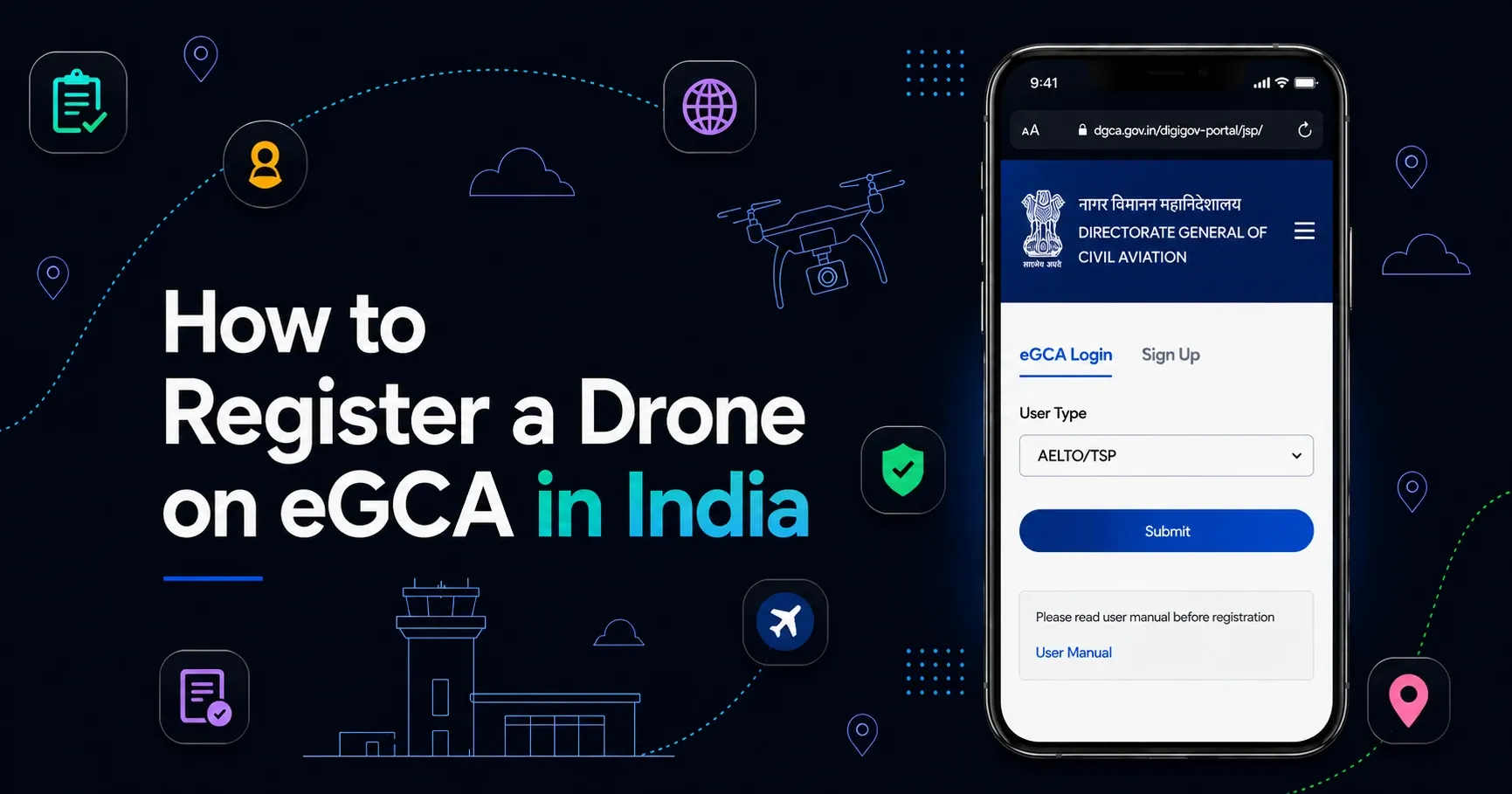
Learning how to fly a drone in India requires compliance with the Drone Rules 2021, the eGCA drone portal workflow introduced after the July 2025 platform migration, and DigitalSky airspace map restrictions enforced through NPNT systems (Ministry of Civil Aviation, 25 August 2021). Every legal flight follows five phases: registration, pre-flight preparation, takeoff, in-flight operations, and post-flight logging. By the end of this guide, readers will understand how Indian drone operations move from UIN issuance to landing discipline under the current regulatory stack.
Why the operational sequence matters now
Drone operations in India moved out of the hobby category once the Drone Rules 2021 replaced the older Unmanned Aircraft System Rules framework on 25 August 2021 (Ministry of Civil Aviation, 25 August 2021). The new structure simplified approvals, reduced licence categories, and introduced DigitalSky-linked NPNT enforcement across compliant aircraft.
The second inflection point arrived in July 2025, when drone registration and operator records shifted into the eGCA workflow while DigitalSky retained the operational airspace and permission platform (DGCA Public Notice, 3 July 2025). Most legacy flight guides still describe DigitalSky as a single portal. The operational reality is now split between identity management on eGCA and airspace control on DigitalSky.
Commercial demand also expanded. Agricultural spraying corridors, drone survey tenders, utility inspections, and state procurement programmes added new operators into controlled airspace. The Government e-Marketplace folded drone-as-a-service procurement requirements into public tenders, pushing operators toward formal logging and compliance discipline (Government e-Marketplace tender norms, 2025).
The draft Civil Drone (Promotion and Regulation) Bill 2025 added another layer of urgency. The draft framework references AI-assisted UTM integration, expanded BVLOS corridors, and tighter operational record requirements (Press Information Bureau, September 2025). Operators learning how to fly a drone in India today are entering a regulated aviation ecosystem, not a consumer-electronics category. The full Drone Rules 2021 framework sits at the centre of this transition.
The five-phase framework for flying a drone in India
Every legal drone flight in India runs through the same five-phase operational framework. Each phase sits on a different platform, requires a different artefact, and answers a different compliance question. The framework gives operators a single mental model that maps cleanly onto DGCA enforcement.
Phase one is registration. The drone receives a Unique Identification Number through the eGCA portal and the operator receives a Remote Pilot Certificate through a DGCA-authorised Remote Pilot Training Organisation. Phase two is pre-flight. The operator runs equipment, software, and environment checks under a structured time-sequenced protocol. Phase three is takeoff. The first sixty seconds of flight reveal whether the aircraft is operationally safe. Phase four is in-flight, where altitude management, VLOS drone India compliance, right-of-way discipline, and battery management dominate. Phase five is post-flight, where log capture, incident reporting, and maintenance records close the compliance loop.
Phase | Primary action | Platform | Required artefact |
|---|---|---|---|
Registration | Aircraft identity creation | eGCA | UIN |
Pilot qualification | Operator certification | DGCA-authorised RPTO | Remote Pilot Certificate |
Airspace check | Zone verification | DigitalSky | Zone status |
Permission workflow | Yellow Zone approval | DigitalSky | Permission Artefact |
Flight logging | Record retention | Operator system | Flight logs |
This framework forms the backbone of the drone pre-flight to landing checklist India operators reference during enterprise survey, agricultural spraying, and infrastructure inspection missions. The draft Civil Drone Bill 2025 will tighten Phase 1 and Phase 5 obligations further, with stricter type certification and AI-assisted UTM logging built in (Press Information Bureau, September 2025).
Registration, certification, and insurance: the three pre-launch conditions
Before a drone leaves the ground, three operational conditions must already exist. The aircraft must carry a valid registration identity, the pilot must meet the applicable certification threshold, and the operator must understand the airspace category for the intended mission.
The first requirement is drone registration India through the eGCA workflow. A registered aircraft receives a UIN linked to the operator and aircraft record (DGCA Public Notice, 3 July 2025). The UIN identifies the drone. It does not authorise unrestricted flight. That distinction creates a recurring compliance failure among first-time operators. A detailed walkthrough of the drone registration on the eGCA portal sits in the regulatory cluster.
The second requirement is pilot certification. A Remote Pilot Certificate, issued through a DGCA-authorised RPTO, is mandatory for drones above the exempt Nano category used recreationally in Green Zone airspace (DGCA Drone Training Circular 02 of 2022). DGCA annual reporting data recorded more than 3,000 Remote Pilot Certificates issued nationwide by 2025 (DGCA Annual Report, 2025). Do I need a licence to fly a drone in India? Yes, for any drone above Nano flown for any purpose other than recreational Green Zone hobby flight.
Insurance forms the third layer. Rule 47 of the Drone Rules 2021 requires third-party liability insurance for drone operators for categories above Nano classification (Ministry of Civil Aviation, 25 August 2021). Enterprise operators, survey contractors, and agricultural service providers also maintain payload and hull coverage because state tenders now require proof of operational insurance.
The weight category determines which conditions apply. The full Nano, Micro, Small, Medium, Large drone categories breakdown sits in the regulatory pod. Nano drones below 250 grams used recreationally inside Green Zone airspace are exempt from UIN, RPC, and insurance. Every other class triggers the full three-layer pre-launch sequence.
Operators researching aviation regulation must treat registration and operational permission as separate layers of the same flight sequence. Possessing a UIN does not authorise flight in a Yellow Zone. That authorisation comes from the Permission Artefact, generated through DigitalSky on the day of the mission.
Reading the airspace before the day of the flight
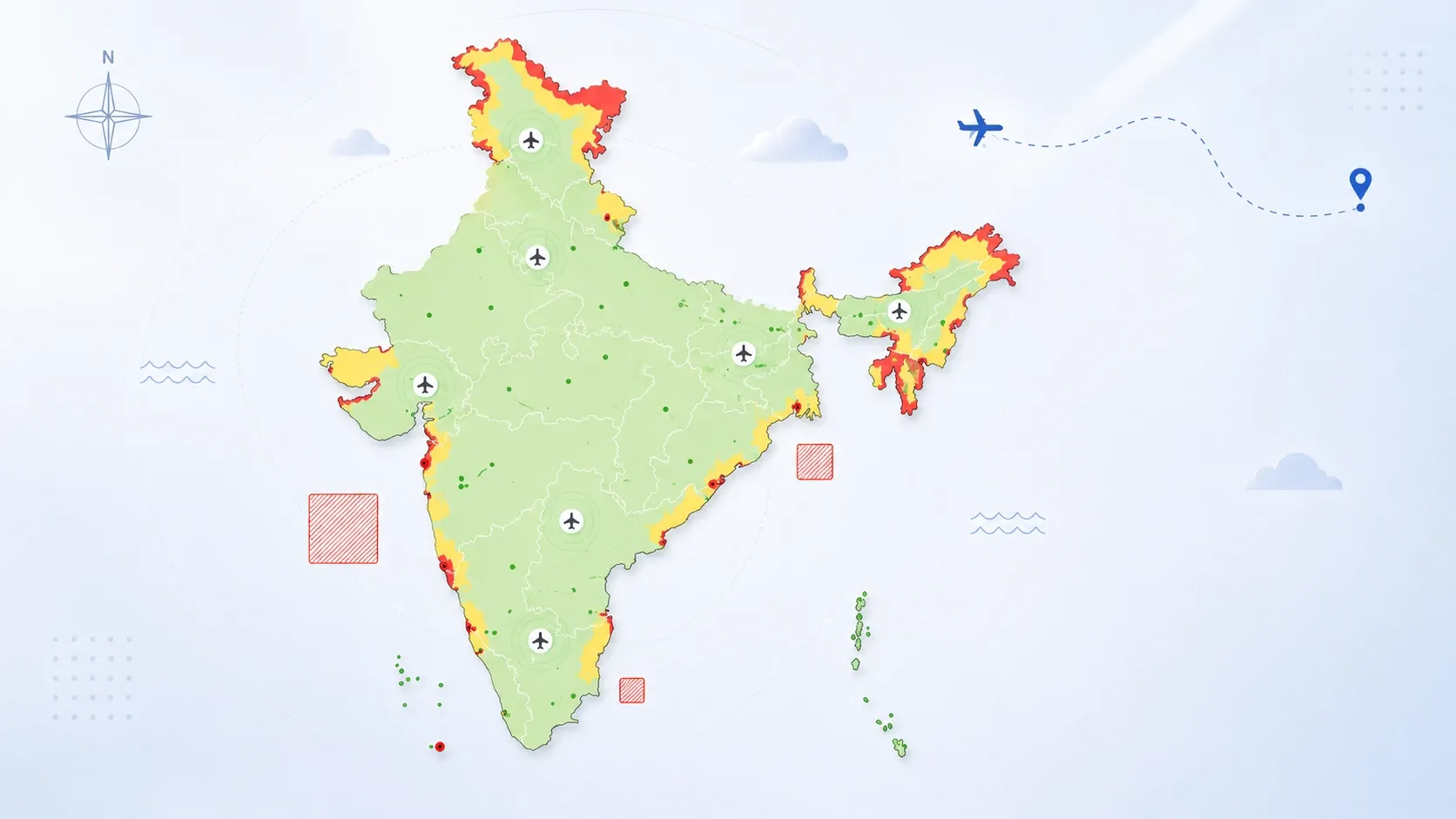
The full Nano, Micro, Small, Medium, Large drone categories breakdown sits in the regulatory pod. Every mission begins with a zone review on the day of the flight because temporary restrictions may appear around public events, VIP movements, or security deployments (DigitalSky Platform Guidance, DGCA). The DGCA drone rules India enforcement model treats the airspace map as the authoritative source, and operators who pre-cache zone status the night before risk flying into a temporary Red Zone declared overnight.
Green Zones allow operations up to 120 metres Above Ground Level without prior permission for compliant categories. Around operational airports, the permitted ceiling drops to 60 metres inside the 8 to 12 kilometre airport-proximity band. These ceilings apply even when the surrounding map area appears green.
Yellow Zones require a Permission Artefact before an NPNT-equipped aircraft will arm. The NPNT Permission Artefact handshake verifies the digital signature against the drone firmware before motors can spin. Operators flying in controlled corridors without a valid artefact face enforcement exposure under the Aircraft Act 1934 and Drone Rules 2021.
Red Zones include military facilities, international borders, strategic government infrastructure, nuclear facilities, and Parliament-controlled sectors. Flights in these areas require explicit central government approval, regardless of drone weight category. The Green Zone Yellow Zone Red Zone drone India classification covers every operational airspace check across the country.
How do I check no-fly zones in India? The DigitalSky airspace map at digitalsky.dgca.gov.in is the only authoritative source. Third-party apps and cached zone files miss temporary restrictions and should be treated as advisory only.
Wind speeds above 20 km/h reduce flight stability for smaller multirotor aircraft. Visibility degradation affects VLOS compliance because Drone Rules 2021 require the aircraft to be visible to the unaided eye during operation. AI-assisted route planners can pull DigitalSky zone APIs and propose compliant flight paths, but the operator carries final responsibility for zone verification.
The pre-flight sequence: equipment, software, and environment checks
A drone pre-flight checklist India is not paperwork. It is the operational filter that separates routine missions from incident reports. Commercial operators run this sequence in timed stages before launch, and the DGCA pre-flight requirements drone framework follows the same logic across small, medium, and large category aircraft.
At roughly T-30 minutes, the aircraft inspection begins. Propellers are checked for edge cracks, motor mounts are inspected for movement, and frame screws are verified for tension. Payload locks, landing gear, and battery seating points are physically confirmed before power-up. Each propeller surface is scanned for chips along the leading edge because micro-fractures propagate into in-flight blade failures under load.
At T-15 minutes, the power and software stack is checked. Flight batteries should be balanced within safe voltage tolerances, and controller power levels stay above operational reserve thresholds. Firmware compatibility, NPNT activation, and remote controller telemetry links are confirmed before GPS acquisition begins. Yellow Zone operators download the approved Permission Artefact during this stage. Spare batteries are warmed if ambient temperature is below 10 °C because LiPo discharge curves degrade sharply in cold conditions.
At T-5 minutes, environmental and navigation checks take priority. Wind direction, electromagnetic interference exposure, crowd clearance, and takeoff surface conditions are reassessed immediately before arming. Operators wait for a stable GPS lock, typically above 12 connected satellites, before motor start. If the aircraft has moved more than 50 kilometres since its last operation, compass calibration is repeated. The drone hover test procedure India will fail without a stable compass and GPS baseline.
Return-to-Home settings are configured before takeoff. The RTH altitude must exceed nearby obstacles because automatic return paths follow the stored safety profile during signal loss events. First-time operators routinely set the RTH altitude too low. The standard fix is to set RTH altitude at least 30 metres above the tallest obstacle inside a 500-metre radius of the home point.
Agricultural pilots, inspection crews, and survey operators brief observers and payload teams before launch because communication failures during takeoff are a leading operational risk factor in multirotor missions.
Takeoff: the first 60 seconds in the air
The first minute after takeoff determines whether the rest of the flight is operationally stable. Pilots begin with a low-altitude hover test between one and two metres above the ground. This phase reveals asymmetric motor behaviour, vibration irregularities, GPS drift, or telemetry instability before the aircraft climbs into operational altitude. The drone takeoff and landing procedure used by enterprise operators starts here.
The arming sequence follows a strict order. Motors arm at low throttle, then the operator observes for asymmetric spin or vibration before throttle-up. The aircraft climbs to one to two metres and holds for 10 to 15 seconds. The operator checks for drift, yaw stability, and GPS hold. If any of those readings are unstable, the drone is landed and inspected before any further flight attempt. The VLOS drone India rule applies from the moment the aircraft leaves the ground.
After the hover check, operators climb gradually to approximately five metres and monitor signal strength, video transmission stability, and control responsiveness. If the aircraft is stable, the mission proceeds toward planned altitude limits inside the authorised airspace envelope.
Visual Line of Sight is mandatory for standard operations under Rule 27 of Drone Rules 2021 (Ministry of Civil Aviation, 25 August 2021). Small-category drones stay operationally visible at roughly 400 to 500 metres under daylight conditions. Beyond that range, operations cross into Beyond Visual Line of Sight operations and require separate approval frameworks. The rule has no aided-vision exception. Binoculars, scopes, and zoomed-in screens do not satisfy the rule.
Daylight-only operation is the default. Civil twilight to civil twilight is the legal flight window unless a specific DGCA night-operations permission is held. Can I fly a drone at night in India? The answer is no for the default authorisation. Night flying requires explicit DGCA approval, anti-collision lighting, and operational protocols defined in the night-ops endorsement.
Failure modes flagged during the first 60 seconds include GPS drift, compass error, ESC desynchronisation, and RC link loss. Each of these telemetry warnings triggers an immediate abort. Aborting at five metres costs nothing. Aborting at 100 metres costs the airframe.
In-flight discipline: altitude, distance, and right-of-way
Standard Green Zone operations cap flights at 120 metres AGL. Airport-proximity restrictions, temporary NOTAM conditions, and local administrative advisories may reduce that ceiling further. What is the maximum altitude for a drone in India? The answer is 120 metres above ground level in standard Green Zone airspace, dropping to 60 metres inside airport-proximity bands. The drone altitude limit India ceiling does not change with weight class for civilian operators.
Lateral distance management follows the VLOS rule. Small-category drones cap useful range at 400 to 500 metres for a trained operator under daylight conditions. Further range is BVLOS territory and requires separate approval. Operators tracking subjects across longer distances should plan repositioning, not stretching the VLOS envelope.
Manned aircraft retain right-of-way at all times. If a helicopter or low-flying aircraft approaches the operational area, the drone operator descends or repositions immediately (Drone Rules 2021, Rule 27). Flights above uninvolved public gatherings increase liability exposure and operational risk during battery or control failures. A 50-metre horizontal separation from any uninvolved person is the minimum, with larger separations applied during populated public events.
Mission-specific rules layer on top. No payload drop without DGCA approval. No flying within 5 kilometres of an operational airport without a valid Permission Artefact. Agricultural spraying operations, agricultural drone operations under the Kisan Drone scheme, and infrastructure inspections each carry additional layered constraints.
Battery management is the final in-flight control layer. Commercial operators begin return procedures near the 30 percent threshold instead of waiting for emergency low-voltage warnings. LiPo instability during aggressive discharge profiles is a common cause of uncontrolled descent in multirotor systems. Onboard AI assists with obstacle avoidance, subject tracking, and Return-to-Home path correction, but the operator stays accountable for battery state and recovery routing.
Emergency protocols follow a fixed sequence. RC link loss triggers RTH. Geofence breach triggers hover-and-hold. LiPo fault triggers immediate descent to the nearest safe landing zone. Each of these protocols is configurable inside the flight controller and should be verified on the ground before every mission.
Landing and the first five minutes on the ground
Landing discipline begins before descent starts. Operators position themselves with the wind direction where possible and maintain a stable glide path into the landing zone. Sudden throttle reductions near the ground destabilise multirotor aircraft and increase rollover risk during touchdown. The drone landing procedure India followed by enterprise operators treats the approach as a discrete phase.
The aircraft descends steadily before entering a low-hover flare between one and two metres above the ground. Motors stay active until the aircraft settles completely. Disarming during descent risks uncontrolled shutdown and hard impact damage. Touchdown happens with motors still spinning at idle, and the operator disarms only after the airframe is stationary on the surface.
Once landed, shutdown order matters. The aircraft powers down before the controller because firmware and telemetry systems may continue writing logs for several seconds after touchdown. Batteries cool before removal or transport because thermal stress affects long-term cell life.
Post-flight inspection closes the operational loop. Propellers, motors, frame joints, payload mounts, and gimbal assemblies are checked for stress or vibration marks. Flight logs are exported and retained because DGCA may request operational records under Rule 35 of Drone Rules 2021.
The LiPo battery storage drone India protocol used across enterprise fleets calls for storage at roughly 3.8 volts per cell, not full charge, in a fireproof container or LiPo-safe bag. Storing fully charged packs accelerates degradation and increases fire risk during long-term storage.
Incident reporting carries formal timelines. Any airspace incursion, operational failure, or safety event must be reported within 48 hours under DGCA procedures. Insurance providers also require flight logs and weather conditions during claim review windows. Operators who skip the post-flight log capture lose the ability to defend against enforcement actions and insurance disputes simultaneously.
Where AI is changing how operators fly drones in India
AI is reshaping every phase of the framework, not replacing the operator. Pre-flight, AI weather models that integrate IMD data flag flight windows with safer cross-wind profiles. Auto-route planners pull DigitalSky zone APIs and propose compliant flight paths with terrain-aware altitude profiles. AI drone flight planning India tools have moved from research demonstrations into commercial mission-planning workflows over the last 18 months.
In-flight, onboard AI assists with obstacle avoidance, subject tracking, and Return-to-Home routing around late-emerging obstacles. Computer-vision payloads classify crop stress, structural defects, and survey targets in real time. The pilot supervises rather than steers, intervening only when the autonomy stack flags an exception. The shift mirrors the broader trend across FPV drones in India, where AI-assisted target lock and frequency-hopping resilience have moved into field-trial state with indigenous defence programmes.
Post-flight, AI auto-tags photogrammetry datasets, flags anomalies in flight logs, and predicts component fatigue from motor and battery telemetry. The drone flight log requirement DGCA places on operators intersects with AI analytics: anomaly detection surfaces airframe and battery issues before they cause incidents. Predictive maintenance reduces unscheduled groundings across enterprise fleets.
The Indian regulatory anchor is the draft Civil Drone Bill 2025. The Ministry of Civil Aviation has flagged AI-assisted UTM as a pillar of the draft framework (Press Information Bureau, September 2025). DRDO and indigenous defence programmes have deployed AI-assisted FPV and swarm prototypes in field trials, anchored by the Indian Army's operational use during Operation Sindoor (Press Information Bureau, 14 May 2025). Enterprise survey, agriculture, and infrastructure inspection workflows are absorbing AI tooling at every phase of the five-phase framework.
The operator's job is changing. Less stick-time, more mission-design and exception-handling. Operators who learn how to operate drone in India under AI-assisted workflows will hold the productivity edge across the next regulatory phase.
What this means for operators in practice
Indian drone operations follow a five-phase compliance sequence. The sequence is anchored in Rule 27 and Rule 47 of Drone Rules 2021, and registration, permissioning, airspace review, telemetry management, and incident logging each connect to formal regulatory workflows. Drone usage is expanding into sectors tied directly to public infrastructure, agriculture, surveying, energy inspection, and state procurement. Operators entering these sectors face procurement filters tied to compliance history, insurance coverage, and operational records, including Government e-Marketplace drone procurement tender norms.
The drone takeoff and landing procedure, the airspace check, the hover test, and the post-flight log capture all live inside the same framework. The operator who runs every flight against this template builds a defensible compliance record that survives enforcement audits, insurance disputes, and procurement diligence simultaneously.
The Drone Rules 2021 framework will fold into the Civil Drone (Promotion and Regulation) Act once the draft Bill clears Parliament. Type certification thresholds tighten, BVLOS corridors expand, and AI-assisted UTM moves into production. The operator who internalises the five-phase framework now will fly the next ten years on the same discipline. Only the platform names will change.