Drone Rules 2021 were notified by the Ministry of Civil Aviation on 25 August 2021 under the Aircraft Act 1934 framework, which the Bharatiya Vayuyan Adhiniyam 2024 later replaced from January 2025 (Ministry of Civil Aviation, 25 August 2021; Ministry of Law and Justice, 29 December 2024). The statute now sits alongside two other regulatory shifts: the July 2025 platform split between eGCA and DigitalSky, and the draft Civil Drone Bill 2025 released for public consultation on 16 September 2025 (DGCA Public Notice, 3 July 2025; Ministry of Civil Aviation Consultation Draft, 16 September 2025). This article walks through Parts I to XII of Drone Rules 2021, names the specific rules every Indian operator must clear, and tracks the amendments that reshaped compliance after 2021.
What Drone Rules 2021 actually cover
Drone Rules 2021 replaced the Unmanned Aircraft System Rules 2021 within six months of that earlier framework's notification, after industry and government consultations concluded that the UAS Rules imposed excessive licensing layers on civilian operators (Ministry of Civil Aviation, 25 August 2021). The revised framework reduced approval forms from 25 to 5, cut fee categories from 72 to 4, and abolished older instruments such as the unique authorisation number, the certificate of conformance, the certificate of maintenance, and the operator permit (Press Information Bureau, 26 August 2021).
The statute applies to every civilian unmanned aircraft system with a maximum all-up weight up to 500 kg, an increase from the earlier 300 kg ceiling under previous frameworks. The 500 kg ceiling brings drone taxis and heavy-payload logistics platforms within civilian regulatory scope while leaving systems above that weight to general aviation rules. Drones operated by the naval, military, and air forces of the Union sit outside the statute and remain governed by separate defence frameworks.
Drone Rules 2021 are organised into twelve Parts. Part I sets out the short title, application, and definitions. Part II covers classification, certification, and registration. Part III deals with the manufacture and import of unmanned aircraft. Parts IV and V govern operations and the airspace map. Part VI handles the Remote Pilot Certificate and Remote Pilot Training Organisations. Parts VII and VIII address remote pilot eligibility and the obligations on training organisations. Parts IX and X cover the transfer and deregistration of drones, and the research and development carve-out. Part XI handles insurance and accident reporting. Part XII closes the statute with penalties and miscellaneous provisions.
The drafting philosophy across all twelve Parts is built on trust, self-certification, and non-intrusive monitoring. The Drone Rules 2021 pdf, available on the Ministry of Civil Aviation website, makes this orientation explicit in the preamble. That philosophy explains why most rule-level obligations under the framework run shorter than the equivalent provisions under the older UAS Rules.
How the five weight categories shape every downstream obligation
Rule 5 of Drone Rules 2021 sorts every unmanned aircraft into five categories under drone classification by weight, based on maximum all-up weight which includes payload (Ministry of Civil Aviation, 25 August 2021). The categories are Nano, Micro, Small, Medium, and Large. Every downstream compliance obligation under the statute, from registration to pilot certification to insurance, flows from this classification.
Category | Weight range | Primary trigger | Operational implication |
|---|---|---|---|
Nano | Up to 250 g | Minimal registration obligations | Limited exemption pathway |
Micro | Above 250 g to 2 kg | Registration and operational controls | Commercial operations regulated |
Small | Above 2 kg to 25 kg | RPC and airspace compliance | Enterprise operations common |
Medium | Above 25 kg to 150 kg | Expanded certification requirements | Higher oversight burden |
Large | Above 150 kg | Full regulatory controls | Limited civilian use |
The 250 g threshold carries disproportionate regulatory importance because it separates the Nano category from the Micro category. A Nano drone flown below 15 metres at speeds under 30 km/h sits inside a lighter compliance tier under Rule 14, but operators must still respect restricted airspace and security directives.
The classification also affects insurance exposure under Rule 44. Operators flying Small or Medium category drones for survey, infrastructure inspection, logistics, or industrial mapping face higher third-party liability expectations because payload weight increases kinetic risk. The drone categories under Drone Rules 2021 also shape procurement economics. Survey firms, agricultural operators, and state departments most often procure within the Small category because the compliance burden remains lower than Medium-category operations while still supporting useful payload and endurance profiles.
The classification framework links directly into the wider weight-based category structure and India's drone laws covering Drone Rules 2021, BVA 2024, and the draft Civil Drone Bill 2025.
Type certification and the Quality Council of India route
Type certification sits at the centre of Drone Rules 2021 because registration depends on it. Rules 7 to 12 establish that every unmanned aircraft must hold a valid type certificate before the operator can apply for a Unique Identification Number, with exemptions for Nano drones, model remotely piloted aircraft systems, and prototype drones operating under the Rule 42 research carve-out (Ministry of Civil Aviation, 25 August 2021).
The Quality Council of India received responsibility for the certification standard-setting process. The Director General determines type certificate standards based on QCI recommendations or those of an authorised testing entity. Manufacturers submit the drone for physical examination, accompanied by technical specifications, safety data, and compliance documentation covering airworthiness, communication systems, and NPNT compliance. The Director General issues the type certificate within fifteen days of receiving a satisfactory report from the testing entity (Drone Rules 2021, Rule 8).
The framework also permits the Central Government to recognise foreign type certifications through gazette notification. This route exists to avoid forcing manufacturers with established certifications in other jurisdictions to duplicate the entire process. Acceptance is not automatic — the Central Government must specifically notify the foreign authority whose certificate it recognises.
Type certification is the manufacturer's compliance gate. Without a valid type certificate, no UIN can be issued for any drone of that model, and downstream registration, RPC pairing, and insurance procurement all collapse. This is why drone type certification is the first compliance check Indian enterprise procurement teams now run before signing a purchase order for any platform above the Nano category.
Operators who import drones face an additional layer because the Directorate General of Foreign Trade regulates the import side under separate notifications. DGFT Notification No. 54/2015-2020, dated 9 February 2022, restricted the import of foreign-built drones in Completely Built Up, Semi-Knocked-Down, and Completely Knocked-Down form, with carve-outs for research, defence, and security entities (Directorate General of Foreign Trade, 9 February 2022). Wireless approvals from the WPC under the Department of Telecommunications cover the spectrum side. The three approvals together form the import-side compliance triangle that sits upstream of the Drone Rules 2021 registration process.
Registration and the Unique Identification Number
Registration under Drone Rules 2021 sits across Rules 14 to 18. Rule 14 obliges every operator, except those covered by Nano exemptions or the Rule 42 R&D carve-out, to register the drone on the Government platform and obtain a Unique Identification Number before any flight (Ministry of Civil Aviation, 25 August 2021). Application is made through Form D-2, accompanied by the unique number of the type certificate, ownership records, manufacturer details, and the drone's serial number.
The UIN of a drone is linked to its serial number, the serial number of its flight control module, and the serial number of its remote pilot station. This linkage matters because Rule 15(4) requires the operator to inform DGCA within seven days of replacing a UIN-linked flight control module or remote pilot station. Operators frequently miss this provision when servicing fleets, and the gap creates audit exposure during enforcement checks.
The registration fee remains capped at ₹100 per drone under Schedule II of Drone Rules 2021, paid through BharatKosh. This is one of the rare instances of a Schedule II fee under Indian aviation regulation that has remained unchanged since notification, and it reflects the deliberate policy choice to keep entry barriers low for civilian operators.
The drone registration in India workflow under Drone Rules 2021 migrated from DigitalSky to eGCA in July 2025 under the eGCA and DigitalSky platform split (DGCA Public Notice, 3 July 2025). eGCA registration now handles UIN issuance, type certification records, and Remote Pilot Certificate administration, while DigitalSky and NPNT retain airspace permissions and flight authorisation responsibilities. Operators must understand which platform governs which process - submitting a UIN application through DigitalSky after the migration triggers application failure.
The most consequential operator misunderstanding under Rule 14 is the assumption that the Unique Identification Number authorises flight. It does not. A registered drone with a valid UIN still requires airspace permission for every operation outside the lightest Nano tier. The permission layer sits inside DigitalSky and operates under the No Permission, No Takeoff architecture, separately from the registration record held in eGCA.
The Remote Pilot Certificate after the 2022 amendment
Drone Rules 2021 govern remote pilot eligibility and certification across Rules 32 to 38. The framework changed materially after the Drone Amendment Rules 2022 replaced the older Remote Pilot Licence terminology with the Remote Pilot Certificate, issued through DGCA-authorised Remote Pilot Training Organisations rather than through DGCA directly (Ministry of Civil Aviation, 11 February 2022).
Eligibility under Rule 33 requires the applicant to be between 18 and 65 years of age, to have passed Class X or equivalent from a recognised board, and to have completed training from an authorised RPTO. The training covers air law, meteorology, human factors, radio communication, flight planning, drone maintenance, NPNT operations, and emergency handling. Most operators clear the syllabus inside two to four weeks, although completion times vary by RPTO capacity.
The Remote Pilot Certificate remains valid for ten years unless suspended or cancelled, and is renewable for further periods up to ten years on payment of the prescribed fee (Drone Rules 2021, Rule 36). Validity hinges on registration on the Government platform - a certificate not registered loses operational effect even when the certificate document itself is undamaged.
Rule 35 exempts certain operations from the certificate requirement. No RPC is needed to operate a Nano drone, or to operate a Micro drone for non-commercial purposes. The non-commercial qualifier on Micro operations is the boundary most often misread. A Micro drone flown for paid survey work, paid photography, or any commercial mission requires an RPC regardless of the per-mission revenue scale.
DGCA Annual Report data published during 2025 showed more than 3,015 RPCs issued nationwide since the 2022 amendment, with commercial demand expanding across logistics, infrastructure inspection, agriculture, and security deployments (DGCA Annual Report, 2025). The bottleneck for enterprise scaling now sits at RPTO training capacity rather than at the regulatory framework itself.
Operating restrictions and the airspace zone map
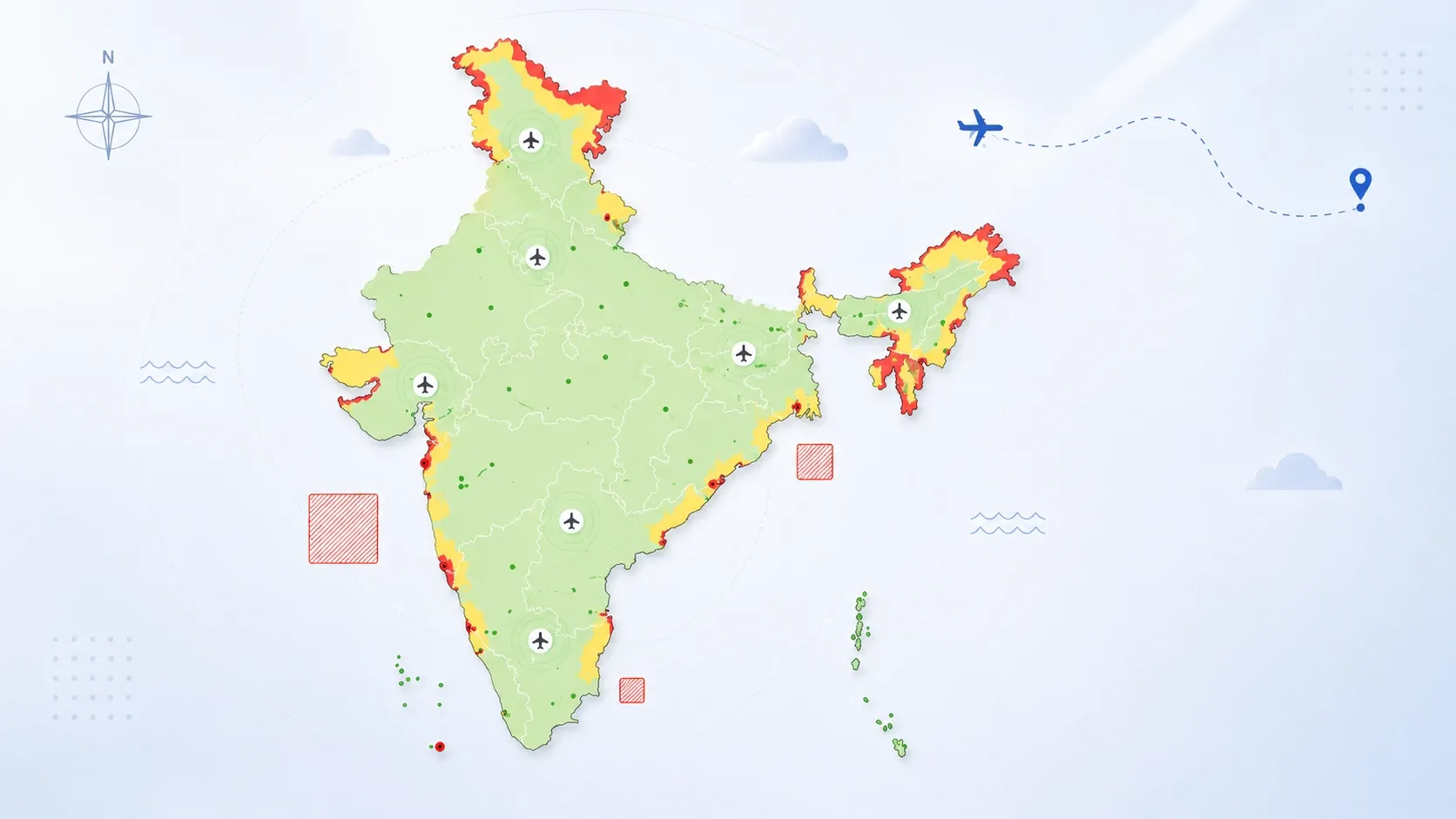
Operational rules sit in Part V of Drone Rules 2021, across Rules 24 to 31. Rule 24 directs the publication of an interactive airspace map that divides Indian airspace into three operational categories: Red, Yellow, and Green drone zones (DGCA Airspace Map Notification, 24 September 2021). The map sits on the DigitalSky platform and is updated by authorised entities from time to time.
Green Zones permit operations up to 120 metres or 400 feet above ground level without prior air traffic clearance beyond standard DigitalSky permissions. Nearly 90% of Indian airspace fell into the Green Zone after the September 2021 map release (Press Information Bureau, 24 September 2021). Yellow Zones operate as controlled airspace buffers - generally 8 km to 12 km from airport perimeters - and require coordination with air traffic control before flight. Red Zones prohibit civilian drone operations without explicit Central Government approval, and apply around military facilities, strategic infrastructure, border areas, and protected national sites.
State governments and law enforcement agencies retain authority to declare temporary Red Zones under Rule 25. The Odisha Government extended the Jagannath Temple Red Zone designation until September 2028 because of security concerns linked to large public gatherings, and Delhi Police imposed a blanket drone restriction during Republic Day security operations in January 2025 (Odisha Government Notification, 2024; Delhi Police Advisory, January 2025). Operators must verify zone status on the airspace zone map before every flight.
Rule 27 prohibits the carriage of arms, ammunition, explosives, military stores, and other restricted items by drones. Flying in a prohibited or restricted zone, and carriage of restricted articles, are both treated as cognizable and non-compoundable offences under the Drone Rules 2021 framework. Rule 29 requires the operator to maintain direct visual line of sight during operations unless a specific BVLOS approval is granted.
Accident reporting falls under Part V as well. The remote pilot must report any drone-related accident through the DigitalSky platform within 48 hours of the incident. This reporting obligation matters most for enterprise operators running multiple missions across infrastructure inspection, utility monitoring, and industrial survey deployments, where a delayed report converts a recoverable incident into an enforcement event.
The Rule 42 R&D and prototype carve-out most operators miss
Rule 42 of Drone Rules 2021 contains one of the most operationally important provisions in the entire statute, and one of the least discussed across the current public SERP (Ikigai Law analysis, September 2025). The Rule grants recognised research and development entities, educational institutions, start-ups, and authorised testing organisations an exemption from type certification, UIN issuance, prior permission, and Remote Pilot Certificate requirements when operating prototype drones for research purposes.
The carve-out is not unconditional. Operations must take place within the premises of the R&D entity in a Green Zone, or in an open area within a Green Zone that is under the entity's control. Restricted airspace remains restricted, and security agency authority over Red Zones is preserved regardless of R&D status. The exemption is operational, not constitutional - it removes specific procedural obligations but does not override the broader safety architecture of the statute.
The carve-out matters for three reader segments that the rest of the SERP largely ignores. Defence integrators developing prototype unmanned systems use the Rule 42 pathway during iterative testing before formal type certification. Academic institutions running drone research programmes use it to fly prototype platforms without the cost burden of full UIN issuance for every variant. Indian start-ups in the DPIIT-recognised pipeline use it to prove airframe and software designs before committing to QCI testing.
The strategic importance of Rule 42 has increased after the draft Civil Drone Bill 2025 entered consultation. Legal analyses of the Bill have flagged that the draft does not preserve a clear R&D carve-out equivalent to Rule 42, although the concept of a "prototype UAS" is retained without operational clarity (Mondaq legal analysis, 29 September 2025). Operators relying on the Rule 42 pathway should track the consultation outcome closely, because the Drone Rules 2021 R&D exemption may not survive into the replacement statute.
The carve-out also intersects with the wider question of whether prototype drones used in R&D should still carry minimum identification, and the Observer Research Foundation has argued that even prototypes should be assigned a UIN to support accident attribution (Observer Research Foundation, July 2022). The Drone Rules 2021 framework currently does not require it, and the gap is one of the open policy questions the Civil Drone Bill 2025 may address.
Third-party insurance under Rule 44
Rule 44 of Drone Rules 2021 makes third-party insurance mandatory for every drone operator, applying the provisions of the Motor Vehicles Act 1988 concerning third-party insurance to drones (Ministry of Civil Aviation, 25 August 2021). Operators flying without insurance breach the statute, even when the drone is correctly registered and the pilot correctly certificated.
The insurance products themselves are regulated by the Insurance Regulatory and Development Authority of India. IRDAI-regulated drone insurance policies cover third-party bodily injury, third-party property damage, and in many cases the hull value of the drone itself. The premium scales with drone category, mission profile, payload weight, and operational geography. A Micro-category survey drone carries a different risk profile, and a different premium, from a Medium-category agricultural sprayer.
The reason Rule 44 matters operationally is that insurance is the layer most commonly missed in compliance audits. Operators secure UIN registration and an RPC, fly Green Zone missions for months, and discover the gap only when an accident triggers a third-party claim. At that point, the claim sits outside the IRDAI-regulated policy framework, and personal liability attaches to the operator rather than the insurer.
Enterprise procurement teams running survey, infrastructure inspection, or logistics missions now treat drone insurance in India as a precondition for contract award. State agencies awarding drone-mapping contracts under SVAMITVA, public-sector procurement for line-survey work, and private infrastructure operators contracting drone inspection services all routinely require proof of policy before mission start.
The Rule 44 framework will be reinforced rather than replaced by the Civil Drone Bill 2025. The draft Bill introduces a broader no-fault compensation regime with fixed compensation amounts under tribunal jurisdiction, and broadens the definition of accident to include property damage in addition to fatal or serious injury (Mondaq legal analysis, 29 September 2025). Operators who already comply with Rule 44 today will face a lower transition cost when the Bill enters force. Operators who do not will face a sharper compliance shock.
Penalties, detention, and the BVA 2024 anchor
Rule 50 of Drone Rules 2021 governs penalties. The Director General, or an officer authorised by the Government, may levy the maximum fine under Drone Rules 2021 of ₹1,00,000 against any person found to have violated the Rules, after giving the person an opportunity of being heard and recording the reasons in writing (Ministry of Civil Aviation, 25 August 2021).
The ₹1 lakh ceiling sits within the Drone Rules 2021 framework itself. Penalties for breaches of other laws — the Indian Penal Code provisions on privacy, the Information Technology Act provisions on data protection, the Arms Act provisions on carriage of prohibited articles — apply independently and can run substantially higher. First-offence non-registration cases commonly attract penalties near ₹25,000, while Red Zone violations reach the ₹1 lakh ceiling depending on operational risk.
The penalty anchor under Drone Rules 2021 originally referred to Section 10A of the Aircraft Act 1934. The Aircraft Act 1934 was repealed by the Bharatiya Vayuyan Adhiniyam 2024, which entered force on 1 January 2025 (Ministry of Law and Justice, 29 December 2024; Ministry of Civil Aviation, 1 January 2025). The BVA 2024 carried forward the civil-aviation penalty framework into a new statutory architecture, and references to Section 10A of the Aircraft Act in older compliance documentation now read against the BVA 2024 equivalent provision. Operators should confirm the current section reference with counsel when citing penalty authority in contracts, audit responses, or procurement filings, because the BVA 2024 section mapping is still settling across departmental usage.
Flying in a prohibited or restricted zone is treated as a cognizable and non-compoundable offence under the framework. The cognizable classification matters because it permits arrest without a magistrate's order and triggers police investigation authority. The draft Civil Drone Bill 2025 expands the cognizable-offence list and introduces imprisonment of up to three years for severe airspace violations, alongside drone detention powers for up to seven days on suspicion of violation (Ministry of Civil Aviation Consultation Draft, 16 September 2025).
The compensation framework also expands under the Bill, with no-fault compensation of ₹2.5 lakh for death and ₹1 lakh for grievous injury under Motor Accident Claims Tribunal jurisdiction. Operators planning fleet operations beyond mid-2026 should model the Civil Drone Bill 2025 penalty and compensation expansion into commercial pricing and insurance procurement now, rather than after enactment.
What the 2022, 2023, and pending 2025 amendments changed
Drone Rules 2021 did not remain static after notification in August 2021. The framework changed through multiple amendment rounds that altered pilot certification terminology, identity-document requirements, operational permissions, and the platform structure supporting registration and airspace compliance.
The Drone Amendment Rules 2022 replaced the earlier Remote Pilot Licence terminology with the Remote Pilot Certificate framework now used across Indian civilian unmanned aviation (Ministry of Civil Aviation, 11 February 2022). The amendment extended certificate validity to ten years and simplified eligibility pathways for certified pilots trained through approved Remote Pilot Training Organisations. The change reduced administrative renewal frequency and aligned the pilot-certification structure with the government's broader drone liberalisation strategy. The 2022 amendment also extended the registration deadline for owners of pre-existing drones manufactured or imported on or before 30 November 2021 to 31 March 2022, closing the legacy onboarding gap.
The Drone Amendment Rules 2023 focused more heavily on operational friction. Identity-document requirements under registration workflows expanded beyond the earlier passport-led structure to include Aadhaar, Permanent Account Number, Driving Licence, Voter ID, and other government-recognised documents (Ministry of Civil Aviation, 2023). The expansion materially reduced onboarding delays for enterprise operators managing distributed pilot teams outside metropolitan centres. The same period also saw procedural easing around component imports and selected night operations linked to low-risk flight categories, which the SERP largely missed.
Another structural change arrived outside the text of the Rules themselves. The July 2025 platform split separated operational responsibilities between eGCA and DigitalSky. Registration management, type certification workflows, and Remote Pilot Certificate administration moved into eGCA, while DigitalSky retained airspace permissions and NPNT validation functions (DGCA Public Notice, 3 July 2025). Operators now navigate two connected digital systems rather than one consolidated platform, and a compliance error often begins with submitting the right form to the wrong platform.
The pending Civil Drone Bill 2025 introduces the possibility of a deeper statutory restructuring. The consultation draft proposes a standalone legislation governing civilian UAS below 500 kg, with revised institutional coordination, expanded enforcement powers, broader insurance and compensation obligations, and tighter type certification requirements under Section 7 of the Bill (Ministry of Civil Aviation Consultation Draft, 16 September 2025). Drone Rules 2021 remain operationally active until the Government notifies replacement rules under the new Act, which means operators face a transition period of indeterminate length where both frameworks coexist. The Civil Drone Bill 2025 reference covers the full divergence in detail.
Where AI and compliance automation help operators stay inside the rules
Drone Rules 2021 created a compliance environment that depends on continuous digital validation rather than one-time licensing. That shift has expanded the role of AI-assisted compliance systems across mission planning, fleet management, and audit workflows, particularly for enterprise operators running survey, inspection, or logistics fleets across multiple states.
The clearest application sits inside mission planning. AI-assisted flight-planning platforms can cross-check proposed routes against Green, Yellow, and Red Zone boundaries published through the DigitalSky airspace map before a permission request is submitted to the platform. The systems flag altitude conflicts against the 120 metre ceiling, surface temporary restrictions declared under Rule 25, and identify restricted-airspace overlaps before flight approval workflows begin. Operators using these tools see fewer rejected applications and lower enforcement exposure across high-volume mission programmes.
A second application covers NPNT permission handling. Automated compliance systems can validate digitally signed permission artefacts against onboard NPNT modules before takeoff. If the permission window has expired, or if the permission does not match the registered UIN, the system blocks mission activation. This is precisely the workflow Drone Rules 2021 envisaged but did not automate at notification.
Fleet-level compliance management has also become more data-intensive. Enterprise operators managing agricultural missions, infrastructure inspection programmes, or industrial surveys must track UIN records, type certificate expiries, Remote Pilot Certificate validity, insurance renewals, and mission histories simultaneously. AI-assisted compliance dashboards surface upcoming expiries and documentation gaps before they convert into enforcement events during audits.
Accident reporting workflows under Part V of Drone Rules 2021 are also moving toward automation. Operators required to file reports within 48 hours can use systems that parse flight logs, telemetry records, and onboard sensor data to generate structured incident reports aligned with DGCA reporting requirements. The reduction in manual reporting burden matters most for fleet operators running dozens of missions per week, where the cost of manual post-incident drafting becomes the primary compliance friction.
Document-handling automation is the fifth application. Large-language-model-assisted document review can extract compliance fields from manufacturer type certificates, DGFT import notifications, and WPC equipment type approvals, and cross-check them against Drone Rules 2021 requirements before registration paperwork is submitted to eGCA. The work that previously consumed days of legal-and-procurement coordination compresses into hours.
The next inflection point sits inside the Civil Drone Bill 2025 transition. Operators planning capacity beyond mid-2026 should track the consultation outcome and run the Drone Rules 2021 workflow in parallel until replacement rules enter force. The framework that survives that transition will favour operators who already treat compliance as a continuously monitored digital pipeline, not as a one-time licensing event.