The drone vs missile cost gap is no longer a foreign-policy briefing point for the Indian defence community. Operation Sindoor (7 to 10 May 2025) forced Indian air defence to expend high-cost interceptors against adversary swarms in a single window. The FY27 capital outlay of ₹2.19 lakh crore (Ministry of Defence, February 2026) responded with indigenous counter-UAS allocations. This piece reads the arithmetic through a cost-mass-counter triad, drawing on Press Information Bureau, Ministry of Defence, and DRDO sources.
Reading the arithmetic behind a 100-to-1 cost ratio
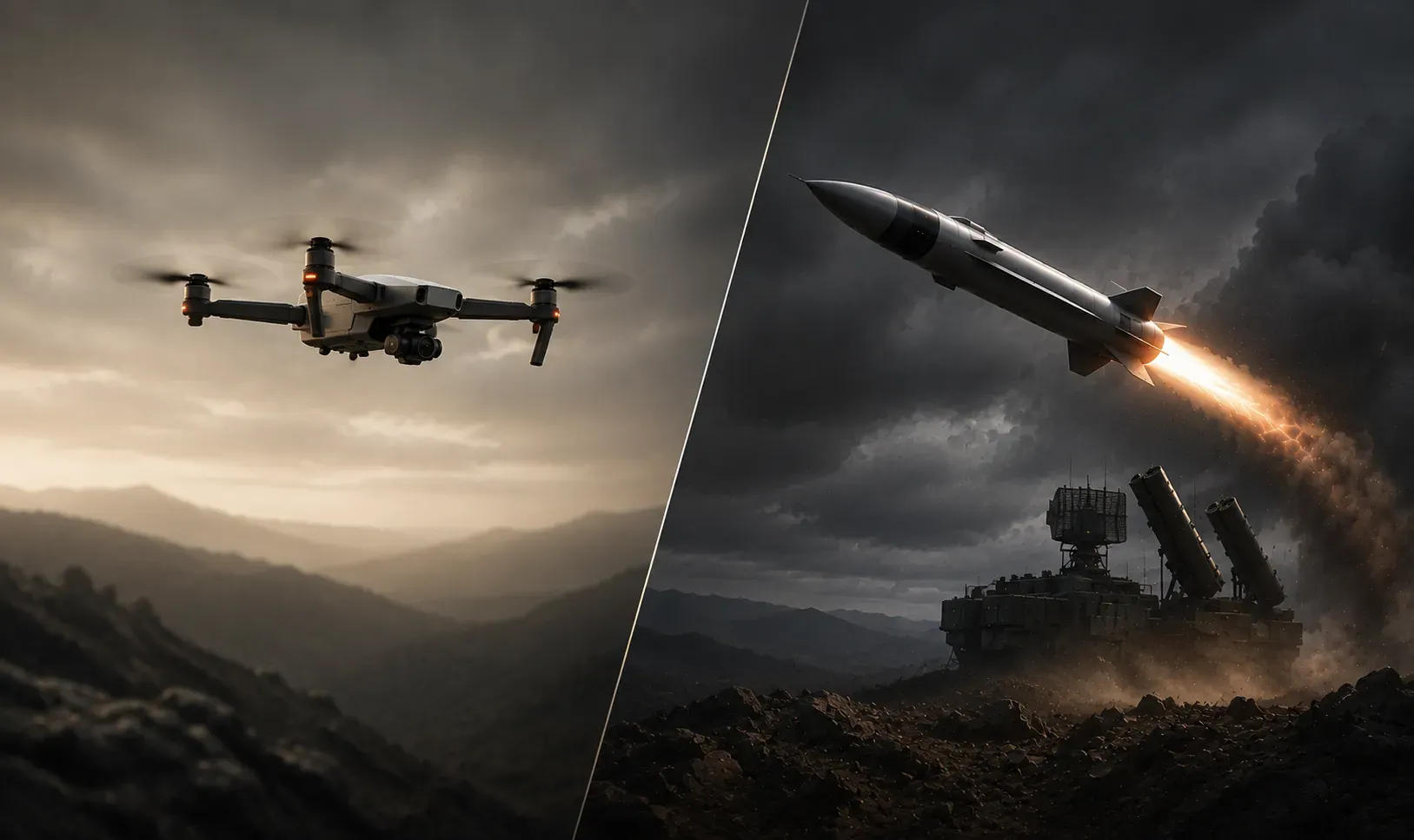
The phrase asymmetric drone warfare describes a battlefield condition where the attacking platform costs far less than the defending interceptor. In some engagement classes, the ratio reaches 100-to-1. A one-way attack drone priced below $20,000 can force the launch of an interceptor missile. That round costs approximately $3.7 million (International Institute for Strategic Studies, 2025).
That arithmetic reshapes procurement because air-defence systems were historically optimised for scarcity. Traditional doctrine assumed a limited number of incoming aircraft or missiles. Drone swarms reverse that assumption through mass production and expendability.
The attacker no longer needs a sophisticated platform. The attacker only needs enough low-cost systems to saturate radar tracking, electronic warfare bandwidth, or missile inventories. The economics become sharper during sustained engagements.
If a defending force launches expensive interceptors against repeated low-cost targets over multiple nights, inventory depletion becomes as important as tactical success. That dynamic has already appeared in Red Sea shipping protection operations and in Eastern European conflict analysis (RUSI, 2023).
India now faces the same arithmetic along both military and border-security corridors. The Border Security Force reported intercepting 125 cross-border drones during 2024 operations along the western frontier (Border Security Force Annual Report, 2024). Those incidents were not high-end strategic attacks. They were persistence operations built around low-cost aerial systems.
The cost-mass-counter triad explains why this matters. Cost measures the attacker-to-defender ratio. Mass measures the volume of systems appearing simultaneously. Counter measures whether the defending architecture can neutralise those systems without exhausting budgets or inventories.
That is the framework Indian procurement now operates inside. The cost ratio drone interceptor question sits at the top of every air-defence acquisition file the Ministry of Defence has opened this fiscal year.
Pricing the attacker side, from Switchblade to Shahed
The cost of loitering munition systems varies by range, payload, and navigation architecture.2 Public reporting shows how low the entry point has become relative to missile-defence systems. The Congressional Research Service estimated the tactical Switchblade 300 class at approximately $6,000 per unit. Larger systems comparable to the Switchblade 600 class reach approximately $70,000 to $80,000 (Congressional Research Service, 2024).
The Shahed-class one-way attack drone family is used internationally as a benchmark for low-cost saturation warfare. It has been estimated between $20,000 and $50,000 depending on payload and production scale (Royal United Services Institute, 2023). That figure matters because it demonstrates how much operational pressure a low-cost airframe can impose on conventional air-defence architecture.
How much does a drone cost vs a missile, in the cost classes deployed today? Public reporting puts the figures inside a narrow range that the table below summarises.
Platform category | Estimated unit cost | Operational role | Source |
|---|---|---|---|
Tactical loitering munition class | Approximately $6,000 | Short-range strike | Congressional Research Service, 2024 |
Medium tactical loitering munition class | $70,000 to $80,000 | Anti-armour strike | Congressional Research Service, 2024 |
One-way attack drone class | $20,000 to $50,000 | Saturation attack | Royal United Services Institute, 2023 |
Long-range cruise missile class | $1.4 million to $2.5 million | Precision strike | Congressional Research Service, 2024 |
Patriot interceptor class | Approximately $3.7 million | Air-defence interception | International Institute for Strategic Studies, 2025 |
The operational consequence is straightforward, and a defending force can destroy every incoming drone and still lose the economic exchange ratio. That is why Indian doctrine is shifting toward layered counters rather than missile-only interception.
The control method also matters for the cost calculation. A live-piloted FPV airframe carries different sensor and bandwidth requirements than an autonomous one-way attack drone, and the defender's interception cost moves accordingly.
Costing the defender side, from MANPADS to Patriot
Interceptor missile cost varies sharply by engagement range and target class. Portable air-defence systems remain cheaper than strategic interceptors. Even lower-tier interception becomes expensive when drone volumes increase. The challenge is not a single engagement, it is sustained repetition.
Strategic missile-defence systems were designed to defeat aircraft, cruise missiles, and ballistic threats carrying high destructive potential. When those systems engage low-cost drones, the defender spends disproportionate resources protecting airspace. The Patriot missile vs drone cost comparison illustrates the issue. The interceptor round may cost nearly 200 times more than the incoming aerial platform (International Institute for Strategic Studies, 2025).
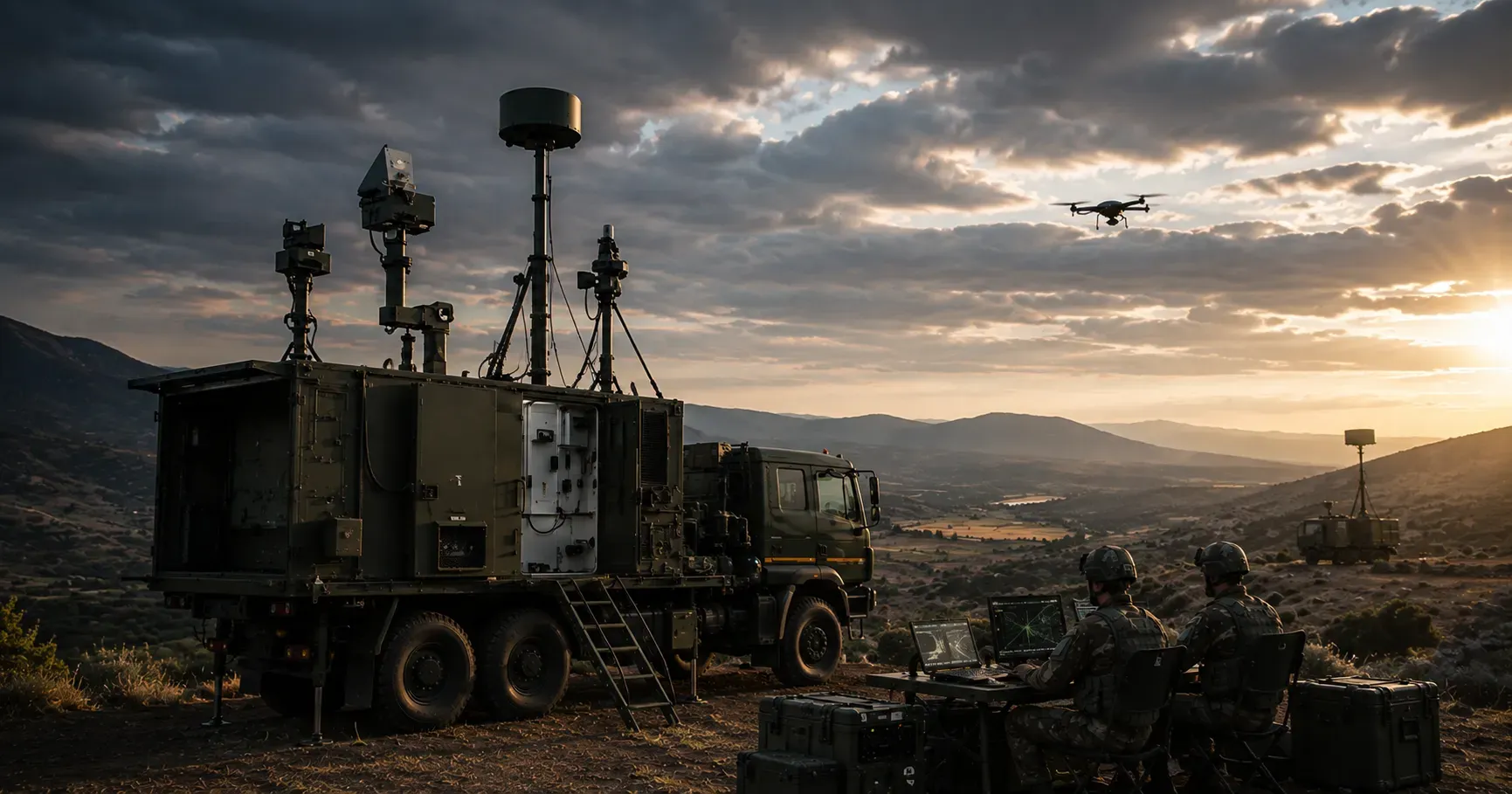
India's doctrine is therefore moving toward layered engagement architecture. The first layer uses radar and electro-optical tracking. The second layer applies jamming and spoofing.
The third layer uses cheaper kinetic or directed-energy engagement where possible. Missile interception becomes the final layer rather than the first response.
DRDO's counter-UAS work reflects that transition. Directed-energy systems demonstrated drone engagement capability at ranges up to two kilometres during public trials. The SAKSHAM counter UAS grid moved into the approved deployment pipeline during 2025 (Defence Research and Development Organisation, 2025 to 2026). Those systems reduce interception cost by replacing missile expenditure with electronic warfare and energy-based engagement.
This also explains why the Indian Army issued a February 2026 RFI for indigenous drone-interceptor systems. The architecture integrates radar sensors, command stations, and interceptor drones into a single operational chain (Indian Army RFI, February 2026). The objective is not merely interception, it is sustainable interception economics. The platform taxonomy on both sides of the engagement, fixed-wing, rotary, hybrid VTOL, complicates defender-side procurement planning further still.
What Operation Sindoor cost Indian air defence in one window
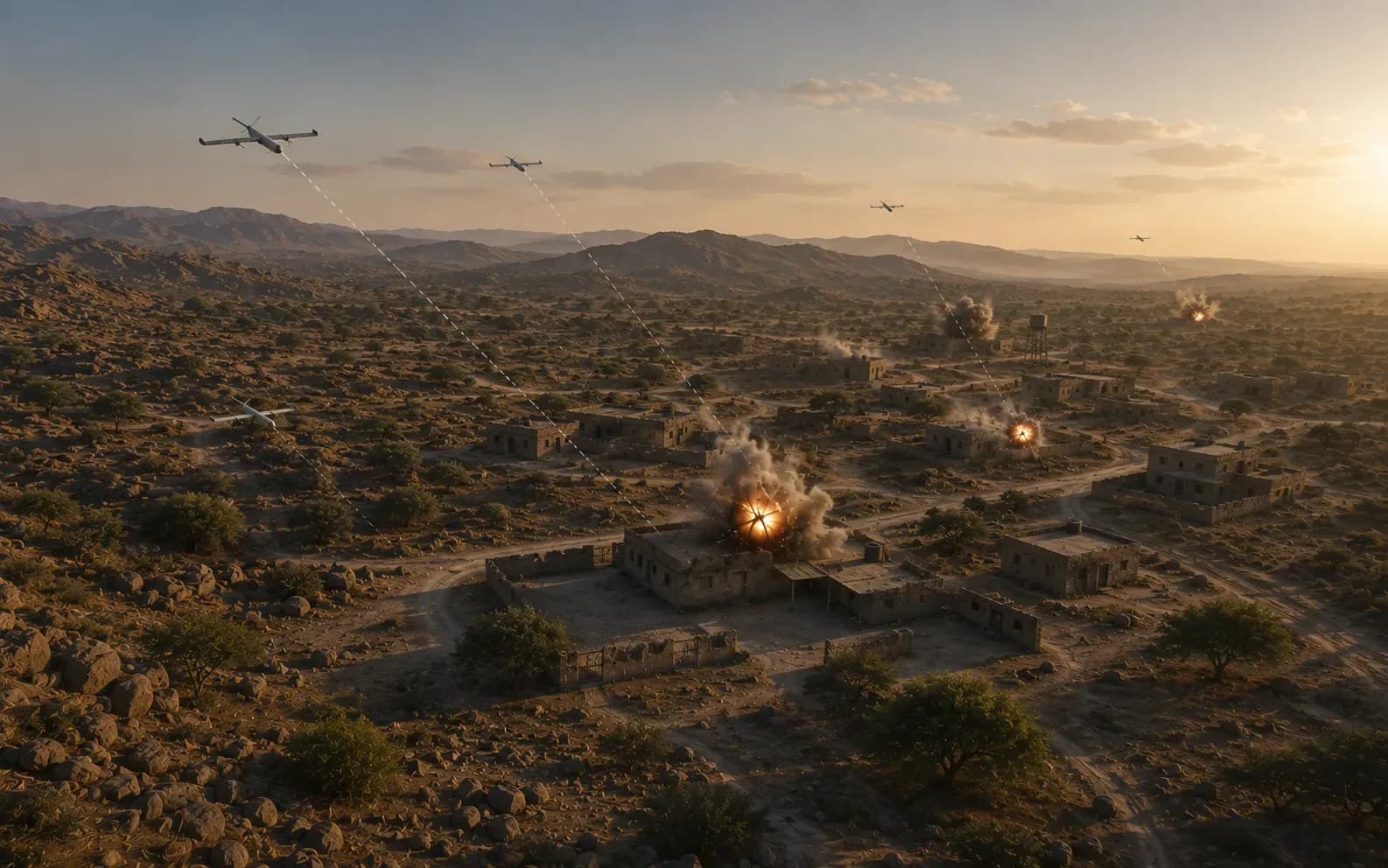
Operation Sindoor provided the first India-anchored demonstration of large-scale drone-versus-interceptor economics. According to the Press Information Bureau briefing issued on 14 May 2025, indigenous loitering munitions participated operationally during the mission window. Indian air-defence systems operated in a layered engagement configuration (Press Information Bureau, 14 May 2025).
Operation Sindoor missile cost data is documented in the Observer Research Foundation analysis published in December 2025. The Observer Research Foundation estimated that approximately 30 Harop loitering munitions were consumed during the operation. Six SCALP-class cruise missiles and multiple BrahMos rounds were also expended (Observer Research Foundation, 10 December 2025). Public reporting estimated SCALP-class missile expenditure at approximately $1 million per round (Observer Research Foundation, 10 December 2025).
The operational importance was not the absolute cost figure, it was the compression of expenditure into a short tactical window. Indian planners confronted a scenario where multiple aerial engagement layers operated simultaneously across compressed engagement windows. That creates sustained inventory pressure even when tactical outcomes remain favourable.
Operation Sindoor also exposed the overlap between military air-defence doctrine and civil airspace governance. Counter-UAS systems now operate inside environments shaped by the Bharatiya Vayuyan Adhiniyam 2024 and the DGCA airspace map architecture governing civilian drone operations. Military counter-drone deployments and civil airspace regulation are beginning to intersect operationally.
The engagement also accelerated procurement urgency. The Ministry of Defence Year-End Review 2025 confirmed that Indian defence production crossed ₹1.5 lakh crore (Press Information Bureau, December 2025). Of 193 contracts signed worth ₹2.09 lakh crore, 177 favoured domestic industry participation. Drone interception, electronic warfare, and low-cost air defence now sit inside that domestic procurement wave.
Mass becomes the doctrine, not the exception
The Indian Army drone interceptor procurement cycle indicates that volume matters as much as sophistication. An 8,000-to-10,000 drones-per-corps target changes logistics, training, maintenance, and electronic warfare planning simultaneously (Indian Army, Chief of Army Staff briefing, 2026). That scale requires lower-cost interception methods because missile inventories alone cannot sustain repeated mass engagements economically.
This is the drone swarm defence India planners are now budgeting for. The restructuring blueprint embeds dedicated drone platoons of 30 to 70 personnel inside infantry units. Two restructuring formations, the Bhairav Light Commando Battalions and the Rudra Brigades, fuse mechanised infantry, special forces, artillery, and unmanned aerial systems for multi-domain operations.
The doctrinal shift is structural, not tactical. Mass at corps level reorganises how the Army plans procurement cycles, training calendars, and replacement inventories. Each unit now operates with the assumption that drones are consumable, not preserved capital.
This transition is visible in how India discusses military drone procurement. The language has shifted from isolated platform acquisition toward networked grids, swarm management, electronic warfare layering, and domestic manufacturing resilience.
Low-cost aerial systems are no longer auxiliary assets. They are becoming the mass layer around which larger procurement decisions are organised. The doctrine and the budget are now aligned on the same question. Can India produce and replace at scale faster than an adversary can saturate the defender's engagement capacity?
Building the indigenous counter-UAS layer
India's response to swarm warfare is moving toward distributed, indigenous counter-UAS layers rather than imported missile-heavy architecture alone. The Integrated Counter-Unmanned Aerial Systems Grid combines detection, jamming, engagement, and recovery into a layered framework. The framework is intended for prolonged operations (Defence Research and Development Organisation, 2025 to 2026). Three procurement signals stand out across this architecture.
First, the Indian Army's February 2026 interceptor RFI emphasised indigenous integration. The architecture required radar systems, control stations, and interceptor drones operating together inside a domestic operational chain (Indian Army RFI, February 2026). The system specification called for tracking of at least 20 targets simultaneously across 360 degrees. Detection ranges were set at four kilometres for micro-drones and ten kilometres for larger platforms.
Second, directed-energy research has moved from laboratory demonstration toward operational evaluation. DRDO's laser-based systems target lower-cost engagement against small aerial threats. That reduces reliance on expensive interceptor missiles during high-volume attacks (Defence Research and Development Organisation, 2025 to 2026). The DRDO counter-drone laser work is the technical anchor for the cost-ratio reset India's planners are betting on.
Third, procurement policy now aligns with industrial strategy. The FY27 defence budget drones allocation supports the indigenisation push. Domestic manufacturing targets connect counter-UAS expansion to broader Ministry of Defence acquisition objectives (Ministry of Defence, February 2026).
Procurement categories favour modular sensors, electronic warfare payloads, and software-defined engagement systems rather than isolated standalone platforms. The procurement cycle is now measuring affordability per engagement hour, not the technical performance of a single missile battery in isolation.
Mapping the FY27 budget as a signal
The FY27 defence allocation signals that India has accepted drone saturation warfare as a structural procurement category rather than a temporary tactical anomaly. The ₹2.19 lakh crore capital outlay and ₹1.85 lakh crore acquisition allocation create fiscal room for layered interceptor systems and indigenous sensors. Counter-UAS expansion sits inside that envelope (Ministry of Defence, February 2026). The capital head rose 17.62 percent over the FY26 revised estimate.
The numbers signal three procurement priorities at once. Domestic manufacturing capacity expands inside the ₹1.85 lakh crore acquisition envelope. Counter-UAS systems move from pilot procurement to scaled induction. The drone swarm defence India is building now has a budget line, not only a doctrine paragraph.
The Ministry of Defence Year-End Review 2025 anchors the industrial side of the same signal. Of the 193 contracts signed in 2025, 177 went to domestic industry (Press Information Bureau, December 2025). That ratio is the procurement system reorganising itself around indigenous supply, including for counter-UAS and drone-interceptor categories.
The next procurement cycle will test whether indigenous counter-drone systems can keep the defender-side cost curve below the threshold where sustained interception remains financially sustainable. The Bharatiya Vayuyan Adhiniyam 2024 governs the civil airspace inside which much of this hardware will operate. The regulatory architecture is converging with the procurement architecture for the first time at this scale.
India's next air-defence doctrine will be judged less by the volume of threats it destroys than by how affordably it can keep destroying them over time.