India's drone industry is being reorganised around a single question: who makes the parts. The Drone Shakti Mission was announced on 2 January 2026 by Principal Scientific Advisor Ajay Kumar Sood. It is the third instrument in India's drone manufacturing framework (Press Information Bureau via PTI, 2 January 2026). It sits alongside the 2022 Drone Shakti programme and the 2021 PLI scheme for drones. This analysis maps the mission's allocation, institutional structure, component priorities, the Operation Sindoor catalyst, and what it changes for manufacturers and defence procurement.
Drone Shakti Mission inside India's three-instrument framework
The Drone Shakti Mission must be read against two earlier policy moves it does not replace. The first is the original Drone Shakti, announced by Finance Minister Nirmala Sitharaman in the Union Budget 2022-23 (Budget Speech, 1 February 2022). That instrument promoted Drone-as-a-Service models and ITI-based pilot skilling. It did not fund manufacturing directly.
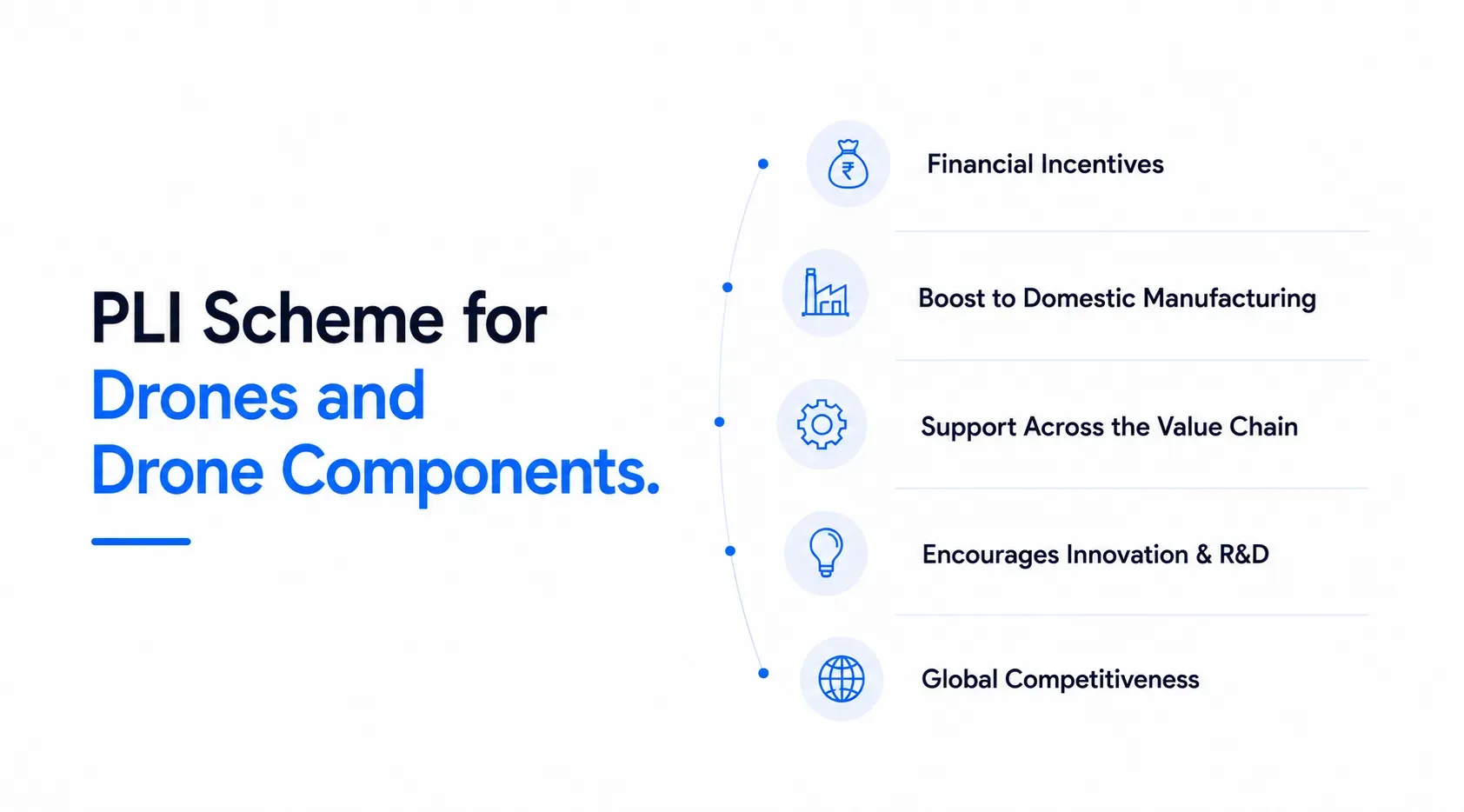
The second is the Production-Linked Incentive Scheme for Drones and Drone Components, notified by the Ministry of Civil Aviation on 30 September 2021. The PLI scheme committed ₹120 crore over three financial years, with an incentive of 20 percent on value addition. Twenty-three beneficiaries were approved across drone and component manufacturers, with lower eligibility thresholds for MSMEs (Ministry of Civil Aviation, 30 September 2021).
The third instrument is the Drone Shakti Mission itself. Announced on 2 January 2026, the mission carries twin objectives: incentivise drone component manufacturing in India, and fund research and development for high-end drones. It will be housed under the Anusandhan National Research Foundation and delivered through the Ministry of Civil Aviation, pending Cabinet approval (PSA briefing, 2 January 2026). The disambiguation matters because public commentary tends to conflate all three.
Instrument | Announced | Allocation | Primary focus | Owning body |
|---|---|---|---|---|
Drone Shakti (Budget 2022) | 1 February 2022 | Not specified separately | DrAAS, skilling, ITI courses | Ministry of Civil Aviation |
PLI Scheme for Drones and Drone Components | 30 September 2021 | ₹120 crore over three years | Output-linked incentive (20 percent value addition) | Ministry of Civil Aviation |
Drone Shakti Mission | 2 January 2026 | ₹1,600 to 1,800 crore over five years (proposed) | Component manufacturing and high-end drone R&D | ANRF, delivered through MoCA |
Budget 2026 manufacturing scheme | 22 December 2025 reportage | ~₹10,000 crore over five years (proposed) | Capital subsidy and output incentive (10 to 15 percent each) | Ministry of Civil Aviation |
PLI 2.0 | 30 January 2026 reportage | Over ₹1,000 crore (proposed) | Expanded scope including drone leasing and UAS software | Ministry of Civil Aviation |
This places the Drone Shakti Mission inside India's broader Make in India drones framework as the third instrument, not as a replacement for the first two.
What the Drone Shakti Mission actually does
The mission's twin objectives are operational, not aspirational. The first is to incentivise the domestic manufacture of drone components. The goal is to move Indian manufacturers from assembly of imported parts toward genuine production. The second is to support R&D for high-end unmanned systems through the ANRF research culture envelope (PSA briefing, 2 January 2026).
The proposed allocation is ₹1,600 to 1,800 crore over five years. The scheme is expected to launch in FY27 and target private Indian companies. The Ministry of Civil Aviation is finalising details before Cabinet consideration. The drone manufacturing incentive scheme structure mirrors the PLI logic across India's 14 sectoral incentive schemes. Those schemes together carry a cumulative outlay of ₹1.97 trillion (Mint, 17 March 2026, citing MoCA officials).
A separate but adjacent instrument is the Budget 2026 manufacturing-focused incentive scheme. The proposal outlines a five-year structure aligned with the 16th Finance Commission period, with a potential fiscal commitment of around ₹10,000 crore. The finance ministry has cleared the proposal in principle and is expected to sanction the full five-year spending upfront (Outlook Business citing MoneyControl, 22 December 2025).
The two figures should not be confused. The ₹1,600 to 1,800 crore is the Mission's own envelope under MoCA and ANRF. The ₹10,000 crore is the larger Budget 2026 scheme. It may absorb the Mission, sit parallel to it, or fund it as one tier inside a wider structure. The final architecture will be visible only when both notifications are gazetted.
The policy shift is already clear. PLI 1.0 rewards output. The Drone Shakti Mission rewards component capacity. The Budget 2026 scheme rewards capital investment ahead of output. India is running three distinct incentive logics in parallel.
Operation Sindoor and the drone component dependency lesson
Operation Sindoor in May 2025 changed how Indian drone manufacturing is assessed. Before the operation, the indigenous ecosystem was evaluated through procurement announcements, funding schemes, and prototype demonstrations. After the operation, the assessment shifted to operational capability under live conditions (Press Information Bureau, 14 May 2025).
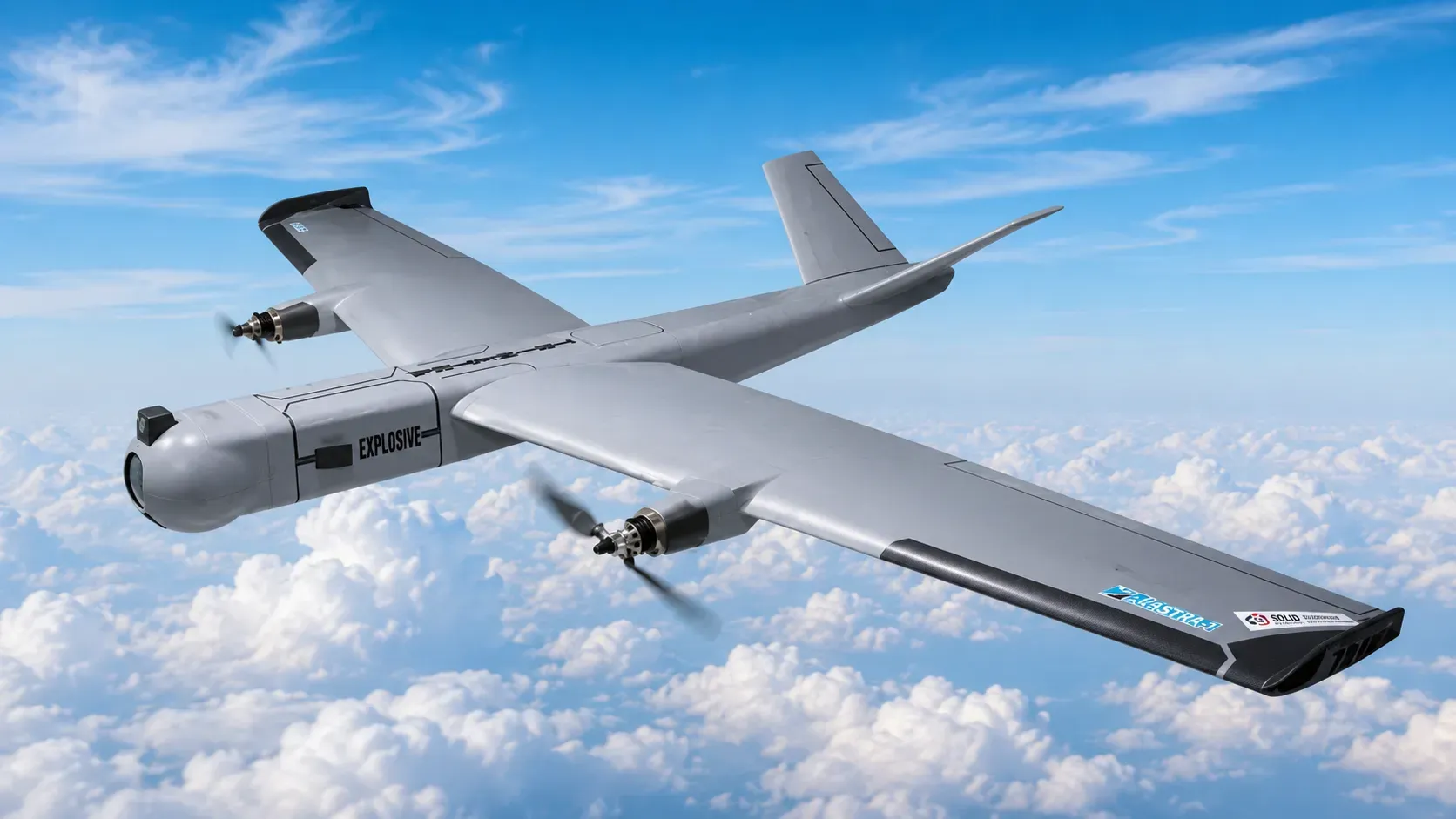
The operation combat-validated indigenous platforms across ISR, loitering munition, and counter-UAS roles. It also exposed the limits of platform-only sovereignty. A number of systems combat-validated during the operation still relied on imported motors, sensors, and propulsion modules. The lesson accelerated policy urgency on component-level indigenisation. For the doctrine that underpinned these platforms, see the May 2025 Operation Sindoor combat validation and the loitering munition doctrine validated during Sindoor.
The Raksha Mantri made the framing explicit on 19 March 2026 at the National Defence Industries Conclave. India must work in mission mode to emerge as a global hub of indigenous drone manufacturing, with self-reliance extending from the product level to the component level. Five Department of Defence Production publications were released the same day, including SAMARTHYA 2026, the self-reliance roadmap for defence manufacturing (Press Information Bureau, 19 March 2026).
The procurement side has already moved. The Indian Armed Forces are establishing a stringent system to check Chinese component signatures inside drones purchased from Indian manufacturers. The government has cancelled past contracts after Chinese parts were found inside delivered platforms (Deccan Herald, 2 January 2026). The PSA's 2 January 2026 announcement of the Drone Shakti Mission landed inside this same policy arc.
Platform sovereignty without subsystem sovereignty is rented capability. The Drone Shakti Mission is the policy instrument designed to convert rented capability into owned capability.
The ANRF and MoCA delivery architecture
The institutional split is the least-reported part of the mission. The Drone Shakti Mission sits under the Anusandhan National Research Foundation, the body created to foster research, development, and innovation across Indian science and technology. Operational delivery, including the manufacturing incentive layer, runs through the Ministry of Civil Aviation (PSA briefing, 2 January 2026).
The split matters. ANRF anchors the R&D layer, which funds the high-end drone development pathway, including autonomy stacks, propulsion, and advanced sensors. MoCA anchors the manufacturing incentive layer. That layer runs through the same notification machinery that delivers the PLI scheme and operates the Drone Rules 2021 framework that MoCA administers.
The umbrella envelope is larger still. The Research Development and Innovation Fund of ₹1 lakh crore provides the broader fiscal context for the Mission. The fund was announced as part of direct government support to private-sector R&D (Press Information Bureau, 2 January 2026, citing Science and Technology Minister Jitendra Singh).
Cabinet approval is pending as of the latest reportage cycle. The Mission moves to the Union Cabinet after finance ministry sign-off. Once notified, the scheme is expected to launch in FY27. That gives manufacturers a measurable window to align capacity investments with the incentive timeline.
The drone component import map from China
The Mission targets a specific dependency map. Indian drone manufacturers continue to import motors, sensors including inertial measurement units, batteries covering LiPo and Li-ion cells, propellers, flight controllers, electronic speed controllers, semiconductors, and rare-earth magnets. China dominates the global supply chain for the affordable segment of every one of these categories (Deccan Herald, 2 January 2026).
The dependency has a number. Fully built drone imports are restricted. Indian manufacturers still depend on imported sensors, avionics, and propulsion systems. Overall import reliance is estimated between 50 and 60 percent of total drone value (Outlook Business, 22 December 2025). The Drone Shakti Mission and PLI 2.0 are jointly designed to reverse that ratio toward roughly 30 percent imported content over the scheme horizon (Whalesbook, 30 January 2026).
The Drone Shakti Mission incentive tier proposes a 50 to 60 percent domestic value-addition threshold for eligibility. Manufacturers below the threshold do not qualify. This is a deliberate filter. The threshold is designed to push capital away from assembly operations and toward true production of the drone categories that depend on these subsystems.
The four highest-priority categories are motors, sensors, batteries, and flight controllers. These are where Chinese supply chain dominance carries the highest single-source risk. The Mission is designed to fund Indian production depth in exactly these four categories first.
How PLI 1.0 and PLI 2.0 integrate
The Drone Shakti Mission does not replace the PLI scheme. It complements it.
PLI 1.0, notified by the Ministry of Civil Aviation on 30 September 2021, committed ₹120 crore over three years. It approved 23 beneficiaries across drone and component manufacturers. Eligibility thresholds sat at ₹2 crore in annual sales for drones and ₹50 lakh for components in the MSME segment, with higher thresholds for larger firms. Incentive was calculated on value addition and capped at 20 percent (Ministry of Civil Aviation, 30 September 2021).
PLI 2.0 is reportedly finalised with a budgetary allocation over ₹1,000 crore. The scope expands to include allied services such as drone leasing and software for unmanned aircraft systems. Local content targets shift the current 50 to 60 percent import reliance toward approximately 30 percent imported content as a minimum (Whalesbook, 30 January 2026).
The Drone Shakti Mission sits alongside both. Its proposed two-tier structure under Budget 2026 combines two layers. A 10 to 15 percent capital subsidy on manufacturing facility setup sits alongside a 10 to 15 percent output-linked incentive (Outlook Business, 22 December 2025). The capital subsidy is the structural innovation. It rewards capacity built ahead of demand, which PLI's output-linked design does not do.
This is the policy shift behind the broader Make in India drones funding escalation. The original PLI rewards companies that already produce and sell. The Drone Shakti Mission rewards companies that build the production base from which future sales become possible.
What the Drone Shakti Mission changes for manufacturers
Three things change for Indian drone and component manufacturers under the Drone Shakti Mission.
The first change is the domestic value-addition threshold. The 50 to 60 percent threshold becomes a qualification gate for Mission incentives. Manufacturers below the threshold do not qualify, regardless of output volume. This filter separates assembly operations from true component production.
The second change is the capital subsidy track. The proposed 10 to 15 percent subsidy on manufacturing facility setup gives MSMEs an investment-linked entry point that PLI's output-linked structure did not provide. Component manufacturers operate on long capital-recovery horizons. A capital subsidy at the facility-setup stage shifts financial break-even forward.
The third change is the time filter. Companies that set up manufacturing units earlier in the five-year window receive higher benefits. This is a deliberate front-loading that rewards capital deployment over wait-and-watch behaviour (Outlook Business, 22 December 2025).
Two industry signals reinforce the window. India has over 400 active drone manufacturing companies producing for defence, healthcare, and surveillance (Drone Federation of India, 18 February 2025). The GST on drones was rationalised to a uniform 5 percent in September 2025, replacing earlier rates of 18 and 28 percent (GST Council, September 2025).
For manufacturers selling through the GeM procurement pathway Indian manufacturers use, Mission-qualifying components carry verified domestic provenance. That provenance feeds directly into government tender compliance and the Buy (Indian-IDDM) preference.
What changes for defence procurement and exports
On the procurement side, the Mission interlocks with a tighter component-provenance regime that the armed forces have already begun to operate.
The Indian Armed Forces are setting up a stringent system to verify Chinese component signatures inside drones purchased from Indian manufacturers. Past contract cancellations after Chinese parts were discovered in delivered platforms establish the precedent (Deccan Herald, 2 January 2026). For the Indian military drone fleet that depends on subsystem sovereignty, this means an additional compliance layer at acceptance.
The Mission incentive aligns with this verification layer. Components that qualify for the Drone Shakti Mission carry verified domestic provenance by definition. The buyer's verification burden collapses when the incentive qualification already encodes the provenance check.
The same logic applies to the counter-UAS systems that require verified domestic provenance. For civilian procurement through the Government e-Marketplace and direct ministry tenders, the Mission indirectly raises the floor on domestic value addition across the supply chain.
The defence-export angle is the harder test. India's defence exports crossed ₹23,000 crore in FY 2024-25, with the Ministry of Defence targeting ₹50,000 crore by FY 2028-29 (Ministry of Defence FY 2024-25 export figures). Export-grade platforms cannot carry hidden import dependencies. Component sovereignty is what allows export scale at the price point Indian platforms target.
The road to FY27 and Cabinet approval
Three milestones will determine whether the Drone Shakti Mission delivers on the policy intent.
The first is Cabinet approval of the Mission notification. The proposal moves to the Union Cabinet after finance ministry sign-off, and the notification is expected to be gazetted before the FY27 scheme launch. The notification will fix the final allocation, eligibility thresholds, and incentive tier structure.
The second is the Budget 2026 manufacturing-focused incentive scheme rollout. The finance ministry has cleared the ₹10,000 crore proposal in principle. The full five-year commitment is expected to be sanctioned upfront, aligned with the 16th Finance Commission period (Outlook Business, 22 December 2025). The relationship between this scheme and the Mission will be visible only at notification.
The third is the FY27 launch window, when first disbursements begin. Operation Sindoor set the lesson in May 2025, and operational tempo does not wait for policy. The pace at which component capacity comes online inside the country is the variable that determines whether the Mission converts a battlefield lesson into a procurement reality.
The strategic question is no longer whether India can assemble drones. The question is whether the country can produce the parts that go inside them, at the pace and price the procurement cycle demands.
India's drone sovereignty will be measured at the component level, not the airframe.