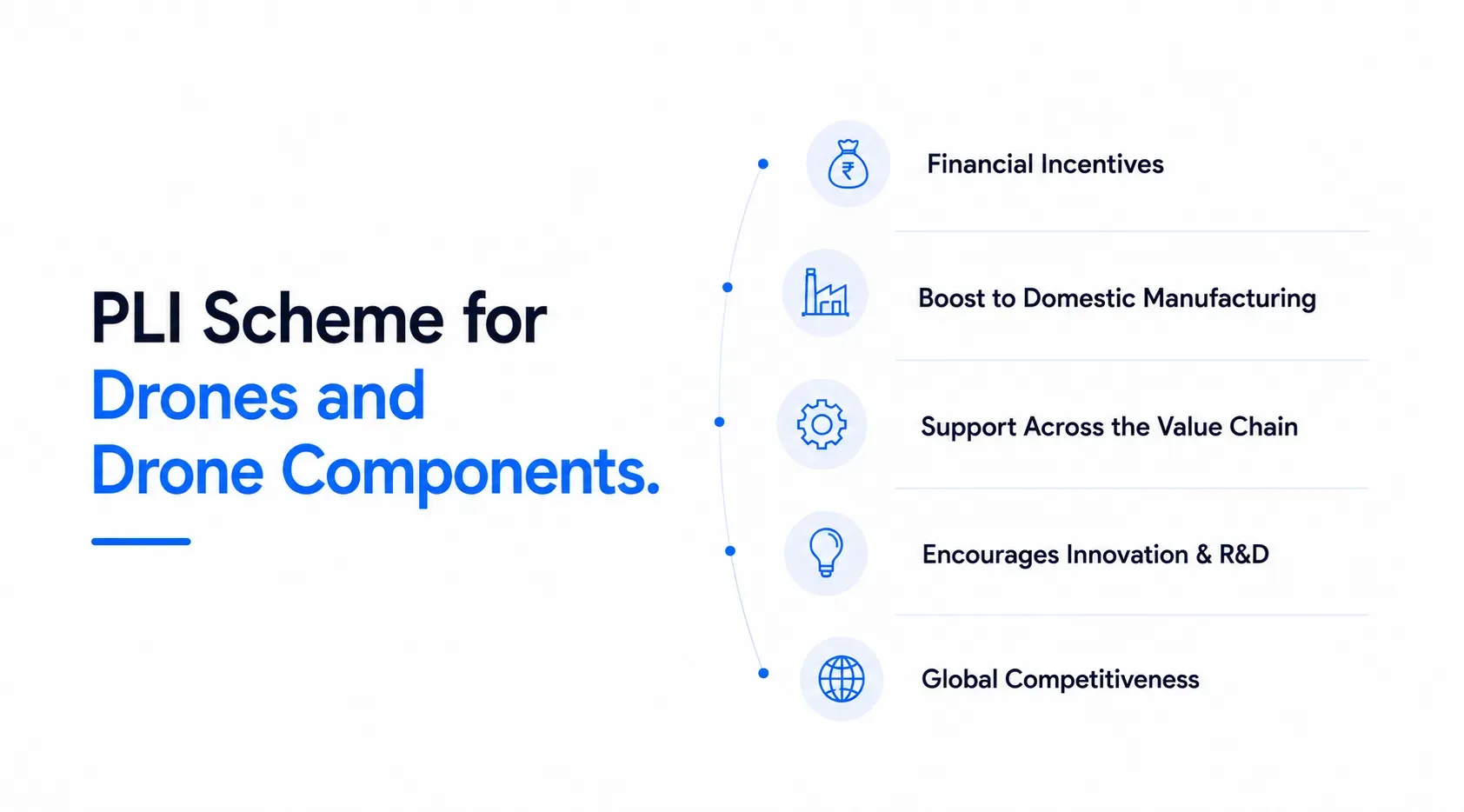
India's PLI scheme for drones ran from FY 2021-22 to FY 2023-24 as an output-linked instrument, not a capital subsidy. The Ministry of Civil Aviation shortlisted 23 beneficiaries across 12 drone manufacturers and 11 component manufacturers (Ministry of Civil Aviation, 6 July 2022). Disbursement reached approximately ₹30 crore in FY 2022-23, paid to 12 firms (Press Information Bureau, 4 April 2023).
PLI 2.0 was finalised for review in early 2026 with a proposed allocation above ₹1,000 crore. This piece breaks down the design, cohort, results, and what comes next.
Why the PLI scheme for drones was notified in September 2021
The PLI scheme for drones was anchored in a specific industrial reality. In FY 2020-21, the combined annual sales turnover of all domestic drone manufacturers stood at ₹60 crore (Press Information Bureau, 16 September 2021). A single mid-tier defence contract could distort the entire sector's revenue base. India needed a manufacturing floor.
The Ministry of Civil Aviation notified the scheme on 30 September 2021 (Ministry of Civil Aviation, 30 September 2021). The notification came five weeks after the liberalised Drone Rules 2021 entered force on 25 August 2021 (Ministry of Civil Aviation, 25 August 2021).
The sequencing mattered. Drone Rules 2021 removed the licensing friction that had constrained commercial operations. The PLI scheme then targeted the supply-side capacity to meet the demand the new rules would unlock.
The instrument sat inside the broader Atmanirbhar Bharat industrial framework alongside the wider Make in India drones manufacturing case. The government's stated target was to build India into a global drone hub by 2030, with sectoral turnover projected at ₹15,000 crore (Press Information Bureau, 16 September 2021). The ₹120 crore allocation, spread over three financial years, was nearly double the combined FY 2020-21 turnover of the sector it was designed to scale. The scheme was the supply-side anchor that the Drone Rules 2021 framework needed.
How the PLI scheme for drones structured its incentive
The mechanics of the PLI scheme for drones were strict on one axis and unusually permissive on another. The PLI rate was set at 20 percent of value addition, held constant across all three financial years. Every other PLI scheme reduced the rate annually; only the drone scheme kept the floor steady (Ministry of Civil Aviation, 30 September 2021).
Value addition was calculated as annual sales revenue from drones and drone components, net of GST, minus the purchase cost of inputs, also net of GST. The minimum value-addition floor was set at 40 percent of net sales, lower than the 50 percent norm applied to other sectors. That softer floor was the policy concession that opened the scheme to component manufacturers competing against subsystem imports.
Eligibility thresholds bracketed the applicant pool. Non-MSME drone manufacturers needed annual sales turnover of ₹4 crore; non-MSME component manufacturers needed ₹1 crore. MSME and startup thresholds were lower, at ₹2 crore and ₹50 lakh respectively (Press Information Bureau, 25 July 2022). The thresholds were deliberately set to pull smaller firms inside the formal incentive grid alongside the eligibility band that intersects with the drone categories framework.
Two structural features distinguished the scheme. The first was the 25 percent cap on annual outlay per beneficiary. This prevented any single firm from absorbing more than ₹30 crore across the three-year cycle.
The second was the shortfall-carryforward provision. A manufacturer who missed the value-addition threshold in one financial year could claim the lost incentive in the next year. The carryforward applied only if the firm made up the gap (Ministry of Civil Aviation, 30 September 2021).
All applications, value-addition certificates, and claim filings ran through the IFCI portal. IFCI Limited served as the appointed Project Management Agency for the scheme.
Who the PLI scheme for drones shortlisted
The Ministry of Civil Aviation released a first provisional list of 14 beneficiaries on 20 April 2022 (Press Information Bureau, 20 April 2022). The list was based on financial data submitted for the ten-month period from 1 April 2021 to 31 January 2022.
A second provisional list followed on 6 July 2022. It expanded the cohort to 23 firms across 12 drone manufacturers and 11 component manufacturers. The list drew on unaudited financial results for FY 2021-22 (Ministry of Civil Aviation, 6 July 2022).
The structural pattern in the cohort is the more useful analytical anchor than individual firm identity. The 23 beneficiaries clustered across nine Indian states. Karnataka concentrated the largest share through Bengaluru firms drawn from both manufacturing and component categories.
Tamil Nadu anchored Chennai-based manufacturers. Uttar Pradesh held two firms in Noida, and Maharashtra contributed firms from Mumbai and Pune. Haryana clustered two in Gurugram, and Telangana held two Hyderabad-based component manufacturers. Delhi, Uttarakhand, and Odisha rounded out the geographic spread.
The cohort distribution mattered for three reasons. The indigenous ecosystem had formed as a distributed industrial network rather than as a single-city cluster. Defence-adjacent geographies such as Hyderabad and Bengaluru concentrated component manufacturing, which aligned with the subsystem-supplier mandate. And no eastern or northeastern state secured a beneficiary in the first cycle, signalling that future schemes would need geographic-diversification triggers.
The combined annual sales turnover of the shortlisted firms grew from ₹88 crore in FY 2020-21 to ₹319 crore in FY 2021-22 (Press Information Bureau, 6 July 2022). That is a 3.6× expansion in the first scheme year. The figure is small in absolute terms, but it signals the velocity of the manufacturing ramp inside the type certification pathway every PLI-funded platform must clear.
What ₹30 crore disbursed in FY 2022-23 says about scheme uptake
The underreported fact about the PLI scheme for drones is the gap between allocation and disbursement. Of the ₹120 crore allocated, the Ministry of Civil Aviation disbursed approximately ₹30 crore in FY 2022-23 (Press Information Bureau, 4 April 2023). That was the first year in which claims became payable. The figure represents a quarter of the total scheme corpus released in the first claim cycle.
More striking is that only 12 of the 23 shortlisted beneficiaries received the FY 2022-23 disbursement. Some shortlisted firms were excluded from the payout cycle. The reasons included incomplete paperwork and unmet documentation requirements (Business Today reporting on Ministry of Civil Aviation disbursement, 4 April 2023).
The first claim cycle therefore covered slightly more than half of the cohort by company count. This was true even though every shortlisted firm had cleared the prior eligibility filter.
The reconciliation problem deepens against the DPIIT Secretary's statement on the drone sector. The Secretary cited seven-fold growth under the PLI scheme (Department for Promotion of Industry and Internal Trade, June 2023). Seven-fold growth on a base of ₹60 crore would imply a sectoral turnover near ₹420 crore.
The shortlisted-firm combined turnover of ₹319 crore for FY 2021-22 sits inside that range. The growth claim and the disbursement evidence reconcile once measurement windows are aligned.
The disbursement shortfall is not a failure of design. It is a measure of how steep the value-addition threshold was for first-cycle applicants. The scheme paid only for verified value addition, not for promises. The lesson for the Drone Shakti Mission's component manufacturing pivot is that allocation headlines mean little if the verification chassis cannot move the funds through.
Where the PLI scheme for drones fell short
The PLI scheme for drones did not operate in isolation. It was paired with the drone import policy notified on 9 February 2022 (Directorate General of Foreign Trade, 9 February 2022). That policy prohibited the import of foreign-built drones into India, with carve-outs for research and development, defence, and security applications.
The ban removed competition for finished-platform demand. It also let the broader Make in India drones procurement shift flow toward domestic suppliers.
The structural gap was that the import ban applied to finished platforms, not to drone components. Subsystem imports continued for radio frequency modules, flight controllers, autopilots, high-density batteries, and electronic warfare components (IMPRI Policy Research analysis, May 2024). The PLI scheme's 40 percent value-addition floor tolerated this.
A beneficiary could meet the floor while importing the majority of its critical subsystems. Reportage from January 2026 places the overall component import share at 50 to 60 percent of total drone value (Whalesbook reportage on PLI 2.0 finalisation, 30 January 2026).
The second shortfall was the absence of a Design Linked Incentive. The PLI structure rewarded production; it did not reward design ownership of the platforms being produced. Industry submissions during the FY 2022-23 disbursement cycle requested a DLI to fund R&D rather than only output (industry beneficiary statements on the FY 2022-23 disbursement, April 2023). This is the structural pattern that the indigenous subsystem gap detailed in the military drones analysis explores at greater depth.
The third shortfall was talent. Industry submissions to the Ministry of Civil Aviation flagged a shortage of qualified drone pilots, UAV engineers, and embedded systems specialists (NASSCOM representation to MoCA, 2021). The submissions surfaced during the scheme's design consultation.
The PLI scheme had no skilling component embedded inside it. The Drone Shakti Budget 2022 announcement attempted to fill the gap through ITI-led courses.
What PLI 2.0 must redesign
PLI 2.0 for the drone sector was finalised for inter-ministerial review in early 2026 (Whalesbook reportage on PLI 2.0 finalisation, 30 January 2026). The proposed allocation sits above ₹1,000 crore. That is an eight-fold expansion over the original scheme. The proposed scope is broader on three axes.
The first axis is sector coverage. PLI 2.0 brings drone leasing services and UAS software into the eligible-applicant pool, recognising that India's drone economy is no longer airframe-only. The PLI 1.0 design covered hardware manufacturers, with software developers added through Clause 5.4. PLI 2.0 raises software to a first-class category.
The second axis is incentive layering. PLI 2.0 is expected to pair a value-addition incentive with a sale-value-percentage incentive. The single-axis structure of PLI 1.0 did not differentiate between firms scaling output and firms maintaining narrow margins. The dual-axis structure aligns the incentive with both growth and indigenisation.
The third axis is the indigenisation target. PLI 2.0 targets approximately 30 percent of total drone value to be produced domestically (Whalesbook reportage on PLI 2.0 finalisation, 30 January 2026). The target addresses the 50 to 60 percent component import dependency that PLI 1.0 did not move. It applies to total drone value rather than to net sales, which makes it more aggressive than the 40 percent floor it replaces.
PLI 2.0 sits alongside two other manufacturing-policy instruments. Budget 2026 reportage describes a separate ₹10,000 crore drone manufacturing scheme over five years (Budget 2026 reportage on drone manufacturing scheme, 22 December 2025). The scheme is structured as a 10 to 15 percent capital subsidy paired with a 10 to 15 percent output incentive.
The Drone Shakti Mission's allocation logic targets a separate corpus for component R&D through the Anusandhan National Research Foundation. PLI 2.0 funds output. The Budget 2026 scheme funds capacity. Drone Shakti funds R&D.
How AI is reshaping the PLI execution layer
Artificial intelligence sits inside PLI 2.0 on two layers, and both shape its operational chassis.
The administrative layer is the closer fix. PLI applications, eligibility verifications, and claim filings flow through the IFCI portal (Ministry of Civil Aviation operational guidelines, 2021). The portal handles structured data forms suited to machine learning. Three use-cases sit on top.
Application screening checks turnover thresholds against submitted financials. Anomaly detection runs across customs declarations and PLI claim filings to flag value-addition inflation. Compliance monitoring verifies beneficiary value-addition certificates against audited results. The FY 2022-23 disbursement, where 11 of 23 shortlisted firms missed the cycle on documentation grounds, suggests that automated pre-submission verification would close real gaps.
The product-side layer is the deeper opportunity. Clause 3.2 of the PLI guidelines covers communication systems, ground control stations, detect-and-avoid systems, and inertial measurement units. AI subsystems sit inside that clause by category. Onboard inference accelerators, computer-vision payloads, edge AI modules, and autonomy software stacks all qualify as eligible products.
PLI 2.0's explicit recognition of UAS software as a first-class category formalises this read. The UTM framework that PLI-eligible software must operate under anchors the integration surface for these software-defined platforms. AI is no longer adjacent to the PLI scheme; it is the eligible product category itself.
What this means in practice for India's drone manufacturing case
The PLI scheme for drones proved that the policy chassis works for airframe assembly. It did not prove that the chassis works for component sovereignty. The ₹30 crore disbursed in FY 2022-23 to 12 firms is the verifiable record, and represents real industrial scaling on a small base. The 3.6× turnover growth in the shortlisted cohort during the first scheme year is the strongest single data point in favour of the design.
What the scheme did not prove is whether output-linked incentives, on a 40 percent value-addition floor, can close India's component import problem. That import share now sits at 50 to 60 percent of total drone value. The Drone Shakti Mission, PLI 2.0, and the Budget 2026 manufacturing scheme are the three instruments designed to test that proposition. Procurement officers, agri-drone buyers, defence integrators, and policy researchers tracking the indigenous drone case should read those three instruments as the next-cycle test.
The verification chassis matters more than the headline allocation. The disbursement-to-allocation ratio for PLI 1.0, ₹30 crore against ₹120 crore in the first claim cycle, is the operational lesson PLI 2.0 must internalise.
Allocation is policy intent. Disbursement is policy outcome. The next round will be judged on the second number.
The PLI scheme for drones proved the airframe chassis. The next instruments must prove the component chassis.