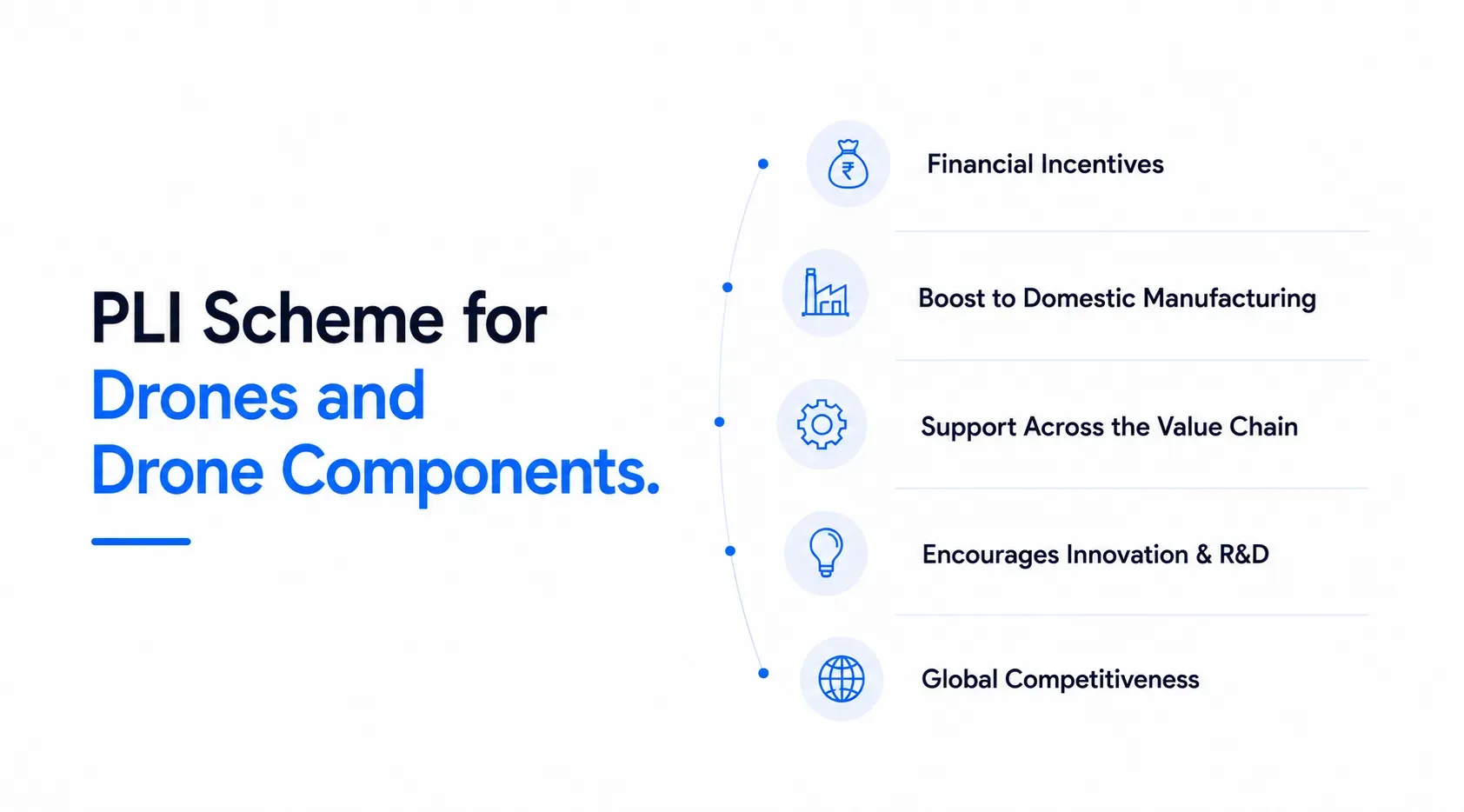
India's drone manufacturing ecosystem now operates through a three-scheme policy cascade. PLI 2.0 was finalised in early 2026, while Budget 2026 discussions named a ₹10,000 crore Drone Shakti manufacturing proposal. The ANRF MAHA Drones component R&D call followed in May 2026.
The first 23 PLI beneficiaries expanded combined turnover from ₹88 crore in FY 2020-21 to ₹319 crore in FY 2021-22. Yet the ecosystem still imports 50–60 percent of high-value components (Ministry of Civil Aviation, 6 July 2022).
Anchoring the second policy phase after PLI 1.0
India's drone manufacturing ecosystem entered its second policy phase in late 2021. The Ministry of Civil Aviation notified the original ₹120 crore PLI scheme on 30 September 2021 (Ministry of Civil Aviation Gazette Notification, 30 September 2021). That scheme targeted drone airframes and components through output-linked incentives tied to domestic value addition.
The government followed the policy with the Drone Rules 2021 liberalisation framework on 25 August 2021. The finished-drone import restriction followed on 9 February 2022 (DGFT Notification, 9 February 2022).
The Drone Rules 2021 framework itself now operates under the Bharatiya Vayuyan Adhiniyam 2024. The statute replaced the Aircraft Act 1934 as the parent civil aviation law during early 2025 (Ministry of Civil Aviation, Bharatiya Vayuyan Adhiniyam Gazette, 18 December 2024). The Adhiniyam strengthens the regulatory base under which DGCA certification and PLI eligibility now run.
The first provisional PLI beneficiary list arrived on 20 April 2022 with 14 approved firms. A second list published on 6 July 2022 expanded the cohort to 23 beneficiaries. The Ministry reopened applications using full FY 2021-22 turnover data (Ministry of Civil Aviation, 6 July 2022). The combined turnover increase from ₹88 crore to ₹319 crore demonstrated that domestic assembly demand existed once policy certainty emerged.
That expansion did not reduce subsystem imports. Flight controllers, brushless motors, lithium-ion cells, thermal sensors, and rare-earth magnet assemblies still arrived through foreign supply chains. The pattern persisted across FY 2024-25 and FY 2025-26 (Global Trade Research Initiative, May 2024). The policy response now separates manufacturing into three layers.
PLI 2.0 targets production output. Mission Drone Shakti targets factory construction and manufacturing capacity. ANRF MAHA Drones targets research into motors, batteries, propulsion systems, sensors, and avionics. The ecosystem shifted from incentive-led assembly toward long-cycle subsystem localisation because the import problem survived the first policy wave.
Building the 23-firm PLI beneficiary cohort
The 23-firm beneficiary cohort formed through two Ministry of Civil Aviation selection rounds during 2022. The first provisional list approved 14 firms using ten months of financial data from April 2021 to January 2022. The second list expanded the group to 23 beneficiaries after firms submitted full-year turnover records for FY 2021-22 (Ministry of Civil Aviation, 6 July 2022).
The Ministry structured the cohort across two manufacturing layers. Twelve beneficiaries qualified as drone manufacturers. Eleven qualified as component manufacturers supplying propulsion systems, electronics, sensors, and avionics.
Eligibility thresholds differed by category. Drone manufacturers required ₹2 crore annual sales, while component firms required ₹50 lakh. Startup and MSME thresholds remained lower to widen participation (Ministry of Civil Aviation Gazette Notification, 30 September 2021).
The cohort spread across Karnataka, Tamil Nadu, Telangana, Uttar Pradesh, Maharashtra, Haryana, Delhi, Uttarakhand, and Odisha. Karnataka carried the largest concentration because Bengaluru already hosted aerospace electronics suppliers, embedded systems engineers, and defence-adjacent manufacturing infrastructure. Hyderabad developed into the second major node because defence electronics and missile-system supply chains already existed through public-sector and defence-industrial activity.
The Ministry reported that beneficiary turnover expanded 3.6 times within one financial year, from ₹88 crore to ₹319 crore (Ministry of Civil Aviation, 6 July 2022). That number matters because the base itself remained small against India's electronics import bill the same year. The scheme demonstrated that domestic assembly could scale under policy support. It did not establish subsystem sovereignty.
The cohort therefore became a baseline rather than a finished industrial ecosystem. Procurement officers evaluating domestic supply chains now use those 23 firms as the first reference layer for indigenous sourcing and subsystem partnerships.
Distributing the 23 firms over nine Indian states
India's drone manufacturing ecosystem developed as a distributed network rather than a vertically integrated industrial corridor. Karnataka hosts the largest cluster, followed by Tamil Nadu, Telangana, Maharashtra, Uttar Pradesh, and Haryana.
Bengaluru concentrates both airframe assemblers and embedded-electronics suppliers. Hyderabad concentrates defence-electronics and avionics specialists. Chennai and Noida support civilian manufacturing tied to agricultural and logistics applications (Ministry of Civil Aviation, 6 July 2022).
The geographic spread creates both resilience and fragmentation. Distributed manufacturing lowers concentration risk because a single disruption does not halt national production. Fragmented supply chains also make subsystem integration slower and more expensive than the manufacturing ecosystems seen in Taiwan or Shenzhen.
The 12 airframe firms operate across agricultural spray platforms, industrial inspection systems, tactical ISR drones, and mapping aircraft. All twelve assemble imported subsystems into domestically integrated airframes. The 11 component manufacturers focus on propulsion electronics, electronic speed controllers, communication modules, batteries, GPS systems, gimbals, sensors, and avionics.
Manufacturing layer | Primary products | Domestic capability | Import dependence |
|---|---|---|---|
Airframe manufacturing | Agricultural, ISR, logistics, survey drones | Mature assembly capability | Medium |
Flight electronics | Flight controllers, ESCs, power boards | Partial domestic production | High |
Propulsion systems | Motors, propellers, magnet systems | Limited indigenous manufacturing | High |
Energy systems | Battery packs, BMS modules | Assembly capability exists | High |
Sensors and payloads | Thermal sensors, LiDAR, EO payloads | Limited domestic ecosystem | High |
The fragmentation explains why drone component manufacturing in India remains difficult to scale. Airframe firms assemble subsystems supplied by specialised manufacturers. Component firms themselves still depend on imported semiconductor inputs, rare-earth materials, and battery cells.
This structure also explains why future policy support targets subsystems instead of basic assembly. The airframe layer already exists. The bottleneck sits inside propulsion, silicon, and sensing systems.
Confronting the 50–60% drone import dependency on components
The finished-drone import restriction announced on 9 February 2022 created an assumption that domestic manufacturing would automatically reduce foreign dependence. That did not happen because the policy restricted finished platforms rather than subsystems (DGFT Notification, 9 February 2022).
PLI 1.0 required 40 percent domestic value addition under its original framework (Ministry of Civil Aviation Gazette Notification, 30 September 2021). Manufacturers could still import 60 percent of subsystem value while qualifying for incentives. That threshold encouraged domestic assembly, not subsystem research.
The highest-value drone components remained import-dependent through FY 2025-26. Flight controllers rely on semiconductor supply chains concentrated in East Asia. Brushless motors require rare-earth magnets, where China controls about 90 percent of global processing capacity. Lithium-ion battery cells still arrive through foreign suppliers because India primarily assembles packs rather than manufacturing aviation-grade high-density cells domestically.
Thermal payloads, LiDAR systems, RF communication modules, and advanced optical sensors remain difficult to source locally at scale. Indian firms reporting indigenous content above 70 percent still import high-value avionics and sensing systems because those components dominate aircraft cost structures.
The result is a split ecosystem. India manufactures airframes, assembly structures, software integration layers, and operational systems domestically. The silicon, sensing, and propulsion layers remain import-linked. The flight controller, motor, and battery import chain therefore defines the structural problem PLI 2.0 inherits.
This distinction matters for procurement officers and defence integrators. A domestically assembled aircraft does not imply a fully domestic subsystem chain. It also explains why the policy conversation shifted from assembly incentives toward component research and manufacturing infrastructure after 2025.
Layering PLI 2.0, Mission Shakti, and ANRF across three bottlenecks
PLI 2.0, Mission Drone Shakti, and ANRF MAHA Drones now operate as separate policy instruments addressing the domestic content requirement for drones at different layers.
PLI 2.0 focuses on production output. Industry reporting during January 2026 indicated that the revised framework could exceed ₹1,000 crore in allocation. The scheme introduces expanded eligibility for software developers and drone leasing providers (Whalesbook Industry Analysis, 30 January 2026). PLI 2.0 also shifts the domestic-content measurement methodology to capture total drone value rather than only net sales addition.
Mission Drone Shakti targets manufacturing infrastructure. Budget-linked reporting during December 2025 described a five-year capital support framework with manufacturing subsidies and capex incentives. Domestic-content thresholds sit between 50 and 60 percent under the proposed structure (Outlook Business, 22 December 2025). The scheme aims to help firms build production facilities rather than only reward finished sales.
ANRF MAHA Drones targets subsystem R&D. The programme funds consortium-driven development for flight controllers, motors, batteries, propulsion systems, sensors, and communication modules. The structure delivers TRL-7 demonstrators within three years (ANRF MAHA Drones CFP, April 2026). It links academia, research laboratories, startups, MSMEs, and industrial manufacturers under a shared mission.
Scheme | Primary target | Mechanism | Policy objective |
|---|---|---|---|
PLI 2.0 | Existing manufacturers | Output-linked incentives | Scale present production |
Mission Drone Shakti | Factory construction | Capex and output subsidies | Build manufacturing capacity |
ANRF MAHA Drones | Component R&D | Research funding | Replace imported subsystems |
The schemes run in parallel because the ecosystem problem exists across three time horizons. Manufacturers need cash flow now. Factories require medium-term capital deployment. Subsystem localisation requires multi-year research cycles.
The structure also reflects a policy lesson from PLI 1.0. Assembly incentives alone cannot localise semiconductor-intensive systems. The government therefore separated manufacturing scale from subsystem research instead of expecting one scheme to solve both constraints.
Scaling the workforce against the manufacturing brief
India's drone manufacturing ecosystem also faces a workforce constraint that incentives alone cannot solve. Training demand expanded after the Drone Rules 2021 liberalisation and the agricultural adoption push tied to the Namo Drone Didi scheme.
The Namo Drone Didi scheme funds drones for 14,500 women self-help groups across FY 2024-25 and FY 2025-26 under a ₹1,261 crore outlay. The scheme creates agricultural-spray demand that depends on trained pilots and serviceable indigenous platforms (PIB, 28 November 2024).
Industry estimates cited during 2025 projected demand for over 100,000 FPV and industrial drone operators by 2030 across defence, agriculture, logistics, and infrastructure inspection sectors. Embedded systems engineers, avionics specialists, propulsion technicians, and DGCA-certified pilots remain in shorter supply than manufacturing expansion targets.
Private institutions and industrial training programmes expanded during FY 2025-26. The scale gap persists. Manufacturing facilities funded through Mission Drone Shakti still require avionics engineers, subsystem technicians, battery specialists, and certification personnel before production lines can scale.
The next 18 months therefore matter more for execution than policy announcements. Procurement officers evaluating domestic sourcing should track four indicators closely.
The first is PLI 2.0 disbursement velocity. The second is Mission Drone Shakti facility construction timelines. The third is ANRF demonstrator progress toward TRL-7. The fourth is export entry through SCOMET Category 5B and GAED-cleared civilian channels.
India's drone manufacturing ecosystem now sits between assembly maturity and subsystem sovereignty. The next policy cycle will be judged on whether incentives convert into domestic component capability or simply scale import-linked production.