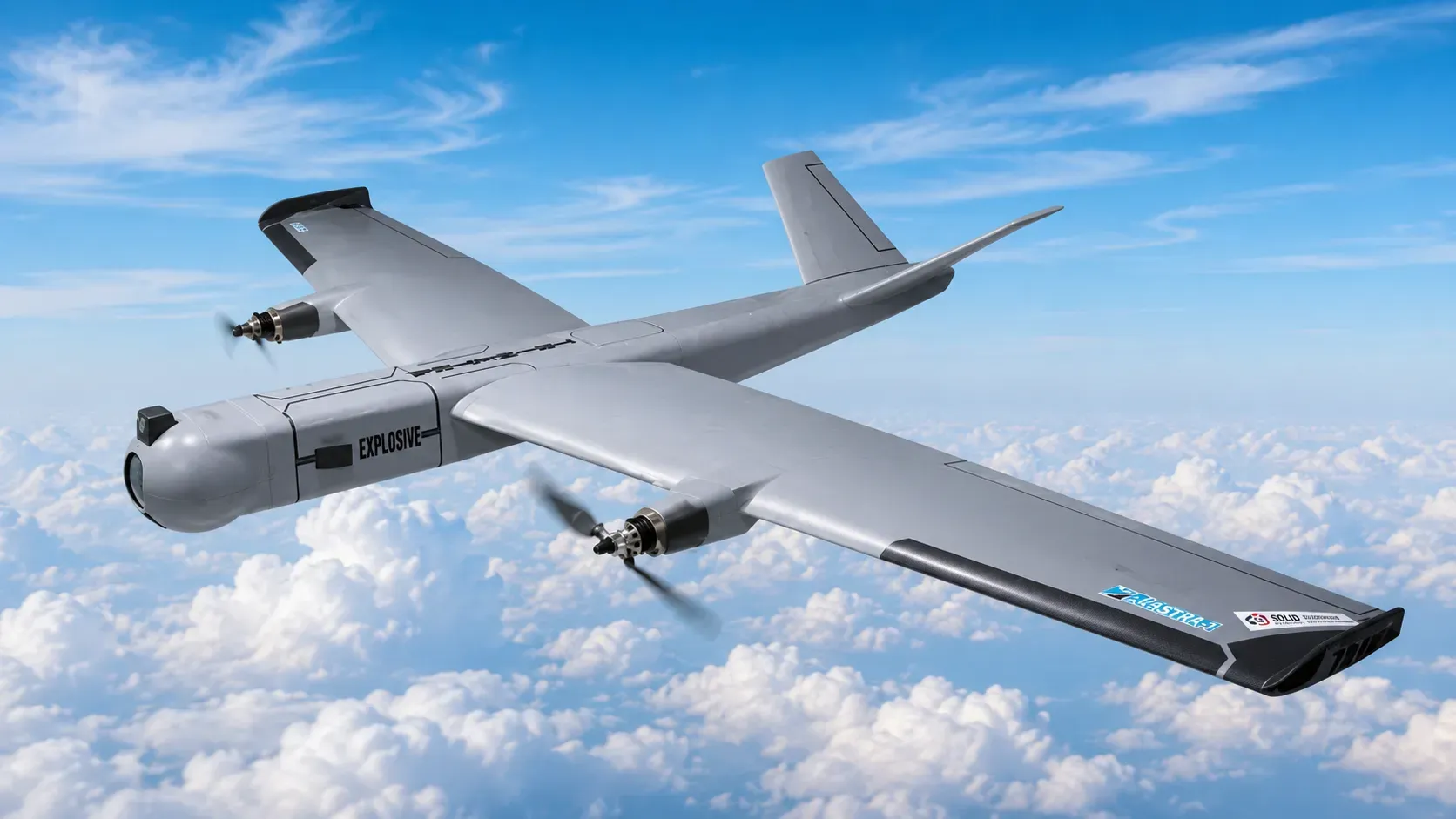
India's Make in India drones programme rests on a four-layer sovereignty framework: the Drone Rules 2021 regulatory base, the February 2022 import restrictions, the PLI scheme and Drone Shakti incentive stack, and the iDEX defence innovation pipeline that cleared 58 prototypes worth ₹3,853 crore for procurement by February 2026 (Press Information Bureau, 19 March 2026). This analysis maps each layer to a specific sovereignty outcome, names the platforms combat-validated during Operation Sindoor in May 2025, and explains why component-level manufacturing is the next binding sovereignty test.
Why indigenous drone manufacturing now defines India's strategic autonomy
Make in India drones now sit at the intersection of defence procurement, industrial policy, and national security planning. The shift did not arrive through a single announcement. It emerged through a sequence of regulatory and operational decisions that changed how India approaches unmanned systems manufacturing.
The policy anchor is recent. At the National Defence Industries Conclave on 19 March 2026, the Raksha Mantri set the policy direction. India must work in mission mode to emerge as a global hub of indigenous drone manufacturing. The statement cited the Russia-Ukraine war and Iran-Israel tensions as proof that drones and counter-drone technologies will shape future warfare (Press Information Bureau, 19 March 2026). It also flagged that self-reliance is required at the component level, covering molds, software, engines, and batteries.
Four sovereignty pressures explain why this matters. The first is supply-chain risk from imported components, exposing operators to sanctions and export-control disruption. The second is electronic-warfare resilience, which requires indigenous firmware to harden navigation and communication stacks against jamming. The third is the cost differential between imported and domestic platforms, which limits procurement scale at fixed budgets. The fourth is doctrinal: Make in India drones for defence must be available in operational surge volumes, not only at peacetime rates.
The remaining sections map each pressure to the specific policy layer addressing it. For the regulatory context, see our analysis of drone laws and regulatory architecture in India.
The Drone Rules 2021 unlocked private capital for Make in India drones
The Drone Rules 2021 created the regulatory base that made indigenous manufacturing investable. Earlier frameworks imposed certification delays, layered approvals, and fragmented compliance obligations that limited domestic manufacturing scale.
The Ministry of Civil Aviation notified the revised rules on 25 August 2021 (Ministry of Civil Aviation, 25 August 2021). The notification reduced compliance forms from 25 to 5 and cut fee categories from 72 to 4. The notification also restructured remote pilot licensing, aligned airspace permissions with the DigitalSky platform and airspace map, and expanded green-zone access to remove low-risk operational bottlenecks.
The rules reduced the compliance burden for manufacturers pursuing type certification. This change mattered because certification costs had previously favoured imported platforms with global scale advantages. Lowering certification friction shifted the economics in favour of domestic manufacturers entering surveillance, logistics, agriculture, and tactical support segments.
A second structural change arrived through the Drone Certification Scheme that came into force on 26 January 2022 (Quality Council of India, 26 January 2022). Certification requirements moved toward lighter processes for compliant airframes and components, reducing approval friction across the indigenous drone manufacturing pipeline.
The combined effect was strategic rather than procedural. The Drone Rules 2021 transformed drones from a tightly restricted aviation category into a domestic industrial sector with scalable manufacturing potential. Private capital followed the regulatory clarity. The indigenous case became investable for the first time.
India's drone import ban closed the foreign-platform dependence loop
India's drone import ban changed the economics of domestic manufacturing. The Directorate General of Foreign Trade notified the restriction on 9 February 2022, prohibiting imports of fully built foreign drones (Directorate General of Foreign Trade, 9 February 2022). Exemptions remained for research, defence, and security purposes.
The objective extended beyond trade protection. The policy addressed supply-chain vulnerability. Imported systems created dependence on foreign firmware, communication architecture, navigation modules, and battery ecosystems. In defence scenarios, these dependencies create operational exposure during sanctions, export restrictions, or supply-chain disruptions.
The restriction framework aligned with India's broader Atmanirbhar Bharat drones strategy. Domestic procurement incentives alone could not scale indigenous manufacturing if imported finished platforms retained unrestricted market access. The import controls therefore acted as a demand-side enforcement mechanism complementing the supply-side PLI structure.
The policy reshaped procurement incentives across the operator base. State agencies, infrastructure operators, agriculture service providers, and tactical procurement divisions shifted toward domestic systems. For the operator-side picture of platforms compliant under this framework, see our explainer on drone categories in India.
The shift remains incomplete. India still imports several high-value drone components. The import ban changed market direction but did not by itself solve the deeper challenge of drone component manufacturing India PLI categories. That challenge requires the next two policy layers.
The PLI scheme for drones turned policy intent into manufacturing capacity
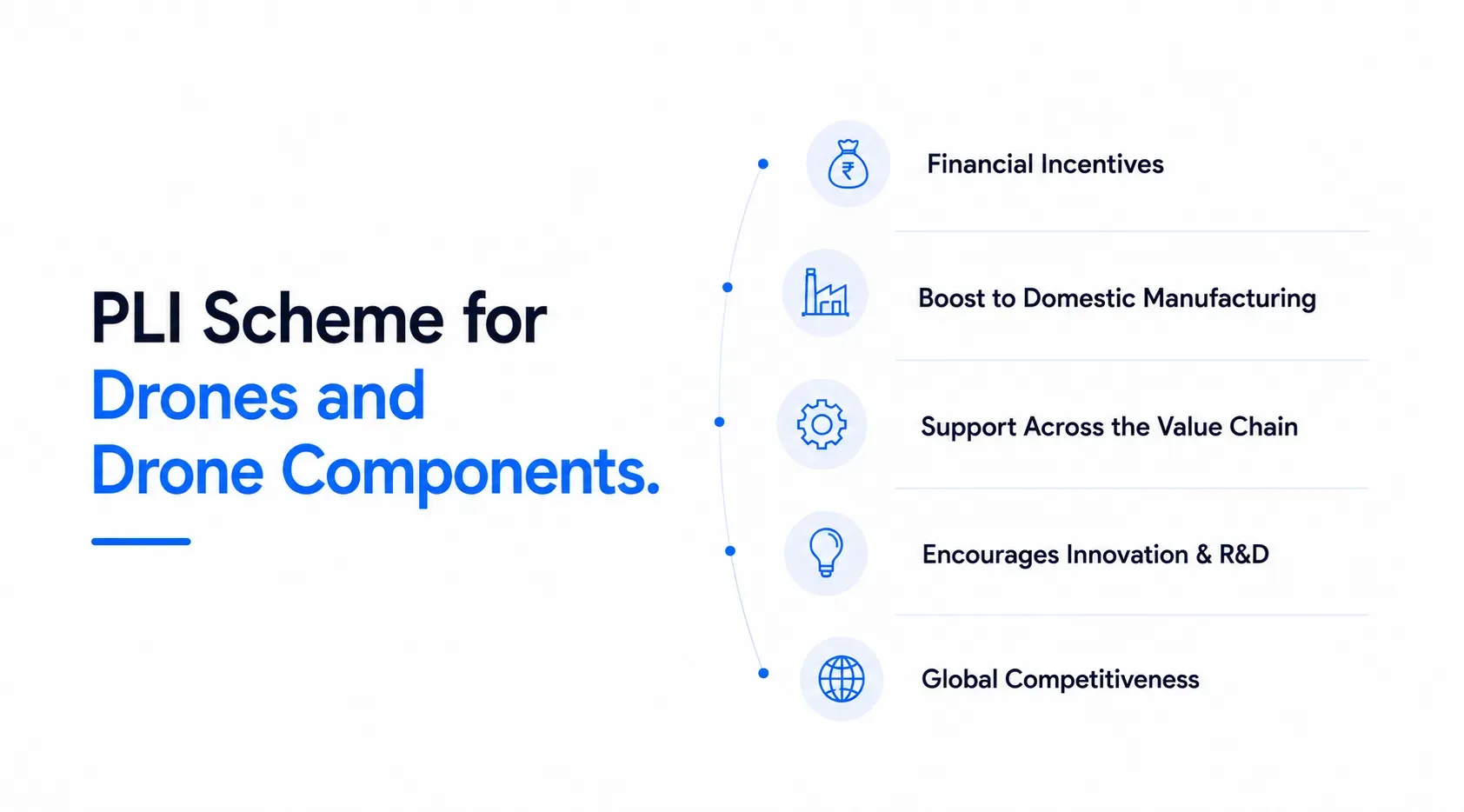
The PLI scheme for drones gave the indigenous case its industrial spine. The Ministry of Civil Aviation notified the scheme on 30 September 2021 with an allocation of ₹120 crore over three financial years (Press Information Bureau, 30 September 2021). The structure carried a 20 percent value-addition incentive, one of the highest rates among India's 14 PLI schemes.
Eligibility thresholds were deliberately low. Non-MSME companies needed annual sales turnover of ₹4 crore for drones and ₹1 crore for components, with lower MSME thresholds. The structure pulled smaller manufacturers into the formal incentive grid.
The Ministry of Civil Aviation released a second provisional list of PLI beneficiaries in 2022. The list named 23 companies: 12 drone manufacturers and 11 component manufacturers (Ministry of Civil Aviation, 2022). The beneficiaries spread across Bengaluru, Chennai, Noida, Mumbai, Gurugram, Pune, Hyderabad, New Delhi, and Belagavi. The geographic spread indicated that the indigenous ecosystem was forming as a distributed industrial network rather than a single-city cluster.
The financial impact appeared quickly. Combined annual sales turnover of PLI beneficiaries rose from ₹88 crore in 2020-21 to ₹319 crore in 2021-22 (Press Information Bureau, 2022). That represents a 3.6× expansion in the first year of the scheme.
The PLI structure also reshaped investor behaviour. Capital allocation shifted toward long-horizon manufacturing infrastructure instead of short-cycle assembly operations. This matters for Make in India drones for defence because sovereign capability depends on production continuity during operational surge cycles.
Drone Shakti and the shift to investment-linked manufacturing incentives
The Drone Shakti scheme extended the PLI logic from output-linked incentives toward investment-linked manufacturing support. Announced under the Union Budget 2022, the framework focused on Drone-as-a-Service models and component-level value addition.
The funding escalation followed in stages. In July 2025, the government allocated an additional ₹2,000 crore (approximately $234 million) for the domestic drone industry over a three-year horizon (Ministry of Defence allocation, July 2025). The timing reflected the four-day cross-border clash earlier that year, which underscored the operational risks of foreign-platform dependence.
A further proposal emerged in December 2025. The Union Budget 2026 outlined a five-year manufacturing-focused incentive structure aligned with the 16th Finance Commission period, with a potential fiscal commitment of around ₹10,000 crore. The proposal combines a 10–15 percent capital-spending subsidy for drone manufacturing units with separate manufacturing-support layers, marking a shift from output-linked PLI design to investment-linked Drone Shakti design.
The distinction matters. PLI rewards companies that already produce and sell. Investment-linked incentives reward companies that build capacity ahead of demand. For component manufacturers, where capital intensity is high and order books take years to mature, investment-linked support is the more relevant policy instrument.
The Drone Shakti scheme manufacturing incentive structure signals an acknowledgement. India's drone sovereignty challenge is now industrial rather than conceptual. Airframe assembly capability exists. The pressure point lies in deep manufacturing capacity across propulsion, batteries, communication stacks, composite materials, and autonomous control software.
DRDO indigenous drone programmes anchor the sovereign capability stack
DRDO indigenous drone programmes form the public-sector backbone of India's sovereign drone capability. Public-sector research institutions anchor long-horizon strategic development because the commercial market alone cannot fund the multi-decade R&D cycles that high-end unmanned systems require.
The medium-altitude long-endurance segment runs through the TAPAS-BH-201 and Archer-NG programmes. Both focus on intelligence, surveillance, and reconnaissance capability aligned with persistent deployment along contested borders. These platforms reduce dependence on imported MALE-class systems while building domestic expertise in long-endurance airframe design and sensor integration.
The Ghatak programme represents a separate strategic category. Now positioned as the Remotely Piloted Strike Aircraft initiative, it secured Indian Air Force approval in April 2026 (Ministry of Defence, April 2026). The ₹39,000 crore programme funds indigenous unmanned stealth fighters. The initial ₹10,000 crore tranche covers six flying prototypes, with an 80 percent indigenisation target across the airframe. The platform is designed to operate in tandem with the Advanced Medium Combat Aircraft through manned-unmanned teaming under Vision 2047.
The CATS Warrior loyal-wingman programme pairs unmanned systems with manned aircraft to extend reconnaissance reach and operational survivability. The SWIFT scaled-down technology demonstrator completed its first autonomous flight in July 2022, building the test base for the broader Ghatak airframe. The Abhyas high-speed expendable target programme rounds out the DRDO portfolio with a platform for missile-defence and air-defence training.
The strategic point is structural. The DRDO platform map covers surveillance, stealth strike, loyal-wingman, and target-drone roles within a single sovereign capability stack. For a comparison against global benchmarks, see our analysis of the most advanced military drones in the world.
iDEX defence innovation built the MSME and start-up backbone
The iDEX defence innovation framework created the supply-chain foundation behind India's indigenous drone manufacturing expansion. Launched in 2018, iDEX connects start-ups, MSMEs, research institutions, and defence procurement structures through challenge-based development programmes.
By February 2026, the Ministry of Defence reported that 676 start-ups, MSMEs, and individual innovators had entered the iDEX ecosystem (Press Information Bureau, 19 March 2026). The framework launched 566 technology challenges, signed 548 contracts, and cleared 58 prototypes for procurement worth ₹3,853 crore. A further 45 procurement contracts have been signed, worth ₹2,326 crore.
The significance of iDEX lies in manufacturing diversity. Sovereign drone capability cannot depend on a narrow group of assemblers. It requires distributed capability across sensors, propulsion, AI software stacks, communication systems, batteries, and electronic warfare adaptation layers. The India indigenous drone ecosystem MSME segment is the structural answer to that problem.
The ecosystem also reduced the gap between prototype development and procurement access. Earlier innovation models stalled because defence procurement cycles remained disconnected from prototyping pathways. iDEX shortened that separation by linking challenge winners directly to procurement clearances. The ADITI framework adds a deep-tech layer and the Defence India Start-up Challenge 14 refreshes the problem statement pipeline annually.
The MSME structure positions smaller firms as subsystem specialists rather than full-platform assemblers. This mirrors mature aerospace ecosystems where strategic capability depends on industrial depth rather than a handful of flagship manufacturers. The next phase will focus on component sovereignty, which is the binding constraint the Raksha Mantri flagged in March 2026.
Operation Sindoor indigenous drones proved the sovereignty thesis in combat
Operation Sindoor in May 2025 changed how India's drone ecosystem is evaluated. Before, indigenous drone manufacturing was assessed through procurement announcements, funding schemes, and prototype demonstrations. After Operation Sindoor, the assessment shifted to operational capability under live conditions (Press Information Bureau, 14 May 2025).
Indigenous systems operated across surveillance, tactical reconnaissance, and loitering munition roles during the operation. The Nagastra-1 loitering munition, developed under DRDO oversight, was confirmed in combat use. The JM-1, described in PIB releases as the first 100 percent Indian-designed kamikaze drone, made its combat debut during the operation. The ALS-50 loitering munition completed operational validation in the same cycle (Press Information Bureau, 14 May 2025).
The operational lesson was structural. Battlefield effectiveness no longer depends only on aircraft capability. It depends on software integration, production speed, sensor resilience, communication survivability, and adaptation under electronic warfare pressure. Make in India drones Operation Sindoor framing therefore concerns whether the manufacturing pipeline could sustain platforms through operational surge.
Operation Sindoor also exposed the limits of platform-only sovereignty. Several combat-validated systems still relied on imported components, particularly motors, sensors, and propulsion modules. The lesson accelerated policy urgency around component-level indigenisation. For the loitering munition doctrine that underpinned these platforms, see our analysis of kamikaze drones and loitering munitions.
Component manufacturing is the next sovereignty test for Make in India drones
Component manufacturing is the binding sovereignty test for the next phase of Make in India drones. The Raksha Mantri's 19 March 2026 statement set the framing explicitly. Self-reliance must extend from the product level to the component level, covering molds, software, engines, and batteries (Press Information Bureau, 19 March 2026).
The policy recognition is already visible. Eleven of the 23 PLI beneficiaries are component manufacturers covering avionics, navigation, composites, propulsion, and aerospace electronics. The proposed five-year ₹10,000 crore Drone Shakti manufacturing incentive targets component-level capacity build-out rather than airframe assembly.
Three indicators will determine whether the transition succeeds. The first is production continuity: scalable output under sustained procurement demand rather than at prototype scale. The second is subsystem indigenisation: sovereign control over sensors, motors, batteries, and software paired with domestic airframe assembly. The third is procurement integration: defence procurement frameworks aligning operational requirements with domestic manufacturing capability, which iDEX already signals.
India's defence export trajectory frames the opportunity. Defence exports crossed ₹23,000 crore in FY 2024-25, with the Ministry of Defence targeting ₹50,000 crore by FY 2028-29 (Ministry of Defence FY 2024-25 export totals). Component sovereignty is what allows export scale, because exported platforms cannot carry hidden import dependencies.
Strategic autonomy in unmanned systems will depend less on import speed and more on indigenous production depth. The next inflection point arrives with the Ghatak prototype rollout, the Archer-NG induction timeline, and component-level import substitution under the proposed Drone Shakti structure. For the broader doctrinal trajectory, see our analysis of autonomous drone warfare and India's position.