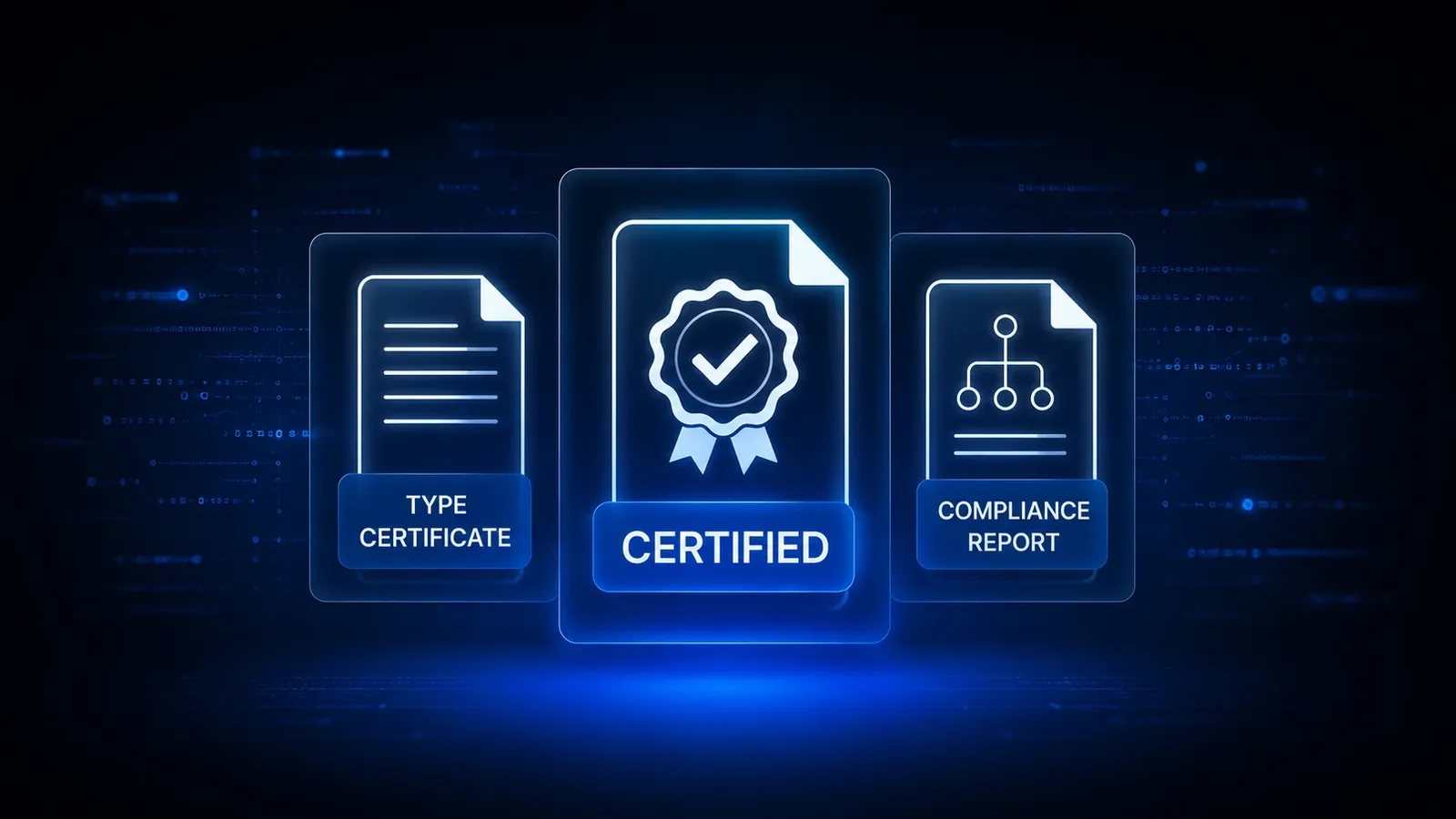
India's drone sector now operates inside a formal certification framework. Under the Drone Rules 2021, every drone above the Nano category must receive a Type Certificate before legal deployment in India. The rule applies to commercial, industrial, agricultural, and infrastructure drones across multiple weight classes. The certification process connects multiple agencies through a single approval workflow. The Directorate General of Civil Aviation (DGCA), the Quality Council of India (QCI), authorised Certification Bodies, testing laboratories, and wireless regulators all sit inside it.
The framework expanded after January 2022 when India launched the Certification Scheme for Unmanned Aircraft Systems (CSUAS). The scheme introduced structured testing standards, defined certification procedures, and recognised third-party testing bodies under an aviation-grade process. By December 2023, the government had also authorised the National Test House in Ghaziabad as a provisional Certification Body.
How the Drone Rules 2021 created the certificate
India's drone certification structure changed after the Ministry of Civil Aviation replaced the earlier Unmanned Aircraft System Rules with the lighter Drone Rules 2021 on 25 August 2021. The government reduced approval forms, simplified compliance steps, and shifted toward trust-based regulation. (Ministry of Civil Aviation, 25 August 2021)
Rule 7 of the DGCA drone rules created the legal foundation for the DGCA type certificate. The rule states that a drone requires a valid Type Certificate before operation in India unless it falls under an exempt category. The certificate validates drone airworthiness at the design level, covering propulsion, communication systems, software controls, safety architecture, and operational reliability, rather than each individual unit. This distinction matters because manufacturers and operators routinely confuse type certification with operational permissions.
The certification framework expanded again on 26 January 2022 when QCI introduced the Certification Scheme for Unmanned Aircraft Systems. The scheme aligned QCI drone certification with ISO/IEC 17065 product certification standards used across regulated manufacturing sectors. The CSUAS structure created three operational layers. A Multi-Stakeholder Steering Committee supervises policy direction. A Technical Committee defines evaluation standards and testing methods. Authorised Certification Bodies conduct physical inspections, testing, and compliance reviews.
This architecture changed how DGCA and MoCA regulate drones. The government no longer treats drones as isolated flying devices. The sector is now regulated as part of a larger aviation and manufacturing ecosystem tied to industrial policy, wireless compliance, and airspace security. Type certification has become the legal gateway into India's regulated drone economy, and every downstream approval, from registration to commercial deployment, depends on it.
Which drones need a type certificate
India classifies drones into five categories using maximum all-up weight (MAUW). The 250-gram threshold remains the most important dividing line in the framework. Nano drones weighing up to 250 grams remain exempt from Type Certification under current rules. Every category above Nano requires formal DGCA approval before operation, which is why the list of DGCA approved drones now spans every category from Micro upwards.
Micro drones cover aircraft above 250 grams and up to 2 kilograms. Small drones include aircraft above 2 kilograms and up to 25 kilograms. Medium drones include platforms above 25 kilograms and up to 150 kilograms. Large drones include every platform above 150 kilograms. The rule applies to drones used for agriculture, mapping, infrastructure inspection, industrial surveys, logistics, and commercial imaging. (Drone Rules 2021, Ministry of Civil Aviation)
Imported drones fall under the same compliance structure. Foreign-manufactured platforms still require recognition inside India's approval framework before lawful deployment. Rule 7 additionally allows the Director General to recognise approvals issued by foreign Contracting States under specific conditions. That clause matters because global drone certification systems are becoming more connected. Aviation regulators across the United States, Europe, and Asia are moving toward interoperable airworthiness standards for unmanned aircraft systems. Indian manufacturers exporting to those markets benefit from the future possibility of mutual recognition.
The type certificate also does not replace operational approvals. Operators still require separate permissions linked to registration on the Digital Sky platform, Remote Pilot Certification, and DigitalSky flight authorisation. A useful way to understand the framework is to read it alongside the drone categories under the Drone Rules 2021, because category and certification obligations move together.
How the DGCA approval workflow runs
The certification process starts long before physical testing begins. Approval delays in technical review almost always trace to two causes: incomplete technical records, or applications submitted before wireless clearances are in hand. The workflow begins with the manufacturer creating an account on the government aviation platform connected to DGCA approval systems. The applicant then submits Form D-1 with technical specifications, operational manuals, engineering drawings, subsystem details, maintenance records, and test documentation.
The documentation requirement is extensive. A complete Form D-1 submission includes communication system reports, propulsion details, battery specifications, ground test reports, flight test reports, safety architecture records, and maintenance inspection schedules. Wireless communication modules require Equipment Type Approval (ETA) clearance from the WPC Wing of the Department of Telecommunications before certification review begins. This is the single most common rejection trigger. ETA validates that the drone's radio frequency, transmission power, and communication protocols comply with India's wireless allocation framework. A type certificate application filed without ETA in hand will not progress past initial document verification.
After document verification, DGCA forwards the application to an authorised Certification Body or testing entity. The prototype undergoes technical evaluation, reliability testing, communication validation, operational assessment, and airworthiness review. The Drone Rules prescribe a maximum certification timeline of 75 days. Certification Bodies receive up to 60 days to complete testing and submit recommendations. DGCA receives another 15 days for final review after receiving the technical report. (Drone Rules 2021, Ministry of Civil Aviation)
The timeline holds when technical records match the declared drone configuration. Delays occur when the declared maximum weight differs from operational weight, or when maintenance documentation is incomplete. The approval process changed structurally after India's aviation systems began shifting toward the eGCA framework in 2025. Registration workflows, certification records, and operational approvals now operate through more connected digital systems. The earlier standalone structure has been replaced, a shift covered in detail in the eGCA migration guide.
Documents required for Form D-1
Form D-1 is the container, but the technical evidence sits in seven document families. Missing evidence in any one of them is the most frequent reason applications stall before testing begins. Certification Bodies flag incomplete evidence packs at first review, and the file returns to the applicant rather than moving into the laboratory queue.
Document family | What DGCA and the Certification Body expect |
|---|---|
Applicant and manufacturing | Company details, manufacturing address, applicant declaration |
Airframe and configuration | MAUW, dimensions, propulsion architecture, payload interface |
Engineering drawings | Structural drawings, electrical schematics, flight-control architecture |
Software and firmware | Version records, geofencing logic, remote identification, change logs |
Communication and wireless | Radio specifications, ETA clearance from WPC Wing |
Test evidence | Ground test reports, flight test reports, safety and reliability data |
Maintenance and lifecycle | Maintenance schedule, inspection procedures, component replacement plan |
The DGCA approval workflow treats these seven families as one integrated evidence pack. The file moves to a Certification Body only when every family is closed. First-time applicants should treat the drawing set and the software version record as the two lines most likely to slip, because both need engineering sign-off before Form D-1 is uploaded.
How much certification costs and how long it takes
The disclosed testing fee is only one line of the compliance budget. Manufacturers routinely underestimate the wider spend because the fee is public but the redesign, retesting, and wireless clearance costs are not. A first-time applicant should budget for at least three cost lines beyond the testing fee itself, and should treat the 75-day statutory clock as a floor rather than a ceiling.
Cost line | Notes |
|---|---|
Certification Body testing fee | ₹4.2 lakh disclosed by the National Test House; private bodies negotiate case-by-case |
Wireless clearance | ETA charges applied per radio module |
Documentation and drawings | Engineering support cost, borne by the manufacturer |
Retesting after non-conformance | Applied per failed test line |
Configuration amendment filings | Applied per supplementary application |
The statutory timeline is up to 75 days, split into 60 days for the Certification Body and 15 days for DGCA. The clock only starts once ETA is in hand and the technical file is complete. Delays almost always trace to weight mismatches between declared and operational configuration, incomplete software version records, or firmware changes filed mid-review.
Type certificate vs UIN, RPC and DigitalSky
Manufacturers, procurement officers, and first-time commercial operators regularly assume the type certificate covers every approval needed to fly. It does not. Type certification approves the drone model at the design level. Registration approves the individual aircraft. Pilot certification approves the person. Flight authorisation approves the specific operation. Each sits inside a different rule and cannot substitute for another.
Approval | What it covers | Who needs it |
|---|---|---|
Type Certificate | Approves the drone model design | Every drone above Nano category |
UIN registration | Identifies the individual aircraft | Every applicable unit |
Remote Pilot Certificate | Qualifies the remote pilot | Applicable commercial operations |
Flight authorisation on DigitalSky | Permits the specific flight | Applicable operations in controlled airspace |
ETA from WPC Wing | Clears the communication equipment | Applicable communication modules |
The practical answer to the "I have type certification, can I fly the drone?" question is that the drone model has been approved. The individual unit still needs UIN, the pilot still needs RPC, and the flight itself still needs DigitalSky drone permission in India where the airspace demands it.
Keeping the certificate valid after changes
A Type Certificate validates a specific drone configuration as approved on the date of issue. The certificate does not automatically extend to subsequent design changes. Manufacturers that modify propulsion architecture, communication subsystems, flight control firmware, or safety-critical components are required to file a supplementary application before the modified drone enters production or sale. CSUAS treats these as design amendments rather than new certifications, which keeps the review focused on the changed elements rather than the full prototype cycle.
Software-side changes receive specific attention. Firmware updates affecting flight control behaviour, geofencing logic, or remote identification protocols are now treated as certification-relevant events. Manufacturers maintaining a Type Certificate are expected to keep configuration records, software version histories, and component change logs available for audit. Compliance traceability is becoming the operational hinge of certification. The certificate represents not a one-time approval but a continuing declaration that the drone in production matches the drone that was tested.
Freezing the drone before you apply
The certificate approves the exact drone that was tested. Manufacturers that submit before the airframe, propulsion, communication, and firmware are frozen almost always land in a redesign loop. Before Form D-1 is filed, the applicant should have MAUW verified across every document, propulsion and battery specifications locked, communication modules and their ETA clearance in hand, ground and flight test evidence complete, and the software version stamped and archived. Any change after certification triggers a supplementary filing rather than a full new application.
Change to a certified drone | Certification impact |
|---|---|
Motor or propeller change | Supplementary application typically required |
Battery chemistry or capacity change | Supplementary application typically required |
Flight controller change | Full retesting of affected subsystems |
Firmware affecting flight, geofencing, or Remote ID | Software-side amendment filing |
Communication module change | Fresh ETA plus supplementary filing |
Payload interface change | Reviewed against certified payload envelope |
Structural change | Reviewed against original airworthiness evidence |
DGCA approval is therefore not a one-time gate. It is a continuing declaration that every production unit matches the drone that was tested, and configuration control is what keeps the certificate valid over the drone's operational life.
Why applications get rejected
Failed submissions rarely fail on technical merit. They fail on evidence hygiene, on filing sequence, or on configuration drift between the drawing set and the physical prototype. Certification Body reviewers see the same seven patterns repeat across applicant cohorts, and each one is preventable at the applicant's end before the file leaves the manufacturer's office.
The most frequent failure trigger is filing before ETA is issued, which halts the file at initial verification. The second is a MAUW figure that differs between the airframe drawing, the operational manual, and the flight test report. The third is a firmware version mismatch, where the prototype tested carries a different build to the version listed on Form D-1. The fourth is incomplete maintenance documentation, particularly the inspection schedule and component replacement plan. The fifth is a communication module change made after Form D-1 upload but before laboratory testing, which restarts the wireless clearance line. The sixth is treating the type certificate as flight permission, which surfaces later as a compliance gap during airspace clearance. The seventh is assuming the certificate automatically covers a modified variant, which the CSUAS amendment structure specifically prevents.
Who runs the testing in India
India initially approved three Certification Bodies under the CSUAS framework after the scheme launched in 2022. TQ Cert Services, UL Solutions India, and Bureau Veritas India received QCI authorisation as drone certification bodies in India during the first cohort. They continue to handle technical reviews, product testing, and compliance validation. (Quality Council of India, 2022) Each operates under ISO/IEC 17065 protocols, which is what allows their recommendations to flow into DGCA's final review without further audit.
The government expanded the network in December 2023 by approving the National Test House in Ghaziabad as a provisional Certification Body. The decision brought a public-sector laboratory into the CSUAS framework alongside the three private bodies. The Ministry of Consumer Affairs stated that the laboratory had already processed more than 50 drone certification applications at the time of approval. (Ministry of Consumer Affairs, 29 December 2023) The National Test House also disclosed a certification fee of approximately ₹4.2 lakh, the lowest publicly disclosed rate in the sector. (Ministry of Consumer Affairs, 29 December 2023) That figure matters because compliance cost is the single largest barrier for smaller manufacturers entering regulated sectors.
The full certification budget extends well beyond the testing fee itself. Manufacturers also spend on prototype redesigns, electromagnetic interference testing, communication validation, wireless approvals, documentation preparation, and compliance support. The compliance burden rises further for drones carrying heavier payloads, advanced communication systems, or industrial operating equipment.
This certification network now plays a structural role in India's manufacturing policy. The PLI Scheme for Drones was notified by the Ministry of Civil Aviation in September 2021 with a ₹120 crore allocation. The scheme ties incentive eligibility to verifiable compliance, and type certification is the verification mechanism. Import restrictions, localisation targets, and operational approvals all depend on the same enforceable check. Drone manufacturing compliance in India has moved from a soft expectation to a hard gating condition.
What defence-adjacent operators need to know
Type Certification applies to a wider set of operators than commercial manufacturers alone. Drones operated directly under the Ministry of Defence are typically exempt from civil aviation certification. Defence-adjacent entities, including paramilitary forces, state police units, disaster response teams, and private defence contractors, fall under DGCA jurisdiction in most operational contexts. Procurement officers in these organisations regularly assume the defence exemption applies more broadly than it does, which creates downstream compliance exposure when platforms move from procurement to deployment. Verifying Type Certificate status before procurement closes is the cleanest preventive step.
What is changing after 2025
India's regulatory direction after 2025 points toward tighter operational enforcement and stricter compliance accountability. The Bharatiya Vayuyan Adhiniyam 2024 came into force on 1 January 2025, replacing the older Aircraft Act. It rebuilt the statutory frame for civil aviation in India, including unmanned systems. The draft Civil Drone Bill released for consultation in September 2025 proposed stronger penalties for restricted-airspace violations. It also proposed expanded insurance obligations and broader enforcement powers linked to drone operations. (Ministry of Civil Aviation, 16 September 2025) The proposed framework does not remove the existing five-category structure created under the Drone Rules 2021. Instead, it strengthens how compliance is monitored after certification approval, as detailed in the Civil Drone Bill 2025 analysis.
Manufacturers should expect greater scrutiny around software integrity, communication security, remote identification systems, and firmware traceability over the next regulatory cycle. Lifecycle compliance is also becoming more important. Regulators now expect manufacturers to maintain records linked to serial numbers, software updates, maintenance logs, and communication hardware changes throughout the operational life of the drone.
The operational environment is changing at the same time. India is pushing drones into logistics, industrial inspection, agriculture, disaster response, and infrastructure monitoring at a much larger scale than during the early commercial drone phase. That expansion increases regulatory pressure. Aviation authorities now treat drones as part of national airspace infrastructure rather than isolated commercial devices.
Manufacturers that treat drone certification as a late-stage paperwork process will face higher redesign costs, longer approval delays, and tighter operational restrictions as the framework matures. India's drone manufacturing ecosystem will scale only when regulatory credibility and industrial growth advance through the same certification stack. Mapping that stack is exactly what the drone laws in India pillar was built to