India's drone compliance system, built on the Drone Rules 2021 and the wider drone laws in India, depends on a cryptographic approval chain that begins before the motors arm. Under the Directorate General of Civil Aviation's No Permission No Takeoff framework, every drone above the Nano category must validate a digitally signed Permission Artefact issued through DigitalSky before takeoff. The framework originated under Civil Aviation Requirements Section 3, Series X, Part I in August 2018 and integrated into the Drone Rules 2021. Since July 2025, drone registration shifted to eGCA while the Digital Sky platform retained flight authorisation and NPNT enforcement responsibilities, and the DigitalSky portal now issues every Permission Artefact through the DGCA approval chain. This architecture makes India one of the few jurisdictions that enforce flight permission directly inside drone firmware rather than through post-flight enforcement alone. (DGCA, 27 August 2018) (Ministry of Civil Aviation, 26 August 2021)
Building enforcement into firmware
NPNT stands for No Permission No Takeoff. The term describes a firmware-level lock that prevents compliant drones from arming without a valid flight authorisation file. The approval itself arrives as a digitally signed Permission Artefact generated through DigitalSky after the operator submits flight details.
Operators sometimes search for a Digital Sky app or an NPNT app download, but NPNT is not a standalone app. It is a firmware feature that pairs with the Digital Sky platform (also written as DigitalSky in current DGCA documentation) and the drone's Registered Flight Module. DGCA NPNT compliance now sits as a standard procurement filter alongside DGCA drone rules for Type Certification, UIN registration, and DGCA approval for any operator working in commercial airspace.
This model differs from traditional aviation compliance, where authorities investigate violations after the flight. India's framework moves enforcement upstream into the aircraft. The firmware verifies whether the flight envelope, pilot identity, location boundaries, altitude ceiling, and operating window match the signed permission. If validation fails, the motors remain locked.
The framework evolved after regulators struggled to scale manual drone approvals during the first phase of commercial UAS adoption. Earlier draft systems required operators to submit flight plans up to 60 days in advance. NPNT replaced that process with API-driven approvals that arrive within minutes for green-zone operations. The standard NPNT envelope caps at 120 metres or 400 feet AGL in green zones, with stricter ceilings inside controlled airspace.
The policy also aligned with India's wider push for indigenous drone manufacturing under the drone rules India framework, after the government restricted fully built drone imports in February 2022. Domestic manufacturers including ideaForge, Asteria Aerospace, Garuda Aerospace, IoTechWorld, and Dhaksha adopted NPNT-compatible architectures for commercial and government deployments. (Directorate General of Foreign Trade, 9 February 2022)
The Nano category and certain government, defence, and law-enforcement operations remain outside the standard NPNT permission flow. Those exemptions are covered separately later in this article.
Who needs NPNT compliance in India
The full exemption framework sits later in this article, but most operators reach this page looking for a quick decision. The table below is that decision, keyed to weight class and operation type under the Drone Rules 2021 and the wider drone laws in India.
Drone or operation | NPNT requirement | What to check |
|---|---|---|
Nano drone under 250 g in green zone | Exempt from Permission Artefact | Weight, altitude ceiling, uncontrolled airspace |
Micro drone in green zone below 200 feet | Intimation flow only | DigitalSky intimation, no signed artefact |
Small, Medium, or Large drone in any zone | Full NPNT Permission Artefact | UIN, Type Certificate, DigitalSky permission |
Any commercial operation above Nano | Full NPNT Permission Artefact | Remote Pilot Certificate plus signed artefact |
Defence, government, or law-enforcement operation | Separate authorisation pathway | MoD or security-agency approval outside DigitalSky |
Experimental or exempt operation | Case-specific | DGCA conditional exemption letter |
If the operation falls above the Nano threshold and outside a formal exemption, DGCA NPNT compliance applies. Everything else on this page unpacks how the check runs, what the Permission Artefact contains, and what fails when the firmware refuses to arm.
NPNT vs DigitalSky vs eGCA
Operators searching for the DigitalSky portal, the eGCA framework, or an NPNT app often reach the same page because the three names describe overlapping but distinct parts of India's drone compliance chain. The mapping below fixes that.
Layer | Role | Runs on |
|---|---|---|
eGCA | Drone registration, UIN issuance, Type Certificate, Remote Pilot Certificate | Directorate General of Civil Aviation applicant portal at dgca.gov.in/digigov-portal |
DigitalSky | Airspace permission, NPNT enforcement, Permission Artefact generation, digital sky portal for flight authorisation | Ministry of Civil Aviation DigitalSky platform |
NPNT | Firmware-level compliance mechanism that validates the artefact and locks motors on failure | Registered Flight Module on the drone itself |
NPNT is not an app or a portal. Operators searching for a digital sky app or an NPNT download are looking for a firmware layer that only functions when the drone, the UIN, the Type Certificate, and the DigitalSky Permission Artefact align through the correct DGCA approval chain.
Understanding the Permission Artefact
The Permission Artefact is the technical core of the NPNT framework. Public explanations describe it as a permission file. The artefact is a structured XML document secured through XML Digital Signature standards, commonly referred to as XMLDSig.
The artefact carries pilot identification and drone UIN, the approved latitude-longitude polygon, the maximum altitude ceiling, the takeoff-and-landing window, and the digital signature plus certificate validation data needed to verify origin. The signature structure itself includes SignedInfo, DigestValue, SignatureValue, and X509Certificate blocks. These components allow the drone's Registered Flight Module to verify that the permission originated from an authorised DigitalSky signing authority and was not modified after issuance. (iSPIRT ProductNation, September 2019) (QCI RPAS Scheme Section 3, January 2021)
The artefact also carries a limited validity window. Industry implementation guidance published during the first NPNT rollout specified that the validation handshake must complete within roughly three minutes of artefact activation. Operators preload the artefact in remote deployments because the validation itself happens locally on the drone rather than through continuous internet connectivity.
That offline capability matters for infrastructure inspection, agricultural spraying, disaster assessment, and forest survey operations where cellular connectivity remains inconsistent. Once validated, the drone continues operating within the approved flight envelope unless it breaches altitude or geofence restrictions.
The takeoff handshake step by step
The validation sequence runs in a fixed order before motor arming. The Registered Flight Module first reads the Permission Artefact from local storage. It then computes the digest of the SignedInfo block and compares the result against the DigestValue carried in the artefact. The module verifies the SignatureValue against the public key extracted from the embedded X509Certificate. That step confirms the artefact came from DigitalSky and has not been altered.
The firmware then cross-checks live flight conditions against the approved envelope. Current GPS coordinates must fall inside the approved latitude-longitude polygon. The barometric altitude must remain below the approved ceiling. The system clock must read within the approved takeoff-and-landing window. The drone UIN encoded in the artefact must match the UIN burned into the firmware.
Motor arming proceeds only after all checks succeed. If any single check fails, the firmware refuses to arm and writes the failure into a signed event log for later inspection. (Flykit Technical Reference, November 2019)
Comparing international approaches
Framework | Country / Region | Primary mechanism | Pre-flight approval required | Firmware-level takeoff lock |
|---|---|---|---|---|
NPNT | India | Signed Permission Artefact | Yes | Yes |
Remote ID | United States | Broadcast identification | No | No |
U-space Direct Remote ID | European Union | Network and broadcast ID | Limited | No |
UTM research systems | United States | Traffic management coordination | Experimental | No |
SAFE flight envelope | Canada | Geofence envelope | Yes | Limited |
India's approach remains unusual because enforcement occurs before takeoff rather than through identification and post-flight penalties alone. (FAA Remote ID Final Rule, January 2021) (EASA U-space Regulation, January 2023)
NPNT vs geofencing vs Remote ID: three different problems
NPNT, geofencing, and Remote ID are treated as interchangeable in casual coverage. They solve different problems and act at different points in the flight cycle. The mapping below separates them.
Technology | Primary purpose | When it acts |
|---|---|---|
NPNT | Authorises the flight before motors arm | Before takeoff and continuously during the mission |
Geofencing | Restricts the drone from entering defined polygons | During the flight |
Remote ID | Broadcasts drone identity, position, and operator to receivers on the ground | During the flight |
UTM | Coordinates multiple drone missions across shared airspace | Across concurrent operations |
NPNT is not simply geofencing. Geofencing prevents movement across a boundary. NPNT prevents motor arming without a signed permission and locks the drone into a specific envelope for the mission window. The distinction is what makes India's model unusual in international comparison.
Traditional aviation enforcement runs on the sequence: flight, then violation, then detection, then investigation, then penalty. The NPNT model inverts that. Permission comes first, validation runs on the drone, and only then does takeoff occur.
Securing the Registered Flight Module
The Registered Flight Module, or RFM, performs the permission verification process. It acts as the trusted hardware layer between DigitalSky approvals and the drone's flight controller. The module also handles three further responsibilities as defined in DGCA's RPAS Guidance Manual: drone registration validation, permission-to-fly verification, and the production of signed flight log data after the mission ends. (QCI RPAS Scheme Section 3, January 2021)
Early NPNT implementations used software-based key management systems referred to as Level 0 compliance. In these architectures, encryption keys and verification logic operate inside companion computing hardware. Newer systems use Level 1 architectures where secure hardware modules or FPGA-backed security components protect signing keys against tampering. Defence and BVLOS programmes specify hardware-secured implementations because software-only architectures remain more exposed to firmware modification attempts. The procurement distinction matters because Level 1 hardware-secured keys remain protected against the same firmware-modification routes that have compromised software-only Level 0 systems in adversarial testing.
The same public-key infrastructure supporting NPNT verification also supports authenticated firmware updates. When a manufacturer pushes a firmware revision, the update package carries a signature from the manufacturer's signing certificate. The drone validates that signature against the trusted certificate chain before applying the update. If an unauthorised firmware package attempts to bypass NPNT restrictions, compliant drones reject the update because the package lacks a trusted signing certificate. The same mechanism prevents downgrade attacks where an operator tries to flash an older firmware version that lacked NPNT enforcement. This approach mirrors secure-boot models already common in military communications and critical infrastructure systems. (AeroMegh Technical Briefing, 2024)
The ecosystem also depends on third-party providers beyond drone manufacturers themselves. Several companies operate as Flight Module Providers that integrate NPNT verification into drone systems supplied to enterprise operators. Indian Flight Module Providers include PDRL's AeroGCS - used by the majority of Indian drone manufacturers - alongside AeroMegh and the open-source Aerobridge stack maintained by the Indian developer community. The architecture stacks drone manufacturer hardware at the base, with the Registered Flight Module provider supplying firmware on top, the ground control software interface managing operator interaction, and DigitalSky permission infrastructure issuing the artefacts that flow through the entire chain. The separation allows operators to update mission software without redesigning the underlying NPNT security layer.
Handling envelope breaches mid-flight
NPNT enforcement does not stop after motor arming. The Registered Flight Module monitors live flight conditions against the approved envelope for the full mission duration. A breach occurs when GPS position drifts outside the approved polygon, when altitude exceeds the approved ceiling, or when the system clock crosses the approved landing time.
Compliant drones respond through configured failsafe behaviour. The default response triggers automated return-to-home, where the drone climbs to a safe altitude and navigates back to the recorded launch coordinates. Some platforms support controlled mission termination instead, where the drone executes a slow descent at the breach point. The selected failsafe depends on platform architecture, payload risk, and the operating mode active during the breach.
The drone also writes signed operational logs throughout the mission. These logs record GPS tracks, altitude profiles, breach events, and the full Permission Artefact reference. The logs sign with the RFM private key, producing a tamper-evident audit trail that authorities can review after the mission. The Ministry of Civil Aviation directed enforcement teams to draw on these logs during incident investigations near airports, strategic facilities, and urban airspace corridors during the 2023-to-2025 enforcement cycle. (Ministry of Civil Aviation enforcement directives, 2025)
From the operator's perspective, seven failure modes cover almost every real-world NPNT rejection. The Permission Artefact may be missing, the artefact may have expired, the drone UIN may not match, the current GPS position may sit outside the approved polygon, altitude may exceed the ceiling, the artefact digital signature may fail verification, or the firmware itself may fail integrity checks. Before takeoff, any of these seven produces a hard motor-arm block. During the flight, the same failure classes route into the configured failsafe: automated return-to-home or controlled mission termination depending on payload risk and platform architecture.
Where NPNT does not apply
The NPNT permission flow covers most commercial drone operations, but several categories operate outside it. Nano drones below 250 grams flying below 50 feet in uncontrolled green-zone airspace do not require a Permission Artefact. The exemption recognises that the safety risk from a sub-250-gram drone at low altitude does not justify the firmware compliance burden.
Micro-category drones flying below 200 feet in green zones operate on an intimation flow rather than a full drone permission flow. Operators notify the DigitalSky portal of the planned flight time and location through the platform but do not receive a signed Permission Artefact. The intimation flow keeps the regulatory record without imposing the full firmware-validation overhead on lower-risk operations. (Drone Rules 2021, Rule 34)
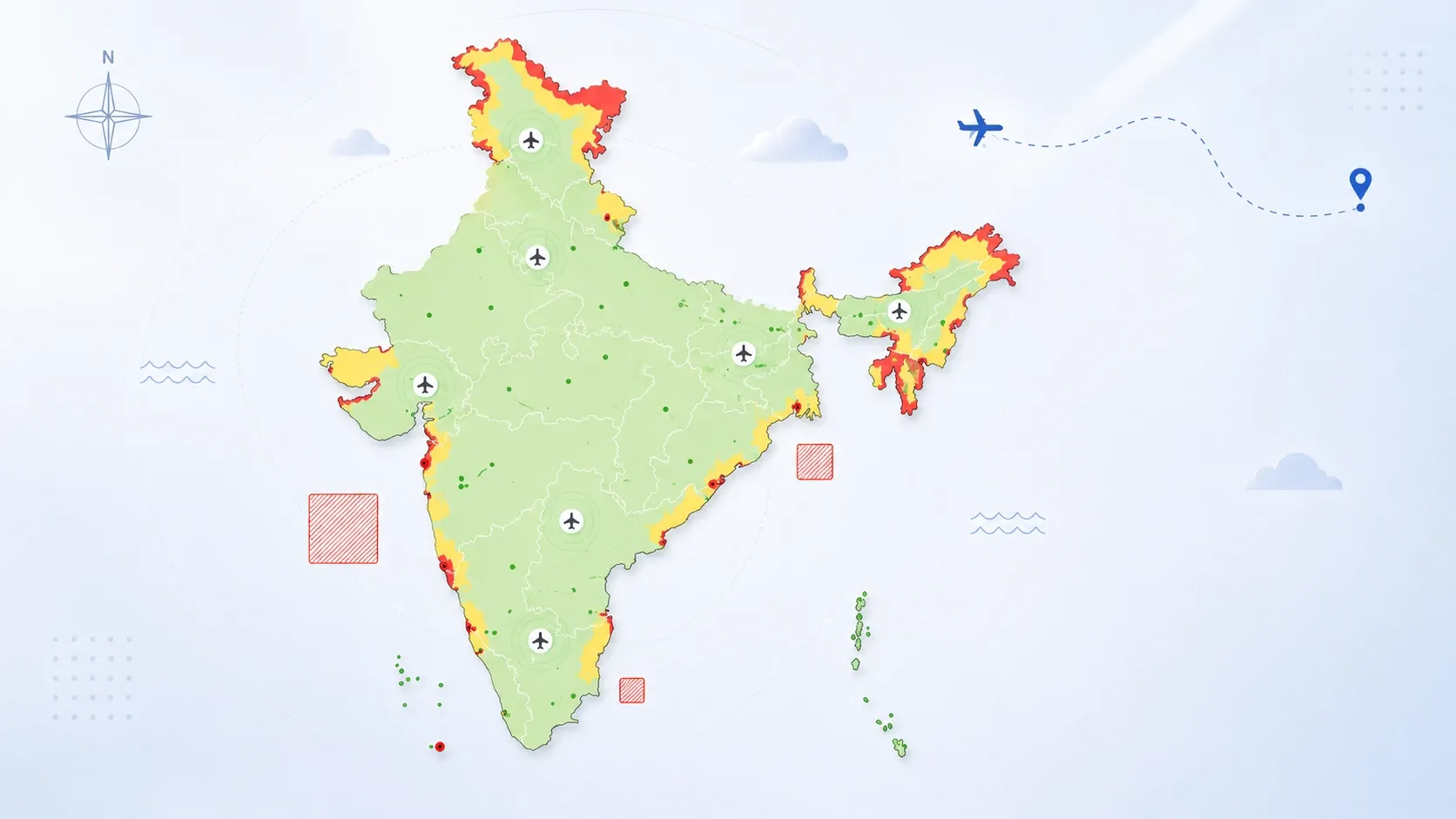
Yellow Zone operations require ATC coordination through DigitalSky before any flight, regardless of weight category, and the standard NPNT permission flow applies on top of that ATC clearance. Red Zone operations remain blocked unless the operator obtains specific authorisation from the relevant security authority - typically the Ministry of Defence, AAI, or the local airport operator depending on the zone designation. The full mapping of green, yellow, and red zones under the drone rules 2021 sits inside the drone airspace zone map.
Government, defence, and law-enforcement drones operate under separate authorisation pathways defined through the Ministry of Defence and the relevant security agencies. These pathways include CEMILAC certification for military airworthiness and dedicated mission approval channels that sit outside DigitalSky entirely.
Conditional research exemptions cover specific experimental programmes. The Telangana medical-delivery trials received DGCA conditional exemption for BVLOS operations during 2021 and 2022, allowing operations that did not fit cleanly inside the standard NPNT envelope. Comparable exemptions support agricultural research, disaster-response trials, and academic flight testing on a case-by-case basis. Operators outside these defined exemptions remain inside the standard NPNT permission flow regardless of mission purpose.
NPNT-compliant manufacturers in India
The current NPNT-compliant drones list in India is gated by the DGCA Type Certificate framework, which sits inside the wider DGCA approval architecture. A drone receives a Type Certificate only after testing through QCI-accredited laboratories that verify NPNT firmware behaviour against the published specification, and only then does the aircraft qualify for a drone license India workflow through eGCA and the DigitalSky permission flow. The first DigitalSky-enabled NPNT flight took place in 2020 using Asteria Aerospace's A200 micro drone, which served as the proof-of-concept for the firmware-level enforcement model now applied across the commercial fleet.
The current NPNT-compliant manufacturer list includes ideaForge for surveillance and industrial mapping, Asteria Aerospace for security and defence applications, IoTechWorld for agricultural spraying drones, Garuda Aerospace for agriculture and delivery applications, Throttle Aerospace Systems for surveying, Dhaksha Unmanned Systems for tactical and agricultural roles, Paras Defence and Aerospace for defence-grade platforms, and General Aeronautics for industrial inspection. Several other domestic manufacturers including Tata Advanced Systems, Adani Defence, and Newspace Research operate in the defence-grade NPNT-compliant fleet.
DJI consumer and enterprise drones are not NPNT-compliant by default. The reasons are policy-driven rather than technical, and they are covered in the next section. Custom-built drones using flight controllers like Pixhawk fall outside the NPNT-compliant fleet because they cannot receive a UIN through the standard registration flow without a Type Certificate. Open-source NPNT implementations exist on the ArduPilot platform, but the resulting drone still requires formal DGCA certification and laboratory testing before it can legally operate as NPNT-compliant. Builders can enlist non-NPNT drones for ground-only or experimental status, but those drones cannot legally fly under standard commercial permissions. The constraint significantly shapes how the type certification process interacts with the procurement choices available to Indian operators.
Why DJI drones are not NPNT-compliant in India
The DJI question shapes most operator-side conversations about NPNT because DJI dominates the global consumer and enterprise drone market everywhere except India. DJI publicly criticised the early NPNT framework in 2019 and proposed an alternative No Notification, No Takeoff model that relied on operator declarations rather than mandatory pre-flight government approval. The company argued that the original NPNT specification would classify roughly half of India's landmass as restricted airspace, which would make routine commercial operations infeasible.
Regulators later softened the green-zone framework under the Drone Rules 2021, expanding the permitted airspace meaningfully. The disagreement nonetheless contributed to DJI's decision not to introduce officially supported NPNT-compliant variants of its consumer platforms in India. The 2022 DGFT import restrictions then compounded the issue by stopping new-model imports through official channels, tightening the DGCA drone rules on foreign-manufactured aircraft entering the Indian commercial fleet.
The result is a market where DJI drones imported before 2022 still operate physically but cannot receive Permission Artefacts. Operators flying these aircraft remain exposed to enforcement action under the Drone Rules 2021 because operating a non-NPNT drone outside the Nano exemption is itself a violation regardless of the original purchase date. The position remains unresolved and shapes the entire commercial drone procurement decision in India in 2026.
The enforcement reality
NPNT solved the policy problem of how to scale drone permissions without solving the parallel problem of how to enforce compliance against non-compliant drones already in the country. Industry analysis published through 2024 and 2025 estimates that thousands of non-NPNT drones operate inside India through legacy DJI imports, custom Pixhawk builds, modified flight controllers, and grey-market entries. (Aviation World policy analysis, 2024)
Local enforcement agencies face two practical limitations. First, NPNT compliance is invisible from the outside of a drone. A police constable cannot verify firmware compliance through visual inspection alone. Second, portable verification tools that interrogate a drone's NPNT state in the field are not standardised across enforcement agencies. The result is that enforcement triggers reactively, after a complaint, an incident, or surveillance flagging at sensitive sites such as airports, defence installations, and government complexes.
The framework therefore operates more strongly as a procurement filter than a flight-time enforcement layer. Enterprise operators, government contractors, and BVLOS-corridor participants comply because their operations are visible, audited, and procurement-gated. Hobbyists, recreational FPV builders, and individual operators outside enterprise channels remain partially outside the firmware-enforced fleet. The enforcement gap is not a flaw in the NPNT design - it is a consequence of how compliance was layered onto a market that already contained non-compliant hardware. The drone penalty regime closes part of this gap by making enforcement consequences serious enough to deter visible non-compliance, even where field verification is impractical.
NPNT under the Civil Drone Bill 2025
The draft Civil Drone (Promotion and Regulation) Bill 2025 will reshape NPNT enforcement if enacted in its current form. The Bill proposes to elevate NPNT compliance from subordinate rule into primary legislation, which strengthens the legal weight behind firmware-level enforcement. It also proposes criminal penalties including jail terms for several drone violations that currently attract civil penalties under the Drone Rules 2021.
Industry analysis raised three specific concerns about the draft. First, the criminalisation of routine compliance violations risks treating commercial misconfiguration the same as malicious intent. Second, the Bill grants police search-and-seizure powers that allow on-the-spot drone confiscation, which creates operational risk for enterprise operators flying expensive equipment under tight project deadlines. Third, the Bill contains limited provision for regulatory sandboxes or experimental BVLOS carve-outs, which restricts the pathways for innovation that the Drone Rules 2021 had begun to open.
The Bill remained in draft consultation as of early 2026. The Drone Rules 2021 continue operating in parallel until the Bill is enacted in final form. Compliance officers planning multi-year drone deployments treat the draft as a probable two-year forward risk and include criminal-liability scenarios in their procurement and insurance analyses.
The 5G and U-space future of NPNT
The current NPNT model issues a Permission Artefact valid for a fixed envelope and a fixed time window. The next generation of unmanned traffic management moves toward continuous network authorisation, where drones maintain a live connection to the UTM platform throughout the mission rather than validating an artefact once at takeoff. IG Drones demonstrated India's first 5G-enabled drone, Skyhawk, in 2024 - a platform built explicitly around continuous connectivity rather than pre-validated envelopes.
The shift matters because 5G network slicing allows aviation regulators to allocate dedicated low-latency channels for drone telemetry. Continuous authorisation removes the offline-validation tradeoff that the current Permission Artefact model accepts. A dynamic UTM coordinator can adjust permission boundaries in real time based on weather, manned-aviation movements, temporary no-fly orders, and evolving Indian airspace congestion. This is the architecture that EASA's U-space framework moves toward in the European Union, and the direction India is expected to follow as 5G coverage matures.
The NPNT firmware lock will not disappear in this future. The lock becomes the enforcement floor that activates when network connectivity drops, the regulator revokes permission mid-flight, or the drone enters a dynamically declared restricted volume. Operators who already standardise on Level 1 RFM hardware and DGCA-certified firmware will find the transition easier than operators relying on Level 0 software-only implementations.
NPNT in practice: Namo Drone Didi and self-help groups
The Namo Drone Didi initiative places agricultural drones in the hands of women's self-help groups across rural districts for fertiliser spraying and precision agriculture. The drones supplied through the scheme are NPNT-compliant by manufacturing requirement, and most are agricultural-spraying platforms from IoTechWorld, Garuda Aerospace, and Dhaksha Unmanned Systems.
The operational reality matters because most Drone Didi pilots are first-time drone operators with no prior aviation background. The firmware lock protects them from inadvertently flying outside permitted envelopes — a category of error that experienced pilots manage through training and experience. The Permission Artefact effectively transfers airspace-awareness responsibility from the pilot to the system.
The same architecture supports infrastructure inspection contracts, mining surveys, logistics pilots, and state disaster-response operations. Enterprise operators planning beyond-visual-line-of-sight missions treat NPNT compatibility as a baseline procurement requirement rather than an optional feature.