The Indian Army unveiled the Sapper Scout RP Ver 2.0 at Inno-Yoddha 2025 on 5 December 2025 (Indian Army, 5 December 2025). It is India's first indigenous multi-utility unmanned ground vehicle, and its debut signalled a shift from single-purpose military robots toward multi-role ground systems. This analysis reads India's unmanned ground vehicle effort through a develop-validate-induct pipeline. Each DRDO laboratory owns a weight class, each platform serves a mission, and the gap between trials and induction explains the fielded fleet.
Defining the unmanned ground vehicle in the Indian context
An unmanned ground vehicle is a land platform that performs tasks without an onboard operator. Unmanned ground systems include the vehicle, its sensors, communications architecture, control station, autonomy stack, and mission payloads (DRDO).
India's unmanned ground vehicles span multiple categories. Some carry robotic arms for explosive ordnance disposal. Others perform reconnaissance, mine detection, logistics support, or chemical, biological, radiological and nuclear sensing. The operational requirement shapes the platform architecture, not the reverse.
A bomb-disposal robot differs from a combat UGV because its mission profile is tightly constrained. It moves slowly, operates under direct operator control, and focuses on manipulation tasks. A combat UGV instead demands mobility across difficult terrain, survivability, persistent communications, sensor fusion, target classification, and integration into tactical command networks.
This distinction matters because public discussion groups all military robots into a single category. The Indian Army's operational reality is different. Bomb-disposal robots have already entered service, reconnaissance and surveillance UGVs have completed validation exercises, and combat UGV concepts remain in development and evaluation (DRDO Technology Focus, April; DRDO).
AI now shapes this progression. Modern unmanned ground systems pair obstacle identification, route planning, and edge inference with computer vision that guides unmanned platforms to reduce operator workload. These functions improve mobility and mission effectiveness without crossing into fully autonomous target engagement.
Dividing the work across four DRDO robotics laboratories
DRDO UGV development follows a structured laboratory model. Rather than concentrating military robotics work inside one organisation, DRDO distributes responsibility across laboratories aligned to platform size and mission category (DRDO). This division explains much of India's unmanned ground vehicle progress.
Laboratory | Weight class | Focus area | Example programmes |
|---|---|---|---|
CAIR | 5 kg to 50 kg | Small robotics and autonomy | Mini UGVs, legged systems |
R&DE(E) | 1 to 3 tonnes | Engineering systems | Daksh and support platforms |
VRDE | Up to 5 tonnes | Wheeled mobility systems | Tactical ground vehicles |
CVRDE | Above 5 tonnes | Tracked combat platforms | MUNTRA and combat UGV concepts |
The Centre for Artificial Intelligence and Robotics (CAIR) develops lightweight robotic platforms, autonomy software, computer vision, and perception technologies. Research and Development Establishment Engineers builds operational support robots and engineering systems. Vehicle Research and Development Establishment develops wheeled mobility platforms, while Combat Vehicles Research and Development Establishment leads tracked military vehicle programmes (DRDO).
This structure explains why DRDO unmanned ground vehicle programmes can look fragmented to outside observers. Different laboratories solve different operational problems, and they sit within India's defence drone landscape of parallel air, ground, and counter-UAS efforts. A lightweight reconnaissance robot and a tracked combat vehicle share some autonomy technologies, but they follow separate development tracks and procurement pathways.
For defence integrators, this laboratory map is more useful than a platform catalogue. It reveals where capability gaps, technology partnerships, and procurement opportunities will emerge.
Disposing of explosives with the platforms already in service
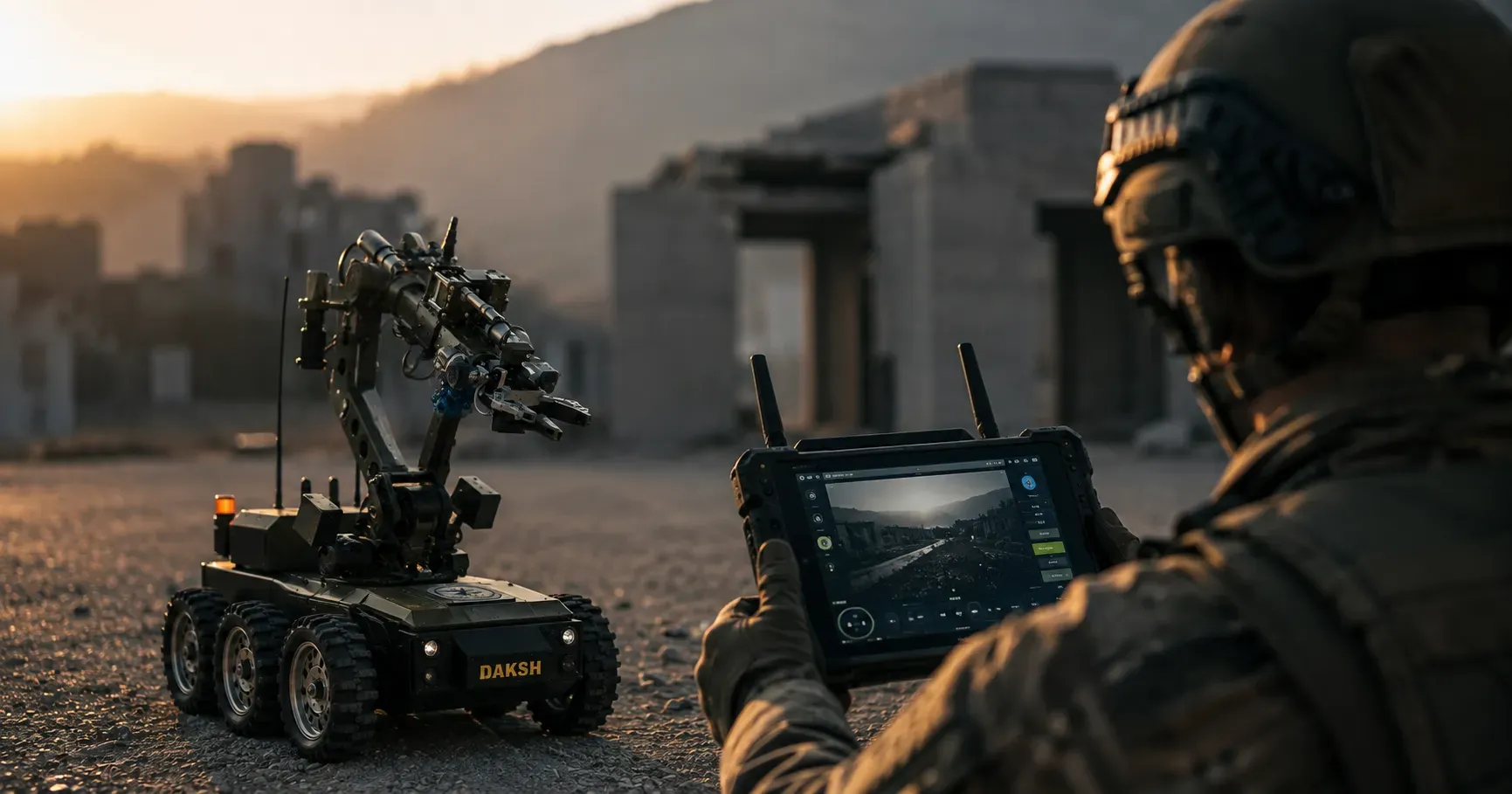
Bomb disposal robots form the longest-fielded segment of the country's military robotics portfolio. The best-known bomb disposal robot India operates is the Daksh, developed by Research and Development Establishment Engineers with autonomy technologies from CAIR (DRDO, 19 December 2011).
The Daksh bomb disposal robot was designed to inspect, manipulate, and neutralise suspicious objects from a safe distance. The platform carries a robotic arm, cameras, communications systems, and payload options. Early operational variants provided line-of-sight control to approximately 500 metres and reached an indigenous content level near 90 percent (DRDO, 19 December 2011).
The fielding record shows how slowly the induction gate opens. The first batch of five Daksh units reached the Corps of Engineers on 19 December 2011 (DRDO, 19 December 2011). The Army's initial order ran to roughly 20 platforms. Technology transfer to Indian production firms followed, widening the manufacturing base under the Make in India drive in defence.
The significance of Daksh extends beyond explosive ordnance disposal. It showed that indigenous military robotics could cross from laboratory development into operational use. That transition remains the hardest step in the develop-validate-induct pipeline.
Daksh also introduced capabilities that still shape military robotics India programmes today. Remote manipulation, computer vision, sensor integration, and operator-assisted autonomy remain foundational building blocks for the unmanned ground vehicle for the Indian Army.
The platform illustrates an important point. Successful fielding does not require full autonomy, because the military value comes from removing personnel from hazardous situations while holding operational control. This approach aligns with India defence robotics philosophy, where automation strengthens the operator rather than replacing human oversight.
Tele-operating the tracked surveillance vehicles
The MUNTRA unmanned ground vehicle family shows how India moved beyond explosive ordnance disposal into battlefield reconnaissance and specialised surveillance. Combat Vehicles Research and Development Establishment built the series on a tracked infantry combat vehicle base and introduced it in 2017 (DRDO CVRDE, 2017).
MUNTRA runs in three mission variants. MUNTRA-S handles surveillance, MUNTRA-M supports mine detection, and MUNTRA-N performs reconnaissance in hazardous environments (DRDO CVRDE). Field evaluations at the Mahajan Field Firing Range in Rajasthan validated multiple configurations under operational conditions.
Unlike bomb-disposal robots, MUNTRA platforms operate as larger tracked systems that support military manoeuvre units. DRDO's wider listing also records smaller machines, including the Suchak CBRN mini-UGV for nuclear and chemical reconnaissance and a miniature unmanned ground vehicle for confined spaces (DRDO). The catalogue spans grams to tonnes, mirroring the laboratory weight-class split.
These platforms show how a UGV for high-altitude border surveillance differs from a bomb-disposal robot. Surveillance vehicles prioritise endurance, mobility, sensor integration, and communications reliability. They must cross difficult terrain while transmitting information to operators and command networks.
The MUNTRA unmanned ground vehicle programme also marks the move toward greater automation. Sensor fusion, route-assistance functions, obstacle detection, and mission-support software reduce operator burden while preserving human control over tactical decisions. This sequence mirrors global military robotics work, where automated mobility matures first and higher-level autonomy follows, once communications, doctrine, and procurement frameworks catch up.
Advancing autonomy through the legged-systems programme
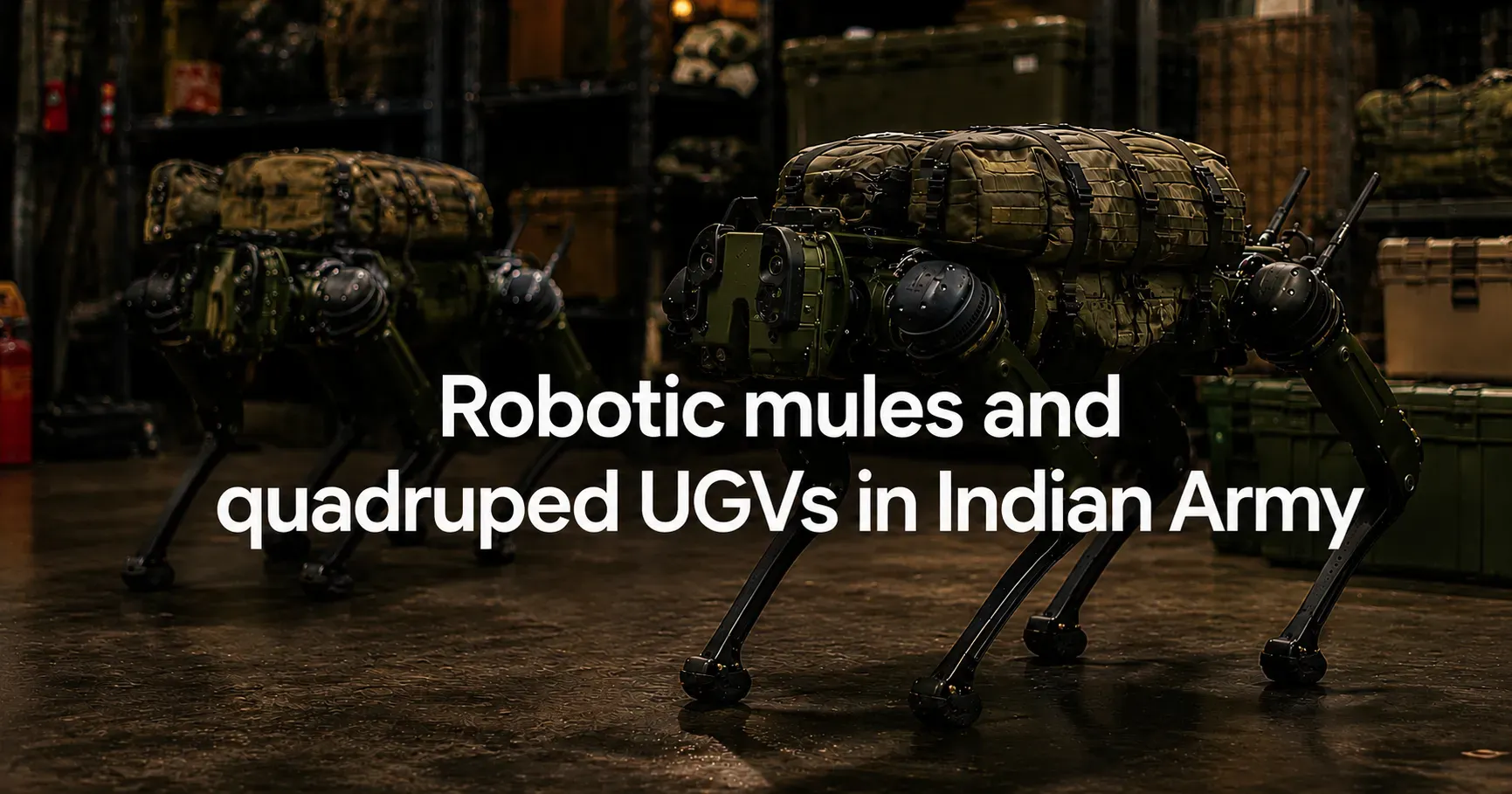
Military robotics India programmes now reach beyond wheeled and tracked vehicles. Legged robots form an active research area inside DRDO's autonomy portfolio.
The CAIR legged robot programme runs through the STAR initiative and related projects. Demonstrations during the National Workshop on Advanced Legged Robotics in Pune showed progress in both bipedal and quadrupedal platforms (DRDO, 24 August 2025).
Legged systems solve a problem conventional vehicles cannot. Stairs, rubble, steep gradients, and broken ground limit wheeled mobility, so legged platforms aim to hold movement where vehicles stall. The same autonomy stack that steers a wheeled autonomous ground vehicle also stabilises a walking robot.
AI plays a direct role here. Computer vision supports terrain classification, sensor fusion improves balance and navigation, and edge inference lets onboard systems process information with less communication dependence. Route-planning algorithms then carry the platform across uneven ground while holding stability.
Mission Sudarshan Chakra frames the longer horizon. The Prime Minister's Independence Day address set out a vision for integrated autonomous defence capability (PIB, 15 August 2025). It named a national security technology shield extending toward 2035. These programmes connect to how autonomous systems perceive and act, the software layer beneath every modern platform.
The autonomy frontier is therefore wider than vehicles. It spans perception systems, communications architectures, machine intelligence, mobility algorithms, and the coordinated drone swarms and teaming concepts that future ground autonomy will draw on.
Weighing the combat UGV question
A combat UGV combines mobility, protection, sensing, and weapons integration in a platform built for frontline operations. India has explored this category, but operational induction has not yet occurred.
The leading concept is the Arjun-based combat UGV proposed through work at Combat Vehicles Research and Development Establishment. Published DRDO technical material describes a tracked unmanned combat platform with advanced sensing and remote-operation capability, intended for the western desert sector (DRDO Technology Focus, April).
The Arjun-based combat UGV shows both the opportunity and the challenge for India's military robotics sector. The mobility platform exists, and the sensing and communications technologies exist. The remaining work lies in integrating those components into an accepted doctrine and procurement framework.
Combat UGVs carry requirements that surveillance vehicles do not. Survivability, secure communications, electronic-warfare resilience, target-classification reliability, and human-authorisation mechanisms move to the centre of the design.
India's defence establishment has therefore moved with care. Validation alone does not guarantee induction, because a platform must show operational utility, sustainment viability, procurement feasibility, and doctrinal fit before it enters service. This is why the bomb disposal robot in Indian service and reconnaissance UGVs reached troops earlier, since their mission boundaries are narrower and their risks lower.
Pairing crewed and uncrewed systems on the battlefield
The practical question is not whether India can build unmanned ground vehicles. India already fields the bomb-disposal robot and has validated reconnaissance platforms across multiple development programmes (DRDO; Indian Army, 5 December 2025).
The sharper question is how fast validated systems cross into service. The Indian Army first indigenous multi-utility UGV, the Sapper Scout RP Ver 2.0, points toward multi-role platforms. A single architecture now folds reconnaissance, logistics, casualty evacuation, counter-UAS tasks, and engineering support (Indian Army, 5 December 2025).
Counter-UAS work links the Sapper Scout to counter-drone systems fielded in India and to the wider fleet of long-endurance military drones. The opportunity for defence integrators sits at the intersection of autonomy software, computer vision, secure communications, sensor fusion, and payload integration. For procurement planners, the task is moving proven platforms through the final induction gate. For policymakers, the work is aligning doctrine, testing, and industrial capacity around manned-unmanned teaming.
The next stage of India's unmanned ground systems will not be defined by a single robot. It will be defined by how well multiple robotic platforms fuse into one battlefield network.
As manned-unmanned teaming becomes a core operational requirement, the platforms that cross the validation-to-induction gap will define the next chapter of India's military robotics capability.