DRDO Daksh sits at the centre of India's counter-IED toolkit, anchoring bomb disposal hardware used by the Indian Army, the National Security Guard, and state police squads. The Bureau of Indian Standards released IS 19445:2025 on 24 December 2025, India's first national standard for bomb disposal systems (Press Information Bureau, 24 December 2025). This article reads the Daksh programme through the threat-platform-doctrine triad: the IED problem, the Daksh family, and the doctrine now sitting inside a formal standard. Government primary sources carry every claim.
Tracing the counter-IED problem the programme was built to solve
DRDO Daksh emerged as a response to India's long-running improvised explosive device challenge. An IED disposal robot allows bomb disposal squads to inspect, manipulate, and neutralise suspected explosive devices while keeping operators at a safer distance.
The requirement became clear during counter-terrorism and internal security operations where bomb disposal teams needed remote handling capability for suspicious packages, vehicle-borne threats, and unexploded ordnance. Research and Development Establishment (Engineers), or R&DE(E) Pune, began dedicated ROV development work in 2002 (Roy, Naik and Kurulkar, R&DE(E) DRDO, 31 August 2022). The programme addressed a specific operational gap in counter-IED handling.
R&DE(E) Pune has served as DRDO's combat engineering centre since its establishment on 9 February 1962. The laboratory's primary mission includes mobility, survivability, military engineering systems, and specialist equipment for the Indian Army Corps of Engineers (India Science, Technology and Innovation Portal).
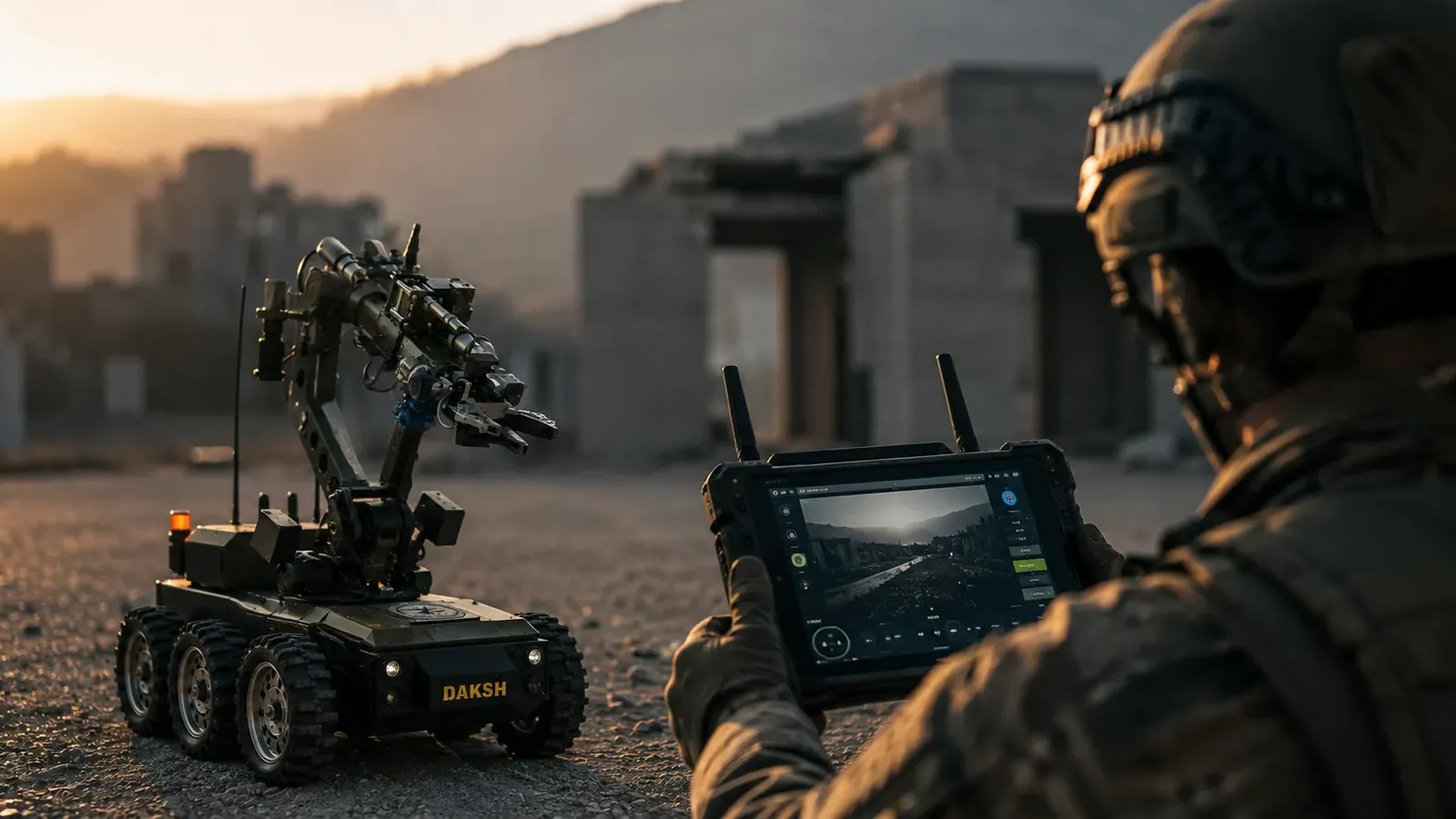
What is DRDO Daksh robot, in operational terms? Daksh is a remotely operated explosive ordnance disposal platform. It inspects, recovers, transports, and disrupts explosive threats without exposing operators directly to danger. As an IED disposal robot, Daksh sits inside a wider category of remote-handling systems that have shaped Indian bomb disposal doctrine since 2011.
The programme also reflects a broader shift in Indian defence technology, with Daksh sitting alongside India's most advanced military drones inside the wider unmanned systems portfolio. Counter-IED systems now combine robotics, computer vision, sensor integration, and remote operation. The goal is not only protection but also faster threat assessment and improved mission effectiveness across military and civilian security environments.
Inside the original ROV Daksh platform
DRDO Daksh is a remotely operated vehicle developed by R&DE(E) Pune for explosive ordnance disposal and hazardous environment operations. The platform completed development in May 2005, after a 30-month programme (R&DE(E) DRDO, 31 August 2022). It then entered operational service with Indian security agencies.
The original platform uses a six-wheeled architecture with blast-resistant solid rubber wheels. A six-degrees-of-freedom manipulator arm enables precise handling tasks. The arm lifts approximately 20 kilograms at 2.5 metres and about 9 kilograms at 4 metres (R&DE(E) DRDO, 31 August 2022). That reach allows operators to recover suspicious packages and move hazardous objects remotely.
The DRDO Daksh specifications reveal a mature explosive ordnance disposal platform. The vehicle includes multiple cameras, a motorised pan-tilt system, a portable X-ray imager, a water jet disrupter, and an on-board shotgun for neutralisation tasks. The master control station supports line-of-sight operation up to 500 metres. It maintains control through up to three internal walls in urban environments (R&DE(E) DRDO, 31 August 2022).
A fibre-optic control option provides additional resilience during electronic interference conditions. The platform can operate continuously for approximately three hours on a single charge. These capabilities explain why Daksh remains relevant despite two decades of technological evolution.
Historically, Daksh robot cost per unit ran at roughly ₹80 lakh in the 2010 to 2011 limited-series-production order, with the carrier vehicle adding approximately ₹25 lakh. The figure reflects the early production period and should be treated as a historical reference rather than a current procurement benchmark. The platform was subsequently transferred for production through Bharat Electronics Limited and partner engineering firms. The move enabled wider induction across India's drone manufacturing ecosystem and the adjacent unmanned systems supply chain.
Mapping the wider family from Mini to Scout
The Daksh family variants extend far beyond the original robot. R&DE(E) Pune expanded the programme into a portfolio of specialised systems (R&DE(E) DRDO, 31 August 2022). The portfolio covers confined spaces, reconnaissance, hazardous material handling, firefighting, and autonomous ground operations.
The first major branch is Daksh Spotter, also known as the CBRNe ROV. This platform supports chemical, biological, radiological, nuclear, and explosive reconnaissance. Multi-sensor payloads help operators assess contamination zones and investigate hazardous environments before personnel enter the area.
Daksh Mini, formally designated the Confined Space Remotely Operated Vehicle, addresses environments where larger robots cannot operate effectively. The platform carries an 8-kilogram payload and supports remote operation up to 200 metres (Press Information Bureau, February 2020). The design targets aircraft cabins, train coaches, and other constrained spaces.
Daksh Scout, designated the Surveillance Remotely Operated Vehicle, focuses on reconnaissance and tactical inspection. The platform can climb stairs, negotiate slopes, transmit day and night imagery, and deploy small disruption charges remotely. Both Mini and Scout were publicly showcased during DefExpo 2020 as part of DRDO's expanding unmanned ground systems portfolio (Press Information Bureau, February 2020).
Variant | Primary role | Key capability | Operating focus |
|---|---|---|---|
ROV Daksh | Bomb disposal | Manipulator arm and disruptors | EOD operations |
Daksh Spotter | CBRNe reconnaissance | Multi-sensor detection | Hazard assessment |
Daksh Mini | Confined-space EOD | Backpack-portable system | Aircraft and rail interiors |
Daksh Scout | Surveillance | Day-night reconnaissance | Tactical inspection |
UXOR | Heavy ordnance handling | 1,000 kg payload class | Unexploded ordnance |
The larger Unexploded Ordnances Handling Robot, or UXOR, represents the heavy end of the family. The system uses dual manipulators, abrasive water jet cutting capability, and payload handling capacity up to 1,000 kilograms. Additional members include the Fire Fighting ROV, the Riot Control ROV, and the Unmanned Ground Mobile Platform (UGMP) (R&DE(E) DRDO, 31 August 2022). UGMP is autonomous and incorporates obstacle avoidance and mission automation features.
Reading the DRDO unmanned ground vehicle architecture
The DRDO ROV programme history makes more sense when viewed through the organisation's wider unmanned ground vehicle architecture. DRDO did not develop Daksh as an isolated platform. The robot sits inside a structured ecosystem spanning multiple laboratories.
According to institutional records, DRDO divided unmanned ground vehicle development across four capability bands inside India's unmanned ground vehicle landscape. Centre for Artificial Intelligence and Robotics, Bengaluru, focused on systems in the 5 to 50 kilogram class. R&DE(E) Pune concentrated on platforms in the 1 to 3 tonne category.
Vehicle Research and Development Establishment, Ahmednagar, covered wheeled vehicles up to 5 tonnes. Combat Vehicles Research and Development Establishment, Chennai, handled tracked systems above 5 tonnes (SPS Land Forces).
This structure allowed each laboratory to specialise around different operational problems. Daksh and its derivatives therefore evolved within a dedicated engineering and robotics environment, not a generic vehicle programme. Parallel airborne efforts include the TAPAS BH-201 programme and related medium-altitude platforms.
The architecture also explains why unmanned ground vehicle India programmes now span multiple mission sets. Some platforms focus on reconnaissance. Others focus on logistics, engineering support, route clearance, or explosive ordnance disposal. The Daksh family occupies the hazardous operations segment within that broader framework.
The emergence of autonomous functions inside UGMP signals a future direction tied to AI and autonomous unmanned systems. Traditional remotely operated vehicles depend on continuous human control. Autonomous ground systems can execute navigation and obstacle avoidance tasks with limited operator intervention. That distinction will shape the next generation of Indian unmanned ground systems.
Locating these robots in operational doctrine across forces
The Daksh robot Indian Army induction began formally in December 2011. The first batch of six systems was handed over to the Indian Army Corps of Engineers at R&DE(E) Dighi, Pune (SPS Land Forces, December 2011).
Operational use expanded beyond the military and now intersects with India's defence drone inventory across forces. State police bomb detection and disposal squads adopted the platform for urban security missions. Pune City Police inducted Daksh on a pilot basis in October 2018, demonstrating utility outside traditional defence environments (Business Standard / PTI, 9 October 2018).
National-level security organisations also evaluated and operated smaller family members. The National Security Guard has examined compact variants designed for confined-space operations and specialist intervention missions. The same family architecture supports counter-terrorism, explosive ordnance disposal, CBRNe response, and infrastructure protection tasks.
The Daksh robot Uttarkashi tunnel rescue deployment highlighted another doctrinal shift. During the Silkyara Bend-Barkot tunnel rescue operation in November 2023, Daksh Mini and Daksh Scout supported inspection and situational awareness activities (Hindustan Times, 20 November 2023). The robots operated within a disaster-response environment.
This operational spread matters because it shows that counter-IED robotics is no longer confined to military bomb disposal teams. The same hardware family now supports disaster management agencies, police units, specialist intervention forces, and engineering formations. The platform evolved from a single EOD solution into a multi-mission counter-IED robotics capability.
Aligning bomb disposal under India's first national standard
IS 19445 bomb disposal standard marks the headline policy development for explosive ordnance disposal hardware in India. The Bureau of Indian Standards released the framework on 24 December 2025 (Press Information Bureau, 24 December 2025). The release creates the country's first formal benchmark for bomb disposal systems.
The standard emerged through the Bomb Disposal Systems Panel under the Arms and Ammunition for Civilian Use Sectional Committee. Terminal Ballistic Research Laboratory, DRDO, served as the technical convenor. Stakeholders included DRDO, the National Security Guard, and the Directorate General of Quality Assurance. The Central Armed Police Forces, Airports Authority of India, and Bureau of Police Research and Development also contributed (Press Information Bureau, 24 December 2025).
The initial release focuses on bomb blankets, bomb baskets, and bomb inhibitors. Remotely operated vehicles are not yet covered directly. However, the significance lies elsewhere, sitting inside the Aatmanirbhar Bharat defence push. India now possesses an institutional mechanism for testing, evaluating, and standardising bomb disposal equipment.
A parallel signal emerged from the Ministry of Defence emergency procurement programme. On 24 June 2025, the Ministry concluded 13 contracts worth ₹1,981.90 crore to strengthen Indian Army counter-terrorism capability (Ministry of Defence, 24 June 2025). Procurement momentum and standardisation momentum are now moving in the same direction.
That combination matters for future robotic systems. Standards create evaluation pathways, evaluation pathways influence procurement requirements, and procurement requirements shape product development across the defence industrial base.
Looking ahead to the next generation of Indian EOD systems
DRDO Daksh demonstrates how defence robotics programmes mature over time. The programme started as a response to a specific explosive ordnance disposal requirement. It evolved into a family of platforms covering reconnaissance, confined-space operations, hazardous material detection, heavy ordnance handling, and autonomous ground mobility.
For defence integrators, the key lesson is that procurement agencies now evaluate systems as part of operational architectures rather than standalone products. Related capability investments sit alongside India's anti-drone systems and adjacent counter-platform programmes. Sensor integration, communications resilience, computer vision, mission software, and interoperability now matter alongside mechanical performance.
For procurement teams, IS 19445:2025 creates an important precedent. The standard does not yet address remotely operated vehicles directly. It still establishes a framework through which future bomb disposal hardware may be assessed and certified (Press Information Bureau, 24 December 2025).
For technology developers, the next opportunity sits at the intersection of robotics and autonomy. Remote operation remains the dominant model. Autonomous navigation, route planning, obstacle avoidance, and edge-based perception are already visible in platforms such as UGMP (R&DE(E) DRDO, 31 August 2022). The next phase of Indian EOD capability will likely focus on reducing operator workload while preserving human control over mission-critical actions.
The next chapter for India's bomb disposal robotics ecosystem hinges on three forces converging. Standards, procurement frameworks, and autonomous ground systems must move into a common operational baseline.