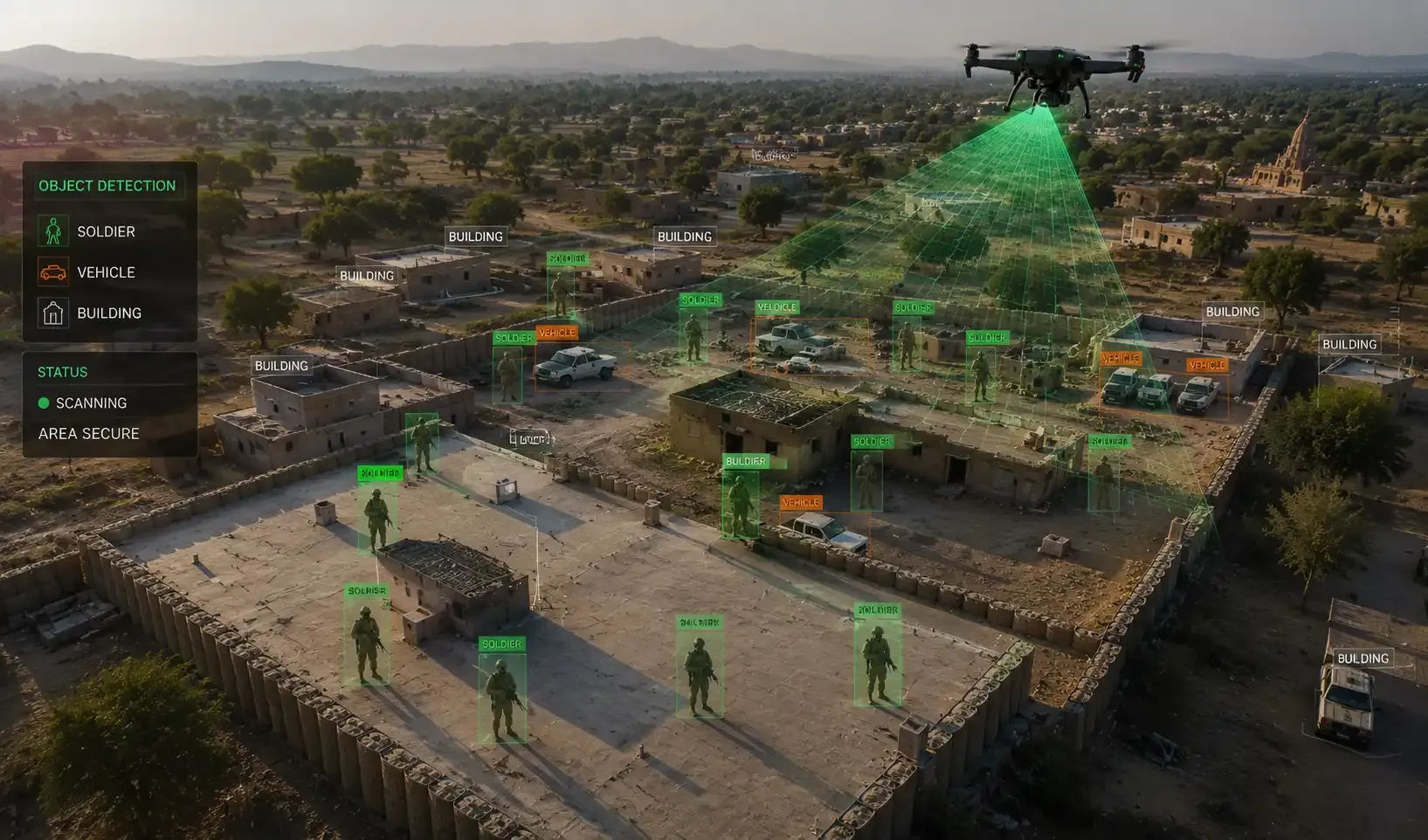
AI in drones is now the procurement gate for Indian defence and the cost lever for Indian commercial UAS. The Defence Acquisition Council cleared four squadrons of Ghatak stealth combat drones on 27 March 2026, valued at approximately ₹39,000 crore (Ministry of Defence, 27 March 2026). The Indian Army selected Shield AI's V-BAT with Hivemind autonomy on 28 January 2026 (Shield AI Mumbai announcement, 28 January 2026). The Indian Air Force launched Mehar Baba Competition 3 in April 2026 with the theme of collaborative drone-based surveillance radars (IAF release, April 2026). This reference page covers the autonomy stack that links perception, navigation, edge inference, and swarm coordination; maps every active Indian programme onto autonomy levels; and explains why AI is now the lens through which both contested-airspace doctrine and commercial UAS economics are being rewritten.
From automation to autonomous drones: what AI changes inside the airframe
A GPS-dependent drone with waypoint navigation is automated, not autonomous. The distinction matters because in contested electromagnetic environments, GPS dependence makes a platform fail the moment its signals are denied. Operation Sindoor, conducted on 7 and 8 May 2025, exposed the limits of automation under sustained pressure on the western frontier (Ministry of Defence press note, 7 May 2025). Indian Armed Forces neutralised hundreds of incoming aerial threats through an integrated air defence shield, and the lesson written into subsequent procurement was direct. Any UAV that fails without GPS, or without an unbroken command link, is operationally dead.
AI in drones changes three things inside the airframe. Perception means the drone interprets sensor data instead of merely collecting it. A camera no longer just records pixels; an onboard neural network classifies what the pixels represent. Decision means the drone selects between mission options instead of executing a fixed script. A path is no longer a sequence of waypoints; it is a continuously updated trajectory chosen against onboard rules. Action means the drone modifies its flight path in response to new information. A target is no longer a coordinate; it is a classified object whose engagement priority can shift mid-mission.
This shift is now visible in the Indian procurement record. The Shield AI Hivemind software development kit, licensed alongside the V-BAT deal, lets Indian partners build sovereign autonomy stacks on top of edge inference rather than dependence on a foreign cloud-side AI (Shield AI, 28 January 2026). The ₹39,000 crore Ghatak procurement is structured around autonomous deep-strike capability, not remote piloting (Business Standard, 4 March 2026). Autonomous drones are now a category line item, not an experimental capability.
The five levels of drone autonomy and where Indian platforms sit today
Drone autonomy levels run from 1 to 5. Level 1 is stabilised manual flight where the pilot retains direct control and the flight controller smooths attitude. Level 2 adds waypoint automation; the drone flies a preloaded route without human stick input. Level 3 adds obstacle avoidance, geofencing, and return-to-home; the drone reacts to its environment within defined boundaries. Level 4 is mission-level supervised autonomy; the drone plans and executes a mission with a human supervisor able to override but not flying the platform. Level 5 is fully autonomous mission completion without human input, including target selection within rules of engagement.
Most commercial drones operate between Level 3 and Level 4 today (Edge AI Vision Alliance, December 2025). Indian platforms are spread across the scale. The Heron Mark 2, operated by the Indian Air Force, sits at Level 3 with mature obstacle avoidance and beyond-visual-line-of-sight capability. The CATS Warrior loyal-wingman drone is being designed for Level 4 supervisory autonomy, with a manned mothership directing two to four warrior drones over combat radii of 150 to 350 km (HAL public statement, January 2025). The V-BAT with Hivemind sits at Level 4 to Level 5 depending on the mission profile, with the autonomy stack capable of beyond-visual-range operation even when communications and GPS are denied (Shield AI India, 28 January 2026). The Ghatak UCAV is designed for Level 5 fully autonomous strike, with cleared procurement of 60 units across four squadrons (Ministry of Defence, 27 March 2026).
Autonomy level | Capability | Indian platform example | Status |
|---|---|---|---|
Level 1 | Stabilised manual flight | Tactical micro-UAVs across the armed forces | Fielded |
Level 2 | Waypoint automation, no environmental reaction | Logistics and survey drones across DGCA-registered fleet | Fielded |
Level 3 | Obstacle avoidance, geofencing, return-to-home | Heron Mark 2 ISR fleet | Operational |
Level 4 | Mission-level supervised autonomy, BVLOS, GPS-resilient | CATS Warrior, V-BAT with Hivemind, ALFA-S | Development and induction |
Level 5 | Fully autonomous mission execution and strike | Ghatak UCAV, advanced Sheshnag swarms | Procurement cleared and prototyping |
The autonomy levels framework is now the lens through which Indian procurement decisions are read. Buyers no longer ask only what a drone can fly. They ask what level of autonomy the drone holds when the link drops.
Perception and sensor fusion: how an AI-enabled UAV sees its environment
Perception is the first layer of the autonomy stack. AI-enabled UAVs combine RGB cameras, thermal imagers, LiDAR arrays, radar, inertial measurement units, GNSS receivers, and optical flow sensors into a single estimation pipeline. Sensor fusion architectures use extended Kalman filters and visual-inertial odometry to maintain a position estimate even when individual sensors degrade. Computer vision in drones turns raw imagery into classified objects through convolutional neural networks running on board.
The Indian engineering work is concentrated in a few clear centres. NewSpace Research and Technologies has built its MOSAIC decentralised swarming autonomy suite around distributed perception, where each drone in a swarm contributes to a shared situational picture (IDRW, 6 April 2026). Tonbo Imaging supplies electro-optical and infrared sensor suites that have been inducted across Indian Army formations for night and adverse-weather operations. Raphe mPhibr builds heavy-payload UAVs with onboard AI inference stacks designed for mountain and maritime environments. The Indian Army has placed orders worth over ₹3,000 crore for indigenous drones and counter-UAS systems through 2025 alone, with perception-grade sensors as a procurement criterion (ThePrint, 8 January 2026).
The procurement shift is direct. Drone perception sensor fusion is no longer a feature on a brochure. It is the criterion that decides whether a platform survives the first ten minutes of a contested mission. Operators who buy on payload and endurance alone now find their platforms outflanked the moment electronic warfare conditions appear.
SLAM, VIO, and GPS-denied navigation in drones
Simultaneous Localisation and Mapping, abbreviated SLAM, is the algorithm that lets a drone build a map of its environment while estimating its own position inside that map. Visual SLAM tracks features across sequential camera frames, computes the drone's pose change, and closes loops when previously mapped areas are revisited. Visual Inertial Odometry, or VIO, fuses camera data with inertial sensor inputs to produce un-jammable, self-contained position estimates (Veriprajna whitepaper, 17 February 2026).
The engineering numbers matter. TensorRT optimisation on NVIDIA Jetson Orin processors can deliver two to three times the inference throughput of raw PyTorch implementations. Quantisation from FP32 to Int8 reduces memory bandwidth by approximately four times and enables the >30 frames per second throughput needed for stable flight control loops (Veriprajna, February 2026). The Jetson Orin NX has emerged as the typical compute platform for tactical micro-drone autonomy, with the larger Orin AGX used in heavier inspection and ISR platforms.
The Indian work is anchored on the DRDO Stealth Wing Flying Testbed, or SWiFT. The seventh developmental test flight in December 2023 demonstrated autonomous landing without ground-based radars or manual control, using only onboard sensor data and GPS-aided GEO-augmented navigation (DRDO press note, December 2023). This established the navigation foundation that the Ghatak programme inherits. The Ghatak, cleared for 60 units across four squadrons, is being designed to operate in defended airspace where GPS-denied navigation is a survivability requirement (Ministry of Defence, 27 March 2026).
Visual SLAM drone systems also matter for commercial Indian operators. Greenhouse monitoring trials in GPS-denied environments now use V-SLAM offloaded to an edge computer via the FPV video link, with the drone executing autonomous daily missions for crop phenology monitoring (MDPI agricultural study, 15 March 2026). The technology stack that protects a UCAV in contested airspace is the same stack that lets an agri-drone fly inside a polyhouse.
Edge AI inference: running neural networks on the drone itself
Edge AI drone architecture runs neural networks on processors inside the airframe rather than over a data link to a ground station. The reason is operational. Cloud-dependent AI fails the moment the link is jammed or the drone moves out of communication range. Onboard AI inference is what lets a UAV continue to function when the C2 link is severed in an electronic warfare corridor.
The hardware tradeoff is constrained by Size, Weight, Power, and Cost. Tactical micro-drones operate on TOPS budgets of 25 to 50 trillion operations per second, thermal envelopes of 15 to 25 watts, and weight budgets measured in tens of grams of compute hardware. Larger Group 3 platforms like the V-BAT carry full edge AI stacks running optimised neural networks for object detection, target classification, and path planning while maintaining 12-hour endurance on a heavy-fuel engine (Shield AI, 28 January 2026).
The Indian compute layer is being built in three places. Zuppa GeoNavTech in Chennai builds indigenous autopilot stacks with onboard AI processing for Indian Army and commercial requirements. NewSpace integrates onboard processors into every ALFA-S air-launched swarm drone, with each unit running local autonomy. Raphe mPhibr designs heavy-payload AI inference platforms for ISR and logistics. The Hivemind SDK that came with the V-BAT deal lets Indian partners develop sovereign autonomy stacks on top of edge inference, instead of buying foreign cloud-side AI as a service (Shield AI India announcement, 28 January 2026). This is the difference between buying a capability and owning a capability.
Drone swarm AI and decentralised coordination
Drone swarm AI is the layer where many UAVs act as one system. Centralised swarm coordination, where one ground station commands every unit, fails the moment the link is jammed. Decentralised coordination uses mesh networking and distributed decision-making, where each drone selects its role, target, and trajectory based on local information shared peer-to-peer. The Indian Army demonstrated this in January 2021 with 75 autonomous drones identifying and engaging simulated targets across a 50 km range without human intervention post-launch (Indian Army press release, January 2021).
The procurement record built on that demonstration. NewSpace delivered 100 heterogeneous swarm drones to the Indian Army in 2023 under fast-track procurement, making India one of the first nations to operationalise high-density swarms (ThePrint, 8 January 2026). NewSpace's MOSAIC architecture enables distributed decision-making across the swarm, so that loss of individual units does not collapse the network (IDRW, 6 April 2026). Sheshnag-20 and Sheshnag-150 are the loitering-munition expressions of the same architecture, with Sheshnag-150 carrying a 25 to 40 kg warhead at over 1,000 km range in coordinated swarms of 50-plus drones (Drishti IAS analysis, 13 March 2026).
The Indian Air Force is pursuing a parallel concept. Mehar Baba Competition 3, launched April 2026, asks startups to build a swarm of unmanned aerial systems functioning collectively as an airborne radar network capable of detecting, tracking, and reporting aerial targets in contested environments (IAF release, April 2026). Instead of relying on a single high-value AWACS aircraft, surveillance functions distribute across many smaller, expendable drone nodes, each acting as a sensing node sharing data with a centralised monitoring station. The inherent redundancy means the loss of individual nodes does not collapse the network. This is the kind of cluster intelligence that air defence doctrine in contested theatres now requires.
Manned-unmanned teaming and the loyal wingman concept
Manned unmanned teaming, or MUM-T, is the doctrine where a manned fighter aircraft commands a formation of autonomous drones that scout, absorb fire, or execute precision strikes. The pilot becomes a battle manager. The doctrine reduces pilot risk in contested airspace and multiplies the firepower of every manned sortie.
HAL's CATS Warrior is the Indian flagship of this concept. The drone is being developed to pair with the Tejas, AMCA, TEDBF, Su-30MKI, and Jaguar across combat radii of 350 to 800 km. CATS Warrior demonstrated dynamic re-routing in contested electronic environments during combat simulations, with maximum take-off weight increased to 2.1 tonnes to support extended-mission payloads (HAL public release, January 2025). HAL chairman confirmed in November 2025 that the drone is on track for production readiness inside 2026 (BusinessToday, 28 November 2025). The Centre for Artificial Intelligence and Robotics, a DRDO laboratory, leads the Air Combat Intelligence Development project that supplies the autonomous target acquisition algorithms.
The Indian Navy is pursuing an analogous concept at sea. NewSpace's Abhimanyu is the carrier-based loyal wingman under the Naval Collaborative Combat Air Vehicle programme, designed to operate alongside MiG-29K and Rafale-M carrier fighters. First flight is anticipated inside 2026 (SSBCrack analysis, 5 November 2025). The Indian Air Force has announced work on the Integrated Indian Combat Aerial System, or I²CAS, the long-term sixth-generation architecture where a manned stealth fighter acts as the command node for multiple unmanned platforms (IDRW, 15 March 2026). AMCA is expected to serve as the initial mothership backbone for that architecture.
AI in autonomous strike and loitering munitions
AI changes loitering munitions from human-in-the-loop weapons to autonomous target-recognition platforms. Automatic Target Recognition, or ATR, systems built by NewSpace and Raphe mPhibr let the drone identify, classify, and prioritise targets onboard. NewSpace unveiled Sheshnag-150 at the World Defence Show 2026 in Riyadh, a long-range collaborative loitering munition with a 1,000+ km range, 5+ hours endurance, 25 to 40 kg warhead, and AI swarm targeting capable of saturating defended targets through coordinated arrival from multiple vectors (Drishti IAS, 13 March 2026).
The inducted Indian arsenal already carries AI-enabled terminal guidance. Nagastra-1, ALS-50, and the Sheshnag-20 canister-launched swarm are operational or in advanced trial. Sheshnag-20 progressed from development to flight testing with the MOSAIC decentralised swarming autonomy suite that enables distributed decision-making, so the swarm can dynamically reconfigure and continue mission execution even when parts are neutralised (IDRW, 6 April 2026). The doctrine question is how much autonomy the Indian Armed Forces are willing to delegate for target selection. The procurement signal indicates that ATR is acceptable for fixed targets like radar sites, armoured formations, and logistics hubs, with human-on-the-loop discipline retained for ambiguous engagements. Related analysis lives in how kamikaze loitering munitions work.
AI in counter-drone systems and autonomous air defence
AI is what lets a counter-UAS system identify and engage hostile drones at machine speed. The radar return from a small drone is similar to that of a large bird, and only AI-based classification can reliably distinguish a threat. The Indian Army is inducting layered indigenous counter-drone capability across three categories. The D4 anti-drone platform combines radar, RF detection, and electronic kill. The SAKSHAM counter-UAS grid was approved in 2025 for integrated national-grid deployment. Bhargavastra is a multi-layer micro-missile and micro-rocket system designed for swarm engagement. DRDO has developed laser-based directed-energy weapons capable of engaging targets at ranges up to two kilometres (Organiser analysis, 15 May 2026).
The AI layer is what assigns the cheapest available kinetic or electronic kill to each incoming threat. A laser is cheap per shot but limited by line-of-sight and atmospheric conditions. A micro-missile is more expensive but works against high-altitude or fast-moving targets. The classifier decides which system engages. Without onboard AI inference, this assignment runs too slow to handle a saturating swarm. Counter-drone autonomy is now a separate procurement category in the Indian defence budget. Further analysis appears in counter-drone systems in India.
AI in commercial drone applications: agriculture, inspection, and mapping
Pillar scope extends beyond defence. AI-enabled multispectral analysis for crop health now runs onboard, with the drone computing NDVI and detecting pest or disease patterns through CNN-based image classification during the flight itself. Precision spraying with zonal mapping replaces blanket application; the drone varies spray rate based on what it sees beneath. Infrastructure inspection UAVs identify corrosion, structural defects, and thermal anomalies through anomaly detection models. Photogrammetry and 3D reconstruction for survey work depend on SLAM-driven feature matching. Last-mile logistics depends on edge AI for landing site selection in unprepared environments.
The policy environment shifted to support this in September 2025. The 56th GST Council meeting approved a reduction in goods and services tax on drones from the earlier fragmented rates of 18 percent and 28 percent to a uniform 5 percent, effective 22 September 2025 (Ministry of Finance notification, 22 September 2025). Military-grade drones, high-performance batteries, and flight simulators were made entirely tax-exempt. India is now home to over 600 drone startups that have collectively raised more than USD 500 million in funding (Organiser, 15 May 2026). The Kisan Drone scheme under the Ministry of Agriculture and Farmers Welfare anchors agricultural adoption. Machine learning drone applications are no longer a research exhibit; they are a working line in the commercial UAS economy.
The Indian autonomous drone programme map
The single most-referenced asset in this pillar is the programme map. The table below covers every active Indian autonomous drone programme with its autonomy level, lead agency, role, and current status.
Programme | Lead agency or developer | Role and autonomy focus | Status |
|---|---|---|---|
Ghatak UCAV | DRDO (ADE, ADA) | Autonomous deep-strike, Level 5 | 60 units cleared by DAC 27 March 2026 at ₹39,000 crore |
CATS Warrior | HAL with NewSpace | MUM-T loyal wingman, Level 4 | Engine ground run January 2025, production ready inside 2026 |
V-BAT with Hivemind | Shield AI with JSW Defence | Group 3 VTOL ISR, Level 4 to 5 | Procurement January 2026, JSW facility at EMC Maheshwaram, $90 million investment |
Abhimanyu | NewSpace, N-CCAV programme | Carrier-based loyal wingman, Level 4 | First flight expected inside 2026 |
ALFA-S | NewSpace with HAL | Air-launched swarm, up to 100 units per launch | Trials underway |
Sheshnag-150 | NewSpace | Long-range swarm loitering munition, 1,000+ km, 50-drone swarm | WDS 2026 debut, highway-launch trials 2026 |
Sheshnag-20 | NewSpace | Canister-launched swarm loitering munition, AI ATR, 50 km range | Army trials pitched April 2026 |
MAPSS | NewSpace | Solar-electric persistent surveillance UAV, Level 4 | ₹168 crore Army order January 2026 |
Mehar Baba Competition 3 | Indian Air Force | Distributed AWACS swarm, collaborative sensing | Competition active from April 2026 |
SWiFT | DRDO ADE | Autonomous flying-wing demonstrator | Autonomous landing demonstrated December 2023 |
I²CAS | Indian Air Force, long-term | Sixth-generation AI-enabled combat cloud architecture | Announced March 2026 |
This is the analytical centrepiece. No competitor in the Indian SERP assembles every active autonomous programme into a single map with autonomy levels mapped against status. Cluster pieces will deep-dive each entry; the pillar holds the synthesis layer.
Challenges: sovereignty, EW resilience, and supply chain
Three open problems remain. First, sovereign autonomy stacks. The Hivemind SDK licence is useful because it transfers a development environment to Indian partners, but the underlying model weights and training pipelines remain with Shield AI. True sovereign autonomy requires Indian-trained models on Indian-designed compute, and that work is at an earlier stage. Second, electronic warfare resilience. Autonomy depends on perception, and perception sensors can be spoofed. GPS spoofing, optical-feature flooding, and radar jamming are all in active use globally, and Indian platforms must harden against each. The shift to VIO and visual SLAM helps, but is not a complete answer. Third, supply chain. Batteries, motors, edge AI processors, and high-resolution sensors are still substantially imported. The CEO of a Bengaluru drone firm noted at the Bengaluru Tech Summit that silicon-chip dependence remains acute (Organiser, 15 May 2026). The policy responses are layered. The PLI scheme provides manufacturing incentives, the GST cut to 5 percent makes end-products cheaper, the iDEX programme has incubated over 200 startups, and a ₹20,000 crore Fast Track Procurement is expected in 2026 (ThePrint, 8 January 2026).
What comes next
The next 24 months will set the trajectory. Ghatak prototypes are expected from the winning development-cum-production partner under the ₹10,000 crore six-prototype phase. The JSW Defence facility at EMC Maheshwaram, Hyderabad, enters V-BAT production in Q4 2026 under the $90 million Shield AI partnership. The Abhimanyu N-CCAV is scheduled for first flight inside 2026. CATS Warrior production readiness was confirmed by the HAL chairman for inside 2026. Mehar Baba Competition 3 final entries close inside the year with the IAF down-selecting distributed-radar swarm winners. The Sheshnag-20 enters Army trials. Operators, integrators, and policy researchers tracking Indian autonomous drones should watch DAC notifications, iDEX project announcements, and HAL and DRDO public releases through the remainder of the year. The autonomy stack is now a primary procurement gate; the procurement signal is set; the only open question is which Indian integrators capture the production share. Related reading lives in the world's most advanced military drones explained, drone laws in India, and India's drone airspace zone map.