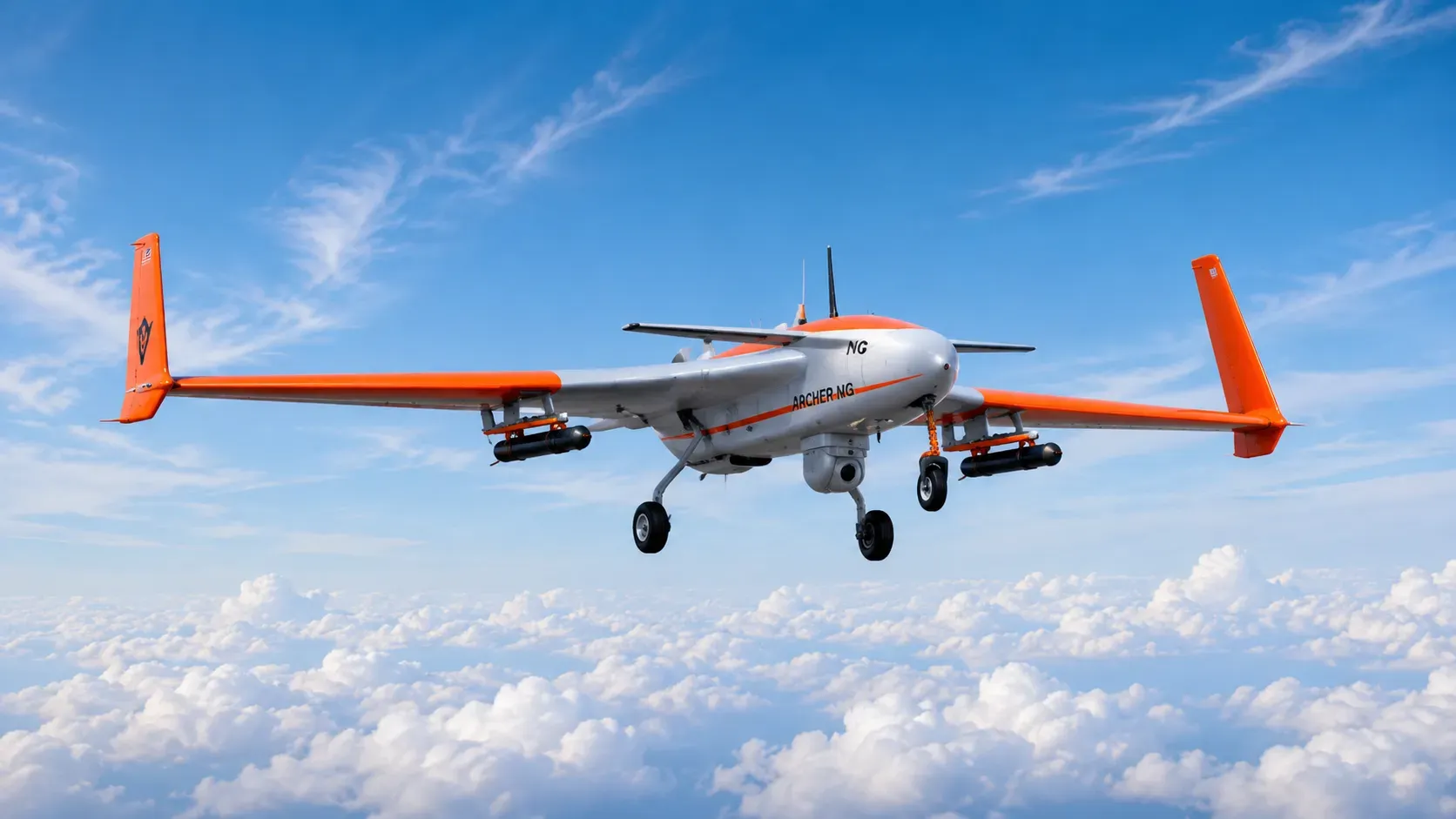
The Indian Air Force has identified manned-unmanned teaming as core to its 2030s combat doctrine. Operation Sindoor in May 2025 turned the concept from doctrine paper to operational reality. This article maps the doctrine, the NATO STANAG 4586 framework, and the full Indian programme stack.
CATS Warrior is in ground trials for a 2027 first flight. Ghatak is targeting a 2026 to 2027 rollout. The Indian Navy has initiated the N-CATS programme for carrier-based teaming.
What manned-unmanned teaming actually means
Manned-unmanned teaming is a doctrine, not a platform. The doctrine pairs a piloted aircraft with one or more unmanned aircraft. The unmanned platforms scout ahead, jam enemy radars, draw fire, carry weapons, or relay sensor data back to the manned platform.
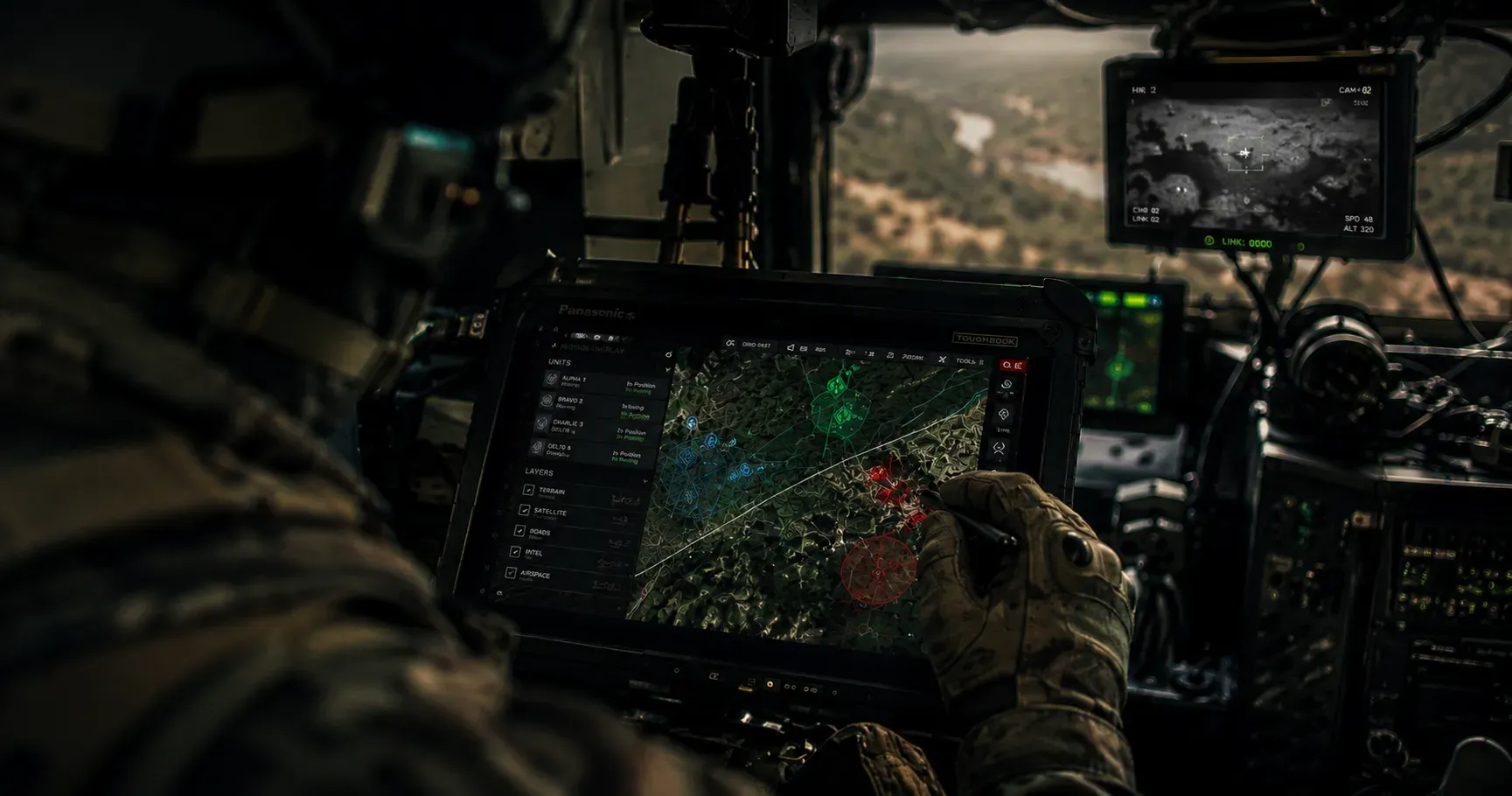
The manned platform itself can be a fighter, an attack helicopter, or a maritime patrol aircraft. The pilot moves from stick-and-rudder operator to battle manager.
Hindustan Aeronautics Limited has positioned MUM-T as the lead doctrine for the Indian Air Force's 2030s combat planning. The Combat Air Teaming System programme is the lead delivery vehicle (HAL programme disclosure, Aero India 2025). The published Kodainya military and defence drones in India pillar covers the full Indian platform inventory the doctrine pulls together.
The Collaborative Combat Aircraft programme is the parallel US Air Force designation for the unmanned half of a MUM-T pairing. The CCA framing adds an affordability criterion. The unmanned platform must be cheap enough to deploy in combat mass, where loss rates remain acceptable against the kill chains it disrupts (US Air Force CCA programme documentation, Air Force Technology, January 2026).
The distinction matters for procurement. A MUM-T pairing optimised only for pilot risk reduction can be expensive per unit. A CCA-style architecture demands unit costs low enough that fleet replacement is sustainable through a contested air campaign. India is building both tracks in parallel.
The STANAG 4586 framework and the five levels of interaction
The canonical framework for manned-unmanned teaming comes from NATO STANAG 4586. The standardisation agreement defines five levels of interoperability between a manned control system and an unmanned aircraft (NATO STANAG 4586 Edition 3, November 2012).
Level | Interaction type | Operational meaning |
|---|---|---|
Level 1 | Indirect payload data | Pilot receives processed sensor information through another control node |
Level 2 | Direct payload data | Pilot receives sensor feeds directly from the unmanned platform |
Level 3 | Payload control | Pilot controls sensors and weapons but not the airframe |
Level 4 | Vehicle control | Pilot controls the aircraft, less launch and recovery |
Level 5 | Full control | Pilot controls the aircraft including launch and recovery |
The framework separates remote support drones from genuine combat teammates. A Level 2 system can pass surveillance feeds to a fighter cockpit, but the unmanned aircraft still depends on a separate ground control station. Level 4 and Level 5 architectures create the cockpit-to-drone control loop where the pilot becomes the mission commander for several unmanned assets at once.
Combat MUM-T concepts target Level 4 interoperability because contested airspace compresses decision windows to seconds. A separate ground station adds latency, communication vulnerability, and fragmented command authority. Sixth-generation combat planners in the United States, United Kingdom, France, Japan, Australia, China, and India now treat Level 4 integration as baseline operational planning. The framework has moved past experimental status.
India's loyal-wingman programmes are being engineered against this framework. CATS Warrior, Ghatak, and the second-wave platforms are structured around direct integration with fighter cockpits and tactical battle-management systems instead of standalone drone operations.
Why MUM-T became inevitable: cost, attrition, and contested airspace
Three forcing functions converge on MUM-T doctrine. The first is unit cost. A CATS Warrior loyal wingman is projected at around USD 5 million per unit. An indigenous Tejas Mk1A sits at roughly USD 50 million and a Rafale at over USD 80 million (HAL programme disclosure, NDIC 2026 reporting).
A force structure that loses three loyal wingmen for one manned fighter is still ahead on cost arithmetic.
The second forcing function is attrition. Integrated air defence systems with layered surface-to-air missiles, long-range air-to-air missiles, and electronic warfare nodes have made manned penetration of contested airspace prohibitively risky. The Russia-Ukraine theatre between 2022 and 2025 demonstrated the loss curve at scale. The May 2025 Operation Sindoor strike packages reinforced the conclusion that the highest-risk mission segments belong to unmanned aircraft.
The third forcing function is doctrine alignment. Every major air force planning sixth-generation combat now assumes loyal-wingman formations as the default rather than an option. India cannot opt out of that doctrine and remain interoperable with partner forces during joint operations.
The three pressures converge on one answer. The manned platform becomes the battle manager. The unmanned platforms absorb risk, generate sensor coverage, and deliver mass at a fraction of crewed-fighter cost. The published Kodainya AI in drones pillar covers the autonomy stack that makes this transition technically possible.
The Indian doctrine signal: Operation Sindoor and after
Operation Sindoor on 7 May 2025 was the largest live demonstration of multi-domain warfare in Indian military history. The Indian Armed Forces deployed Rafale fighters with SCALP missiles and HAMMER bombs against Nur Khan and Rahimyar Khan air bases. Harop loitering munitions struck air-defence radar sites, AI-enabled surveillance drones operated forward, and a Carrier Battle Group was on naval standby (Ministry of Defence statement, 18 May 2025). The Ministry framed the operation as "tri-services synergy, strategic depth, and technological dominance" - the operational template MUM-T doctrine assumes.
The published Kodainya kamikaze drones pillar covers the Harop and indigenous loitering-munition deployments inside Operation Sindoor in detail.
Post-Sindoor procurement signals confirm the doctrine shift. The Defence Procurement Board recommended acquisition of 60 Ghatak units on 3 March 2026. The proposal moved to the Defence Acquisition Council for clearance (Business Standard, 3 March 2026).
At the National Defence Industries Conclave on 23 March 2026, HAL disclosed an Indian Air Force projected requirement approaching 100 CATS Warrior units (HAL disclosure, NDIC 2026). The fleet is sized to support three to four loyal wingmen per manned strike package.
The doctrine question is no longer whether India will adopt MUM-T structures. The question is how quickly Indian services can field operational formations before peer air forces complete their own combat teaming fleets.
CATS Warrior: the flagship Indian loyal wingman
CATS Warrior is the Combat Air Teaming System loyal-wingman platform developed by Hindustan Aeronautics Limited with NewSpace Research and Technologies and Tata Elxsi. The current 2-tonne prototype carries a 9.1-metre length, 7.6-metre wingspan, and 650 kg payload across internal and external hardpoints (HAL specifications, Aero India 2025). Cruise speed is Mach 0.6 with a dash capability to Mach 0.9. Operational ceiling is 9,000 metres, and combat radius runs 350 km for return missions or 700 km for one-way sacrificial strikes.
Armament includes two DRDO Smart Anti-Airfield Weapons internally plus two air-to-air missiles externally. Later configurations are expected to integrate the Astra Mk1 close-combat missile (HAL specifications, Aero India 2025). The Warrior also carries up to 24 ALFA-S loitering munitions in CATS ALFA glide-launch pods. Each pod releases four 25 kg swarm drones after a 100 km standoff glide (HAL CATS architecture disclosure).
The mothership in the current architecture is a modified twin-seat Tejas Mk1A designated CATS MAX. HAL is also planning to adapt the HLFT-42 trainer derivative as a future mothership replacement. A single Tejas mothership can control two to four Warrior drones from up to 150 km standoff. The system integrates HAL's Air Combat Intelligence Development algorithm — known as ACID — with secure datalinks directly into the cockpit (HAL Engineering R&D Director disclosure, February 2021).
Engine ground runs on the full-scale 2-tonne airframe completed in January 2025. The prototype displayed at Aero India 2025 in February 2025 represented the most mature configuration to date (HAL Chairman D.K. Sunil disclosure, July 2025). MUM-T datalink checks are running in parallel and first flight is on track for 2027.
The roadmap extends to a 3-tonne variant and a 5-tonne CATS Warrior II. Both heavier variants are powered by twin HTFE-25 turbofan engines, with certification targeted by 2027 (IDRW, October 2025).
Ghatak and the heavy-strike RSPA: India's stealth UCAV track
Ghatak is the Aeronautical Development Establishment's flying-wing stealth Unmanned Combat Aerial Vehicle. The airframe is sized at approximately 13 tonnes with an internal weapons bay. Combat radius is targeted beyond 1,000 km with five to eight hour endurance and a 1.5 tonne internal weapons payload (Aeronautical Development Establishment programme briefs). The aircraft is powered by a non-afterburning derivative of the Kaveri engine developed by the Gas Turbine Research Establishment.
The operational role differs from lighter loyal wingmen. Ghatak is intended for suppression of enemy air defences, deep-strike against high-value fixed targets, and autonomous penetration into heavily defended airspace before manned aircraft enter the battlespace. The flying-wing configuration with radar-absorbent coatings drives the radar cross-section down to a level where integrated air defence systems struggle for stable track. The published Kodainya types of drones piece classifies Ghatak under the Class III, MALE, fixed-wing UCAV category.
Programme acceleration moved Ghatak into the operational planning horizon during the first quarter of 2026. The Defence Procurement Board recommended the acquisition of 60 Ghatak units on 3 March 2026 (Business Standard, 3 March 2026). The proposal moved to the Defence Acquisition Council for clearance. Larsen and Toubro is fabricating the prototype airframe.
The Remotely Piloted Stealth Aircraft programme led by the Aeronautical Development Agency sits in the same 13 to 15 tonne class. RSPA is being integrated with the Electro-Optical Targeting System originally developed for the Advanced Medium Combat Aircraft. The integration enables multi-spectral infrared and optical target identification through weather (ADA programme disclosure, Defence News India, 2025). Ghatak and RSPA together form the heavy-strike unmanned track that pairs with Tejas Mk2 and AMCA inside the Indian Air Force's 2030s combat doctrine.
FUFA and the second wave of Indian loyal wingmen
Beyond CATS Warrior and Ghatak, a second wave of Indian loyal-wingman tracks is now visible. The Future Unmanned Fighter Aircraft, designated FUFA, is the stealth UCAV referenced in disclosures during late 2025. FUFA carries an internal weapons bay sized for a 1,000 kg payload, with potential air-to-surface munition options including the BrahMos-NG.
The mission profile covers autonomous suppression of enemy air defences and evasion of surface-to-air missile envelopes. FUFA is being designed for integration with the Integrated Air Command and Control System for coordinated kill chains (IDRW programme disclosure, September 2025).
Private-sector loyal-wingman programmes are also visible through the Innovations for Defence Excellence pathway. The Ministry of Defence has run iDEX challenges covering autonomous tactical platforms, weaponised AI-enabled hive systems, and modular MUM-T-capable unmanned aircraft (iDEX challenge documentation, Defence Innovation Organisation). The Kodainya eGCA registration walkthrough covers the procurement and certification pathways that govern these programmes.
Defence procurement analysts now expect the Indian Air Force to operate a multi-tiered unmanned fleet. CATS Warrior carries the loyal-wingman escort and tactical-support load. Ghatak and RSPA carry the deep-strike SEAD load. FUFA carries the clandestine stealth penetration load.
Lower-cost private-sector platforms layer in for electronic warfare and decoy missions. No single airframe answers every MUM-T mission profile. The doctrine assumes a stacked unmanned fleet under the manned fighter's command.
Army and Navy MUM-T: the tri-service picture
The MUM-T story is not Air Force only. The Indian Army's Apache, Prachand, and Rudra fleets are being positioned for MUM-T integration. Colonel Vikrant Sharma, Commanding Officer of the Apache 451 Squadron, identified drones, loitering munitions, and counter-UAS systems as the future tactical battlespace under land-force control. The remarks came during the Brahmastra firing exercise at Pokhran Field Firing Range on 9 April 2026 (Indian Army briefing, April 2026).
The Army's iDEX challenge for weaponised AI-enabled hive systems under MUM-T doctrine is active. The signal extends MUM-T expansion beyond aerial pairings into ground combat formations.
The published Kodainya counter-drone defence stack analysis covers the C-UAS layer that pairs with Army MUM-T formations during integrated operations.
The Indian Navy has opened a parallel track. The Navy has initiated the N-CATS programme — a Navy-specific Combat Air Teaming System — with HAL. The architecture integrates carrier-based MiG-29K and future Rafale-M fighters with unmanned platforms for ISR, electronic warfare, and strike support (IDRW disclosure, August 2025).
The Naval Collaborative Combat Air Vehicle Abhimanyu, developed by NewSpace Research and Technologies under iDEX selection, is a jet-powered low-RCS drone. Abhimanyu carries a four-metre wingspan and AI-driven autonomy for carrier deck operations. The Navy also operates two leased MQ-9B SeaGuardian platforms for maritime ISR in the Indian Ocean Region (Ministry of Defence release, October 2024).
The Indian Air Force has added a swarm dimension through Mehar Baba Competition 3, launched in April 2026 (Indian Air Force release, April 2026). The competition asks startups to build an unmanned aerial system swarm functioning collectively as an airborne radar network in contested environments.
Across services the doctrine converges. The manned platform becomes the battle manager. The unmanned platforms execute the highest-risk segments of the mission.
How AI changes MUM-T: from remote pilot to autonomous teammate
The defining MUM-T technology question for the next five years is autonomy. A loyal wingman that needs constant pilot input cannot survive contested airspace at machine speed. Hindustan Aeronautics Limited is integrating Autonomous Tactical Decision-Making software into CATS Warrior. The software enables onboard threat perception, response prioritisation, and split-second manoeuvres without direct mothership instructions (IDRW, April 2026).
The architecture handles two failure modes that the original cockpit-tethered MUM-T concept could not. Lessons from contested-link operations between 2022 and 2025 demonstrated that GPS-reliant navigation collapses under coordinated jamming and spoofing. HAL is reworking the Warrior's navigation logic around Visual Simultaneous Localisation and Mapping plus terrain-matching.
The platform can then hold mission profile when satellite navigation is denied. Sensor-fusion processing also moves on-board so the unmanned aircraft can prioritise which threat data to push back to the manned cockpit through a constrained datalink.
The distinction between MUM-T and the broader Collaborative Combat Aircraft concept is autonomy-driven. MUM-T can operate at lower autonomy levels with the pilot in tighter tactical control. CCA architectures assume high-autonomy unmanned platforms making real-time tactical decisions while the pilot retains strategic oversight and abort authority (US Air Force CCA programme documentation, Air Force Technology).
India's CATS Warrior is moving closer to the CCA model than to the original MUM-T template it grew from. The published Kodainya autonomy levels analysis covers autonomy levels 1 to 5 in detail and positions each Indian platform on the autonomy scale.
The unresolved engineering question is sensor-data compression. Translating multi-sensor inputs into prioritised cues that fit a secure cockpit datalink has proven harder than initial CATS architecture assumed. Solving it is the next deliverable on HAL's MUM-T roadmap.
The decisive question for Indian manned-unmanned teaming is timeline compression. CATS Warrior first flight is targeted in 2027. Ghatak prototype flight and Defence Acquisition Council clearance are expected by 2027.
FUFA architectural disclosures are likely at Aero India 2027. Mehar Baba Competition 3 selections close through Q4 2026.
The Indian Air Force has the doctrine, the procurement signal, and the post-Sindoor political backing. What it needs is propulsion maturity through Dry Kaveri and HTFE-25 certification. The AI autonomy stack must mature in parallel.