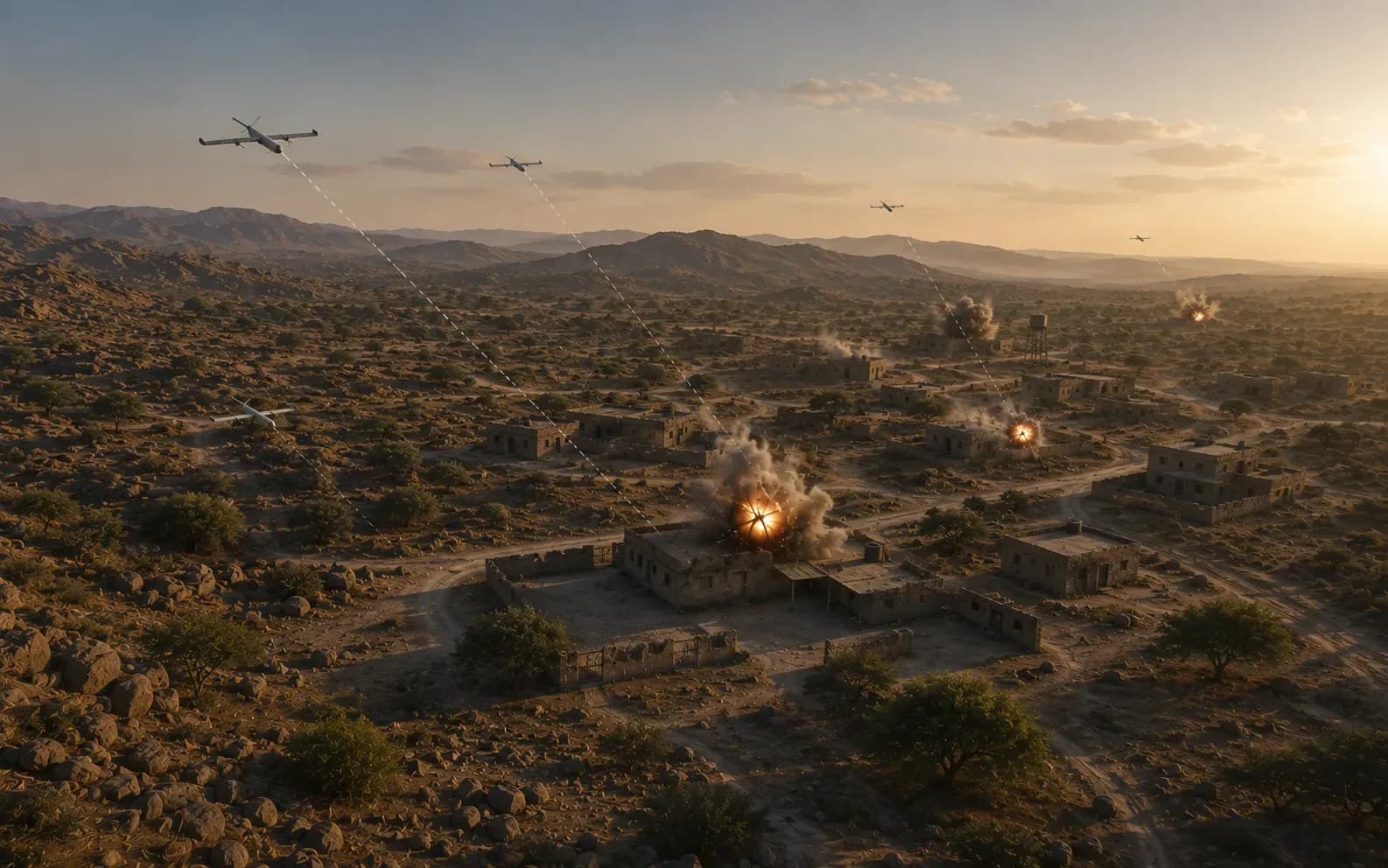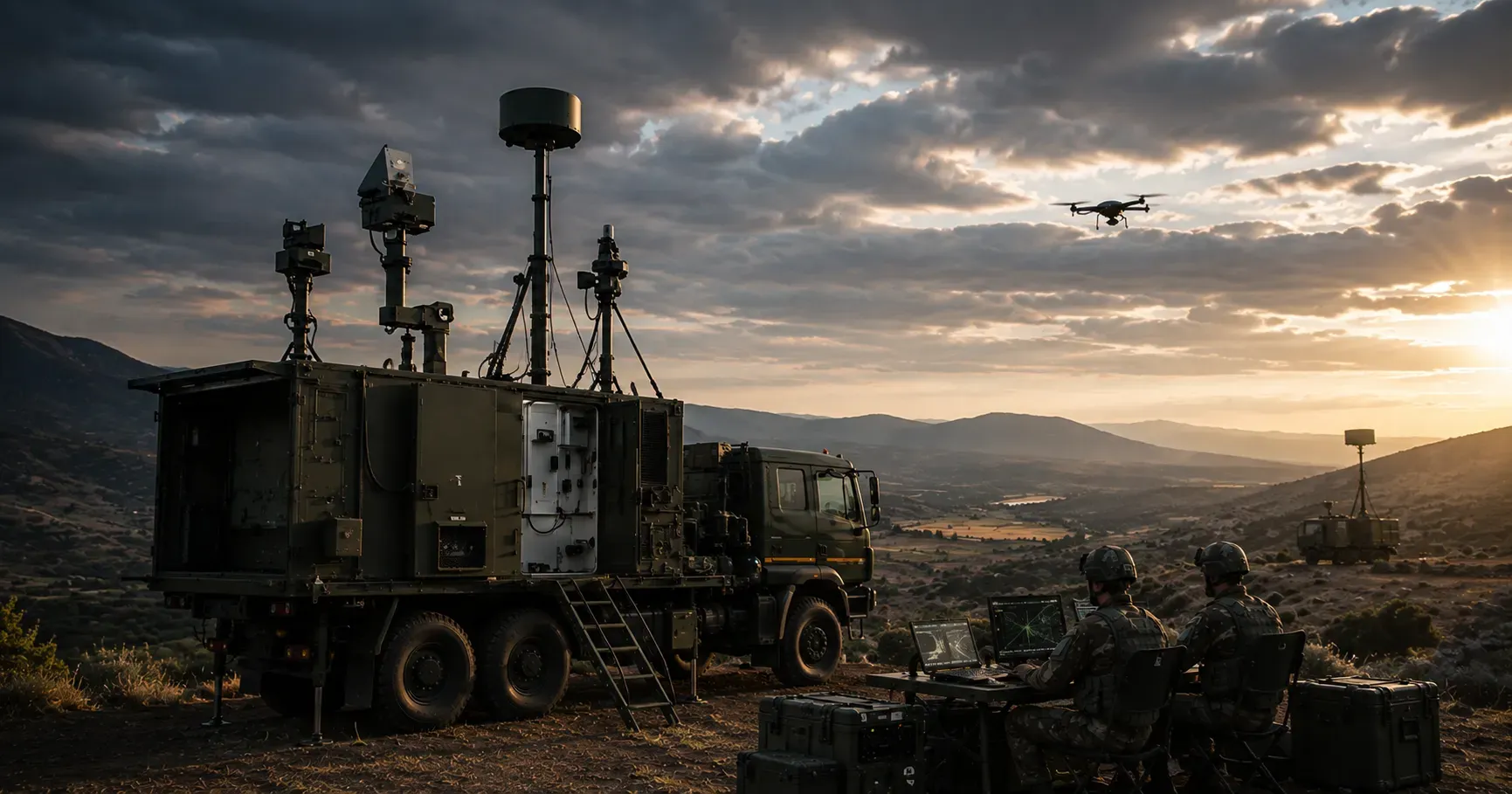
Drone swarms are not fleets, formations, or networked groups. A swarm runs distributed intelligence. Each drone exchanges state with neighbours, contributes to collective decisions, and the system survives node loss. This piece explains how swarm intelligence works in modern warfare and the bio-inspired algorithms behind it. It also covers where indigenous Indian swarm capability stands after the Indian Army's May 2026 sovereign swarm RFP.
Why drone swarms matter now
Three procurement and doctrinal events in the past sixteen months pushed swarm intelligence from research status to fielded capability inside the Indian Armed Forces. Operation Sindoor in May 2025 was the first sustained drone-saturation engagement in South Asia. Indian air defence units intercepted over 600 hostile drones along the western border (Press Information Bureau, 13 May 2025). The Kodainya pillar on India's military and defence drone programme covers the broader fleet context that frames the swarm doctrine.
The Indian Air Force followed in April 2026 with the third Mehar Baba Competition. The theme was Collaborative Drone-Based Surveillance Radars, funding swarm intelligence as a distributed sensing layer (Indian Air Force, 8 April 2026). The Indian Army then issued a Request for Proposal in May 2026 for a sovereign swarm warfare framework. A pre-bid meeting was scheduled for the second week of May (Defence Standard, 2 May 2026).
The three events tie back to one procurement signal. Indigenous control of the swarm autonomy stack is now treated as a sovereignty requirement, not a technology preference. The May 2026 RFP bans third-party black-box autonomy engines. It requires source code and intellectual property to be jointly shared with the selected partner. It also mandates fully offline capability for contested environments (Indian Defense News, May 2026). Defence Acquisition Procedure 2026 is being amended to remove foreign components from drone supply chains (Defence Standard, 2 May 2026).
A swarm is no longer a tactical novelty bolted onto a conventional force. It is the architectural unit around which Indian Army drone platoons, the IAF's distributed sensing concept, and the Indian Navy's underwater unmanned vehicle programme are being designed.
What a drone swarm is, and is not
A drone swarm is a system of three or more unmanned platforms that exchange state with each other and contribute to a collective decision. The US Government Accountability Office defines drone swarms as groups of drones that coordinate using algorithms and local sensing, often without direct human control (US GAO, 17 March 2023). The Indian Army's January 2021 Army Day demonstration showcased this architecture. The 75-drone swarm flew as a single coordinated unit and reorganised itself under node loss (Indian Army, 15 January 2021).
The category is bounded by what it is not. A fleet has a centralised controller, and the platforms are subordinate to that controller. If the controller is jammed, the fleet stops. A formation maintains spatial geometry under a single command, and the geometry breaks if the leader is lost. A networked group of drones shares data over a radio link, but each drone executes its own pre-loaded mission plan. Only a swarm carries three properties together: distributed decision-making, peer-to-peer state exchange, and graceful degradation under node loss.
The Kodainya cluster on the perception, decision, and action loop inside every autonomous drone covers the single-platform autonomy stack that sits underneath every swarm. The swarm layer sits on top. It takes per-drone perception and decision outputs and combines them into collective behaviour.
The three rules behind swarm intelligence
Every modern swarm algorithm extends three foundational rules formalised by Craig Reynolds in 1987. Separation maintains a minimum distance from neighbours. Alignment matches average heading and speed with neighbours. Cohesion holds position relative to the local neighbourhood centre. The three rules together generate emergent flocking and formation behaviour from purely local interactions (Craig Reynolds, ACM SIGGRAPH proceedings, 1987).
Reynolds called the simulated agents boids, and the model became the foundation for every later swarm algorithm. The boids model proves a counter-intuitive engineering claim. Complex collective behaviour does not require complex individual agents. It requires simple agents executing the same local rules in parallel. A starling murmuration of 400,000 birds runs on the same three rules as a three-drone swarm. The behaviour scales because the rules are local and the computation is per-drone.
Every algorithm in the swarm intelligence family extends the boids rule set with additional terms. Particle swarm optimisation adds attraction to a personal best and a global best. Ant colony optimisation adds pheromone deposition and decay. Behaviour trees add priority-ordered finite-state machines. The three Reynolds rules remain the foundation across all of them.
The swarm intelligence algorithm family
The algorithm layer is where vendor blogs hand-wave and where procurement officers read closely. Four algorithm classes carry the working load of every fielded swarm system today.
Particle swarm optimisation, or PSO, models the swarm as particles in an n-dimensional space. Each particle remembers its personal best and the global best across the swarm. It updates velocity based on both. PSO solves drone path planning, target search, and formation reconfiguration because the search converges on local and global optima in parallel (Frontiers in Applied Mathematics and Statistics, 21 October 2021). Motion-encoded PSO improves moving-target detection by 24 percent over the baseline (arXiv preprint, 2020). Force Field PSO adds repulsive terms between particles to eliminate inter-drone collisions during search.
Ant colony optimisation, or ACO, models foraging behaviour observed in ant colonies. Simulated ants lay virtual pheromones along candidate paths. Paths that yield shorter routes accumulate stronger pheromone trails. Later ants probabilistically follow stronger trails. ACO suits distributed route planning for drone swarms operating across large search areas under partial information.
Behaviour trees are the practitioner choice for swarms where deterministic behaviour matters more than mathematical optimisation. Each drone runs a finite-state machine with priority-ordered behaviours: maintain formation, avoid obstacle, prosecute target, return to base, emergency land. Emergent swarm behaviour arises from every drone running the same tree on the same local sensor inputs. Behaviour trees underpin fielded military swarms because they are auditable, deterministic, and certifiable.
Consensus algorithms ensure all drones in the swarm agree on a shared decision before acting. The decision could be target identity, formation transition, or abort criteria. Consensus makes decentralised swarms behave coherently under partial communication loss. The class includes Byzantine fault-tolerant consensus, which holds even when a subset of drones is compromised. Consensus protocols distinguish a swarm under electronic warfare pressure from a swarm under benign conditions.
The four classes are not mutually exclusive. A fielded swarm typically runs PSO for path planning, behaviour trees for tactical decision-making, and consensus protocols for shared state agreement. The Kodainya cluster on drone categories and classification under Indian rules covers how the algorithm choice maps to platform classification.
Centralised, decentralised, and hierarchical architectures
Architecture is the choice that defines how a swarm survives contact. Three classes carry the load.
Centralised swarms run a single ground-station or leader-drone controller. The controller plans, and the swarm executes. Centralised swarms are simpler to engineer and easier to certify because mission logic lives in one place. They are brittle under jamming or controller loss. If the link to the controller breaks, the swarm stops.
Decentralised swarms run the same algorithm on every drone, with no designated leader and redundancy built in. Each drone exchanges state with neighbours and contributes to collective decisions. Decentralised swarms are harder to engineer. They survive node loss and remain operational under contested communications. The MOSAIC decentralised swarming autonomy suite, integrated by NewSpace Research and Technologies into the Sheshnag-20, is the Indian flag-bearer of this class (Indian Defence Research Wing, 6 April 2026).
Hierarchical swarms combine the two approaches. A small number of leader drones run high-level mission logic and coordinate sub-swarms of follower drones. Hierarchical architectures balance certifiability with resilience. They are the dominant pattern in long-range collaborative loitering munitions like the Sheshnaag-150 (Army Recognition, 11 February 2026).
Architecture | Certifiability | EW resilience | Indian platform example |
|---|---|---|---|
Centralised | High mission logic in one place | Low - single point of failure | Army Day demonstration swarm (2021) |
Decentralised | Moderate distributed logic harder to audit | High - survives node and link loss | Sheshnag-20 with MOSAIC suite |
Hierarchical | High - leader logic remains centralised | Moderate to high - depends on leader redundancy | Sheshnaag-150 long-range class |
The architectural trade-off maps directly onto procurement language in the May 2026 RFP. The framework requires decentralised or hierarchical autonomy with fully offline capability, which rules out the centralised class. The Kodainya cluster on human-on-the-loop oversight inside autonomous operations covers how human authorisation sits across all three classes.
The mesh networking layer for swarms
Mesh networking is the standard communication architecture for fielded swarms. Every drone communicates with neighbours over an ad-hoc wireless mesh, with no fixed infrastructure. Routing is dynamic. If a node fails, traffic routes around it. Bandwidth is shared and contention-managed by the protocol. Latency is the binding design constraint. Sub-second consensus requires sub-100 millisecond message propagation across the swarm.
Contested electromagnetic environments break naive mesh designs. Jamming, spoofing, and selective denial demand frequency-hopping radios, encrypted payloads, and fall-back behaviours that keep the swarm operating under degraded communication. The Indian Army's May 2026 RFP requires fully offline capability for contested-environment operation. It excludes cloud dependency and bans third-party black-box autonomy engines (Defence Standard, 2 May 2026).
The mesh layer is the discriminator between a swarm that survives electronic warfare and one that does not. During Operation Sindoor, hostile drone activity reportedly jammed GPS signals across a 150-kilometre radius in some sectors (Press Information Bureau, May 2025). The Indian requirement is therefore explicit. Swarm communications must operate without GPS dependency and without command-link reliance. The communication-layer trade-offs decide whether a swarm survives contact.
Self-healing and the resilience layer
A swarm earns its name by surviving losses. Self-healing means the surviving drones detect a peer's failure, redistribute the failed drone's mission load, and reconfigure formation to maintain mission coverage. Dynamic retasking means the swarm changes objectives mid-mission, switching from ISR to strike, or splitting a mission across two target sets, without ground-station intervention.
The Sheshnag-20 demonstrated self-healing logic in flight trials. When a portion of the swarm is jammed or destroyed, the surviving units automatically reconfigure formation and continue mission execution (Defence News India, 7 April 2026). The Sheshnaag-150 programme lists self-healing swarms, dynamic retasking, and advanced mesh networking as deliverables that distinguish it from one-way strike drones (Army Recognition, 11 February 2026).
The resilience layer converts a swarm from a tactical asset into a doctrinal one. A force that fields 1,000 attritable drones in coordinated waves presents a saturation problem that conventional air defence cannot solve economically. The Kodainya cluster on the Indian loitering munition fleet from Nagastra-1 to the long-range class carries the production weight of this resilience model.
India's indigenous swarm stack and the sovereign RFP
The Indian indigenous swarm stack spans six anchor programmes by May 2026. The January 2021 Army Day demonstration was the first public proof of a 75-drone swarm with no designated leader (Indian Army, 15 January 2021). The demonstration set the operational direction for everything that followed.
DRDO's LOCUST programme, announced in 2023, sits upstream of the privately developed swarm platforms in the indigenous roadmap (DRDO press release, 2023). The DRDO jet-powered stealth swarm loitering munition programme, reported in March 2026, extends the indigenous reach to the 600-kilometre deep-strike envelope (Indian Masterminds, 10 March 2026). The Sheshnag-20 represents the 50-kilometre tactical class. The Sheshnaag-150 carries 25 to 40 kilograms over a 1,000-kilometre-plus range with five-hour endurance (Army Recognition, 11 February 2026).
The Indian Air Force's third Mehar Baba Competition, launched in April 2026, funds a parallel concept. The theme is Collaborative Drone-Based Surveillance Radars. The concept distributes the AWACS function across small unmanned platforms, sharing data with a centralised monitoring station (Press Information Bureau, 8 April 2026). Swarm intelligence converts from a strike asset into a sensing asset.
The Indian Army's May 2026 sovereign swarm RFP is the procurement vehicle that ties the stack together. The programme is structured in two phases over six months. A pre-bid meeting was scheduled for the second week of May 2026. The first phase delivers an indigenous ground control station and a software-only integration framework. The framework allows existing drones to be commanded without hardware or firmware modification (Defence Standard, 2 May 2026). The second phase culminates in a live field demonstration of multi-drone surveillance and coordinated payload delivery under a unified command structure (Indian Defense News, May 2026).
Three RFP requirements are non-negotiable. Fully offline capability is mandatory. Third-party black-box autonomy engines are banned. Source code and intellectual property must be jointly shared with the selected partner. The combined effect is a procurement standard for indigenous autonomy that no foreign vendor satisfies without modification.
Counter-swarm reciprocity and India's layered defence
A swarm in attack mode is a saturation problem for the defender. Hundreds of low-cost drones arriving simultaneously can overwhelm radar tracking, exhaust interceptor magazines, and force a defender to choose between targets. Operation Sindoor in May 2025 stress-tested exactly this scenario. Indian air defence units intercepted over 600 hostile drones along the western border. The Integrated Air Command and Control System coordinated the layered response (Press Information Bureau, 13 May 2025).
India's counter-swarm response is layered across four classes of effector. The D-4 anti-drone platform handles short-range engagements. The SAKSHAM counter-UAS grid, approved in 2025, provides area coverage at the formation level. The Bhargavastra multi-layer micro-missile system, tested at the Gopalpur Seaward Firing Range in May 2025, addresses cost-per-shot against cheap incoming drones (Organiser, 15 May 2026). DRDO's directed-energy weapons, capable of engagement at ranges up to two kilometres, complete the layered stack.
The cost-per-shot economics are the binding constraint for counter-swarm defence. A 100-drone swarm at 1,000 dollars per drone costs the attacker 100,000 dollars. Defending the same swarm with multi-million-rupee interceptor missiles is unsustainable in any extended engagement. DRDO's 300-kilowatt scalable directed-energy weapon programme is the response. Laser interception drives cost-per-shot to a level that makes saturation defence economically tractable (Defence News India, May 2026). The same architectural thinking links the Indian counter-drone stack from D-4 to Bhargavastra to the offensive swarm capability the Indian Army is fielding in parallel.
What this means in practice
The procurement signal across the Indian indigenous swarm stack converges on three propositions. First, the algorithm and architecture layers are now treated as sovereignty assets. Foreign-licensed swarm software and cloud-dependent autonomy engines are excluded by design. Second, the resilience layer (self-healing, dynamic retasking, mesh networking under contested conditions) is the discriminator that converts a swarm into a doctrinal asset. Indian platforms that demonstrate resilience under trial conditions will set the procurement bar for follow-on contracts. Third, counter-swarm defence is reciprocally indigenous. The same architectural thinking that produces a sovereign offensive swarm produces the sovereign laser, micro-missile, and grid-coordination stack that defends against an adversary swarm.
For procurement officers and integrators, the practical implication is direct. Capability claims that do not name the algorithm class, the architecture class, the mesh protocol, and the demonstrated resilience behaviour are marketing claims, not capability claims. The May 2026 RFP and the IAF Mehar Baba MBC-3 framework set the technical vocabulary procurement evaluation will use for the next 24 months.
Where Indian swarm capability goes from here
Three inflection points define the next two years. First, the sovereign swarm RFP completes its two-phase six-month evaluation and produces an indigenous algorithm framework that every Indian swarm platform will reference. Second, the DRDO jet-powered swarm loitering munition reaches first flight, extending Indian swarm reach to the 600-kilometre strategic-strike envelope. Third, the IAF's Mehar Baba MBC-3 matures into a fielded distributed airborne radar architecture.
The procurement signal is consistent. The Indian Armed Forces are no longer chasing swarm capability. The indigenous stack now sets the standard the procurement framework will enforce. The remaining question is whether the May 2026 RFP produces a unified autonomy backbone for every Indian swarm platform. The alternative is that each prime contractor retains a proprietary stack. The next 24 months, bounded by the sovereign swarm RFP evaluation cycle and the DRDO jet-powered swarm first flight, will produce the answer.
Indian swarm doctrine has cleared the proof-of-concept threshold and entered the procurement-standardisation phase.