The Drone Amendment Rules 2022 restructured Part VI of Drone Rules 2021 and aligned five Forms (D-1 to D-5) with a new certificate framework (Ministry of Civil Aviation, G.S.R. 108(E), 11 February 2022). The amendment transferred Remote Pilot Certificate issuance from DGCA to authorised Remote Pilot Training Organisations. It also fixed the legacy-drone registration cutoff at 31 March 2022. Paired with the drone import policy of 9 February 2022, it is the operational hinge of India's drone reform sequence.
What the Drone Amendment Rules 2022 amended
What is Drone Amendment Rules 2022, and when was Drone Amendment Rules 2022 notified? The Ministry of Civil Aviation issued the notification as G.S.R. 108(E) on 11 February 2022. It cites Section 5, sub-section 2 of Section 10, and Sections 10A, 10B, and 12A of the Aircraft Act 1934 as its statutory authority (Ministry of Civil Aviation, 11 February 2022). MoCA dispensed with the previous-publication requirement under the proviso to Section 14, citing public interest. The amendment therefore took effect on the date of Gazette publication, without a draft-comment cycle.
The Drone Rules 2022 key changes are a series of targeted substitutions. Rule 3(t) was redefined. Rule 16 sub-rule (1) was substituted to fix the legacy-registration deadline. Rule 34 sub-rule (4) was omitted. Rule 35(c) replaced "Director General" with "authorised remote pilot training organisation". The headings of Parts VI to VIII and Part XII were updated. Forms D-1 through D-5 were substituted in full (Drone Amendment Rules 2022, Rules 2 to 9).
The speed of the reform tells its own story. The parent Drone Rules 2021 framework had been live for less than six months when the amendment landed. Operator feedback on the Remote Pilot Licence pathway had already identified throughput bottlenecks at DGCA. The certificate model offered a faster distribution mechanism through authorised training organisations.
The Remote Pilot Licence to Remote Pilot Certificate rename
The RPL to RPC rename sits in Rule 3(t). The clause was substituted to redefine the Remote Pilot Certificate as "the certificate issued by an authorised remote pilot training organisation to any individual under rule 34" (Drone Amendment Rules 2022, Rule 2). The Part VI heading was changed from REMOTE PILOT LICENCE to REMOTE PILOT CERTIFICATE. Every occurrence of "licence" inside Parts VII, VIII, and XII was replaced with "certificate" (Drone Amendment Rules 2022, Rules 4 and 5).
The Drone Rules 2021 vs Drone Amendment Rules 2022 comparison reads cleanly side by side.
Provision | Drone Rules 2021 (pre-amendment) | Drone Amendment Rules 2022 (post-amendment) |
|---|---|---|
Rule 3(t) definition | "Remote Pilot Licence" | "Remote Pilot Certificate" |
Part VI heading | REMOTE PILOT LICENCE | REMOTE PILOT CERTIFICATE |
Rule 35(c) issuing authority | Director General | Authorised remote pilot training organisation |
Rule 16(1) registration window | Rolling 31-day window | Hard cutoff: 31 March 2022 |
Rule 34 sub-rule (4) | In force | Omitted |
Forms D-1 to D-5 | Original 2021 schema | Substituted in full |
The substantive shift hides inside Rule 35. Pre-amendment, the issuing authority was the Director General of Civil Aviation. Post-amendment, Rule 35(c) reads "authorised remote pilot training organisation" in place of "Director General" (Drone Amendment Rules 2022, Rule 7). This is regulatory devolution, not cosmetic renaming. DGCA stepped back from direct issuance and pushed credentialling into the training-organisation layer.
Rule 34 sub-rule (4) was omitted, simplifying the procedure further (Drone Amendment Rules 2022, Rule 6). The clean-up of Form D-4 closed the loop. The difference between RPL and RPC drone credentials therefore runs deeper than the name change suggests. The certificate framework is what an operator works inside today through the operational pathway to a Remote Pilot Certificate.
Why the issuance authority shifted from DGCA to RPTOs
The drone pilot certificate authority India question turns on Rule 35. The pre-amendment DGCA drone licence pathway concentrated all approvals at the regulator. Every applicant routed through a single-point queue, and licence issuance scaled at the speed of one regulator. The bottleneck was visible inside the first two quarters of Drone Rules 2021 implementation.
Post-amendment, DGCA-authorised Remote Pilot Training Organisations issue the certificate after the candidate completes training and assessment. MoCA has authorised 116-plus RPTOs across India. Each organisation runs its own batches inside the syllabus DGCA defines (Ministry of Civil Aviation, Lok Sabha written reply, July 2023). DGCA retained two anchors of authority: syllabus-setting through DTC 02 of 2022, and audit authority over RPTOs through periodic compliance review.
The Lok Sabha written reply of July 2023 also disclosed an operational outcome figure. The Ministry confirmed that 5,500-plus Remote Pilot Certificates had been issued under the post-amendment framework. The number is the cleanest available indicator that the devolution model worked at the throughput layer DGCA had targeted.
The devolution model borrows from the Aircraft Maintenance Engineer training framework, where DGCA approves training organisations and the organisations issue the technical credential. Civil aviation in India has used this two-layer architecture for decades. Extending it to the drone-pilot stack let MoCA scale credentialling without scaling DGCA headcount. The network of authorised RPTOs is now the single largest distributor of aviation credentials in the country.
The registration deadline shift under Rule 16
The Rule 16 substitution looks small on paper. The pre-amendment text read "within a period of thirty-one days falling after the said date". The post-amendment text reads "on or before the thirty-first day of March, 2022" (Drone Amendment Rules 2022, Rule 3). The compliance effect was substantial.
Every owner of an unmanned aircraft system manufactured in or imported into India on or before 30 November 2021 now had a hard deadline. The drone registration deadline 31 March 2022 had to be met through Form D-2 on the DigitalSky platform. The fee was specified in Rule 46 of the parent Rules (Drone Rules 2021, Rule 46). A hard cutoff date gave the system a clean before-and-after line, replacing the rolling 31-day window that had created uneven compliance windows for legacy operators.
The UIN registration window pre-dated a series of registration moratoria that MoCA used to bring older drones onto DigitalSky. Registration functions then migrated to the eGCA platform on 3 July 2025. The legacy-drone clean-up that began with the Rule 16 substitution is what made the platform migration possible. The UIN registration pathway via DigitalSky still uses the Form D-2 schema introduced by the 2022 amendment, even after the move to eGCA.
The micro-drone non-commercial exemption
Rule 5 of Drone Rules 2021 defines the weight categories. It was untouched by the 2022 amendment. Nano sits at up to 250 g. Micro covers above 250 g to 2 kg. Small covers above 2 kg to 25 kg. Medium covers above 25 kg to 150 kg. Large covers above 150 kg (Drone Rules 2021, Rule 5). What changed in 2022 was the certificate requirement, not the categories.
The micro drone licence requirement India position now reads as follows. No Remote Pilot Certificate is required for the Nano category. No certificate is required for the Micro category when the drone is flown for non-commercial purposes (Drone Amendment Rules 2022, read with Drone Rules 2021, Rule 36). For commercial Micro use, the certificate requirement applies. Corporate photography, paid inspection, contract survey, and event work all sit on the commercial side of that line.
The press release issued by PIB after the notification described the change as the drone licence abolished India framing (PIB, PRID 1881767, December 2022). Half the secondary coverage in 2022 read that phrasing as no certificate for any drone. The actual position is narrower. The RPL was renamed to RPC, the issuance pathway shifted to authorised training organisations, and the Micro-category non-commercial use was exempted from the certificate requirement. The Nano, Micro, Small, Medium, and Large weight categories continue to determine which operator needs which credential.
The Forms overhaul from D-1 to D-5
Five Forms were substituted under the Drone Amendment Rules 2022. Form D-1 captures applications for a Type Certificate. Form D-2 captures applications for registration and Unique Identification Number. Form D-3 captures transfer or deregistration of unmanned aircraft systems. Form D-4 captures Remote Pilot Certificate applications filed by RPTOs. Form D-5 captures applications for RPTO authorisation (Drone Amendment Rules 2022, Rules 10 to 14).
The substitution served two functions. The first was terminological consistency: every "licence" reference inside the Forms was updated to "certificate". This removed the friction that mismatched terminology created at application processing. The second was a government-procurement carve-out. A Note added to Forms D-1 and D-2 exempts government users from three fields. The exemption covers serial numbers 10 and 11, plus the DIN field at serial number 12. It applies to any Ministry, Department, police force, or government-controlled institution (Drone Amendment Rules 2022, Rules 10 and 11).
That Note is the legal basis on which state police drone fleets, paramilitary procurement, disaster-response units, and similar government drone deployments use abbreviated registration paths today. The CSUAS-graded Type Certificate pathway via the Quality Council of India still applies to the equipment. The Type Certificate pathway under CSUAS is the channel through which government-procured drones earn airworthiness recognition.
The R&D carve-out and the Quality Council of India shift
The R&D drone exemption India clause is the most under-reported element of the Drone Amendment Rules 2022. R&D entities no longer need a Type Certificate, a UIN, prior permission, or a Remote Pilot Licence or Certificate for drones used in R&D work (Drone Amendment Rules 2022, read with Drone Rules 2021, Rule 41). It unlocked drone testing for DRDO labs, the Indian Space Research Organisation, IIT incubators, and private R&D arms without DGCA workflow overhead.
The Type Certification authority was clarified in parallel. The Quality Council of India, or any certification entity authorised by QCI or the Central Government, issues Type Certificates. Applications are filed via the DigitalSky platform (Drone Rules 2021, Rule 7). The 2022 amendment kept that architecture and tightened the Form D-1 application schema around it. The Certification Scheme for Unmanned Aircraft Systems was independently notified on 26 January 2022, giving the certification process its standalone scheme document (Ministry of Civil Aviation, 26 January 2022).
Three QCI-authorised Certification Bodies were approved under CSUAS, expanded in December 2023 with the National Test House as a provisional body (Ministry of Consumer Affairs, 29 December 2023). The drone certification India network operates inside this CSUAS perimeter. The CSUAS framework and the QCI-authorised Certification Bodies remain the spine of India's drone airworthiness regime today.
Placing the 2022 amendment in the reform sequence
The Drone Rules 2022 sit inside a deliberate reform sequence. Drone Rules 2021 were notified on 25 August 2021 (Ministry of Civil Aviation, 25 August 2021). The Drone Import Policy was notified on 9 February 2022, banning foreign drone imports and liberalising drone-component imports (PIB, PRID 1881767, December 2022). The Drone Amendment Rules 2022 followed on 11 February 2022. The PLI scheme guidelines for drones were notified on 29 November 2022. The Drone Amendment Rules 2023 were notified on 27 September 2023, expanding the identity-document list for RPC applicants. Voter ID, Ration Card, and Driving Licence were accepted in lieu of Passport (PIB, PRID 1986162, December 2023).
The 2022 amendment is the operational hinge. The import ban of 9 February 2022 and the certificate-pathway simplification of 11 February 2022 were paired by design. Together, they pushed domestic manufacture and pilot training in the same direction. The PLI scheme closed the manufacturing-incentive side later that year. The 2023 amendment closed the rural-pilot access gap.
The two amendments read cleanly side by side. The 2022 amendment restructured authority, framework, and Forms. The 2023 amendment relaxed identity documentation. The first reshaped the regulator-operator relationship; the second widened the pilot funnel. The full reform stack from Drone Rules 2021 to the Civil Drone Bill 2025 reads as one programme, with the 2022 amendment as its load-bearing component.
What the 2022 amendment did not change
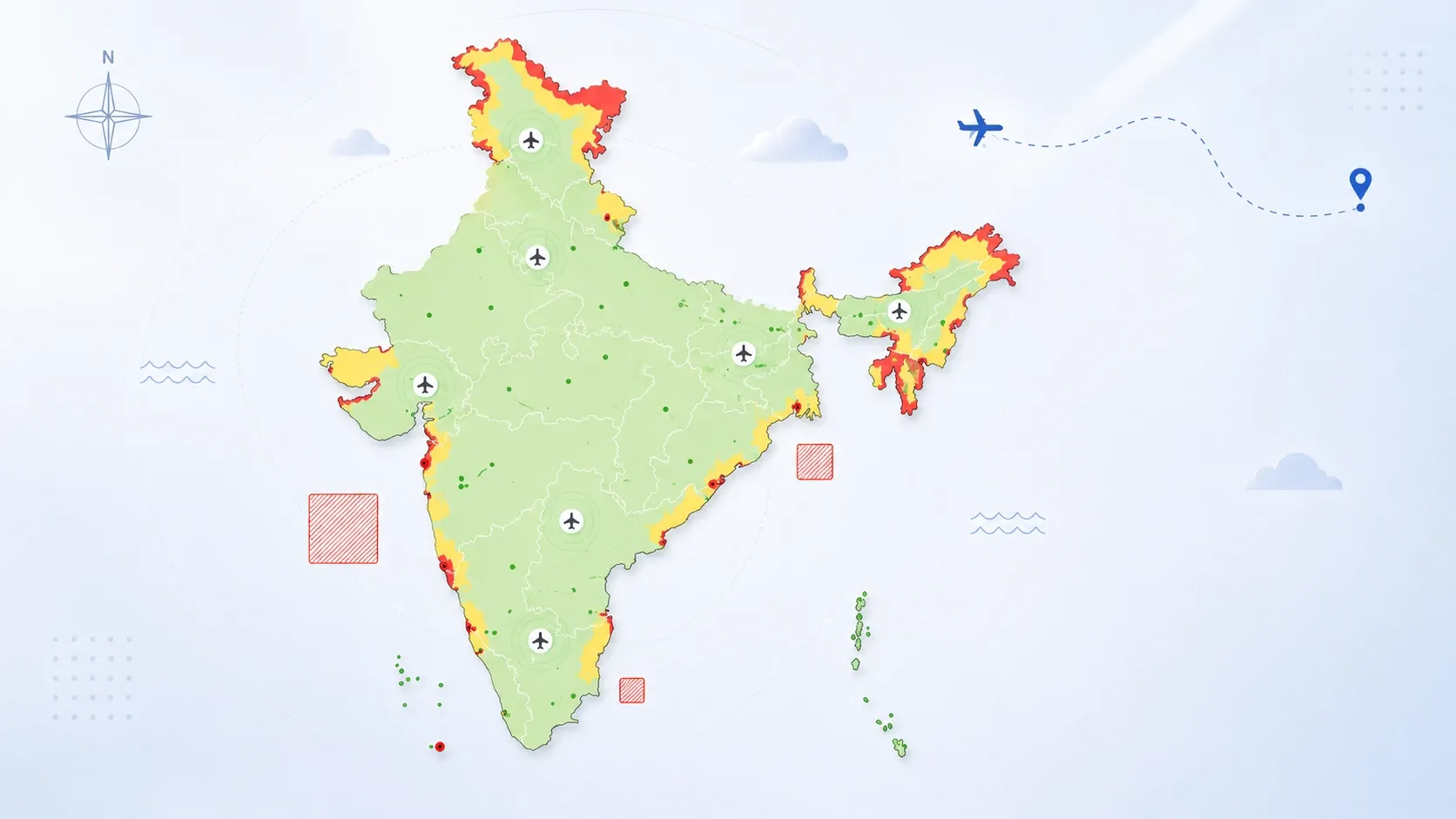
The Drone Amendment Rules 2022 were narrowly tailored. The 120-metre altitude ceiling for standard civilian operations remained intact (Drone Rules 2021, Rule 22). The Green, Yellow, and Red Zone airspace classification was untouched. It is governed by the airspace map on the DigitalSky platform (Drone Rules 2021, Rule 24). The Rule 46 fee schedule structure was preserved. The Rule 38 medical-fitness requirement calls for a fitness certificate from any registered medical practitioner. It was carried forward unchanged. The Rule 38 standard continues to be misread in secondary coverage as the aviation Class 2 medical standard (Drone Rules 2021, Rule 38).
The Rule 49 penalty structure was preserved in full. Operating a drone in a Red or Yellow Zone without prior permission remained a cognisable and non-compoundable offence. The investigating officer retains arrest-without-warrant authority (Drone Rules 2021, Rule 49). The amendment did not touch the airspace, altitude, or safety architecture. It cleaned procedural and authority layers, and it left the safety and enforcement architecture alone. Operators flying lawfully on 10 February 2022 continued to fly lawfully on 12 February 2022. The Green, Yellow, and Red Zone framework is what an operator still queries before every flight. The 2022 amendment did nothing to soften it.
How the 2022 amendment reads in 2026
Drone Rules 2021, as amended in 2022 and 2023, remains the operational rulebook in India. The parent Act underneath has changed: the Bharatiya Vayuyan Adhiniyam 2024 replaced the Aircraft Act 1934 from 1 January 2025 (Bharatiya Vayuyan Adhiniyam 2024). The Drone Rules 2021 framework continues unchanged under the new parent. Every Remote Pilot Certificate, Type Certificate, and UIN issued under the 2022-amended framework retains its validity.
The draft Civil Drone (Promotion and Regulation) Bill 2025 proposes statutory backing for drone-specific rulemaking and shifts several enforcement boundaries (Ministry of Civil Aviation, 16 September 2025). The Bill covers unmanned aircraft systems below 500 kilograms. It expands enforcement authority, compensation rules, insurance obligations, and criminal penalties. The 2022 amendment's certificate framework, the RPTO devolution model, and the QCI certification pathway are expected to carry forward. Operators preparing for the Bill should read the 2022 amendment as the architectural template the proposed Civil Drone (Promotion and Regulation) Bill 2025 builds on.
The 2022 amendment lifted the throughput ceiling that Drone Rules 2021 placed on commercial drone deployment. The certificate framework it built is the architectural template the Civil Drone Bill 2025 will inherit. The next test sits in how the post-Bill rules treat training organisations.