India's drone corridor architecture sits on two scaffolds: the Drone Rules 2021 framework, and the Beyond Visual Line of Sight project-specific exemption pathway introduced through the Telangana annexure of 25 August 2021. As of May 2026, six corridors run operationally against a national target of approximately 100. Telangana, Uttarakhand, and Gujarat carry the three template architectures the rest of the country inherits (Ministry of Civil Aviation, 2025). Two policy events reset the conversation in 2025: the Civil Drone Bill released for consultation on 16 September 2025, and the eGCA migration in July 2025. This page sets out the map, the economics, and the forward roadmap.
What India's drone corridor framework actually means
Drone corridors in India rest on three regulatory anchors. The Drone Rules 2021 set the 400-foot Above Ground Level ceiling and define the five drone categories by maximum all-up weight (Ministry of Civil Aviation, 25 August 2021). The 24 October 2021 UTM Policy Framework introduced the architecture for unmanned aircraft traffic management. The BVLOS corridor exemption pathway, codified inside the Telangana annexure of 25 August 2021, set the template that every subsequent corridor inherits.
A corridor in this framework is not a licence. It is a project-specific exemption granted to a named operator consortium for a defined airspace, a defined use case, and a fixed operational window. The Beyond Visual Line of Sight Experimentation Committee, constituted under the Airports Authority of India from June 2020, cleared 13 sandbox consortia to operate inside this pathway (BEAM Committee, June 2020). Each consortium files a Standard Operating Procedure for BVLOS operations, a separate SOP for ATC and Indian Air Force coordination, and a Hazard Identification and Risk Management workshop record before the first sortie.
Three terms get blurred in popular writing. An operational corridor is one with active BVLOS sorties under a current exemption. A planned corridor is one with state-side governance approval but no MoCA exemption yet. A manufacturing cluster is an industrial zone for drone production, not airspace. As of May 2026, India runs six operational corridors against approximately 100 planned, with the planning pipeline anchored on the Drone Rules 2021 corridor cargo provision (Ministry of Civil Aviation, 2025). The compliance walkthrough sits inside the drone laws in India and BVLOS operations in India references.
The Telangana drone corridor and Medicine From The Sky
The Telangana drone corridor runs the operational template every other state copies. The Medicine From The Sky project launched at Vikarabad on 11 September 2021, with Union Civil Aviation Minister Jyotiraditya Scindia and Telangana IT Minister K T Rama Rao inaugurating the first BVLOS sortie (Government of Telangana ITE&C Department, September 2021). The project ran in partnership with the World Economic Forum, NITI Aayog, and HealthNet Global.
The Vikarabad pilot covered 45 days. Payload-capable unmanned aircraft systems flew 600 kilometres of aerial distance and completed 326 sorties across the trial period (Telangana Today, May 2022). Eight air corridors were activated within a 16-corridor sandbox window endorsed by the regulator. Seven different multi-rotor platforms operated under the exemption. The average flight altitude was 300 feet and the average payload was 2.3 kilograms across boxes, supplies, and coolants. The operational architecture used Government Area Hospital Vikarabad as the central hub and primary health centres plus sub-centres as the spokes.
One anchor mission inside the Medicine From The Sky corridor was a 26-kilometre Vikarabad to Bomraspet vaccine flight. The sortie delivered 300 doses of Revac B and 15 doses of Tubervaac under a 4.6-degree Celsius cold-chain envelope. An operator consortium running a multi-rotor platform with a 5-kilogram payload and a 10-kilometre single-run range conducted VLOS operations up to 1 kilometre and BVLOS operations up to 9 kilometres during the same window. Vikarabad was selected because it is largely rural yet reachable from Hyderabad by road in two hours, giving the trial both operational realism and logistical proximity to the Shamshabad ATC.
The Telangana drone corridor has since scaled. The state's medical drone network now spans 80 villages across 125 kilometres of validated BVLOS routes (Ministry of Civil Aviation, 2024). The Vikarabad template, documented inside the Medicine From The Sky programme explainer and the DigitalSky platform reference, is the inherited blueprint for every medical corridor that follows.
The Uttarakhand drone corridor and the hill-corridor pipeline
The Uttarakhand drone corridor sits on a different operational logic. The state runs one operational medical corridor, Dehradun to Uttarkashi, with AIIMS Rishikesh as the medical-aid spine. Six additional corridors are planned across three Garhwal and three Kumaon routes. The pipeline sits with the Information Technology Development Agency, which issued a stakeholder proposal call on 5 June 2023 to drone operators and manufacturers (Government of Uttarakhand ITDA, 5 June 2023). Proposals route through the Uttarakhand Civil Aviation Development Authority and onward to the Directorate General of Civil Aviation.
The hill-state economics differ from the Telangana plains template in three ways. Battery-range constraints bite harder because terrain elevation forces longer climbs and reduces effective payload over distance. Route planning needs vertical-corridor design rather than flat point-to-point hops. Monsoon-window restrictions cut available operating days, with heavy rain, landslides, fog, and snow disrupting connectivity for parts of the year across hilly, forested, and river-adjacent districts. The corridor case for hill states therefore rests on health-emergency response rather than steady-state delivery throughput.
A cross-state proof point came from Himachal Pradesh's 170-kilometre BVLOS trial in Chamba district during 2024 (Government of Himachal Pradesh, 2024). The Chamba run validated that terrain-aware route planning and platform-class selection could compress travel times from hours of road transit to under 30 minutes of corridor-routed flight. Uttarakhand's planned corridors inherit this lesson directly because Garhwal and Kumaon share the same elevation bands and weather windows as Chamba.
The state-side rationale also carries a security overlay. Uttarakhand is a border state, and the dedicated-corridor logic includes restricted-airspace coordination with the Indian Air Force as a baseline condition. The National Highways Authority of India 600-wayside-amenity helipad-and-drone integration plan overlays this corridor architecture onto hill highways (NHAI, 2025). For platform selection across these corridors, the drone categories in India and types of drones references set out the relevant MAUW bands and payload classes.
The Gujarat drone corridor and the industrial cluster model
The Gujarat drone corridor runs the third template inside India's drone corridor system. The state announced its Drone Promotion and Usage Policy on 11 August 2022, with Chief Minister Bhupendra Patel framing the five-year policy as the foundation for a drone service ecosystem (Government of Gujarat, 11 August 2022). The policy aimed at making drone services more accessible and creating direct and indirect employment across the supply chain.
The Gujarat model differs from the Telangana medical and Uttarakhand hill templates by fusing civilian, surveillance, manufacturing, and space anchors into a single industrial cluster strategy. Three subsequent policy instruments deepen the architecture. The SpaceTech Policy 2025-2030, India's first state-level space policy, targets USD 5 billion in investment and 25,000 jobs across satellite manufacturing, launch services, ground systems, and space applications. The Electronics Component Manufacturing Policy 2025 targets ₹35,000 crore for sensors, semiconductors, communication modules, and avionics. The Global Capability Centre Policy 2025-30 supports research and development in cybersecurity, data analytics, and artificial intelligence (Government of Gujarat, 2025).
Policy instrument | Year | Headline target | Anchor body |
|---|---|---|---|
Drone Promotion and Usage Policy | 2022 | Five-year drone service ecosystem | Government of Gujarat |
SpaceTech Policy 2025-2030 | 2025 | USD 5 billion investment, 25,000 jobs | IN-SPACe, ISRO partnership |
Electronics Component Manufacturing Policy 2025 | 2025 | ₹35,000 crore for sensors, avionics | Government of Gujarat |
GP-DRASTI surveillance corridor | 2025 | 33 police stations, 4 cities | Gujarat Police |
The surveillance layer activated in April 2025 with Gujarat Police Drone Response and Aerial Surveillance Tactical Interventions, deployed across 33 police stations in Ahmedabad, Surat, Vadodara, and Rajkot, with 8 drones operational in Ahmedabad during the first phase (Gujarat Police, April 2025). The Sanand industrial region anchors precision engineering and component manufacturing. Vadodara and Halol host defence component vendors. ISRO's Space Applications Centre in Ahmedabad provides the satellite-systems research backbone. The architecture means a corridor application in Gujarat can simultaneously route through industrial, surveillance, and space stakeholders inside a single state administrative envelope.
The BVLOS corridor exemption pathway across all three states
The compliance stack for drone corridors in India is identical across Telangana, Uttarakhand, and Gujarat, because every corridor inherits the Telangana annexure of 25 August 2021 as the regulatory template (Ministry of Civil Aviation, 25 August 2021). What changes is the state-side governance routing.
Each consortium files two documents with DGCA before commencement: a Standard Operating Procedure for BVLOS operations, and a separate SOP for coordination with Air Traffic Control and the Indian Air Force, including command-and-control lost-link contingencies. The Ministry of Home Affairs issues security clearance for non-government entities, personnel, and the proposed airspaces. The 400-foot Above Ground Level ceiling applies, with a 15 per cent energy reserve as a non-negotiable margin. A Hazard Identification and Risk Management workshop runs before any flight.
Compliance condition | Source authority | Application stage |
|---|---|---|
BVLOS SOP and ATC/IAF SOP | DGCA approval | Pre-application |
Security clearance for entities and airspace | Ministry of Home Affairs | Pre-application |
400-foot AGL ceiling with 15 per cent energy reserve | DGCA | Operational condition |
HIRM workshop | Consortium-led, DGCA-acknowledged | Pre-flight |
Pilot certificate of training plus VLOS safety record | DGCA | Pre-flight |
IAF and local administration clearance | IAF, district administration | Pre-flight |
Single Point Coordinator at relevant ATC | AAI | Operational duration |
Flight plan with FIC and ADC numbers | AAI, IAF | Per sortie |
NOTAM | General Manager (ATM), AAI | Per operating window |
Sunrise-to-sunset VMC window | Manufacturer limits, DGCA | Operational condition |
Pilots hold a valid certificate of training plus a documented VLOS safety record. Clearance from the Indian Air Force and the local administration is obtained before commencement. A Single Point Coordinator is posted at Shamshabad ATC for the entire Telangana trial duration, with equivalent SPC postings at the relevant ATC for Uttarakhand and Gujarat corridors. A flight plan with FIC and ADC numbers is filed per BVLOS sortie. NOTAMs route through the General Manager (Air Traffic Management) at AAI. Operations run sunrise to sunset in Visual Meteorological Conditions. State-side governance routes through UCADA in Uttarakhand and the Gujarat Department of Science and Technology, with the operator stack also touching the BVLOS operations in India and NPNT framework India layers.
The operational drone corridor map of India today
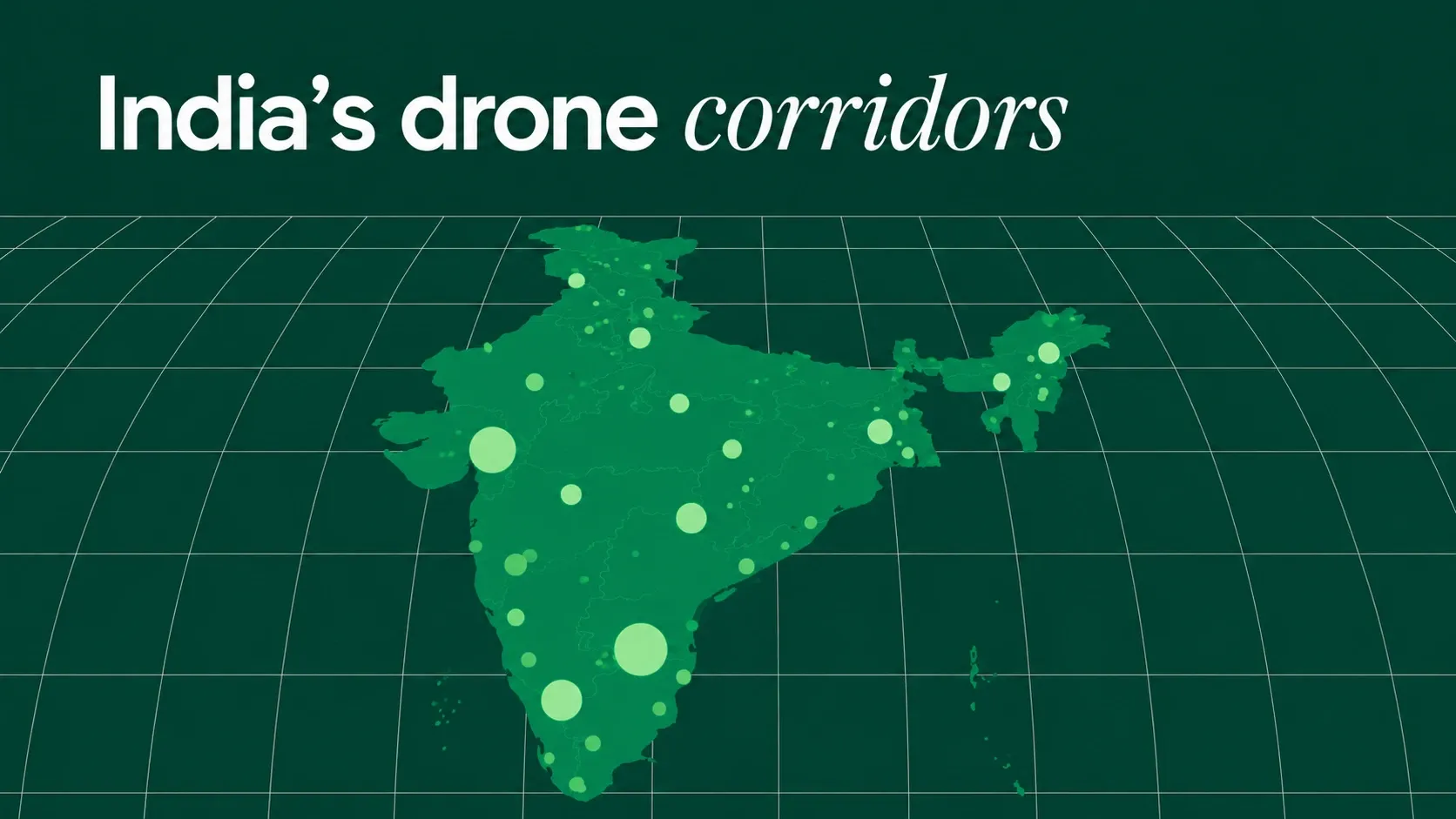
The operational drone corridor map of India today shows six routes live against the approximately 100-corridor national target (Ministry of Civil Aviation, 2025). The three states anchored in this blog account for the three template architectures the country inherits.
State | Anchor use case | Anchor flight or programme | Anchor date |
|---|---|---|---|
Telangana | Medical delivery | Medicine From The Sky Vikarabad launch | 11 September 2021 |
Uttarakhand | Hill medical aid | Dehradun-Uttarkashi corridor, AIIMS Rishikesh spine | Operational 2024 onward |
Gujarat | Industrial and surveillance | GP-DRASTI four-city deployment | April 2025 |
Karnataka | Medical and logistics testing | Lok Sabha Unstarred Question 4759 reply | 21 August 2025 |
Andhra Pradesh | Coastal monitoring | DGCA policy update | 2026 cycle |
Himachal Pradesh | Long-range BVLOS proof | 170-kilometre Chamba district trial | 2024 |
Karnataka entered the corridor inventory via parliamentary record. Lok Sabha Unstarred Question 4759, answered on 21 August 2025, confirmed government work on dedicated drone corridors. The reply named medical supply, disaster response, and agricultural services as the use cases across Karnataka districts (Lok Sabha Unstarred Question 4759, 21 August 2025). Andhra Pradesh anchors coastal monitoring under the 2026 DGCA policy cycle. A cross-corridor reference flight worth noting is the 104-kilometre Baruipur to Medinipur BVLOS run in West Bengal during 2024 (Government of West Bengal, 2024), which proved the long-range envelope even outside the briefed three-state anchor set. The NHAI 600-wayside-amenity helipad-and-drone integration plan layers a national highway overlay onto the corridor map (NHAI, 2025). The operational geometry sits inside the drone airspace zone map reference for zone-by-zone verification.
The 100-corridor national roadmap and the Civil Drone Bill 2025
The forward roadmap for drone corridors in India turns on three pivots. The first is the Civil Drone (Promotion and Regulation) Bill 2025, released for consultation on 16 September 2025 (Ministry of Civil Aviation, 16 September 2025). The Bill applies to UAS below 500 kilograms. It mandates type certification before sale or operation, requires compulsory third-party insurance, and introduces a statutory no-fault compensation framework with ₹2.5 lakh for death and ₹1 lakh for grievous injury under Motor Accident Claims Tribunal jurisdiction. The Bill also empowers authorities to detain a drone on suspicion of violation. The consultation window extended through October and November 2025 after industry feedback.
The second pivot is the eGCA migration of July 2025 (DGCA, July 2025). The transfer of type certification and Remote Pilot Certificate workflows from DigitalSky to eGCA changes the application path for every corridor operator. The Drone Rules 2021 remain in force in parallel, leaving operators with a two-platform workflow until the new Bill enters statute. The Type Certification process India and drone insurance India references walk the operator-side compliance stack.
The third pivot is the operational technology layer that scales the corridor count from six to one hundred. AI lifts three layers of the corridor stack without replacing any compliance step. AI route-planning models ingest terrain elevation, wind data, NOTAM overlays, and Rule 24(2) temporary red-zone declarations to compress route planning from hours to minutes. For Uttarakhand's hill corridors, this addresses the battery-range constraint named in the ITDA 2023 proposal (Government of Uttarakhand ITDA, 5 June 2023). At the airspace layer, computer-vision Detect-and-Avoid stacks on multi-rotor BVLOS platforms triangulate ADS-B feeds, electronic-conspicuity returns, and onboard sensor fusion to maintain the corridor safety case. At the platform layer, telemetry-driven failure-prediction models on Type Certified platforms cut unscheduled-grounding rates that cap weekly sortie counts. The Vikarabad 326-sortie record across 45 days (Telangana Today, May 2022) sets the benchmark. AI compresses the operational cycle inside the corridor. It does not replace MoCA approval, MHA clearance, or the SPC posting at the relevant ATC. The 100 drone corridors India target therefore depends on regulatory architecture and operational technology landing together.
India's corridor framework against FAA Part 108 and Transport Canada CARs Part IX
Two parallel jurisdictions changed their BVLOS rulebook during 2025. The Federal Aviation Administration published the Part 108 Notice of Proposed Rulemaking on 7 August 2025, with comments closing on 6 October 2025 (FAA, 7 August 2025). Part 108 covers BVLOS package delivery, shielded operations, and the Automated Data Service Provider category under proposed Part 146. Transport Canada brought CARs Part IX into effect on 4 November 2025, introducing an automated-BVLOS framework for Canadian operators (Transport Canada, 4 November 2025).
Jurisdiction | Model | Status | Key date |
|---|---|---|---|
India | Corridor-segregated airspace, project-specific exemption | Drone Rules 2021 in force; Civil Drone Bill 2025 in consultation | 16 September 2025 |
United States | Conformance-monitoring with ADSP and Part 146 services | Part 108 NPRM, comments closed | 6 October 2025 |
Canada | Automated-BVLOS framework under CARs Part IX | In effect | 4 November 2025 |
India's corridor-segregated airspace model contrasts with the FAA conformance-monitoring approach. The corridor model trades operational density for safety-case manageability. The FAA model trades safety-case overhead for operational density. India's next iteration likely converges through Civil Drone Bill 2025 UTMSP recognition and a layered third-party-service-provider framework similar to Part 146.
The next 24 months are an execution test, not a policy test. The Drone Rules 2021 corridor cargo provision, the BVLOS exemption template, and the eGCA platform are all in place. What remains contested is the path between application and approval. Operators that file complete BVLOS SOPs and secure MHA clearance early move from queue to operational status. The ones that coordinate the SPC posting with the relevant ATC before the first sortie and align platform selection to the corridor's terrain and payload band reach approval fastest. Three watchpoints frame the year ahead: the final shape of the Civil Drone Bill 2025 after consultation closes, the activation pace of Uttarakhand's six planned corridors through the UCADA-DGCA pipeline, and Gujarat's ability to convert manufacturing capacity into operational BVLOS routes rather than only surveillance deployments. The corridor that opens in the next quarter is the one with state-side governance, MoCA approval, MHA clearance, a Type Certified platform, and a credible operator stack all lined up. The rest stall at the application stage.