India's drone industry is no longer a hardware story. Drone-as-a-service has become the operating model behind the country's projected USD 2.44 billion drone services market by 2026 (Fortune Business Insights, 2025), powered by the Drone Shakti mission announced in the Union Budget 2022-23, the Namo Drone Didi central scheme allocating ₹1,261 crore for 15,000 drone-owning Women Self Help Groups, and the GST cut to 5% on drones notified after the 56th GST Council meeting (PIB, 3 September 2025). This blog maps the model end to end.
What drone-as-a-service actually means and why it now dominates Indian drone procurement
Drone-as-a-service in India is the commercial structure under which aerial capability is procured on demand rather than owned outright. Operators sell flight hours, payload deployment, pilot services, and bundled regulatory clearances against measurable units of work — per acre sprayed, per kilometre delivered, per square kilometre mapped, or per defect detected. The buyer pays for the outcome; the operator carries the airframe, the pilot pool, the maintenance burden, and the compliance exposure.
The model moved from niche procurement to national-scale operating layer after the Drone Rules 2021 simplified licensing, airworthiness, and operational approvals for civil unmanned aircraft (Ministry of Civil Aviation, 25 August 2021). The change reduced entry barriers for service operators and shifted commercial demand away from outright ownership toward outsourced aerial capability.
The Union Budget 2022-23 formalised the policy frame. The Drone Shakti mission, announced on 1 February 2022, explicitly referenced "Drone-as-a-Service (DrAAS)" as a mechanism for supporting startups and enabling application-led growth across sectors (Ministry of Finance, 1 February 2022). The subsequent Drone (Amendment) Rules 2022 abolished the drone pilot licence requirement and replaced it with a Remote Pilot Certificate issued by a DGCA-authorised RPTO (PIB, 11 February 2022). Together, the two notifications converted DaaS from a commercial preference into a regulator-backed operating model.
The four pricing models powering the Indian DaaS economy
The Indian DaaS market now operates across four distinct pricing structures, each aligned to a different operational sector and procurement pattern.
Pricing model | Operational basis | Primary sectors | Typical contract structure |
|---|---|---|---|
Pay-per-use | Per acre, kilometre, or flight | Agriculture, logistics | Short-duration field operations |
Subscription | Monthly operational access | Infrastructure and utilities | Fixed recurring contracts |
Project-based | Defined mission completion | Surveying and mapping | EPC and state projects |
Outcome-based | Deliverable-linked payment | Logistics and analytics | KPI-linked agreements |
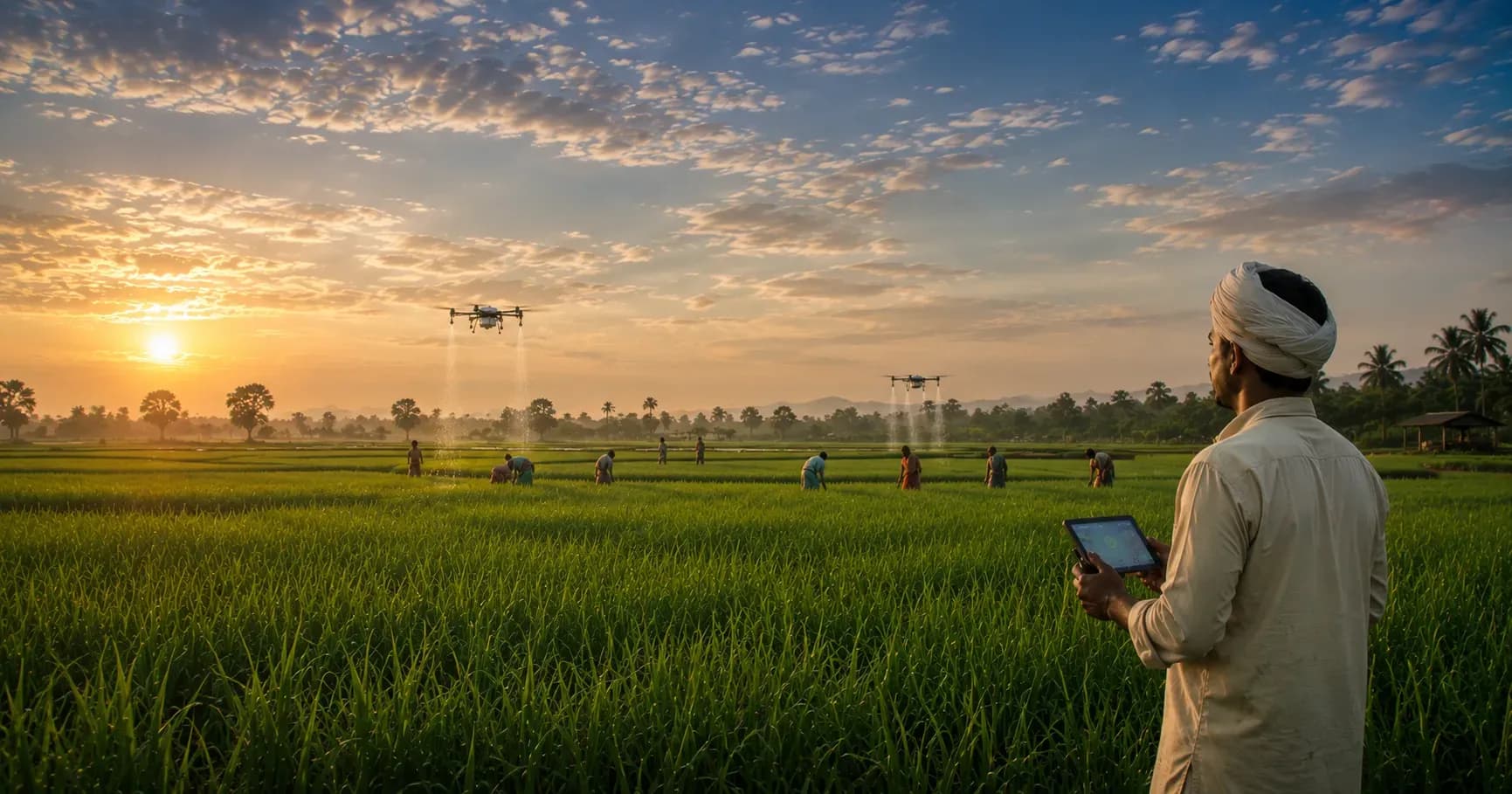
Pay-per-use remains the dominant structure in agricultural spraying. Operators charge between ₹300 and ₹500 per acre depending on crop type, chemical payload, and terrain complexity (Ministry of Agriculture and Farmers Welfare, Operational Guidelines, 2024). The model dominates custom hiring centres and FPO-led spraying contracts because it aligns directly with seasonal demand cycles.
Subscription-based DaaS contracts dominate infrastructure and utility operations. Renewable-energy operators, transmission-grid inspectors, and EPC contractors now procure drone hours through monthly service retainers instead of purchasing fleets directly. This structure shifts maintenance exposure and obsolescence risk to the drone operator.
Project-based pricing dominates government mapping and large infrastructure assignments. The SVAMITVA programme has mapped more than 67,000 square kilometres covering over 300,000 villages using survey-grade unmanned systems and geospatial workflows (Ministry of Panchayati Raj, 2025). These tenders typically use milestone-linked payment structures.
Outcome-based pricing represents the highest-margin segment. Under this structure, operators are paid for completed outputs — mapped terrain volumes, inspected transmission lines, crop-health analytics, or delivered medical payloads. The model depends heavily on AI-enabled analytics pipelines that convert raw aerial imagery into deliverables a buyer will pay against.
The government scheme stack that built the Indian DaaS market
India's DaaS market did not emerge through private capital alone. A layered government architecture created the procurement base operators now serve.
The Drone Shakti mission established the policy frame, positioning drones as a service-delivery layer across agriculture, mining, logistics, and infrastructure (Ministry of Finance, 1 February 2022). The ₹120 crore PLI scheme for drones and drone components, notified on 15 September 2021, ran over three financial years from 2021-22 to support domestic manufacturing and bring down hardware costs for service operators (Ministry of Civil Aviation, 15 September 2021).
The agriculture stack carries the highest demand-side weight. The Sub-Mission on Agricultural Mechanisation extends 40 to 100 per cent subsidy slabs to individual farmers, FPOs, custom hiring centres, and SC/ST and Northeast operators procuring drones for spraying services (Ministry of Agriculture and Farmers Welfare, SMAM Guidelines). The Namo Drone Didi scheme, approved on 29 November 2023 with a ₹1,261 crore outlay, provides 15,000 drones to Women Self Help Groups at 80 per cent Central Financial Assistance capped at ₹8 lakh per SHG (Cabinet Committee on Economic Affairs, 29 November 2023). Each SHG operates as a local agricultural service provider — drone ownership is the asset, but the revenue model underneath is DaaS.
Tax policy closed the loop. The GST Council reduced the rate on drones to a uniform 5 per cent at its 56th meeting, replacing the earlier 18 and 28 per cent slabs (PIB, 3 September 2025). The cut materially lowered procurement cost for service operators and state departments.
Agriculture as the largest DaaS vertical: unit economics and the FPO channel
Agriculture remains the largest operational DaaS vertical in India because the economics favour service-led deployment. India cultivates roughly 150 million hectares of farmland, creating a recurring market for spraying, nutrient application, and crop-health analytics (Food and Agriculture Organization, India country data).
A typical agricultural spraying drone covers 30 to 40 acres per day depending on battery logistics, refill infrastructure, and weather conditions (Ministry of Agriculture and Farmers Welfare, Operational Guidelines, 2024). At ₹400 per acre and 35 acres per day, an operator generates roughly ₹14,000 in gross daily revenue before labour, logistics, and maintenance costs. At sustained 25-day monthly utilisation during peak spraying cycles, gross billing approaches ₹3.5 lakh; well-run operators with multi-cluster contracts approach ₹6 lakh per month.
FPOs and custom hiring centres act as the aggregation layer for these contracts. Instead of marketing directly to fragmented landowners, operators secure district-level spraying assignments covering multiple villages or crop clusters. Aggregation reduces idle flight hours and improves battery-cycle economics. The Namo Drone Didi rollout layers a second aggregation channel underneath this: Women SHGs become village-level operators feeding into FPO contracts, with Lead Fertilizer Companies acting as the distribution and demand-creation partner (PIB, 14 February 2024).
DaaS for infrastructure, mining, and energy: the recurring-revenue verticals
Infrastructure inspection is the second major recurring-revenue segment of the Indian DaaS economy. State surveying programmes, road and rail infrastructure projects, mining lessees, and solar and wind operators procure aerial mapping and inspection through contracted DaaS providers rather than building in-house drone teams.
The SVAMITVA programme is the largest single demand engine for survey-grade DaaS — 67,000 square kilometres mapped and 300,000 villages covered, with milestone-based payments routed through state Panchayati Raj departments (Ministry of Panchayati Raj, 2025). EPC contractors building national highways and rail corridors now procure progress-monitoring flights monthly through subscription contracts rather than commissioning ad-hoc surveys.
Energy and mining round out the vertical. Transmission-line inspection, solar-panel thermal analysis, wind-turbine blade inspection, and stockpile volumetrics in coal and iron-ore mines all fit the DaaS structure because inspections recur across the operational lifecycle. The margin profile is materially better than agriculture: per-mission contract values run into lakhs rather than thousands, and outcome-based pricing is easier to negotiate because the deliverable (defect map, thermal anomaly report, volumetric calculation) is digital and audit-ready.
Medical, logistics, and emerging delivery DaaS: from Medicine from the Sky to urban corridors
Healthcare and logistics are moving DaaS into corridor-scale deployment. The "Medicine from the Sky" initiative in Telangana, launched in partnership with NITI Aayog and the World Economic Forum, completed approximately 650 flights and transported more than 10,000 vaccine doses and medical payloads. Delivery times on remote routes compressed from eight hours to roughly 22 minutes (World Economic Forum, 2022) (NITI Aayog, 2022).
Hospital-linked procurement expanded through GeM during 2024. The AIIMS Guwahati 104-kilometre BVLOS medical delivery corridor tender, awarded in March 2024, became the longest BVLOS medical delivery contract issued through Indian government procurement to that date. The contract reflected a broader shift: hospitals are now buying delivered medical payloads, not drones.
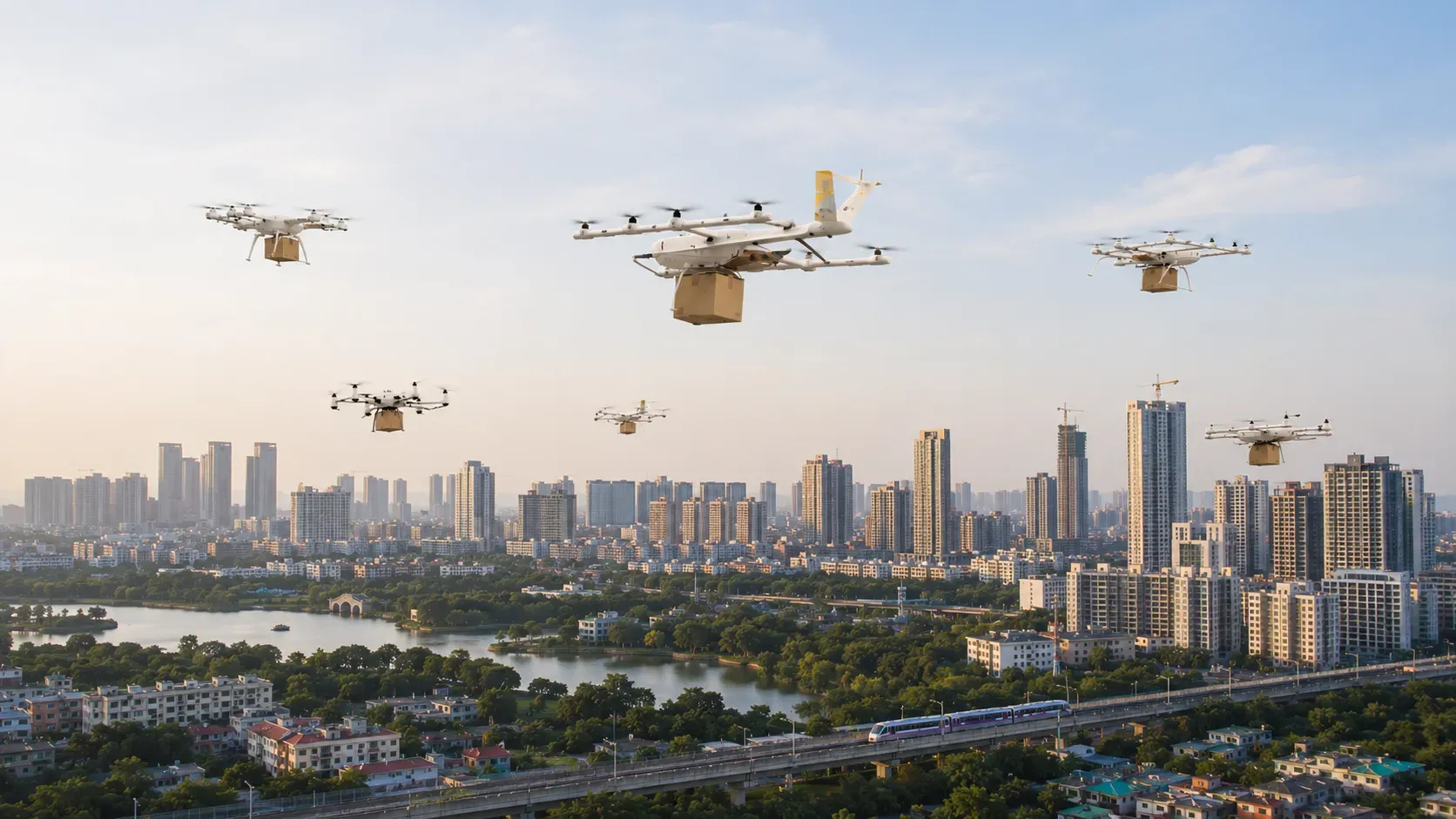
Urban logistics is the next inflection point. The Mumbai Siddha Sky residential drone delivery launch, announced for early 2026, signals the move from rural-corridor pilots to urban last-mile networks delivering groceries, medicines, and small parcels to housing complexes. BVLOS corridor approvals and Digital Sky integration are the regulatory unlocks. The next phase of expansion depends less on aircraft hardware and more on airspace integration, fleet scheduling, and automated operational control.
GeM portal: how the government buys DaaS at scale
The Government e-Marketplace is now the mandatory procurement layer for public-sector DaaS deployment. Rule 149 of the General Financial Rules makes GeM use mandatory for ministries, departments, autonomous bodies, and public sector enterprises across eligible procurement categories (Ministry of Finance, Office Memorandum, 10 July 2024).
The flagship transaction is the AIIMS drone-as-a-service procurement announced during the GeM 8th Incorporation Day. Agricultural DaaS contracts at the ₹79 lakh tier are now being awarded through the portal, with state agriculture departments procuring spraying services rather than airframes. The buyer-side advantage is risk transfer — maintenance, insurance, regulatory compliance, and obsolescence all sit with the service provider.
Defence procurement is converging on the same channel. The ₹5,000 crore Akash Missile System equipment procurement routed through GeM is the precedent that opened the door for tier-two defence components and drone-system subassemblies to flow through GeM rather than the conventional Defence Acquisition Procedure 2020 route. Prime UAS contracts still sit under DAP 2020, but the wedge for Indian drone subsystem and counter-UAS hardware manufacturers is now the GeM portal for drone procurement.
Regulatory and compliance stack a DaaS operator must run
A scalable DaaS operation is a regulatory stack as much as a flight operation. The compliance layer separates margin-positive operators from those who run flights but cannot bid into government tenders.
The base layer is DGCA registration. Every airframe operating in Indian civil airspace must be registered on the Digital Sky platform and carry a Unique Identification Number under the Drone Rules 2021. The pilot layer sits on top: every commercial pilot needs a Remote Pilot Certificate issued by a DGCA-authorised RPTO, the requirement that replaced the older drone pilot licence after the Drone (Amendment) Rules 2022 (PIB, 11 February 2022).
The airframe layer is drone Type Certification, processed through the Quality Council of India and the Certification Scheme for Unmanned Aircraft Systems (CSUAS). Type Certification is the gating compliance for any drone sold to government buyers or used in GeM tenders. NPNT - No Permission, No Take-off - is the runtime compliance layer that enforces airspace-zone permissions on every flight through the Digital Sky permission artefact.
Drone insurance under the third-party liability framework rounds out the stack. The IRDAI-supervised drone insurance market now covers hull, third-party liability, and payload liability lines, and proof of cover is increasingly mandatory inside GeM service tenders. For a Drone Service Provider registration in India, the full stack - UIN, RPC, Type Certification, NPNT compliance, and active insurance - is the precondition for any contract above the ₹10 lakh tier.
How AI and fleet software turn a small DaaS operator into a scalable platform
AI and fleet software now define the margin structure of scalable DaaS operators. Hardware alone no longer provides durable differentiation because procurement barriers fell after the Drone Rules 2021 reforms.
AI-driven route optimisation is the first margin lever. Mission-planning systems that ingest field geometry, wind, NOTAMs, and battery state produce flight paths that cover materially more acreage per battery cycle than manual planning, with industry deployments reporting 18 to 25 per cent gains (FlytBase enterprise-deployment data, 2025). For an agri-DaaS operator running 35 acres per day at ₹400 per acre, that range translates to ₹2,500 to ₹3,500 of additional daily revenue at near-zero marginal cost.
Predictive maintenance is the second lever. Telemetry-fed machine-learning models flag motor degradation, ESC anomalies, and battery health drift before they cause mission aborts. Downtime is the largest hidden cost inside DaaS unit economics, because idle fleets generate no billable output while still carrying financing and maintenance exposure.
Computer-vision analytics is the third lever, and the one that shifts pricing structure. NDVI and multispectral pipelines, defect detection on solar panels and transmission lines, and stockpile volumetrics on mining sites convert raw flight data into the digital deliverable that outcome-based contracts pay against. The operator stops selling flight hours and starts selling processed intelligence.
Fleet autonomy is the fourth lever and the gating technology for BVLOS at scale. AI-based deconfliction, geofencing, and autonomous dock-to-dock operations are what allow a single operations team to coordinate dozens of simultaneous missions across multiple districts. Operators with this stack are positioned for the next government corridor rollout; operators without it remain stuck in VLOS economics.
The structural read for the Indian market is simple. AI is not a feature on top of a DaaS business. It is the difference between a ₹6 lakh per month operator and a ₹60 lakh per month one.
Where the Indian DaaS market goes next
Drone-as-a-service is no longer a sector inside India's drone industry. It is the substrate of the drone economy itself. The next inflection point is the convergence of BVLOS regulatory clearance, fleet-autonomy software, and GeM-routed government procurement into a single scalable channel. Three forward anchors are visible already: the Drone Corridor rollouts being sequenced under Drone Shakti, the Mumbai Siddha Sky-style residential delivery networks scheduled for early 2026, and the second-wave PLI announcements signalled by the Ministry of Civil Aviation for the next financial year. Operators who have stacked Type Certification, DGCA pilot pools, IRDAI-compliant insurance, and AI-driven fleet platforms enter that wave with the compliance gate already cleared. Operators who have not, do not.