Drone insurance in India has shifted from an optional operational expense to a regulatory requirement tied directly to India's Drone Rules and the Civil Drone (Promotion and Regulation) Bill. For most operators above the nano category, insurance is no longer about protecting hardware alone. It is about legal liability, third-party injury exposure, and operational continuity.
Most commercial drone operators still underestimate where the largest financial risk sits. A damaged UAV can usually be replaced. A third-party injury claim, privacy dispute, or property-damage lawsuit can financially cripple a small operator. Under India's regulatory framework, drone liability increasingly overlaps with Motor Vehicles Act principles and Motor Accident Claims Tribunal enforcement structures.
This guide explains what Rule 44 actually requires, how drone insurance premiums are calculated, what policies cover, which exclusions operators miss most often, how claims work in practice, and how the Civil Drone Bill liability framework changes insurance exposure for commercial and enterprise deployments. Whether you operate a single FPV drone for cinematography or manage a commercial fleet for surveys and inspections, the compliance stack now applies the same way — only the premium and coverage depth change.
What every Indian drone operator needs to know about insurance
Third-party drone insurance is mandatory in India for all drones above 250 grams under Rule 44 of India's Drone Rules. Nano drones remain exempt. Annual premiums typically range from ₹3,000 for basic micro-drone liability cover to more than ₹3,00,000 for BVLOS logistics operations and high-value industrial fleets.
Comprehensive policies covering hull damage, payloads, and operator injury can push annual premiums beyond ₹1,50,000 for high-value commercial setups. Standard policies also exclude many high-risk scenarios, including unauthorized red-zone flights, BVLOS operations without endorsements, cyber incidents, and Digital Personal Data Protection-related privacy claims.
The Civil Drone Bill is also expected to strengthen compensation obligations through tribunal-linked mechanisms, raising the financial stakes for uninsured operators.
What is drone insurance, and why it's now a compliance instrument
Drone insurance in India refers to IRDAI-approved insurance products covering financial liability and operational losses arising from unmanned aircraft operations. Unlike traditional aviation insurance frameworks built primarily around aircraft ownership, India's drone-insurance structure focuses heavily on third-party liability obligations under Rule 44.
The regulatory structure operates on two separate axes.
The first axis is third-party exposure. This includes bodily injury, property damage, public liability, and legal claims resulting from drone operations. This is the portion directly connected to statutory compliance under India's Drone Rules.
The second axis is equipment exposure. This covers physical loss or damage to the UAV, payload systems, batteries, cameras, LiDAR modules, thermal sensors, and associated equipment. Commercial operators typically purchase this layer because the replacement cost of enterprise drone systems can exceed several lakh rupees.
India's insurance structure also differs from many international recreational drone markets because liability principles are partially linked to the Motor Vehicles Act framework. That linkage shapes compensation handling, claims procedures, and tribunal jurisdiction for injury-related incidents.
For enterprise operators, insurance now functions as a compliance instrument rather than only a financial safety layer. Major production houses, real-estate firms, government clients, and infrastructure contractors now demand certificates of insurance before approving a flight — making insurance a procurement gate, not just a regulatory one. Large infrastructure contracts, cinematography deployments, mining inspections, agricultural spraying operations, and logistics pilots increasingly require proof of liability insurance before deployment approval.
Is drone insurance mandatory in India? The Rule 44 framework
Rule 44 of India's Drone Rules mandates third-party insurance for drone operations across the country, except for nano-category drones. The rule also states that drone insurance products must comply with applicable provisions of the Motor Vehicles Act and require IRDAI approval before sale or issuance.
A drone falling from 100 metres carries serious kinetic energy. Rule 44 exists because the public should not bear the cost of an operator's accident. The legal purpose of the rule is straightforward — drone operations create public-risk exposure, and insurance ensures that injured individuals or damaged-property owners can seek financial compensation even if the operator lacks sufficient assets.
The rule also closes an important regulatory gap. Before India's Drone Rules were notified, commercial drone liability operated in a fragmented environment with inconsistent insurer participation and unclear enforcement standards. Rule 44 established a uniform compliance baseline.
IRDAI approval is equally important. Many operators incorrectly assume any aviation-style policy qualifies as valid drone insurance. In practice, insurers must file approved products or endorsements specifically aligned with Indian drone operations.
Weight-class compliance matrix
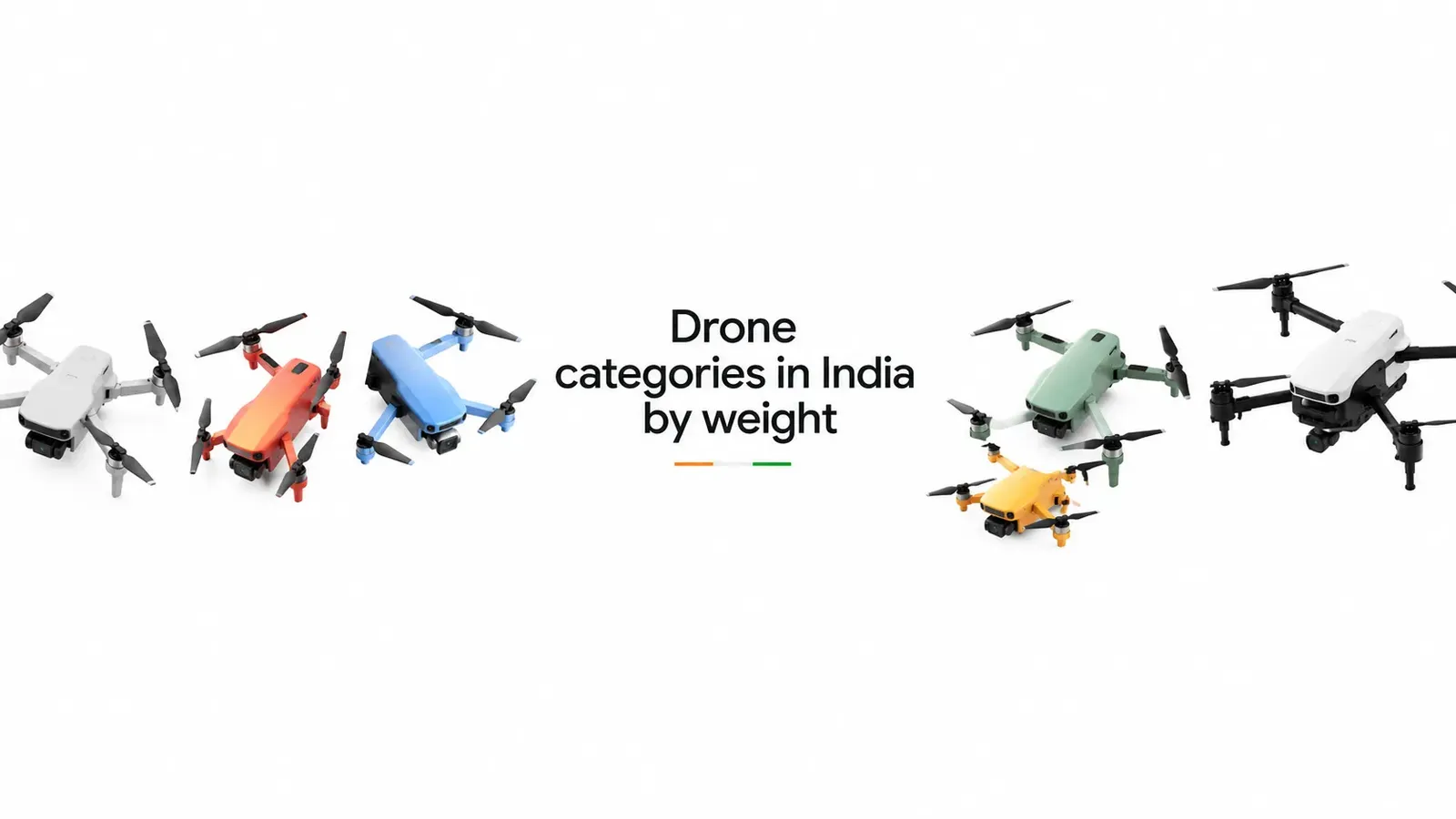
Drone class | Weight | Insurance required? | Recreational | Commercial |
|---|---|---|---|---|
Nano | ≤250g | No statutory requirement | Not required | Not required |
Micro | 250g–2kg | Conditional | Strongly advised | Mandatory |
Small | 2–25kg | Yes | Mandatory | Mandatory |
Medium | 25–150kg | Yes | Mandatory | Mandatory |
Large | >150kg | Yes | Mandatory | Mandatory |
Micro-category drones occupy the most misunderstood segment. Many recreational FPV operators assume insurance is optional because their aircraft remain relatively small. Once commercial activity begins — including wedding shoots, real-estate filming, inspections, or monetized content creation — liability exposure increases significantly. DGCA enforcement around the micro class has tightened, and most professional clients now refuse to engage uninsured operators regardless of weight.
Once weight-class and use-case obligations are clear, the next question becomes what kind of cover you actually need.
The five types of drone insurance you can actually buy in India
1. Third-party liability insurance
Third-party liability insurance is the mandatory component under Rule 44. It covers bodily injury, death, and property damage caused to external parties during drone operations. This is the only insurance category that is statutorily mandatory. Every other layer is a commercial decision.
Coverage limits vary widely. Entry-level commercial operators often purchase ₹10 lakh to ₹25 lakh policies. Enterprise contracts frequently require ₹50 lakh to ₹5 crore limits depending on operational risk.
Urban operators remain consistently underinsured. A drone collision involving vehicles, pedestrians, power infrastructure, or high-value property can produce liability exposure far exceeding the coverage purchased by small operators.
2. Drone hull insurance
Hull insurance covers physical damage or loss involving the drone itself. This includes crash damage, fire, theft, water exposure, hard landings, and certain flyaway scenarios.
Most Indian policies operate on agreed-value structures rather than depreciated replacement calculations. The insured value is declared during underwriting and determines compensation ceilings. The declared value should reflect the realistic replacement cost including duties, GST, and any imported components — not the original purchase invoice.
Deductibles typically range between 5% and 15% of the claim amount. Operators using modified drones, FPV builds, or custom payload integrations often face stricter underwriting scrutiny.
3. Payload insurance
Payload coverage protects attached equipment including cameras, gimbals, thermal sensors, LiDAR systems, multispectral modules, and industrial inspection tools.
This remains one of the least-purchased but most operationally important coverage layers in India's commercial drone sector. Cinematography payloads alone can exceed the value of the aircraft platform carrying them. A RED Komodo, ARRI Mini, or high-end gimbal stack can easily cross ₹15–25 lakh, while the drone carrying it costs a fraction of that.
Survey operators, mapping firms, and production houses increasingly purchase dedicated payload riders because standard hull policies frequently cap accessory compensation.
4. Transit insurance
Transit insurance covers drones during transportation by road, air cargo, or logistics providers. Commercial fleets moving equipment across multiple states often use this layer extensively.
Battery exclusions remain common. Lithium-polymer battery damage during transport may require separate declarations or endorsements.
Airline transit also creates unique exposure because standard baggage liability frameworks rarely compensate enterprise-grade UAV systems adequately.
5. Personal accident and operator cover
Personal accident policies cover injury or disability involving pilots, observers, and operational ground crews.
Agricultural spraying operations, infrastructure inspections, and cinematography teams face elevated field-risk exposure due to terrain, electrical infrastructure, chemical handling, and extended outdoor deployment cycles.
Emerging coverage layers
Cyber-liability coverage has started appearing within commercial drone-insurance discussions because UAV operations increasingly depend on connected navigation systems, cloud-linked telemetry, and data-processing workflows.
GPS spoofing, unauthorized access, payload-data breaches, and hijacking incidents create liability exposure outside traditional aviation-insurance models. As India's drone economy depends increasingly on connected telemetry and cloud workflows, cyber liability is no longer a fringe concern.
BVLOS logistics operators are also beginning to procure specialized cargo and mission-interruption coverage as commercial delivery pilots expand.
Drone insurance cost in India: A real premium matrix
Coverage | Typical annual premium (INR) | Notes |
|---|---|---|
Third-party liability only (micro) | ₹3,000 – ₹8,000 | FPV, photography, small commercial |
Third-party liability (small/commercial) | ₹8,000 – ₹25,000 | Survey and inspections |
Comprehensive (hull + liability, micro) | ₹15,000 – ₹40,000 | Cinematography |
Comprehensive (hull + payload, small) | ₹40,000 – ₹1,50,000 | High-value commercial |
Agricultural drone cover | ₹20,000 – ₹60,000 | Spraying operations |
BVLOS and delivery operations | ₹75,000 – ₹3,00,000+ | Advanced commercial operations |
Commercial drone premiums in India remain highly fragmented because underwriting standards vary substantially between insurers. A ₹2 lakh FPV cinematography build operating in controlled rural conditions may receive lower premiums than a cheaper urban-inspection drone operating near dense infrastructure.
The seven factors that swing your premium
1. Drone weight and declared value. Heavier UAVs generate larger kinetic-impact risk, and higher declared equipment values also increase hull exposure. A 5kg survey drone declared at ₹4 lakh attracts very different underwriting from an 800g FPV setup declared at ₹50,000, even if both fly similar missions.
2. Use case. Agricultural operations, industrial inspections, logistics, and BVLOS deployments receive different risk classifications. A pure cinematography operator and a chemical-spraying agricultural operator pay very different premiums even for identically priced drones.
3. Operating environment. Urban-density exposure significantly affects underwriting decisions. Flights near airports, power infrastructure, highways, and crowded public areas increase premiums. Urban operators in Mumbai, Delhi, or Bengaluru face premium loading that rural agricultural operators in Madhya Pradesh or Punjab do not.
4. Pilot certification. Operators holding valid Remote Pilot Certificates from recognized training organizations typically receive better underwriting outcomes. Underwriters often request RPC documentation and training-organisation grading as part of the proposal form.
5. Claims history. Repeated crash claims or policy disputes materially increase future premium pricing. A clean two-year claims record is usually the threshold at which insurers offer their best renewal terms.
6. Coverage structure. Higher liability limits, payload riders, theft protection, and cyber endorsements increase premium costs. Operators building a full coverage stack should expect premiums to scale roughly linearly with each added layer.
7. Operating geography. Red-zone proximity, state-specific drone restrictions, and border-area operations all influence underwriting decisions. Operators flying in Kashmir, the North-East, or near international borders typically face additional scrutiny and loading.
Why identical coverage prices vary between insurers
Premium differences of 40% to 80% for nearly identical policies remain common in India's drone-insurance market.
The variation comes from differences in underwriting models, reinsurance partnerships, claims history, and product-filing structures. Older IRDAI-approved products often remain cheaper because insurers filed them before the current high-growth commercial-drone environment.
Broker platforms also negotiate bundled pricing across insurers, creating additional pricing variance. Operators sourcing through three to four insurers directly, and one broker, typically uncover the true price floor for their risk profile.
IRDAI-approved drone insurance providers in India
Provider | Product types | Strengths | Distribution |
|---|---|---|---|
New India Assurance | TPL, hull | PSU network | Direct and brokers |
United India Insurance | Agricultural, hull | Rural reach | Direct and brokers |
IFFCO Tokio | Agricultural, TPL | Crop-linked specialization | Direct |
Bajaj Allianz | Comprehensive cover | Commercial pricing | Direct and brokers |
Tata AIG | TPL and commercial | Enterprise focus | Direct and brokers |
HDFC Ergo | Theft and liability | Digital claims workflow | Direct |
Provider participation in the drone segment changes periodically as insurers refile products. Always verify current product availability with the insurer or an IRDAI-registered broker before committing.
Different providers dominate different operational segments. IFFCO Tokio maintains strong agricultural positioning because of rural distribution strength and crop-linked underwriting familiarity. Tata AIG and Bajaj Allianz remain active in commercial urban deployments involving cinematography, infrastructure inspection, and enterprise operators. HDFC Ergo continues expanding digital claims workflows, which appeals to operators requiring faster documentation handling and online issuance.
The PSU-versus-private trade-off is worth weighing carefully. Public-sector insurers like New India Assurance and United India bring distribution reach and lower base premiums but often have slower digital claims workflows. Private insurers like Tata AIG, Bajaj Allianz, and HDFC Ergo typically offer faster issuance and clearer endorsement structures but at a premium.
Specialist drone-insurance brokers and marketplaces
TropoGo operates as one of India's earliest dedicated drone-insurance marketplaces and distributes products from multiple insurers. PolicyBazaar aggregates drone-insurance products through its broader insurance-distribution ecosystem, while niche intermediaries increasingly focus specifically on commercial UAV fleets and industrial operators.
What drone insurance does NOT cover
Most operators review inclusions carefully but ignore exclusions until a claim dispute occurs. The exclusion stack typically combines regulatory non-compliance triggers and standard aviation-insurance carve-outs.
Regulatory non-compliance exclusions are the most punishing. Flights conducted without valid registration, operations inside restricted or red-zone airspace, missions flown by pilots without valid RPC certification, unauthorised BVLOS deployments, and unapproved night flights are almost always denied at the claims desk. Insurers classify these as regulatory violations rather than operational accidents, not insurable incidents.
Standard aviation carve-outs cover deliberate negligence, intoxicated operations, wear and tear, war, terrorism, and nuclear exposure. These are familiar to anyone with general insurance experience and rarely produce disputes — they are universally excluded.
The newer exclusion category is data and cyber. Cyber incidents, GPS spoofing claims, and Digital Personal Data Protection regulatory penalties typically sit outside standard cover unless the operator buys a dedicated rider. This is the gap that catches enterprise operators most often, because the assumption that "comprehensive cover" includes cyber risk is rarely accurate.
How to claim drone insurance in India: The step-by-step process
Immediate incident response
Secure the area immediately after the incident. Photograph the UAV, surrounding environment, damaged property, and any injury scene before moving equipment unless safety conditions require otherwise. Preserve the SD card and any onboard video footage — this is often the decisive evidence in a disputed claim.
Notify the insurer quickly
Most policies require claim notification within 24 to 72 hours. Delayed reporting becomes a common reason for claim disputes. Most insurers ask for a written incident report within the notification window, accompanied by photos and the operator's account of what happened. Verbal notification by phone is not enough.
File FIR when necessary
Third-party injury, public damage, theft, or major operational incidents often require police reporting. Liability claims linked to tribunal proceedings generally depend on documented incident records. Even minor third-party incidents benefit from an FIR copy in the claims file.
Submit DGCA incident reporting
Serious incidents involving injury or significant property damage may require reporting under the accident-handling provisions of India's Drone Rules. Failure to report can void coverage entirely, since insurers treat regulatory non-reporting as a compliance violation.
Prepare the documentation pack
Operators preparing a claim typically need the insurance policy documents, UIN certificate, Remote Pilot Certificate, complete flight logs from the Digital Sky platform, mission records, photographs of the incident, repair estimates, witness statements, and FIR copies where applicable. The flight log from Digital Sky is often decisive, and gaps or inconsistencies between the log and the incident report are a frequent reason for claim denial.
Surveyor assessment
IRDAI-licensed surveyors inspect damage and validate operational circumstances before claim settlement decisions. Surveyors examine flight conditions, pilot certifications, airspace authorisation, and equipment status. Operators who cooperate fully and maintain organised documentation typically see faster surveyor reports.
Claim adjudication
Straightforward hull claims may settle within several weeks. Complex liability disputes involving injury, tribunal proceedings, or regulatory violations often take substantially longer — sometimes spanning multiple quarters where MACT involvement is triggered.
The DPDP Act intersection: When your drone insurance won't save you
Drone operators increasingly function as data collectors rather than only aircraft operators.
Real-estate mapping, wedding cinematography, industrial inspections, infrastructure surveys, and urban monitoring missions routinely capture identifiable personal information including faces, vehicle numbers, private residences, and location-linked behavioral data.
Under the Digital Personal Data Protection framework, operators handling such data may qualify as Data Fiduciaries depending on operational scale and processing practices.
A wedding cinematographer flying over a public road, an industrial drone capturing neighbouring residences during a factory inspection, or a real-estate operator filming a colony from above — all three may technically process identifiable personal data without realising it. The trigger is not commercial intent. It is the nature of the data captured.
This creates a major insurance gap.
Standard third-party liability policies generally exclude regulatory penalties arising from data-protection violations. Even operators carrying high-value liability coverage may discover their policy does not respond to privacy complaints, unlawful-data-processing allegations, or regulatory enforcement actions.
Urban commercial operators face the highest exposure because flights routinely capture densely populated environments where personal-data visibility becomes unavoidable. Cyber-liability and data-protection endorsements are likely to become standard enterprise requirements as India's drone economy matures.
Sector-specific insurance considerations
Agricultural drone operators
Agricultural spraying operators face a unique mix of operational and chemical-risk exposure. Insurance structures increasingly integrate crop-protection, spraying liability, and fleet-risk models. The Namo Drone Didi scheme and PMFBY-linked crop insurance create bundling opportunities that pure commercial operators do not have, and government-linked agricultural-drone initiatives also influence subsidy-linked insurance structures over time.
Cinematography and event operations
Wedding, film-production, and event operators typically prioritize payload coverage because cinema cameras and stabilization systems often exceed aircraft value. Production houses increasingly require minimum liability limits before approving aerial shoots, and contractual minimums of ₹50 lakh to ₹1 crore are becoming standard for mid-tier productions.
Real-estate and infrastructure inspection
Urban infrastructure operators face elevated public-liability exposure because flights occur near roads, buildings, power systems, and populated environments. This segment also carries significant DPDP-related exposure, since survey flights frequently capture neighbouring properties and individuals incidentally.
BVLOS and logistics operations
BVLOS deployments require specialised underwriting because operational risk extends beyond visual pilot control. Cargo coverage, mission-interruption protection, and higher liability ceilings become important. Operators in this segment should expect premiums substantially above standard commercial cover and longer underwriting timelines, often involving direct conversations with senior underwriters rather than off-the-shelf quotations.
Defence and government deployments
Government procurement structures sometimes operate through self-insurance models or specialized contractual frameworks. Cybersecurity, counter-UAS exposure, and operational confidentiality increasingly influence defence-related insurance structures.
Choosing the right drone insurance: A practical six-step framework
Step 1 - Confirm your Rule 44 obligations. Identify your weight category and operational use case. Nano hobby flights are exempt. Everything above triggers Rule 44 the moment commercial intent enters the picture.
Step 2 - Calculate realistic liability exposure. A rural agricultural sprayer faces very different third-party exposure from an urban infrastructure inspector. Build your liability limits around the worst plausible incident in your typical operating environment, not the average.
Step 3 - Assess hull and payload value honestly. List the realistic replacement cost of the drone, every payload module, batteries, and ground systems. Most operators underinsure the payload, which is precisely the layer most likely to be damaged in a survivable crash.
Step 4 - Compare multiple IRDAI-approved providers. Approach three or four IRDAI-approved insurers directly, plus one broker. Premium variance of 40–80% is common across providers for nearly identical risk profiles.
Step 5 - Read exclusions before inclusions. The exclusion section determines what you are actually buying. Read it twice. Pay particular attention to airspace restrictions, pilot certification requirements, and cyber-incident carve-outs.
Step 6 - Verify claims-support quality. Ask the insurer for their typical claim-settlement timeline for drone cases specifically, not aviation cases generally. Some insurers fold drone claims into general aviation queues, slowing them substantially. Fast claim handling matters more operationally than marginal premium savings.
The compliance stack, fully assembled
Drone insurance in India has matured into a compliance instrument, a commercial-contract enabler, and a financial-risk firewall in equal measure. The compliance stack now reads: Digital Sky registration, valid Remote Pilot Certificate, Rule 44 insurance, and DPDP readiness. Operators flying inside that stack carry a defensible operational position. Operators flying outside it carry exposure that no policy can fix after the fact.