The Indian drone market has crossed a quiet inflection point. It moved from ₹1.58 billion in 2024 toward a projected ₹4.87 billion by 2030, growing at roughly 22 per cent compound annually. Buyers driving that growth are no longer asking "should I buy a drone?" They are asking which type of drone, across the full classification of drones from multi-rotor to fixed wing UAV, hybrid VTOL, tethered drone, or MALE-class platform, fits their mission, their regulatory class, and their budget envelope. Each answer points to a different aircraft, a different licence pathway, and a different operating cost. This blog is the structured reference for every category in active commercial and defence use today, classified by design, weight, range, altitude, propulsion, autonomy, and legal-operation class.
What is a drone? UAV, UAS and RPAS clarified
A drone, formally an unmanned aerial vehicle, is an unmanned aircraft that operates without a pilot on board. It is controlled remotely, runs autonomously through software and sensors, or combines both modes. The Directorate General of Civil Aviation regulates unmanned aerial vehicles in India under the Drone Rules, 2021, and the same statute governs the broader unmanned aircraft system that surrounds the airframe. Three terms appear repeatedly in regulatory and procurement documents, and the distinctions matter.
Term | Meaning | Common usage |
|---|---|---|
UAV | Unmanned Aerial Vehicle (the aircraft alone) | Technical, engineering |
UAS | Unmanned Aircraft System (UAV plus ground station and command link) | DGCA, FAA, procurement |
RPAS | Remotely Piloted Aircraft System (UAS that integrates into manned airspace) | ICAO, civil aviation |
Procurement teams typically purchase a UAS, not a UAV. The aircraft alone cannot complete a mission without its ground control station, datalink, and trained operator.
The seven ways drones are classified
There is no single "right" classification of drones, and the different types of drones cross-classify along multiple axes at once. Each axis answers a different question. Engineers ask about design. Regulators ask about weight. Procurement teams ask about drone range and altitude. Operators ask about legal class. A complete reference on types of UAV platforms covers all seven axes:
- By design - wing and rotor architecture
- By size and weight - DGCA classes
- By range
- By altitude - tactical, MALE, HALE, HAPS
- By propulsion or power source
- By autonomy level
- By legal operation class - VLOS, EVLOS, BVLOS
The remainder of this blog walks through each axis with named platforms, regulatory implications, and decision criteria.
Types of drones by design
The shape of a drone - how it generates lift and how it transitions through the air - is the most visible classification. It also dictates what missions the aircraft can run.
Multi-rotor drones
The multi rotor drone uses three or more propellers arranged symmetrically. The most common multirotor drone configuration is the quadcopter with four rotors, which is why "quadcopter" and "drone" are used interchangeably in everyday language. Hexacopters carry six, octocopters carry eight, and the additional rotors deliver redundancy and payload capacity rather than speed.
Strengths include vertical takeoff and landing, precise hover, low capital cost, and short learning curve. The trade-offs are limited endurance - typically 20 to 40 minutes - and modest payload. Multi-rotors dominate aerial photography, infrastructure inspection, real estate documentation, agricultural spraying at the small-farm scale, and tactical military reconnaissance.
Fixed-wing drones
A fixed wing drone looks and flies like a miniature aircraft, and the fixed wing UAV shape sits at the centre of every long-range drone deployment. The wing generates lift through forward motion, which makes fixed-wing platforms energy-efficient compared with rotor-driven aircraft. A fixed-wing UAS can stay airborne for one to twenty-four hours and cover thousands of acres in a single flight.
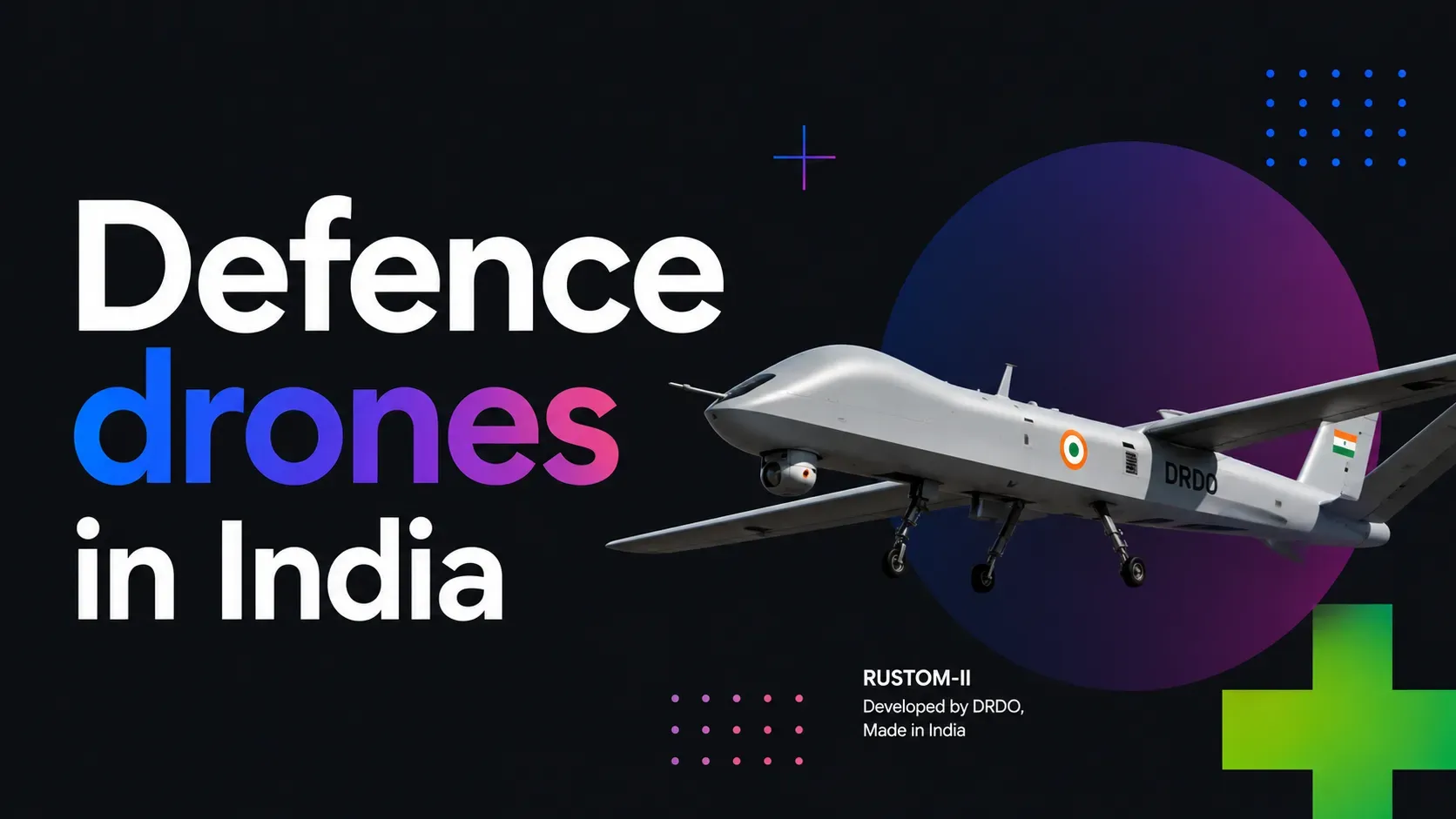
The cost of that efficiency is loss of hover. Fixed-wing aircraft cannot pause in mid-air. They also need a runway, a launcher, or a hand-launch from a trained operator. Mapping, intelligence, surveillance and reconnaissance (ISR), border surveillance, and large-area agricultural surveys are the dominant use cases. The Indian Defence Research and Development Organisation (DRDO) Rustom-2, also designated TAPAS-BH-201, is a fixed-wing platform in the medium-altitude long-endurance class.
Single-rotor (helicopter-style) drones
The single rotor drone uses one large main rotor for lift and a smaller tail rotor for stability and yaw control. This is the helicopter drone form-factor, and it behaves in flight the way a miniature helicopter does. Most single-rotor platforms run on internal combustion engines rather than batteries, which gives them longer endurance and far higher payload capacity than electric multi-rotor systems.
Single-rotor platforms are the workhorses for heavy LiDAR surveys, agricultural spraying over large estates, naval ISR, and any mission where lifting more than ten kilograms matters. The downside is mechanical complexity. Maintenance is closer to that of a manned helicopter than a consumer drone, and the larger blades introduce real safety risk. The Yamaha RMAX and Schiebel Camcopter S-100 are widely cited examples.
Hybrid VTOL and fixed-wing drones
The hybrid VTOL drone combines vertical takeoff with fixed-wing cruise, and the hybrid drone category is the fastest-growing architecture in the commercial market. A VTOL drone launches straight up using rotors, transitions into horizontal flight, and lands vertically again. There is no runway requirement and no need for a launcher.
This is the architecture that has made beyond visual line of sight (BVLOS) operations commercially viable. Endurance typically runs from two to eight hours. Payload sits between multi-rotor and fixed-wing levels. Long-range parcel delivery, BVLOS mapping, search and rescue, and maritime surveillance are the standout applications. Pipistrel's Nuuva V300, which made its first flight in January 2025, demonstrated a 2,500-kilometre range with 300 kilograms of cargo using hybrid-electric propulsion.
Tethered drones
The tethered drone is the category most classification posts ignore, and the omission is difficult to justify given persistent-ISR demand. A tethered drone connects to a ground power and data station through a thin micro-cable. Power is unlimited, communications are routed over a jam-resistant fibre-optic line, and endurance is bounded only by maintenance cycles. Documented test flights have stayed airborne for fifty hours and longer.
The trade-off is fixed coverage. A tethered platform is a stationary aerial sensor, not a free-flying aircraft. It cannot pursue a moving target, and its operating area is limited to the tether radius. The global tethered drone market was valued at USD 301.4 million in 2025 and is projected to reach USD 560.4 million by 2036, growing at 5.8 per cent compound annually. Defence and security applications — forward operating base overwatch, port and border perimeter, event surveillance, and disaster response command — drive the bulk of demand.
Comparison: design type and mission fit
Type | Hover | Endurance | Payload | Runway | Best for |
|---|---|---|---|---|---|
Multi-rotor | Yes | 20–40 min | Low | No | Photography, inspection, tactical |
Fixed-wing | No | 1–24 hr | Medium | Yes | Mapping, ISR, surveillance |
Single-rotor | Yes | 1–4 hr | High | No | Heavy lift, LiDAR, naval |
Hybrid VTOL | Yes | 2–8 hr | Medium-high | No | BVLOS, delivery, search and rescue |
Tethered | Yes | 24–50+ hr | Medium | No | Perimeter, persistent ISR, telecom |
Types of drones by size and weight (DGCA classification)
For Indian operators, weight is the single most consequential classification axis. The Drone Rules, 2021 sort every UAS into one of five weight bands. Each band carries its own registration, licensing, and altitude rules.
Nano drones (up to 250 grams)
Nano drones include hobby quadcopters, micro racers, and palm-sized camera platforms. They are exempt from most regulatory requirements. Operators do not need a Unique Identification Number (UIN), a Remote Pilot Licence (RPL), or a Type Certificate for non-commercial use. The flight ceiling is 15 metres above ground level in uncontrolled airspace.
This is the category for journalists, students, indoor inspections, and recreational users.
Micro drones (250 grams to 2 kilograms)
Micro drones cover most prosumer photography platforms and light commercial mapping aircraft. The altitude cap is 60 metres, or 200 feet. UIN registration on the DigitalSky platform is mandatory. Commercial operators need an RPL. The aircraft itself must hold a Type Certificate.
Real estate, light surveying, journalism, and short-range inspections sit here.
Small drones (2 to 25 kilograms)
The small-drone tier opens up mid-range commercial operations. The altitude cap rises to 120 metres, or 400 feet. Full DGCA compliance applies. RPL is mandatory. This is where precision agriculture spraying, infrastructure inspection, and mid-scale surveying live. Most agri-drones supported under Indian government subsidy schemes fall in this band.
Medium drones (25 to 150 kilograms)
Medium drones receive near-aircraft regulatory treatment. They require Type Certification, special airspace clearance, and an RPL-Medium endorsement. Tactical military UAS, larger logistics platforms, and BVLOS commercial systems sit here. The category is small in unit terms but disproportionately important in capability and capital outlay.
Large drones (above 150 kilograms)
Large drones are regulated like manned aircraft. They require aircraft-grade airworthiness, BVLOS approvals, and dual oversight from the Ministry of Defence and DGCA where applicable. Strategic ISR, MALE and HALE platforms, and unmanned combat aerial vehicles (UCAVs) sit in this band. The DRDO TAPAS-BH-201, with a maximum takeoff weight of approximately 1,800 kilograms, is the most recognisable Indian example.
The DGCA weight class master table
Class | Weight | UIN | RPL | Type cert | Altitude cap |
|---|---|---|---|---|---|
Nano | ≤ 250 g | No | No | No | 15 m |
Micro | 250 g – 2 kg | Yes | Yes | Yes | 60 m |
Small | 2 – 25 kg | Yes | Yes | Yes | 120 m |
Medium | 25 – 150 kg | Yes | Yes | Yes | Special clearance |
Large | > 150 kg | Yes | Yes | Yes | Special clearance |
The DigitalSky platform handles every registration, every flight authorisation, and every audit trail. Every flight in classes Micro through Large requires a No Permission, No Take-off (NPNT) authorisation issued in real time.
Types of drones by range
Range is what most defence and commercial buyers care about second, after weight. The standard taxonomy uses five bands.
Range class | Distance | Typical use | Example |
|---|---|---|---|
Very close | < 5 km | Recreation, indoor inspection | Hobby quadcopters |
Close | 5–50 km | Commercial inspection, tactical | Mid-tier prosumer platforms |
Short | 50–150 km | ISR, surveillance | RQ-7 Shadow class |
Mid | 150–650 km | MALE strike and ISR | MQ-9 Reaper |
Long / HALE | > 650 km | Strategic ISR | RQ-4 Global Hawk |
The longest-range platforms in active service exceed 22,000 kilometres in a single flight. The shortest commercial systems rarely operate beyond a half-kilometre radius from the operator. Both extremes can be the right tool - what matters is matching the range envelope to the mission.
Types of drones by altitude
Altitude classification is the lens defence procurement uses. The categories are evergreen and apply globally.
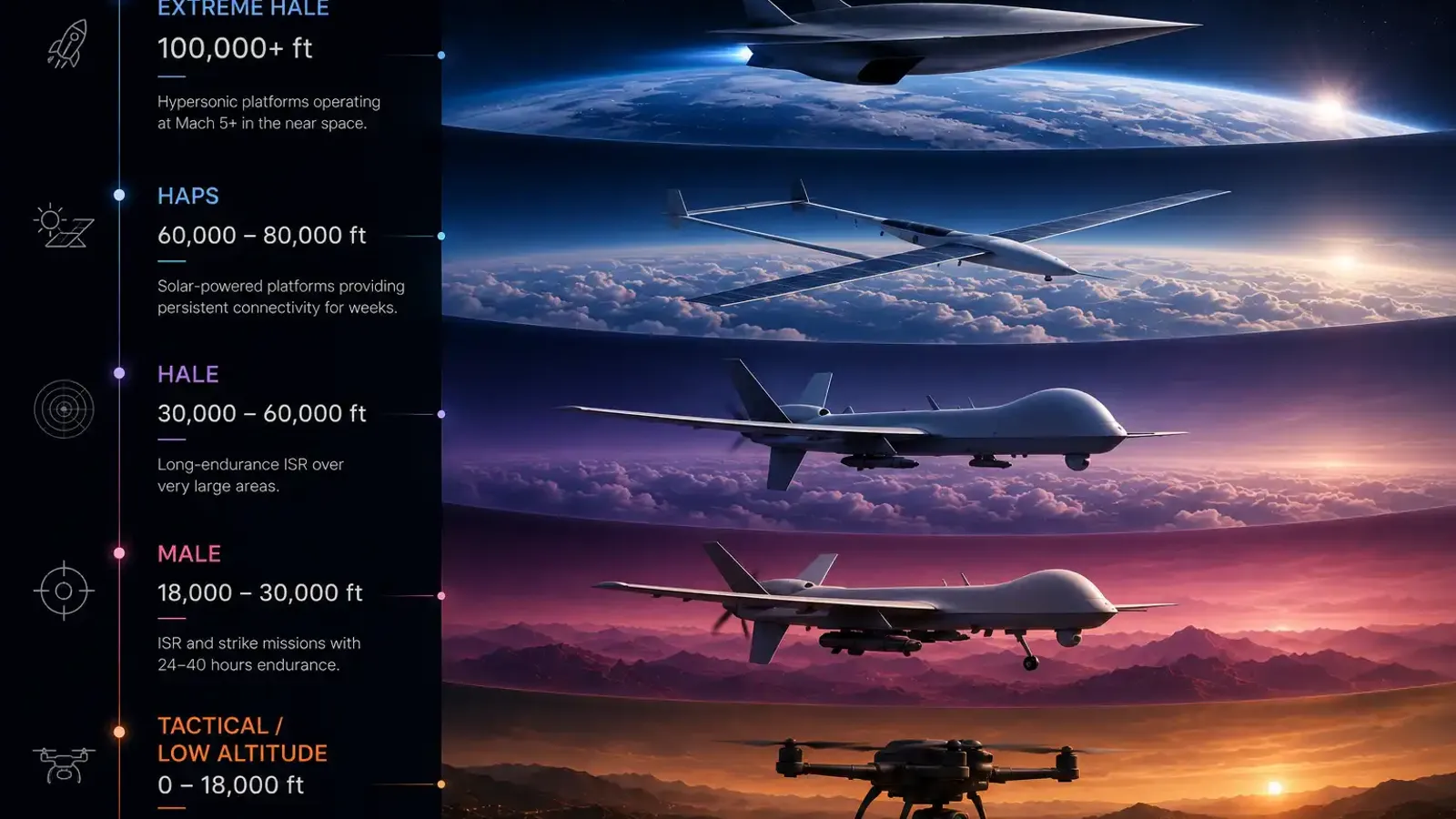
Tactical UAVs operate below 18,000 feet. Missions are short, line-of-sight or limited beyond visual line of sight, and typically support a small unit. Hand-launched fixed-wing systems and tactical multi-rotors live here.
The MALE drone class covers medium-altitude long-endurance operations between 18,000 and 30,000 feet, and the MALE UAV segment carries both ISR and strike payloads on endurance envelopes of 24 to 40 hours. The MQ-9 Reaper, Heron TP, and DRDO TAPAS-BH-201 are MALE-class platforms. The Indian UAV market projects MALE as the dominant segment by revenue through 2026, driven by defence and industrial ISR demand.
The HALE drone class covers high-altitude long-endurance operations above 30,000 feet, often beyond 60,000, and the HALE UAV segment supports persistent strategic ISR over large areas. Endurance can exceed 30 hours. The RQ-4 Global Hawk is the standout HALE-class platform in publicly available fleet inventories.
High-Altitude Pseudo-Satellites (HAPS) push the envelope further. They cruise between 60,000 and 80,000 feet on solar power and remain airborne for weeks or months. The PHASA-35 and Airbus Zephyr are the publicly demonstrated examples.
Hypersonic UAVs are emerging. The International Civil Aviation Organization (ICAO) reference taxonomy includes hypersonic platforms operating at Mach 5 or above, ranges over 200 kilometres, and altitudes reaching suborbital.
Types of drones by propulsion
Power source shapes endurance, payload, operating cost, and noise signature.
Battery-electric platforms dominate the commercial and consumer market. Lithium polymer (LiPo), lithium-ion, nickel-metal hydride, and nickel-cadmium chemistries are all in service. Electric drones are quiet, low-maintenance, and limited to roughly 60 minutes of flight in current generations.
Gasoline and turbine powerplants drive the heavy-lift and military endurance segments. Single-rotor agricultural platforms and large fixed-wing UAS typically run on petrol or jet fuel.
Hybrid electric and combustion systems combine the takeoff efficiency of electric rotors with the cruise efficiency of an internal combustion engine. The Pipistrel Nuuva V300 is the headline platform, demonstrating 2,500 kilometres of range with 300 kilograms of payload.
Hydrogen fuel-cell drones have moved from research demonstrators to early commercial deployment. The Heven Raider is one of the publicly profiled platforms. Hydrogen offers longer range than batteries with zero emissions.
Solar-powered drones target the HAPS segment. The PHASA-35 demonstrator is advertised for flight times of up to one year on solar power alone.
Laser-charged drones are still experimental. A research team at Northwestern Polytechnical University in Xianyang demonstrated indefinite airborne operation in 2024 using a vision-tracked laser beam that kept the aircraft continuously powered. The technology is more proof-of-concept than commercial reality.
Tethered platforms are technically a propulsion category as well — the tether delivers continuous wired power that removes endurance from the equation.
Types of drones by autonomy level
Autonomy is increasingly the differentiator between competing platforms with similar physical specifications. Five tiers describe the current state of the art.
- Level 0 - Manual / RC-piloted. The operator controls every input. Visual line of sight only. Most racing and toy drones operate here.
- Level 1 - Stabilised. An onboard inertial measurement unit and flight controller hold attitude and altitude. The pilot remains primary.
- Level 2 - Autopilot and waypoint. The operator pre-programmes a route. The drone executes it. The pilot supervises and can intervene.
- Level 3 - Semi-autonomous. Auto-takeoff, return-to-home, obstacle avoidance, and AI-assisted target tracking are standard. The operator supervises rather than pilots.
- Level 4 - Fully autonomous. On-board decision-making, swarm coordination, and GPS-denied navigation. The operator sets intent; the system executes.
Swarm operations are the live frontier. In August 2024, a joint Airbus and Quantum Systems demonstration flew seven mixed-type drones in formation under mission AI that maintained alignment despite simulated jamming and mid-flight aircraft removals. The 2026 research literature is now layering foundation models - large language and vision models - over swarm command interfaces. The shift in commercial implications is significant: by 2030, surveys, mapping, and large-area inspection are likely to be conducted by coordinated drone teams rather than single aircraft.
Types of drones by legal operation class
This is the classification axis that procurement officers care about most, and that consumer-leaning blogs ignore most consistently. Three operation classes define what an operator can legally do, regardless of the aircraft's physical capability.
Visual Line of Sight (VLOS) keeps the drone within the pilot's direct visual range. It is the default operating class for most commercial flights. No special waiver is required beyond the standard licensing and registration. Photography, short-range inspection, and recreational flying live here.
Extended Visual Line of Sight (EVLOS) uses positioned visual observers to extend the pilot's effective sight line. Mid-range inspections and agricultural surveys often operate under EVLOS. The operator coordinates with observers under defined procedures.
Beyond Visual Line of Sight (BVLOS) is the unlock for commercial-scale drone operations. A BVLOS-approved aircraft operates beyond direct or observer-assisted visual range. It must carry detect-and-avoid systems, broadcast Remote ID, and integrate into an Uncrewed Traffic Management (UTM) layer. DGCA approval is required.
The Indian BVLOS picture in 2026 is mixed. Of 100 planned national BVLOS corridors, only six are operational. Drone delivery zones are scheduled to expand in phases through the year - metro deployments first in Delhi-NCR, Bengaluru, Mumbai, Hyderabad, Chennai, and Pune; Tier-2 cities by mid-year; semi-urban and rural BVLOS corridors by year-end. The corridors that exist are the sole legal pathway for routine commercial drone delivery and large-scale linear infrastructure inspection.
Operation class | Pilot visibility | Typical range | Approval | Use cases |
|---|---|---|---|---|
VLOS | Direct visual | < 500 m | Default | Photography, short inspection |
EVLOS | Visual observer assisted | 500 m – few km | Conditional | Mid-range survey, agriculture |
BVLOS | Beyond visual range | Multi-km, regional | DGCA + UTM | Delivery, long inspection, ISR |
Types of drones by application
The use-case lens cuts across every other axis. Most operators arrive at this classification through their mission, not their aircraft.
Consumer and recreational
Toy drones, FPV racing platforms, and beginner camera quadcopters define the consumer segment, which is the entry point for most first-time buyers exploring drone uses across recreation and content creation. Sub-250-gram weights keep most of these aircraft outside formal registration requirements. The category has become a feeder for serious commercial pilots, and several of the leading prosumer platforms are now legal-to-fly entry points for content creators.
Photography and cinematography
Aerial photography remains the largest single application by unit volume. The professional segment uses prosumer multi-rotors and high-end cinema platforms with gimbal-stabilised cameras and obstacle sensing. Wedding photography, real estate, film and television, advertising, and journalism all anchor here.
Agriculture
Agriculture is the largest segment of the Indian drone market by application share - close to 35 per cent. The Ministry of Agriculture allocates a subsidy of up to 75 per cent, capped at ₹7.5 lakh, for crop-spraying drone purchases. More than five million hectares of Indian farmland are now under regular drone-spraying coverage.
The platforms used for spraying typically carry 10 to 40 litres, fly under VLOS at low altitude, and complete a one-acre treatment in roughly five minutes. Multispectral and thermal imaging drones support a separate but parallel function - crop health monitoring, irrigation planning, and yield estimation. Indian indigenous manufacturers including IdeaForge and Garuda Aerospace lead the agri-drone segment domestically, supported by the Production-Linked Incentive (PLI) scheme.
Survey, mapping and inspection
Survey-grade drones combine LiDAR sensors with Real-Time Kinematic (RTK) or Post-Processed Kinematic (PPK) positioning to deliver centimetre-level accuracy. The SVAMITVA scheme, which uses drones to map rural land parcels for property records, has covered more than 310,000 villages by end-2024.
Beyond government applications, mining, construction progress monitoring, telecom tower inspection, power line inspection, pipeline surveys, and bridge inspection all use this category heavily. Energy and utilities is the fastest-growing commercial segment in 2026.
Delivery and logistics
Drone delivery has moved past pilot status in 2026. Lightweight medical supplies, lab samples, and time-critical e-commerce shipments are the first commercial use cases. Hybrid VTOL platforms dominate longer-range deliveries; multi-rotors handle last-mile drops. The Indian delivery ecosystem is concentrated in metro and industrial zones today, with a phased BVLOS expansion planned.
Military and defence
Defence drones break into five operational sub-classes:
- Intelligence, Surveillance and Reconnaissance (ISR). Long-endurance fixed-wing and MALE platforms - TAPAS-BH-201, Heron TP, MQ-9B SeaGuardian.
- Combat Unmanned Aerial Vehicles (UCAVs). Armed platforms - MQ-9 Reaper, HAL CATS Warrior.
- Loitering munitions (kamikaze drones). Single-use precision strike platforms.
- Decoy and electronic warfare. Banshee, ALS-50.
- Tactical reconnaissance. Hand-launched fixed-wing and small multi-rotors.
Counter-drone systems
Counter-drone systems are becoming a category of its own. Detection layers use radar, radio frequency monitoring, and acoustic sensors. Interception layers cover kinetic kill, jamming, directed-energy weapons, and drone-on-drone engagement. The United States Department of War requested over USD 3 billion for counter-drone capabilities in fiscal year 2026 - a clear signal of how seriously the threat is now being treated.
Underwater drones
Underwater drones, also called Remotely Operated Vehicles (ROVs) or Autonomous Underwater Vehicles (AUVs), are used for naval mine detection, pipeline inspection, marine research, and offshore platform maintenance. Tethered ROVs deliver real-time video over a fibre-optic cable; autonomous AUVs operate untethered.
Passenger drones and eVTOL
Passenger drones and electric vertical takeoff and landing (eVTOL) aircraft are the urban air mobility category. Manned and pilot-optional aircraft are in advanced certification programmes worldwide. Commercial passenger service remains in trial deployment as of mid-2026.
Energy and utility inspection
Energy and utility inspection has emerged as the fastest-growing commercial vertical in 2026. Power line patrols, solar farm thermal inspection, wind turbine blade inspection, and pipeline integrity surveys all benefit from BVLOS operations. Long-route inspection that once required helicopter overflights or rope-access teams is now routinely flown by autonomous fixed-wing or hybrid aircraft.
The Indian drone market in 2026
Three numbers define the commercial backdrop for any drone-type decision in India.
The first is market size. India's drone market grew from USD 1.2 billion in 2023 to a projected USD 4.87 billion by 2030, growing at a compound annual rate of 22.15 per cent. The growth is no longer driven by experimental pilots; it is driven by scaled commercial deployment.
The second is application split. Agriculture leads at roughly 35 per cent of the market. Surveillance and security, infrastructure inspection, logistics and delivery, and mapping and surveying make up the balance. The growth-rate leader for the rest of the decade is logistics, with energy and utilities inspection close behind.
The third is regulatory infrastructure. The Drone Rules, 2021 set the foundation. The DigitalSky platform is the live operational layer. The PLI scheme has allocated ₹48,000 crore in incentives across 14 sectors, with drone components included. Six of 100 planned BVLOS corridors are operational. Phased delivery-zone expansion is under way through 2026.
The implication for procurement teams is direct. Drone type is no longer a hardware decision. It is a regulatory, business-case, and operating-cost decision - one that compounds across years of fleet deployment.
How to choose the right type of drone
Five questions structure the decision.
- What is the mission? Photography, agriculture, survey, defence, delivery, inspection, or perimeter security each map to a different platform shortlist.
- What is the operating area? Less than 1 square kilometre points to multi-rotor. Between 1 and 100 square kilometres points to fixed-wing or hybrid VTOL. Above 100 square kilometres requires MALE or HALE.
- What is the payload? Camera, multispectral sensor, LiDAR, cargo, or munition each carry different weight and integration requirements.
- What is the regulatory class? DGCA Nano through Large determines licensing burden. VLOS, EVLOS, or BVLOS determines operational scope.
- What is the budget envelope? Roughly ₹10,000 for consumer, ₹50,000 to ₹15 lakh for commercial, ₹50 lakh to ₹10 crore and beyond for defence-class.
The decision matrix below combines mission and regulatory class.
Use case | Recommended type | DGCA class | Operation class |
|---|---|---|---|
Wedding or hobby photo | Multi-rotor (consumer) | Nano / Micro | VLOS |
Real estate, infra inspection | Multi-rotor (prosumer) | Micro / Small | VLOS / EVLOS |
500-acre farm spraying | Multi-rotor (agri) | Small | VLOS |
5,000-acre crop survey | Fixed-wing or hybrid VTOL | Small / Medium | EVLOS / BVLOS |
Urban package delivery | Hybrid VTOL | Small / Medium | BVLOS |
Border or perimeter ISR | Tethered or fixed-wing | Medium / Large | VLOS (tethered) / BVLOS |
Strategic defence ISR | MALE / HALE | Large | BVLOS, military airspace |
Procurement teams should treat this matrix as a starting point. Field conditions, integration with existing fleets, training pathways, and after-sales support always shift the final selection.
The future of drone classification
Five shifts will reshape the taxonomy by 2030.
Swarm-class drones will become a recognised category in their own right. Single-aircraft missions will give way to coordinated multi-platform operations for surveys, mapping, and defence applications.
Autonomy-level grading will replace binary "manual or auto" labelling. Procurement specifications will name a Level 3 or Level 4 system rather than describe individual features.
Hydrogen and solar long-endurance platforms will move from demonstrator status into commercial mainstream. Hours of flight will give way to days and weeks.
BVLOS will become the default operational class for commercial logistics, infrastructure inspection, and large-area survey, supported by mature Uncrewed Traffic Management infrastructure.
Counter-autonomous drone systems will mature into a parallel category - protecting critical infrastructure, military installations, public events, and airports. The early USD 3 billion-plus annual budget signals from major defence buyers point to a category that will shape airspace policy for the rest of the decade.
Drone classification has stopped being a textbook exercise. It is the language of procurement, doctrine, regulation, and capital allocation. The operators who understand exactly which type of drone fits which mission - and which regulatory class - will be the ones who scale through 2030 and beyond.