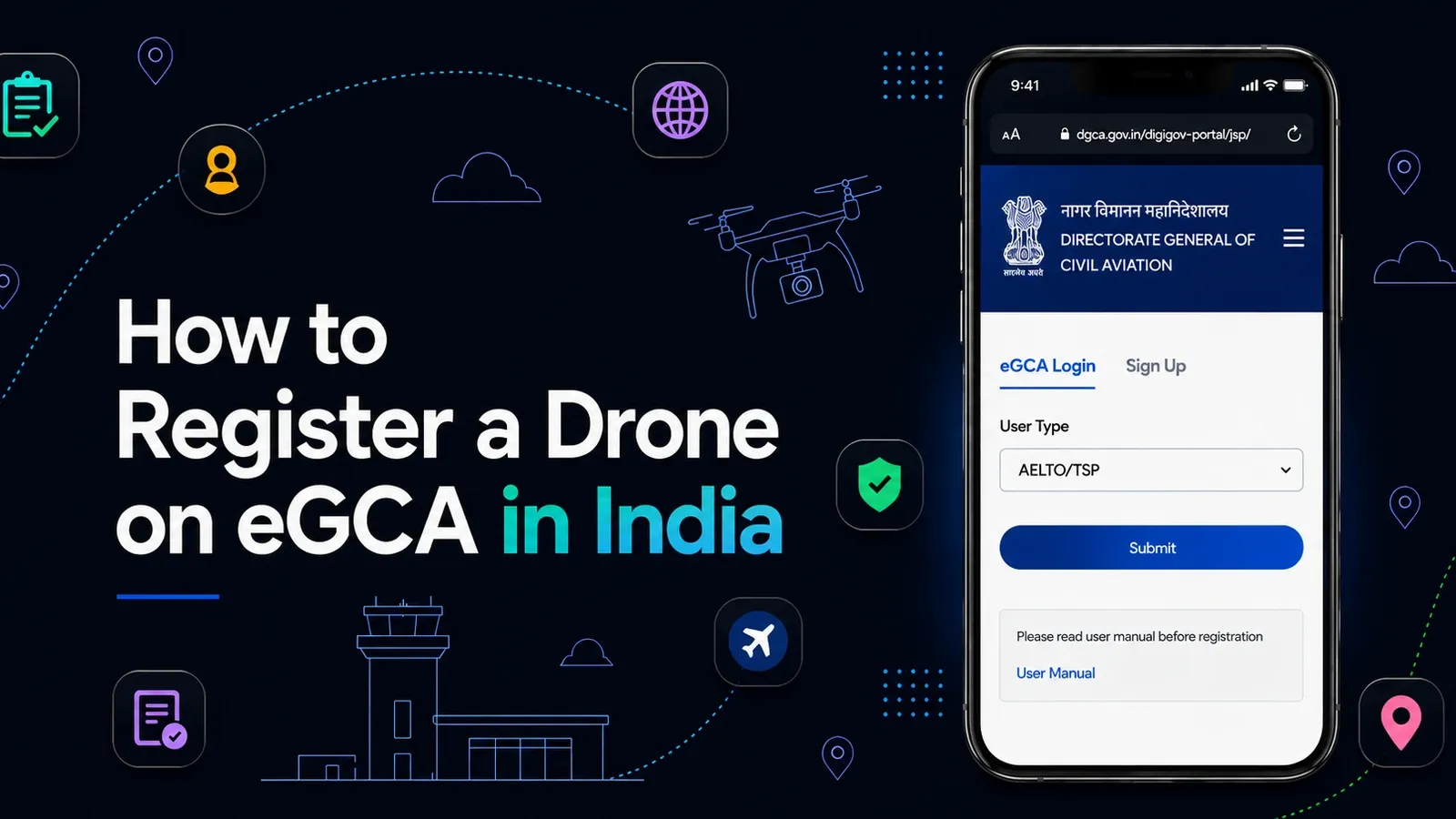
The Directorate General of Civil Aviation began migrating drone registration services from the older Digital Sky Platform to the eGCA portal in July 2025, consolidating Unique Identification Number issuance, Remote Pilot Certificate management, and type-certification workflows on a single regulatory interface. DigitalSky retains airspace validation, NPNT permission artefacts, and per-flight authorisation. The standard government registration fee remains ₹100 per aircraft under Schedule I of the Drone Rules 2021, but a registered drone is not a cleared drone - operators who skip the DigitalSky permission layer remain exposed to fines up to ₹1 lakh and equipment confiscation under current enforcement provisions. (DGCA, July 2025)
Why drone registration moved to eGCA in 2025
India simplified drone compliance after the Drone Rules 2021 replaced an approval-heavy framework of 25 forms with a smaller digital structure. The government later separated aircraft identity management from operational airspace enforcement to reduce overlap between registration workflows and mission-level permissions. (Ministry of Civil Aviation, 26 August 2021)
Before July 2025, operators used Digital Sky for nearly every drone-related process. Registration, pilot certification, airspace permissions, and NPNT approvals lived inside one platform. The updated structure divided those responsibilities between eGCA and DigitalSky.
Process | Platform | Operational purpose |
|---|---|---|
Drone registration and UIN issuance | eGCA | Creates the aircraft's legal identity |
Remote Pilot Certificate management | eGCA | Issues and renews pilot credentials |
Type certification records | eGCA | Manages approved-aircraft databases |
Airspace zone validation | DigitalSky | Validates green, yellow, and red zones |
Per-flight permission | DigitalSky | Issues NPNT permission artefacts |
A registered drone without operational approval can still violate Indian aviation rules if the operator bypasses NPNT permissions or enters restricted airspace. The migration is also being staged - DGCA has temporarily suspended registration of Non-Type Certified (non-TC) UAS on eGCA pending further notice, which materially affects custom builds, FPV racing platforms, and unbranded imports.
The restructuring aligns India's drone ecosystem more closely with the Bharatiya Vayuyan Adhiniyam 2024, which became the country's updated aviation framework after replacing the Aircraft Act 1934. The Drone Rules 2021 continue operating underneath that framework until revised drone-specific rules are formally notified. (Ministry of Civil Aviation, 2024)
Documents required before eGCA drone registration
Most eGCA drone registration failures happen before the operator uploads the first document. The platform validates every aircraft entry against DGCA type-certification databases and operator identity records. Small inconsistencies between aircraft model names, serial numbers, invoice records, or legal entity details can trigger automatic rejection during the first review cycle.
Compliance obligations also vary directly by drone category. The five categories defined under Rule 5 of the Drone Rules 2021 carry different documentation thresholds:
Drone category | MAUW range | Registration | Insurance | RPC |
|---|---|---|---|---|
Nano | Below 250 g | Limited exemption | Exempt | Not required |
Micro | 250 g to 2 kg | Required | Required | Commercial use |
Small | 2 kg to 25 kg | Required | Required | Required |
Medium | 25 kg to 150 kg | Required | Required | Required |
Large | Above 150 kg | Required | Required | Required |
Micro, Small, Medium, and Large drones require third-party insurance under Rule 44 of the Drone Rules 2021. Nano drones below 250 grams remain exempt from mandatory insurance.
Imported drones require additional compliance verification because India's drone import structure changed after the DGFT prohibited drone imports in Completely Built Unit, Semi Knocked Down, and Completely Knocked Down form on 9 February 2022. Carve-outs remain limited to recognised R&D institutions, defence applications, security agencies, and selected industrial manufacturing use cases. (DGFT Notification No. 54/2015-2020, 9 February 2022)
Enterprise operators handling imported platforms also require WPC Equipment Type Approval documentation alongside DGFT permissions before operational approvals can proceed. Imported aircraft may encounter firmware-level NPNT compatibility issues after registration approval if the onboard systems cannot integrate correctly with Indian permission workflows.
The 2023 amendment to India's drone framework expanded accepted identity-document categories beyond earlier passport-linked restrictions. Aadhaar, Passport, Driving Licence, PAN, and Voter ID are now accepted across multiple workflows, which simplified registration for enterprise operators managing distributed pilot teams.
Before uploading records to eGCA, operators usually verify six fields across every document:
- Operator legal name matches the invoice and identity records exactly
- Aircraft model name matches DGCA type-certification databases
- Drone serial number matches manufacturer-issued documentation, not packaging
- MAUW classification reflects the heaviest approved payload configuration
- Insurance records match the registered operator entity
- Address documentation matches the operator profile
Most rejected applications originate from inconsistencies across these six fields.
Completing eGCA drone registration: the seven-step process
The eGCA drone registration workflow itself is short when the submitted records align with DGCA databases. Clean applications move faster because the platform validates most technical fields automatically before manual review begins.
- Create the eGCA operator account. Individual operators register through personal identity records; enterprise teams create organisation-linked accounts tied to company documentation. Name consistency matters because the legal entity connected to the operator account must match invoice records, insurance certificates, and identity documentation exactly. Enterprise applications frequently fail because subsidiaries, procurement divisions, and operating entities use different legal names across records.
- Upload identity and address proof. After account creation, the platform requires identity verification before aircraft information can be submitted. Operators upload address documentation, government-issued identity proof, and organisational records where applicable. Most failures during this stage involve expired documents, low-resolution uploads, incomplete organisation certificates, or address mismatches between operator records and invoice documentation.
- Enter manufacturer and aircraft details. Operators enter the manufacturer name, drone model, propulsion type, and aircraft category exactly as they appear inside DGCA-approved type-certification records. Type-certification mismatch remains the single largest cause of registration rejection in India. Operators registering imported platforms such as the DJI Mavic 3 Enterprise or domestic systems like the Garuda Aerospace Droni occasionally encounter model-name mismatches because manufacturer branding can differ across regions and firmware variants.
- Enter the drone serial number and MAUW classification. The platform requires the drone serial number, propulsion details, MAUW classification, and aircraft category. Serial-number formatting errors frequently trigger automatic validation failures. Operators also occasionally enter incorrect MAUW classifications after payload modifications alter the aircraft's operational weight category. These classification errors can later affect insurance coverage, pilot-certification requirements, and operational permissions.
- Upload insurance documentation. Operators registering Micro, Small, Medium, and Large drones upload insurance certificates before the workflow can proceed. Nano-category drones remain exempt under Rule 44. Enterprise operators usually upload policy documents tied directly to the operating legal entity because mismatched insurance ownership records commonly trigger rejection during manual verification.
- Pay the government registration fee. The standard government registration fee remains ₹100 per aircraft under Schedule I of the Drone Rules 2021. Payment processes through the Bharatkosh gateway and usually completes within minutes. Delays typically happen earlier during technical verification rather than during payment processing. (Drone Rules 2021 Fee Schedule)
- Receive the UIN and digital registration certificate. After approval, the operator receives the Unique Identification Number and digital registration certificate linked to the aircraft record inside DGCA systems. The UIN becomes the aircraft's permanent legal identity and must remain visibly attached to the drone according to DGCA marking requirements before flight operations begin.
Realistic eGCA drone registration approval timelines
Approval timelines depend heavily on whether the submitted aircraft already exists inside DGCA-approved databases and whether uploaded records pass validation during the first review cycle.
Registration stage | Typical timeline |
|---|---|
Operator account creation | Same day |
Initial document upload | 30 to 60 minutes |
DGCA review and validation | 1 to 5 working days for clean applications |
Resubmission after rejection | Additional 5 to 10 working days |
UIN issuance after approval | Same day, email-triggered |
UIN validity period | 5 years from issuance |
Imported drones extend operational timelines further because WPC Equipment Type Approval verification and DGFT permission workflows can add multiple weeks before deployment planning can proceed. Manufacturers seeking type certification face a separate workflow that typically runs three to six months, including 60 days for testing-agency reports and 15 days for the DGCA's final certification review.
Enterprise operators planning fleet-scale deployments usually budget six to eight weeks between procurement and the first authorised commercial flight. That timeline includes aircraft registration, Remote Pilot Certificate completion, insurance activation, NPNT firmware verification, and DigitalSky permission workflows operating together.
What the UIN actually permits - and what it doesn't
A Unique Identification Number establishes legal aircraft identity under DGCA systems. It does not independently authorise unrestricted drone operations.
Operational approval still depends on airspace classification, NPNT compatibility, pilot-certification status, and local enforcement restrictions. Operators who receive a valid UIN must still complete DigitalSky permission workflows before conducting most commercial deployments.
Registration approval (eGCA) | Operational approval (DigitalSky) |
|---|---|
Creates aircraft identity | Creates flight permission |
One-time aircraft workflow | Per-flight workflow |
Valid for 5 years | Valid for the approved mission window |
Does not validate airspace | Validates green, yellow, and red zones |
Cannot be bypassed | Cannot be bypassed |
The distinction became more important after India expanded digital NPNT enforcement across commercial drone categories. NPNT-compliant drones cannot legally take off without a valid permission artefact linked to an approved mission request. (DigitalSky Platform Guidance, DGCA, 2025)
The operational sequence works as a connected compliance chain rather than a single approval stage. Operators first register the aircraft through eGCA, validate Remote Pilot Certificate records, verify NPNT compatibility, review airspace restrictions, and finally apply for operational approval through DigitalSky before take-off.
The structure becomes especially important during infrastructure inspections, agricultural spraying, industrial surveys, and logistics deployments where operators frequently manage missions across controlled airspace sectors.
India's standard operational ceiling allows approved drone flights up to 120 metres (400 feet) above ground level under the Drone Rules 2021. Additional restrictions can apply near airports, military zones, temporary security corridors, and state-controlled restricted areas. State-level restrictions imposed around Republic Day security zones in Delhi and religious security corridors near the Jagannath Temple in Odisha have demonstrated how local enforcement advisories can affect otherwise compliant operations.
Penalties for flying an unregistered drone in India
Enforcement under the current Drone Rules 2021 framework can include fines up to ₹50,000 per violation alongside equipment seizure for first offences. Flying inside red zones can attract penalties up to ₹1 lakh and possible criminal prosecution under the Aircraft Act 1934.
The draft Civil Drone (Promotion and Regulation) Bill 2025, currently in public consultation, proposes substantially expanded enforcement powers. Several violations have been criminalised under the draft Bill, with fines up to ₹1 lakh and possible imprisonment for serious offences. The Bill also gives authorities the power to detain a drone for up to three days on suspicion of violation, even before guilt is established. Until the Bill is notified and supporting rules are issued, the current Drone Rules 2021 remain enforceable.
Enforcement intensity also rises during national-security events. Republic Day and Independence Day windows now routinely carry blanket no-fly declarations across entire districts in major cities - a pattern that affects scheduled commercial deployments more than recreational use.
Common eGCA registration failures and how to avoid them
Most rejected applications fail because operators submit records that do not exactly match DGCA databases or operational compliance requirements. The mistakes themselves are often minor, but the platform treats inconsistent aircraft identity records as regulatory mismatches rather than formatting errors.
Failure cause | Why it happens | Operational impact |
|---|---|---|
Type-certification mismatch | Aircraft model name differs from DGCA records | Workflow stops before approval |
Invoice and identity mismatch | Different legal entities appear across documents | Manual verification delays or rejection |
Serial-number formatting errors | Imported aircraft use different manufacturer formats | Automatic validation failure |
Incorrect MAUW classification | Payload modifications alter operational category | Insurance and pilot-certification mismatch |
Firmware incompatibility with NPNT | Imported aircraft cannot integrate with Indian permission systems | Registration succeeds, operational approval fails |
Non-TC UAS submission | Custom builds and unbranded imports currently suspended | Application cannot proceed |
Type-certification mismatch remains the single largest rejection category across commercial registrations. Operators frequently enter aircraft names exactly as printed on packaging or invoices, but DGCA databases may list the same platform under a slightly different manufacturer-approved naming structure. Imported systems create additional complexity because regional naming conventions and firmware variants often differ across markets.
Enterprise operators encounter recurring problems when procurement records, insurance certificates, and operating entities do not use the same legal identity. This usually happens after internal restructuring, subsidiary-level procurement, or cross-border equipment purchases. A drone purchased under one legal entity but registered under another typically triggers additional review cycles during manual verification.
Serial-number inconsistencies create another common rejection pattern. Operators sometimes upload numbers taken from packaging labels rather than aircraft-level manufacturer records. Imported aircraft occasionally use different serial structures for firmware identification and physical chassis identification, which can create mismatches during automated validation.
Imported drones create the highest operational risk because firmware compatibility problems may only appear after registration approval. Some aircraft successfully complete eGCA drone registration but later fail DigitalSky permission workflows because the onboard firmware cannot integrate with India's NPNT enforcement systems.
Understanding the real cost of drone compliance in India
The government registration fee itself remains relatively small at ₹100 per aircraft under Schedule I of the Drone Rules 2021. For most commercial operators, however, registration becomes only one component inside a larger operational compliance budget.
Compliance requirement | Typical operator-side cost |
|---|---|
eGCA UIN registration fee | ₹100 per aircraft |
Third-party insurance (Micro and above) | ₹3,000 to ₹15,000 per year, model-dependent |
Remote Pilot Certificate training (RPTO) | ₹30,000 to ₹60,000 per pilot |
Type certification (manufacturer-paid) | ₹3 to ₹8 lakh, three to six months |
WPC Equipment Type Approval (imported drones) | ₹10,000 to ₹20,000 |
DGFT permission letter (imported drones) | Case-by-case |
Fleet-level compliance management | Scales with aircraft volume |
Insurance requirements, pilot certification, imported-aircraft approvals, firmware validation, and operational readiness usually represent a larger operational cost than the registration fee itself.
Enterprise operators managing multiple aircraft typically allocate additional resources toward compliance coordination because deployment timelines slip when registration records, insurance documentation, or pilot-certification workflows fall out of sync across fleets.
Imported systems create additional indirect costs. Aircraft requiring manual firmware updates, NPNT retrofitting, or repeated operational validation may consume more deployment time than domestically manufactured systems already aligned with Indian compliance structures.
Agricultural operators frequently reassess aircraft classification after payload modifications because heavier spraying configurations can move the drone into a different operational category with separate insurance and pilot-certification obligations.
The eGCA drone registration process therefore functions less like a standalone administrative form and more like the entry point into a broader aviation-compliance structure.
What the 2026 outlook means for drone operators in India
Commercial deployment patterns are shifting alongside the regulatory architecture. DGCA has approved initial BVLOS drone corridors in Telangana, Uttarakhand, and Gujarat for delivery and logistics use cases, with more states expected to follow. Domestic manufacturing has accelerated under the Production-Linked Incentive scheme, expanding the catalogue of type-certified Indian drone platforms available to commercial operators.
Commercial operators increasingly prefer India-manufactured aircraft because domestic platforms align more cleanly with DGCA type-certification databases, DigitalSky permissions, and NPNT integration requirements. The civilian-buyer market for imported consumer drones has effectively collapsed under the 2022 DGFT restrictions, with most active import registrations now belonging to enterprise, government, R&D, and defence categories.
The Civil Drone (Promotion and Regulation) Bill 2025, currently in draft form, is expected to consolidate registration, pilot certification, and operational approvals into a single statutory framework. Until the Bill is notified and supporting rules are issued, the current eGCA and DigitalSky structure remains in force.
India's compliance architecture is no longer a registration form - it is a verified identity layer that connects every drone, every pilot, and every flight to a single enforceable record.