India added 37.9 GW of solar capacity in the first eleven months of FY26 (Press Information Bureau, 8 April 2026). The country closed March 2026 at 143.60 GW of installed solar capacity, the largest single-year addition on record. Drone solar panel inspection in India now sits inside what Kodainya calls the standard-airspace-procurement triad. The three layers are the IEC 62446-3 thermography standard, the DGCA permission chain under the DGCA Drone Rules 2021, and the in-house-versus-outsourced inspection decision.
Sizing the inspection problem
Drone solar panel inspection in India has become an operational necessity because manual inspection cycles no longer match the scale of the installed fleet. Utility-scale parks across Rajasthan, Gujarat, and Maharashtra now represent 58 percent of India's installed solar capacity (MNRE, 30 November 2025). A single 500 MW solar park can contain more than one million modules, with thermal anomalies distributed across strings, junction boxes, bypass diodes, connectors, and inverter pathways.
Manual walkthroughs cover roughly 1 MW per crew-day under field conditions. A radiometric thermal drone workflow covers 10 MW to 20 MW per crew-day, depending on irradiance, terrain, and string density. The FY26 capacity addition alone created an inspection burden that manual-only programmes cannot clear before monsoon moisture ingress and thermal degradation cycles begin.
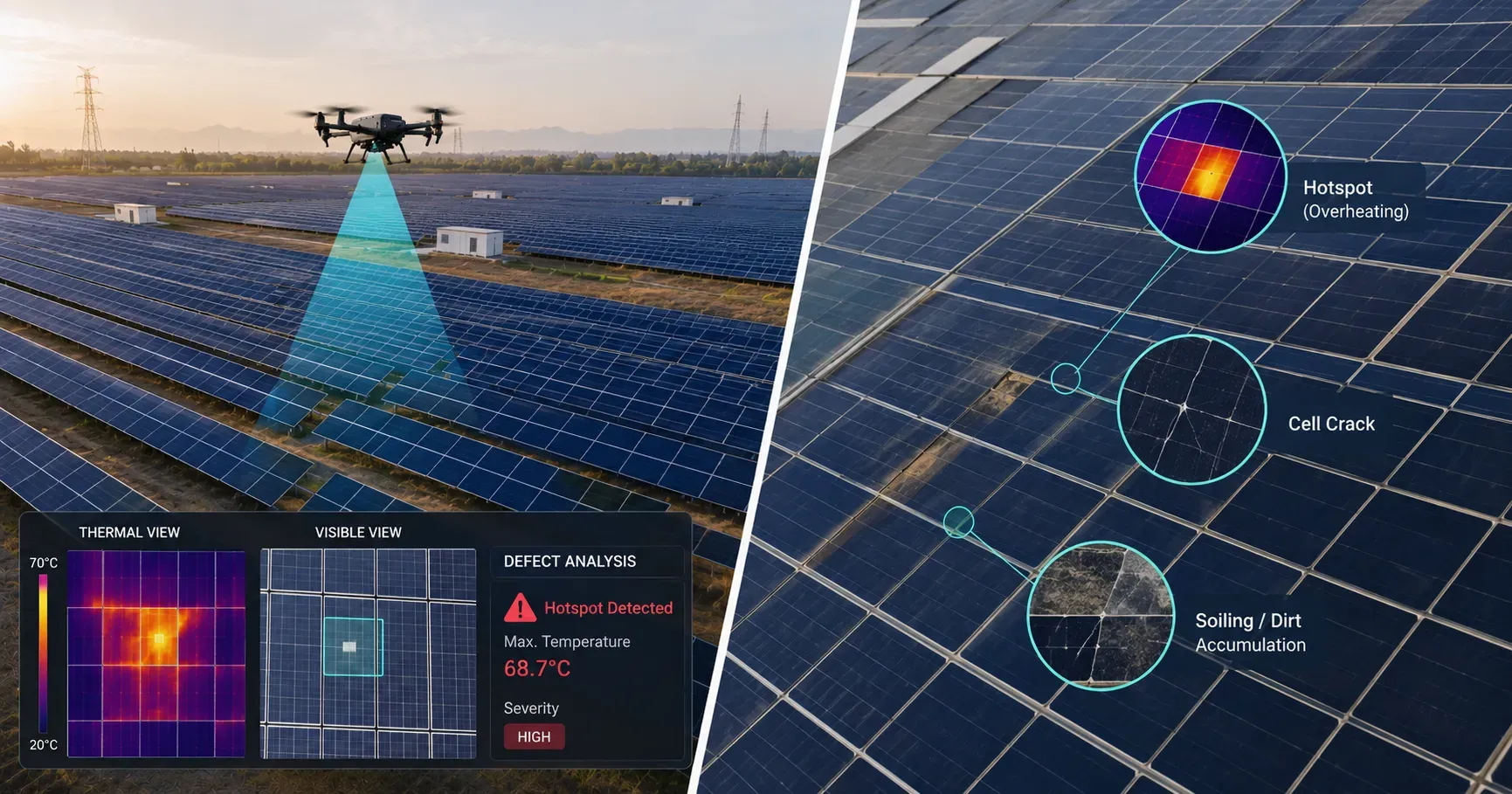
This workload shift changes the role of the drone from imaging platform to operational sensor layer. Thermal sorties now feed computer-vision pipelines that classify hotspot severity, compare temperature deltas against baseline strings, and generate fault-priority queues for field technicians. The inspection workflow now resembles industrial predictive maintenance rather than aerial photography. Photovoltaic hotspot detection drone surveys have moved from a one-off audit to a quarterly operational rhythm tied to plant performance ratios.
The inspection geometry also differs between utility-scale and rooftop fleets. Utility-scale solar inspection drone India workflows prioritise corridor efficiency, altitude control, and automated route planning across hundreds of acres. Rooftop solar drone inspection India operations prioritise obstacle avoidance, short-range thermal passes, and low-altitude imaging around dense urban structures. The DGCA airspace pathway also differs because rooftop assets are more likely to sit inside yellow-zone perimeters near controlled airspace.
The PM Surya Ghar scheme added roughly 8.7 GW of rooftop solar in FY26. That took grid-connected rooftop capacity past 23 GW (MNRE, 30 November 2025). The rooftop fleet sits across dense residential, commercial, and industrial geographies.
The result is a shift in procurement language. Asset owners no longer ask whether drones are useful. Procurement teams ask whether the inspection provider can deliver IEC 62446-3-compliant thermal data inside the DGCA permission window.
Reading IEC 62446-3 as an operator specification
IEC 62446-3 is not a marketing reference. It is the operating specification that defines how solar farm drone thermography must be conducted for panel-level thermal inspection (International Electrotechnical Commission, June 2017).
The standard defines acceptable environmental conditions, thermal measurement procedures, abnormality classification logic, and personnel qualification expectations. It also defines the imaging requirements that determine whether a hotspot dataset is contractually usable during EPC handover or warranty dispute resolution.
The IEC 62446-3 inspection requirements begin with environmental control. Thermal flights must occur under stable irradiance conditions, with sufficient solar loading to expose abnormal heat signatures. Wind conditions, cloud movement, and panel soiling directly affect thermal interpretation quality. A thermal image captured outside these thresholds can generate false-positive anomaly clusters.
Ground sampling distance becomes operationally important at this stage. IEC 62446-3 ground sampling distance solar requirements effectively determine flight altitude, sensor resolution, and corridor overlap percentages. A lower-resolution thermal payload reduces fault visibility at string level. An oversized altitude profile speeds inspection but weakens module-level anomaly detection.
The standard also distinguishes between qualitative and radiometric inspection. A qualitative thermal image identifies visible hotspots. A radiometric thermal drone solar workflow records calibrated temperature values for every pixel in the frame.
EPC operators now require radiometric outputs in FY26 tenders. Warranty enforcement depends on measurable temperature differentials rather than visual interpretation alone.
This is where AI-assisted inspection pipelines enter the workflow. Computer-vision models classify hotspot categories, identify recurring fault signatures, and compare present sorties against historical baselines. The algorithm flags defective cells, string imbalance patterns, and connector overheating clusters without requiring a technician to manually review every frame.
Competitor service pages cite IEC 62446-3 by name. Few explain that the standard functions as a measurable operator threshold rather than a brochure credential. Asset owners that read the standard as a procurement specification negotiate sharper acceptance terms than asset owners that treat it as a label.
Mapping the DGCA airspace pathway
The DGCA permission chain determines whether a solar inspection sortie can legally occur under Indian airspace rules. The Drone Rules 2021 established the green, yellow and red airspace zones framework. The same rules also set up the remote pilot certificate pathway for commercial unmanned aircraft operations (DGCA, 25 August 2021).
A solar farm inspection green zone yellow zone workflow begins with DigitalSky airspace verification. Green-zone operations below prescribed altitude thresholds proceed without additional air traffic clearance. Yellow-zone operations require permission because the asset falls inside controlled airspace proximity. Solar parks near airstrips, refineries, industrial corridors, or defence facilities frequently enter this category.
The Bharatiya Vayuyan Adhiniyam 2024 replaced the Aircraft Act 1934 as the statutory foundation for civil aviation governance in India (Ministry of Civil Aviation, 2024). Drone operations continue to flow through the DGCA rule stack. The legal transition matters because enforcement architecture and compliance interpretation now sit under the updated aviation framework.
The operational stack split in July 2025 also changed how commercial operators manage inspection readiness. Drone registration and pilot records shifted to the eGCA and DigitalSky platform split, with eGCA holding the registration and pilot layer. Airspace mapping and DigitalSky and NPNT compliance remained on DigitalSky (DGCA, July 2025). Operators running utility-scale inspection fleets now manage two operational systems rather than one.
Operational layer | Governing platform | Primary function | Operational impact |
|---|---|---|---|
Airspace permission | DigitalSky | Green-yellow-red zoning and NPNT validation | Determines whether a sortie can launch |
Operator records | eGCA | Pilot licensing and drone registration | Determines operator compliance status |
Type certification | QCI CSUAS | Commercial drone certification pathway | Determines aircraft eligibility |
Insurance compliance | IRDAI framework | Commercial liability coverage | Determines operational legality |
The DGCA drone permission solar inspection workflow also affects inspection scheduling. Utility-scale thermal sorties operate inside narrow irradiance windows. Delayed permissions reduce usable inspection hours and force rescheduling across multiple parks.
Inspection providers that understand both the thermal standard and the airspace stack clear contracts faster than operators that only provide imaging capability. The dual-platform compliance load also acts as a competitive filter inside the operator market.
Selecting the platform and payload stack
The platform-and-payload layer determines whether the inspection output can support asset-level maintenance decisions. A solar inspection aircraft is not selected on flight endurance alone. The aircraft, thermal payload, and route-planning software must operate as a calibrated inspection system.
The QCI Certification Scheme for Unmanned Aircraft Systems acts as the commercial type-certification gate for Indian drone operations (Quality Council of India, current). A commercial solar inspection aircraft without a valid certification pathway cannot legally operate under the Drone Rules 2021 framework. The certification gate filters out hobbyist-grade hardware from commercial inspection contracts.
Payload selection begins with radiometric capability. Non-radiometric thermal cameras generate visual heat signatures but lack calibrated temperature values. Radiometric payloads generate measurable thermal datasets that support engineering analysis and the same contractual evidence chains that govern wind turbine inspection. Sensitivity thresholds below 0.05 degrees Celsius are now common in commercial-grade payloads.
Mission autonomy also matters because inspection consistency affects dataset quality. Automated route planning maintains repeatable overlap percentages, stable imaging geometry, and corridor alignment across repeated sorties. Computer-vision systems then compare historical inspection datasets against present anomalies to isolate degradation patterns across the fleet.
The platform stack now operates as four interlocking layers. Flight-control systems hold altitude stability and execute automated corridors across the park geometry. Radiometric thermal payloads supply the calibrated hotspot measurements that anchor every contractual claim.
RGB imaging layers correlate visual defects with the thermal frame and anchor panel-level mapping inside the report. AI-assisted analytics pipelines then classify anomalies and prioritise the field-maintenance queue.
This differs from generic aerial survey workflows because thermal interpretation requires stable thermal geometry rather than visual coverage alone. A surveying drone can tolerate variable overlap margins. A thermal inspection workflow cannot.
Procurement teams now write these payload requirements directly into solar plant O&M drone services India contracts. The contract specifies sensor class, radiometric capability, reporting structure, and repeatability thresholds rather than simply requesting "drone inspection". RTK positioning, geotag accuracy, and post-processing pipelines also enter the specification because module-level traceability depends on coordinate precision.
Translating thermal data into action
A solar inspection sortie only becomes operationally useful when the thermal data converts into a maintenance decision. IEC 62446-3 defines thermal abnormality categories because not every hotspot represents the same failure risk (International Electrotechnical Commission, June 2017).
The thermal abnormality matrix classifies defects by temperature differential, defect location, and operational severity. Cell hotspots, bypass diode failures, string imbalance, connector overheating, and inverter-side anomalies produce distinct thermal signatures. The inspection objective is not merely to identify heat. It is to determine which anomalies require immediate field intervention.
This classification layer is where computer vision and edge inference materially change inspection speed. AI-assisted systems compare temperature distributions across panel strings and identify recurring degradation patterns. The algorithm identifies clusters that match historical failure signatures, allowing technicians to prioritise field crews against the highest-risk modules first.
The output format also changed. Asset owners now require structured thermal reporting rather than raw imagery archives. A solar drone inspection report format India workflow now includes geotagged anomaly maps, severity classification tables, module identifiers, thermal evidence frames, corrective-action recommendations, and repeat-inspection timestamps. The deliverable is structured for ingestion into computerised maintenance management systems rather than for visual review.
The inspection therefore becomes part of the asset's operational data layer. Thermal sorties are no longer standalone audits performed once a year. They function as recurring maintenance intelligence cycles tied directly to uptime and warranty enforcement.
Choosing the procurement model
The in-house vs outsourced solar drone inspection decision now depends on fleet scale, airspace complexity, and maintenance cadence rather than drone ownership alone. Solar drone inspection cost India calculations also depend on throughput efficiency rather than hardware price alone.
Large independent power producers operating gigawatt-scale portfolios build internal drone cells when recurring inspection frequency justifies permanent operational teams. These operators maintain dedicated pilots, thermal analysts, and airspace coordinators. The model reduces scheduling delays and creates a persistent inspection archive across the asset lifecycle.
Smaller operators and commercial rooftop aggregators continue to rely on outsourced providers because the inspection burden does not justify permanent staffing. The outsourced model also transfers compliance overhead related to remote pilot certification, airspace permissions, drone insurance under Rule 44, and aircraft maintenance.
Procurement model | Best suited for | Operational advantage | Primary constraint |
|---|---|---|---|
In-house drone cell | Multi-site utility portfolios | Faster recurring inspection cycles | Staffing and compliance overhead |
Outsourced inspection partner | Rooftop fleets and mid-size parks | Lower operational burden | Scheduling dependency |
Hybrid model | Mixed rooftop and utility assets | Flexible scaling | Multi-vendor coordination |
Asset owners now measure inspection economics in megawatts cleared per operational day. A provider with stronger airspace coordination and automated reporting can clear larger inspection backlogs inside the same irradiance window. The economic unit has shifted from rupees per drone hour to rupees per megawatt inspected and signed-off.
This procurement transition also creates separation inside the operator market. Some companies can sell inspection services. Fewer can execute compliant thermal operations at utility scale under the DGCA rule stack. The compliance gap is the source of pricing power for operators that hold all four operational layers cleanly.
Writing IEC 62446-3 into the EPC and O&M contract
The inspection has moved from an optional efficiency tool to a contractual infrastructure layer across Indian solar operations. EPC operators now write IEC 62446-3 compliance directly into project acceptance conditions. Insurance exposure, warranty disputes, and maintenance timelines now depend on the inspection record itself.
The contract language has tightened in three places. The acceptance clause names the standard, the sensor class, and the report format. The warranty clause references the thermal evidence chain as the trigger for module-level claims against manufacturers.
The O&M clause specifies the inspection cadence and the reporting deliverable. A contract drafted without these three references leaves the asset owner exposed during warranty enforcement.
The deliverable format also matters during a warranty dispute. Manufacturers accept structured thermal reports anchored to IEC 62446-3 procedures more readily than informal imagery. A radiometric thermal drone solar report with geotagged anomaly maps and severity classifications carries evidentiary weight that a non-radiometric image set does not.
The next operational bottleneck is not aircraft availability. It is regulatory execution. The eGCA-DigitalSky platform split created a dual-compliance workflow that operators must manage continuously. Remote pilot certification, NPNT validation, airspace approval, Rule 44 insurance compliance, and QCI certification now sit inside the same operational chain (IRDAI, current).
Artificial intelligence also enters the solar workflow through a different door. The value is no longer in producing thermal imagery alone. The value sits in anomaly classification, maintenance prioritisation, repeat-sortie comparison, and operational forecasting. Inspection providers that combine compliant flight operations with computer-vision-assisted analytics will define the next inspection layer across India's utility-scale solar expansion.
Kodainya is building toward inspection and autonomy stacks that treat thermal sorties as machine-readable operational infrastructure rather than isolated aerial surveys.