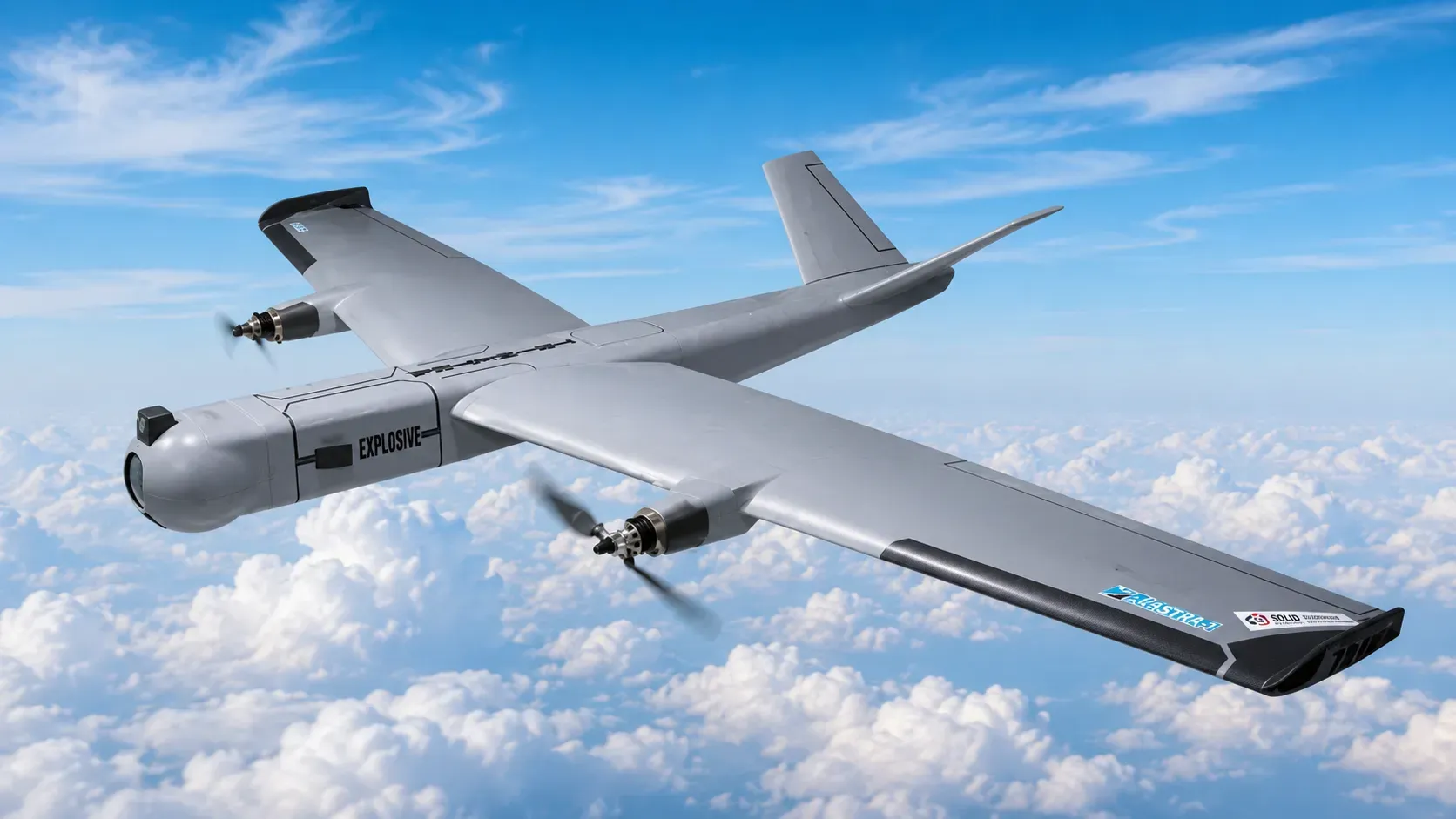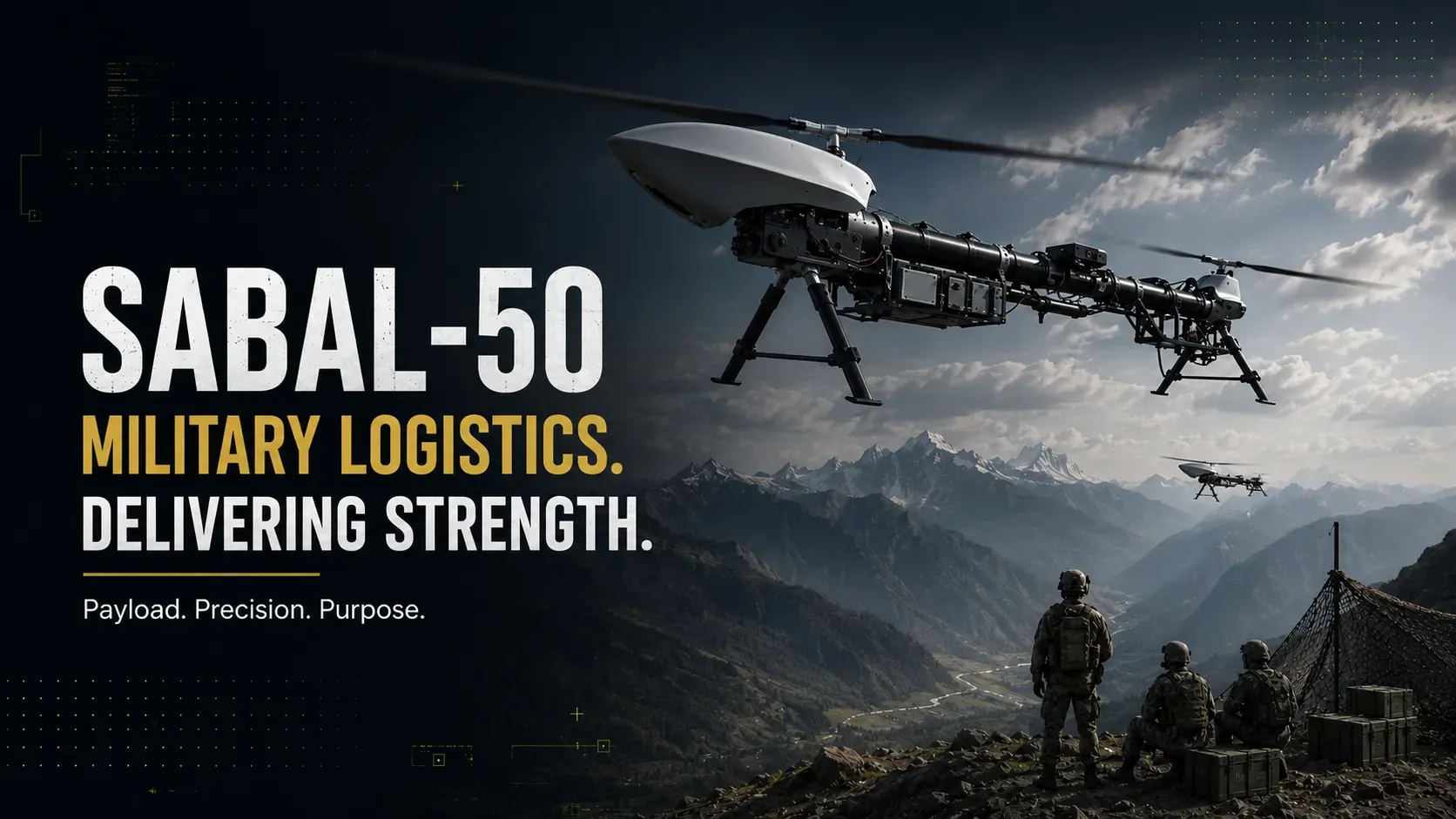
The Sabal-50 drone is a 150 kg unmanned helicopter with a 50 kg payload. It is in pilot testing at IIT Kanpur's Department of Aerospace Engineering for combat-lift missions along the Line of Actual Control. Read through the Kanpur triad of academic lab, testing infrastructure, and procurement route, the platform sits under the ₹500 crore National Military Drone Technology Hub. The Ministry of Defence cleared the Hub in-principle on 18 June 2026 under the Uttar Pradesh Defence Industrial Corridor framework (Department of Defence Production, 18 June 2026).
Locating the Sabal-50 inside India's defence innovation pipeline
The Sabal-50 drone sits inside a defence innovation pipeline that IIT Kanpur has built over more than a decade. The platform is developed within the Department of Aerospace Engineering through the Helicopter and Vertical Take-Off and Landing (VTOL) Laboratory. That distinction separates the Sabal programme from projects that stay confined to demonstration flights or laboratory prototypes.
India's defence modernisation depends on institutions that can move technology through every stage of development. Research laboratories generate the underlying engineering, dedicated flight-testing facilities validate performance, and the armed forces evaluate operational suitability. Government programmes provide mechanisms for scaling production into fielded capability.
IIT Kanpur has assembled each of these elements on a single campus, allowing prototypes to progress beyond experimental development toward Army evaluation. The pattern shows up across India's leading advanced military drones and the wider India defence drone portfolio, where indigenous programmes anchor a larger inventory conversation.
The significance of this pipeline extends beyond one aircraft. The Department of Defence Production granted in-principle approval for the ₹500 crore National Military Drone Technology Hub on 18 June 2026 (Department of Defence Production, 18 June 2026). The Hub recognises IIT Kanpur as a strategic centre for military drone research, testing, and technology transfer under the Uttar Pradesh Defence Industrial Corridor.
The Sabal programme also demonstrates how logistics UAVs occupy a distinct role within modern military operations. Unlike surveillance aircraft, an Indian Army drone tuned for logistics focuses on transporting supplies, communication equipment, batteries, and medical stores to dispersed forces operating in contested terrain. Vertical take-off and landing capability lets these aircraft operate without prepared runways, expanding usefulness across mountainous regions and forward operating bases.
Tracing the Kanpur model from laboratory to Army induction
The Sabal-50 programme builds on a structured innovation process that already put its predecessor into Army service. The Sabal-20 is a 20 kg tandem-rotor unmanned helicopter that the Indian Army inducted for the Eastern Command in November 2024 (Ministry of Defence, September 2024). The Army procured the platform through the Army Commanders Special Financial Powers route reserved for time-sensitive operational requirements. That route lets a General Officer Commanding-in-Chief sign acquisition contracts up to a defined ceiling, bypassing longer capital-acquisition timelines.
The journey begins inside the Department of Aerospace Engineering, where the Helicopter and VTOL Laboratory develops indigenous rotary-wing technologies. Research in rotor dynamics, flight control, lightweight structures, and propulsion integration provides the engineering foundation. The laboratory develops technologies that adapt across multiple military applications, rather than designing one aircraft for one mission.
Testing forms the second pillar because laboratory simulations cannot replicate the variable payloads and changing weather that a logistics drone in India faces in the field. IIT Kanpur pairs the Drone Testing, Innovation and Simulation facility with a DGCA-approved flight-testing area on the 1 km on-campus runway. The National Wind Tunnel Facility completes the setup, validating aerodynamic behaviour, flight stability, and payload integration before military evaluation begins.
Military validation follows engineering maturity. Army users assess reliability, maintainability, payload flexibility, ease of deployment, and mission suitability rather than technical specifications alone. Feedback from these evaluations feeds into the next design cycle, producing continuous improvement rather than one-time acceptance testing. The progression below traces the Kanpur model across five milestones.
Milestone | Institutional outcome | Strategic significance |
|---|---|---|
Helicopter and VTOL Laboratory established | Indigenous rotorcraft research capability | Long-term aerospace research foundation |
Sabal programme developed | Prototype logistics UAV family | Demonstrates laboratory maturity |
Army operational evaluation | User feedback and validation | Confirms military relevance |
Sabal-20 procurement via Army Commanders Special Financial Powers | Initial induction pathway | Bridges prototype to operational capability |
National Military Drone Technology Hub approved | Institutional expansion | Scales research into a national ecosystem |
Reading the Sabal-50 as a military logistics platform
The Sabal-50 is a rotary-wing military logistics UAV whose primary purpose is to move mission-essential supplies directly to operational units. Public briefings communicated through defence trade press place the airframe at 150 kg with a 50 kg payload (IIT Kanpur project team, June 2025).
Endurance runs three to four hours with a tested altitude ceiling of 17,000 feet. The platform flies a Beyond Visual Line of Sight (BVLOS) profile with encrypted communication links. The tandem-rotor configuration draws on the Boeing Chinook design lineage, delivering stability and lifting power for Siachen-class terrain.
Vertical take-off and landing capability allows the Sabal-50 to operate without prepared runways or launch systems. This design enables deployment from temporary operating bases, mountainous terrain, forest clearings, and confined military positions. Flexibility of this kind matters as armed forces adopt dispersed operating concepts that push supplies to smaller units across larger operational areas. Read against Indian loitering munition programmes and the DRDO TAPAS-BH 201 platform, the Sabal-50 sits inside a distinct logistics tier of Indian military UAVs.
Payload capacity determines the operational usefulness of a VTOL logistics drone. Every additional kilogram expands the range of equipment that can be delivered to forward locations. Depending on mission requirements, logistics UAVs may transport communication batteries, medical supplies, emergency rations, and replacement electronic components.
Reliability also outweighs maximum performance. Military operators require aircraft capable of repeated sorties with predictable maintenance requirements and consistent flight characteristics. A logistics UAV that completes multiple successful resupply missions delivers greater operational value than one designed to hit headline performance figures under ideal conditions. The comparison below explains why rotary-wing logistics UAVs occupy a distinct niche.
Operational requirement | Rotary-wing logistics UAV | Fixed-wing UAV |
|---|---|---|
Vertical take-off and landing | Excellent | Requires launch or runway support |
Point-to-point payload delivery | Excellent | Moderate |
Hover capability | Available | Not available |
Long-range area surveillance | Moderate | Strong |
Operations from confined locations | Excellent | Limited |
Understanding autonomy across the flight and mission stack
Military logistics UAVs are evolving from remotely piloted transport platforms into software-defined systems that assist operators with navigation, flight management, and mission execution. The Sabal-50 sits inside this broader technological transition. Its long-term significance lies not only in the airframe but also in the software architecture that supports future upgrades.
Modern logistics missions involve far more than flying between two points. Operators must account for terrain, weather, communication availability, payload weight, and changing mission priorities. Automating routine flight functions lets personnel focus on mission execution rather than continuous aircraft control.
Computer vision is becoming a load-bearing enabling technology for logistics UAVs. Cameras and onboard processors help identify suitable landing zones, monitor payload stability, detect obstacles, and improve navigation when satellite positioning becomes unreliable. Sensor fusion strengthens this further. GNSS receivers, inertial measurement units, barometric sensors, and optical cameras work together to give the flight management system a more accurate reading of the aircraft's position.
Edge computing is another area shaping future logistics UAV capability. Onboard processing reduces dependence on continuous data links to external systems. For missions operating in contested electromagnetic environments, this design principle allows navigation, obstacle detection, and flight management to continue even when communication bandwidth is constrained. The same design logic underpins jam-resistant drone technology that Indian defence programmes now treat as a procurement bar rather than a research topic.
Artificial intelligence enters an autonomous logistics UAV through practical operational functions rather than autonomous target engagement. Route optimisation, obstacle avoidance, predictive maintenance, flight diagnostics, and payload monitoring all represent areas where software improves mission effectiveness. Human operators remain responsible for mission approval, payload release, and operational supervision.
Mapping the campus ecosystem that supports the programme
The Sabal-50 is one outcome of a broader institutional ecosystem that has taken shape around IIT Kanpur since 2018. Understanding this ecosystem explains why the Department of Defence Production selected the campus for the proposed National Military Drone Technology Hub. Rather than concentrating expertise within a single laboratory, IIT Kanpur has assembled complementary research, testing, validation, and collaboration capabilities that collectively support military UAV development in India.
The foundation remains the Department of Aerospace Engineering. Faculty members, researchers, doctoral candidates, and specialised laboratories contribute expertise across aerodynamics, flight mechanics, propulsion, control systems, lightweight composite structures, and unmanned aircraft design.
Dedicated testing infrastructure forms the second institutional layer. The Drone Testing, Innovation and Simulation facility provides controlled environments for evaluating unmanned aircraft under representative operational conditions. Access to a DGCA-approved flight-testing area on the on-campus runway enables real-world validation, while the National Wind Tunnel Facility supports aerodynamic optimisation.
A ₹60 crore Defence Testing Infrastructure Scheme UAS testing facility anchors the certification track (Ministry of Defence, 2024). The setup was formalised with the Ministry and five DPSUs including HAL, BEL, Gliders India, Yantra India, and BEML.
Institutional coordination completes the ecosystem. The Army Design Bureau is the single point of coordination between users, researchers, and industry for the Hub (Department of Defence Production, 18 June 2026). This coordination sits inside India's drone manufacturing ecosystem and connects the Hub to the IIT Kanpur-incubated industrial partner responsible for manufacturing support. The layers below show how the Kanpur model translates research into fielded capability.
Capability layer | Institutional role | Contribution to military UAV development |
|---|---|---|
Research | Department of Aerospace Engineering | Fundamental aerospace research and system design |
Platform development | Helicopter and VTOL Laboratory | Prototype design and flight system integration |
Testing | DTIS facility, DGCA-approved flight-testing area, National Wind Tunnel Facility | Flight validation and performance assessment |
Operational evaluation | Indian Army | User trials and operational feedback |
Coordination | Army Design Bureau | Alignment between military requirements and research |
National scale | National Military Drone Technology Hub | Expansion of indigenous military drone capability |
Sighting logistics-UAV demand after Operation Sindoor
Operation Sindoor demonstrated that future military campaigns will depend as much on sustaining dispersed forces as on deploying advanced combat systems. The operation drew public attention to precision strikes, air defence, and unmanned reconnaissance. It also reinforced a less visible operational requirement: uninterrupted logistics support across distributed formations.
Every modern military operation depends on fuel, batteries, communications equipment, and medical supplies reaching forward units at the right time. That reading tracks with the Operation Sindoor drone deployment analysis Kodainya has published previously.
Traditional logistics methods remain indispensable, but they face increasing operational constraints. Road convoys can be delayed by terrain, damaged infrastructure, or changing tactical conditions. Helicopters provide greater flexibility but represent a finite and expensive resource that must support multiple mission sets simultaneously. Rotary-wing logistics UAVs fill the space between these two approaches by transporting smaller payloads directly to units operating beyond conventional supply chains.
The Army's broader modernisation initiatives reinforce this trend. Concepts such as manned-unmanned teaming doctrine, distributed command posts, mobile sensor networks, and digitally connected battlefield formations increase demand for rapid movement of mission-essential equipment. Communication batteries, electronic warfare modules, surveillance sensors, and medical payloads must be delivered within operational timelines measured in minutes rather than hours.
The significance of the National Military Drone Technology Hub extends beyond research funding because it strengthens the institutional capacity required to develop these future capabilities. The Hub brings together aerospace research, flight testing, military users, and industrial production within one collaborative framework. That environment lets logistics-UAV technologies mature alongside evolving operational doctrine.
Sequencing India's next military logistics capability
The Sabal-50 marks an important stage in India's transition from developing individual drone platforms to building a sustainable military UAV ecosystem. Future success will depend less on producing isolated aircraft and more on creating institutions capable of delivering continuous innovation across multiple generations of unmanned systems. The bar sits alongside India's 100K-drone force target, where procurement scale and indigenous supply must move together.
The approval of the National Military Drone Technology Hub signals that defence planners now recognise this distinction. Investment in laboratories, testing infrastructure, academic research, operational evaluation, and collaborative development creates enduring capability that extends well beyond a single programme.
Software-defined capabilities will define the next platforms. Navigation algorithms, mission planning systems, sensor fusion, and onboard computing will determine operational effectiveness alongside airframe performance. Modular digital architectures will position platforms to incorporate future technologies without complete redesign.
Logistics will emerge as one of the strongest early applications for advanced autonomy. Structured transport missions provide an ideal environment for introducing automated navigation, intelligent route management, and predictive maintenance under continuous human supervision. That pattern also shows up in commercial adjacencies. The same sensor stack pays back the investment inside drone-as-a-service operations and across Indian industry verticals where satellite visibility was already inconsistent.
The Sabal-50 therefore represents more than a logistics aircraft. It illustrates how India's defence innovation ecosystem is evolving from isolated programmes toward an integrated capability pipeline built on research excellence, operational validation, and sustained government support. The organisations that connect laboratory research, operational experience, and scalable manufacturing will shape the next generation of an indigenous logistics UAV in India.