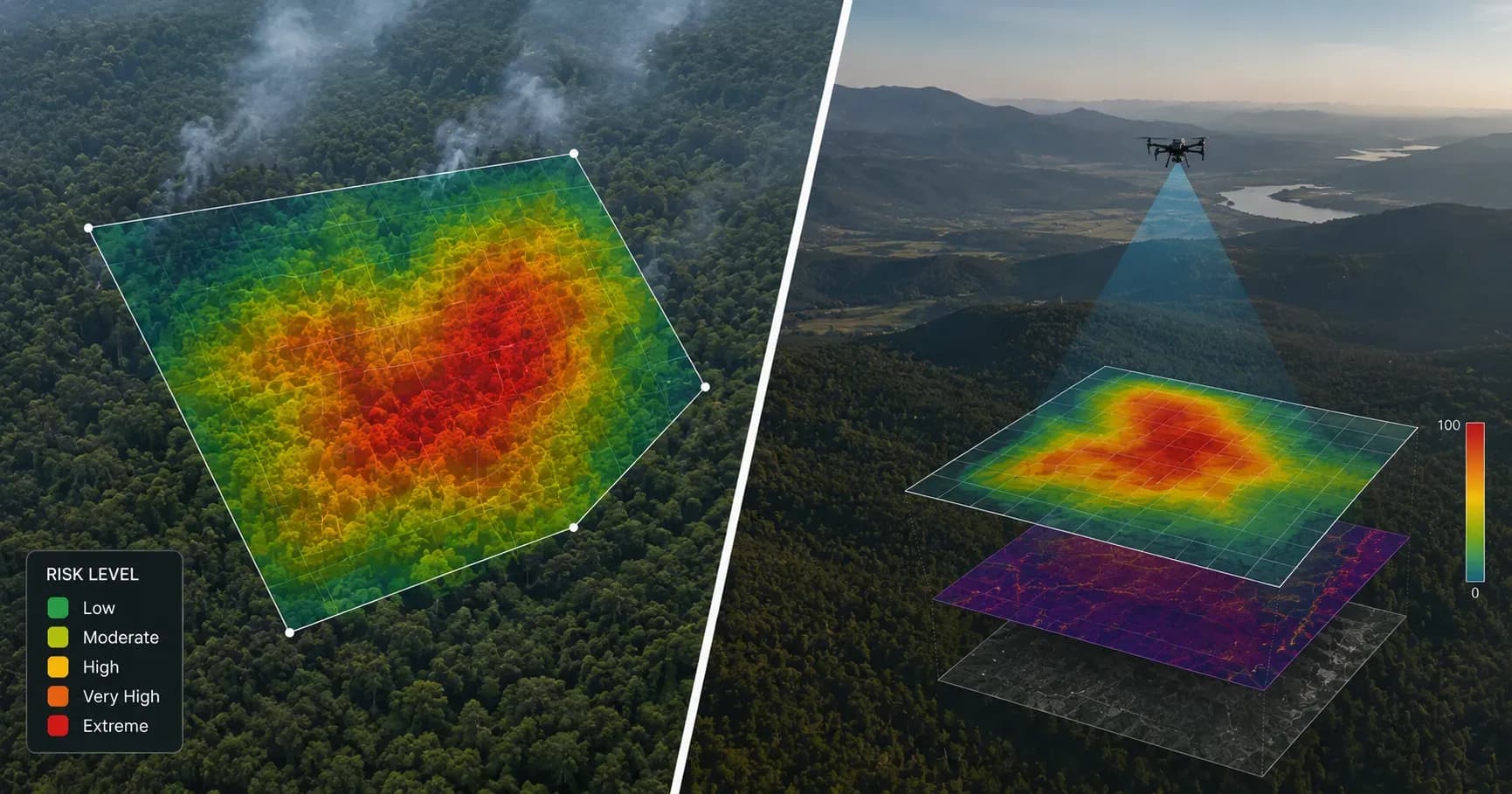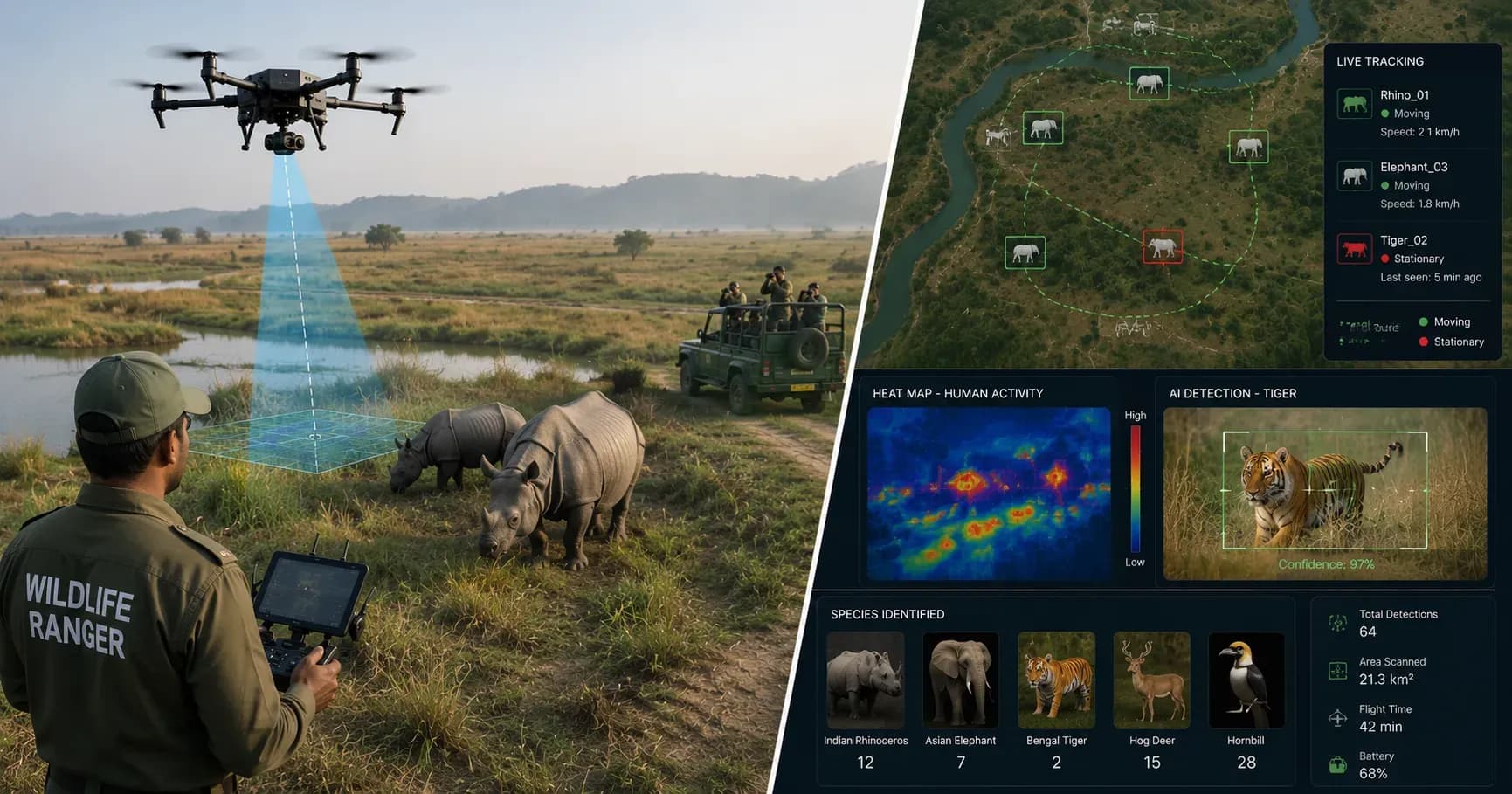
Drones for wildlife conservation in India sit at the intersection of three tracks: DGCA airspace rules, wildlife-protection law, and forest-department operations. The Drone Rules 2021 sit within the Bharatiya Vayuyan Adhiniyam 2024, while the Wildlife (Protection) Act 1972 as amended in 2022 governs activity inside protected areas. Kaziranga recorded zero rhino poaching for the second time in 2025, and NTCA's E-Bird Technology project now supports surveillance across 13 tiger landscapes. This piece maps the airspace-policy-operations triad that governs every conservation flight above a protected area.
Framing the wildlife protection regulatory triad
Drones for wildlife conservation in India operate under three regulatory tracks rather than one approval process. The Drone Rules 2021 breakdown sets aircraft registration, pilot responsibilities, and India's green, yellow, and red airspace zones (Directorate General of Civil Aviation, 25 August 2021). The Wildlife (Protection) Act 1972, amended in 2022, governs conservation activity inside protected areas (Ministry of Environment, Forest and Climate Change, 2022). NTCA and MoEFCC set operational guidance on top of both layers.
The statutory umbrella now sits within the Bharatiya Vayuyan Adhiniyam 2024, which replaced the Aircraft Act 1934 (Ministry of Civil Aviation, 2024). The Drone Rules 2021 continue to function under this framework. Drone use inside a protected area therefore sits under two paths, the Drone Rules 2021 for aviation and the Wildlife (Protection) Act 1972 for conservation.
This distinction shapes every mission. A DGCA-approved flight may still need forest-authority clearance because wildlife protection and habitat management fall under environmental law. MoEFCC filming permissions for commercial productions inside protected areas also stand apart from forest-department operational drone use (MoEFCC, Retrieved 8 May 2026). MoEFCC drone guidelines and NTCA advisories close the gap between aviation permission and conservation permission.
NTCA has folded drones into a wider conservation stack. Its E-Bird Technology project supports aerial monitoring across 13 tiger landscapes. The M-STrIPES ecosystem records patrol, ecological, and human-wildlife conflict data alongside the imagery (NTCA, Retrieved 8 May 2026). Drone imagery becomes one input inside a larger conservation intelligence system.
Tracing the Kaziranga drone deployment origin
Kaziranga anti-poaching drones became India's reference model because they solved a measurable conservation problem. Kaziranga became India's first protected area to use drones for wildlife conservation in 2013 (Assam Forest Department, 2013). Rangers needed persistent aerial observation across floodplains, elephant grass, wetlands, and woodland that patrol vehicles could not cover continuously.
The programme matured through coordination between the Assam Forest Department, NTCA, the Ministry of Home Affairs, and the Ministry of Defence. This work culminated in Central Government approval announced on 5 December 2018 (Kaziranga National Park Administration; NTCA, 5 December 2018). Wildlife surveillance could now operate within India's aviation and conservation regulations without a parallel permission framework.
Kaziranga runs a drone unit at each of its four management ranges instead of one central fleet. Distributed deployment shortens response time when rangers detect movement or receive intelligence from anti-poaching camps. The model also improves aerial coverage during Brahmaputra floods, when roads become inaccessible (Assam Forest Department, 2025).
Flight endurance improved alongside operations. Early platforms remained airborne for 25 to 30 minutes; longer-endurance platforms now extend missions beyond one hour and reduce launches per patrol cycle.
The conservation numbers followed. Kaziranga counted 2,613 greater one-horned rhinoceroses in the 2022 census, up from 2,048 in 2009 (Assam Forest Department, 2022). Rhino poaching fell 86 per cent between 2016 and 2024, and the park recorded zero rhino poaching in both 2022 and 2025. Kaziranga now maintains 253 anti-poaching camps, including 172 under the Eastern Assam Wildlife Division (Assam Forest Department, 2025).
Aerial reconnaissance does not replace ranger patrols. It shortens the time needed to verify intelligence, assess flood conditions, and direct response teams. The Kaziranga model is now the practical reference for forest departments building integrated aerial surveillance across India's protected landscapes.
Mapping tiger reserve anti-poaching operations
Tiger reserve drone surveillance has matured from pilot projects into a structured NTCA programme. Aerial data now feeds patrol records, ecological monitoring, and conflict reporting. Reserve managers treat the surveillance drone as one input to a continuous operational picture rather than a standalone camera (NTCA Public FAQs, Retrieved 8 May 2026).
The NTCA E-Bird Technology drone project is the clearest example. It supports unmanned aerial surveillance in 13 tiger landscapes. It sets operational capability, training standards, and repeatable field procedures. State forest departments then adapt the procedures to local terrain and mission requirements (NTCA Public FAQs, Retrieved 8 May 2026).
Drone operations also feed the SMART patrolling drone M-STrIPES ecosystem, the digital backbone of tiger reserve management. SMART (Spatial Monitoring and Reporting Tool) patrolling and M-STrIPES combine patrol tracks, ecological observations, and human-wildlife conflict events. Drone imagery adds an aerial perspective that helps officers verify patrol reports and inspect areas ranger teams cannot easily reach (NTCA M-STrIPES Protocol, Retrieved 8 May 2026).
The result is a layered model. Ground patrols provide law enforcement and field verification while drones expand the area observed during each cycle. Managers correlate imagery with GPS patrol tracks and intelligence reports before allocating ranger teams.
India's tiger reserve network continues to expand. On 10 March 2025, MoEFCC notified Madhav National Park as India's 58th tiger reserve (MoEFCC; NTCA, 10 March 2025). The network now spans 58 reserves and roughly 106 national parks. Each addition raises demand for standardised drone procedures and interoperable conservation technology.
NTCA has also fabricated a trainer drone and training manual for field staff. Reserve teams learn mission planning, safe flight procedures, payload operation, and post-flight data management.
Monitoring rhinos, elephants and human-wildlife conflict
Thermal imaging wildlife drones have expanded conservation aviation past anti-poaching patrols. Forest departments now track elephant movement after sunset and inspect terrain in poor visibility. Thermal payloads detect heat signatures where RGB cameras fail, letting operators distinguish animals from vegetation during darkness, fog, and dense canopy.
The Nagarahole Tiger Reserve in Karnataka shows the operational shift. In January 2023, the Karnataka Forest Department inducted a Nagarahole thermal drone elephant tracking system valued at roughly ₹25 lakh. The platform flies to about 400 metres, with a 2-kilometre thermal observation range. Field teams can now track elephant movement before conflict reaches nearby villages (Karnataka Forest Department, January 2023).
Thermal reconnaissance also anchors targeted deployment. Officers launch aircraft when villagers report elephant movement, or when patrols pick up suspicious activity that needs aerial verification. This conserves battery endurance while giving field teams eyes above the canopy.
Tamil Nadu has scaled a similar approach. The Hosur Forest Division tracks elephant movement between Bannerghatta National Park and the Cauvery Wildlife Sanctuary (Tamil Nadu Forest Department, 2025). In December 2025, the state opened an AI-enabled Command and Control Centre at Gudalur with 46 thermal cameras (Tamil Nadu Forest Department, 24 December 2025).
Other states are following. West Bengal uses thermal drones around elephant corridors, and Chhattisgarh has tested aerial monitoring in Udanti Sitanadi Tiger Reserve. Karnataka's Bandipur added AI-enabled thermal cameras in early 2026 (State Forest Department releases, 2026).
Drones also support habitat planning and weather-linked environmental programmes used in state elephant corridor design (Karnataka Government project announcement, 2025).
The pattern is clear. Rhino patrols need persistent grassland surveillance, elephant work prioritises conflict prediction and night monitoring, and tiger reserves combine aerial reconnaissance with ranger patrols and ecological mapping. The aircraft stays the same category of tool. The payload, flight profile, and mission change with the species.
Meeting DGCA airspace rules within national parks
Drone airspace protected areas India runs on two parallel approval systems. DGCA governs aviation safety, while MoEFCC, NTCA, and the state forest department govern conservation activity. Operators satisfy both before flying a conservation mission over a protected landscape.
The Drone Rules 2021 split Indian airspace into three categories, mapped inside India's drone laws in India framework. Green zones permit flights up to 400 feet above ground level without prior airspace permission. Yellow zones extend around operational airports and need Air Traffic Control coordination. Red zones remain prohibited unless Central Government authorises the flight (Directorate General of Civil Aviation, 25 August 2021).
Since September 2021, the yellow-zone perimeter has been reduced from 45 kilometres to 12 kilometres, opening up green airspace beyond the buffer (Press Information Bureau, 24 September 2021). The red, yellow, and green drone zones framework tracks these updates on the DigitalSky airspace map.
Indian national parks sit predominantly inside green zones. A DGCA green zone national park drone flight therefore clears the aviation half of the compliance path. Wildlife management runs as a separate track, with protected areas following their own management plans and SOPs (MoEFCC, Retrieved 8 May 2026).
Registration and airspace paths were split during the eGCA transition of July 2025. Aircraft registration moved to eGCA. Flight planning and airspace permissions stayed on DigitalSky, which also handles the No Permission No Takeoff (NPNT) framework (Ministry of Civil Aviation; DGCA, 2025). The eGCA and DigitalSky platform split removed administrative overlap without breaking the national airspace approval process.
Protected-area rules add operational controls beyond aviation. Reserve directors may set seasonal flight restrictions, altitude caps above nesting habitats, or prohibitions over sensitive concentrations. Two adjacent protected areas in identical DGCA zones can therefore run different drone SOPs.
Mission planning is now multidisciplinary. Flight teams check DigitalSky airspace, protected-area management plans, weather, wildlife movement, and patrol goals before every launch.
Fielding thermal, LiDAR and AI payloads for conservation
AI drones wildlife monitoring India runs on mission-specific sensing rather than generic aerial photography. Forest departments no longer pick a drone by endurance or camera quality alone. Selection starts with the mission, whether anti-poaching, habitat assessment, elephant tracking, flood mapping, or ecological monitoring. Payloads match the mission rather than the aircraft.
Thermal payloads own the night. Rangers use thermal imagery to detect heat signatures where dense vegetation or low light defeats visible-spectrum cameras. During anti-poaching patrols, thermal sensors help identify human movement after sunset. During human-elephant conflict response, they locate herds before the animals reach farms or villages, cutting search time and improving ranger safety (Karnataka Forest Department, January 2023).
LiDAR payloads serve a different purpose. LiDAR generates three-dimensional models of forests, wetlands, and canopy. Conservation planners use the datasets to assess habitat quality, measure vegetation density, estimate biomass, and evaluate landscape change. Laser pulses penetrate canopy gaps and reveal terrain features hidden beneath dense forest (Wildlife Institute of India, Retrieved 8 May 2026).
Computer vision in drones then accelerates data analysis rather than replacing human judgement. Edge-processing systems classify objects and prioritise imagery for operator review while the aircraft is still airborne. Trained personnel still verify every operational decision before field teams deploy.
A single conservation flight can now combine RGB imagery, thermal sensing, and AI-assisted processing. The aircraft becomes a data collection platform whose output integrates with ranger observations, GPS patrol logs, and ecological surveys (Wildlife Institute of India, Retrieved 8 May 2026).
The Wildlife Institute of India shapes this pipeline by adapting commercial drones for wildlife use, evaluating payload suitability, and matching sensors to field requirements. Technology selection therefore starts with ecology, not equipment.
Building forest department drone capacity by state
Forest department drone training India is now a strategic requirement across an expanding protected-area network. Aircraft alone cannot lift wildlife protection without trained pilots, mission planners, payload operators, and conservation officers who understand both aviation and ecology.
NTCA has addressed this through structured capacity-building linked to E-Bird Technology. Training covers trainer drones, operational manuals, mission planning, and field exercises. State forest departments then establish permanent in-house drone units instead of leaning on external service providers.
The Wildlife Institute of India drone capacity pipeline complements NTCA. Training covers payload selection, habitat mapping, ecological monitoring, and mission planning. Officers learn how aerial imagery feeds biodiversity surveys, anti-poaching patrols, and landscape management (Wildlife Institute of India, Retrieved 8 May 2026).
Funding also matters. State governments combine departmental budgets with the Compensatory Afforestation Fund Management and Planning Authority (CAMPA) for eligible drone units and capacity-building projects.
Some reserves also lean on drone as a service contracts for specialist missions such as LiDAR habitat mapping and high-endurance patrols. The department can then focus internal training on routine surveillance and conflict response.
Kaziranga remains the operational template. Drone units aligned with individual management ranges shorten response time and strengthen ranger coordination. Other protected landscapes adapt the model to local terrain and species.
India now manages 58 notified tiger reserves and roughly 106 national parks (MoEFCC; NTCA, 10 March 2025). Forest departments now build permanent drone capability alongside Indian government agencies running surveillance drone operations in surveying, inspection, and infrastructure. Common training standards, interoperable procedures, and regulatory guidance apply across every use.
The next chapter of wildlife conservation in India will be defined not by fleet size. It will be defined by how well aviation, conservation policy, ecological science, and field operations function as one integrated system.