Drones in Indian healthcare advanced through a stack of conditional exemptions granted by the Ministry of Civil Aviation to the Department of Health and Family Welfare. ICMR field evidence validated each gate. The exemption-evidence-expansion triad explains every milestone, from the 4 October 2021 Manipur vaccine flight to the 25 March 2025 AIIMS cornea transport. This guide maps each gate with primary-source citations and the operational envelope each unlocked.
Tracing the conditional exemption framework
Medical drone delivery regulations India still operate on a conditional-exemption architecture rather than on a dedicated healthcare aviation code. The Ministry of Civil Aviation granted the Department of Health and Family Welfare a conditional exemption from the Unmanned Aircraft System Rules on 2 July 2021. The instrument authorised healthcare drone operations under defined safety conditions (Ministry of Civil Aviation, 2 July 2021). That DoHFW drone conditional exemption became the legal foundation behind the ICMR i-DRONE initiative, vaccine flights, blood-bag validation missions, and later tissue-delivery trials.
The exemption mattered because the Drone Rules, 2021 established the broader operating stack. The Rules did not create a dedicated pathway for routine Beyond Visual Line of Sight medical flights (Ministry of Civil Aviation, 25 August 2021). Operators behind drones in Indian healthcare still had to clear airspace permissions, No Permission No Takeoff enforcement checks, platform registration, and insurance obligations under Rule 44. The healthcare framework therefore evolved through mission-specific permissions layered over the Drone Rules architecture.
Drone healthcare delivery hub and spoke models in India therefore differ from routine commercial logistics networks. Healthcare corridors required payload integrity validation, temperature-envelope verification, and chain-of-custody documentation alongside flight permissions. The 2022 ICMR Guidance Document formalised those requirements and defined handling conditions for vaccines, medications, and diagnostic samples (Indian Council of Medical Research, June 2022). India's full drone compliance workflow under the Drone Rules 2021 sits inside the same regulatory chain that medical operators continue to use.
Launching i-DRONE on Loktak Lake
Drone vaccine delivery India entered operational reality on 4 October 2021 when ICMR launched the i-DRONE initiative in Manipur. The first mission transported 900 vaccine doses across a 31-kilometre route to Karang Primary Health Centre on an island in Loktak Lake (Press Information Bureau, 4 October 2021). The drone vaccine delivery Manipur Loktak mission was also the first time an indigenous platform conducted a healthcare Beyond Visual Line of Sight flight in South Asia.
The mission mattered for two reasons. First, it validated healthcare logistics in terrain where road transport faced multi-hour delays. The 31-kilometre flight took under 15 minutes against the three-to-four hours road transport required to reach the same island PHC. Second, it established that medical payload integrity could survive real-world flight conditions across humidity, vibration, and battery constraints.
The i-DRONE Manipur deployment also opened the operational space for ICMR drone delivery work to scale. The aircraft category was small-class rotary, the payload class was vaccine vials in a temperature-controlled carrier box, and the route corridor crossed water with limited ground recovery options. Each variable became a data point ICMR used to authorise the next deployment.
Scaling the Northeast vaccine arm into Nagaland and Andaman
The Northeast arm of the ICMR i-DRONE initiative expanded from Manipur into Nagaland and the Andaman and Nicobar Islands within the same exemption window. ICMR confirmed that deliveries between Mokokchung and Tuensang crossed more than 40 kilometres. The aircraft carried 3,525 units of medical supplies on a 3.5-kilogram payload profile. That run remains the longest single i-DRONE flight on the public record (Indian Council of Medical Research, accessed 2025).
The geographic spread shifted the conversation from pandemic-era experimentation toward repeatable infrastructure. Manipur, Nagaland, and the island UT each carried different terrain, airspace, and logistics constraints. Demonstrating the same operational stack across all three states gave the Ministry of Civil Aviation a multi-environment evidence base. The Ministry of Health and Family Welfare then drew on the same base to authorise the next category of payload.
The Northeast missions also intersected with India's early BVLOS authorisation framework. In November 2021, the Council of Scientific and Industrial Research's National Aerospace Laboratories conducted a conditional BVLOS vaccine-delivery flight in Karnataka. The mission used the CSIR-NAL Octacopter platform under Ministry of Civil Aviation permission (CSIR-NAL, 13 November 2021).
The significance was regulatory rather than symbolic. India was testing whether medical logistics could become the first scalable civilian BVLOS category, and the answer was provisional yes. How India's airspace zone map decides where a medical delivery flight can launch still shapes every healthcare corridor approved today.
Codifying the ICMR operating model
The ICMR Guidance Document drone framework published in June 2022 converted field experience into a repeatable operating model. The document defined payload categories, temperature envelopes, handling procedures, and route-planning requirements for healthcare logistics (Indian Council of Medical Research, June 2022). It was the first time an Indian government scientific body had published an operating standard for civilian drone medical delivery.
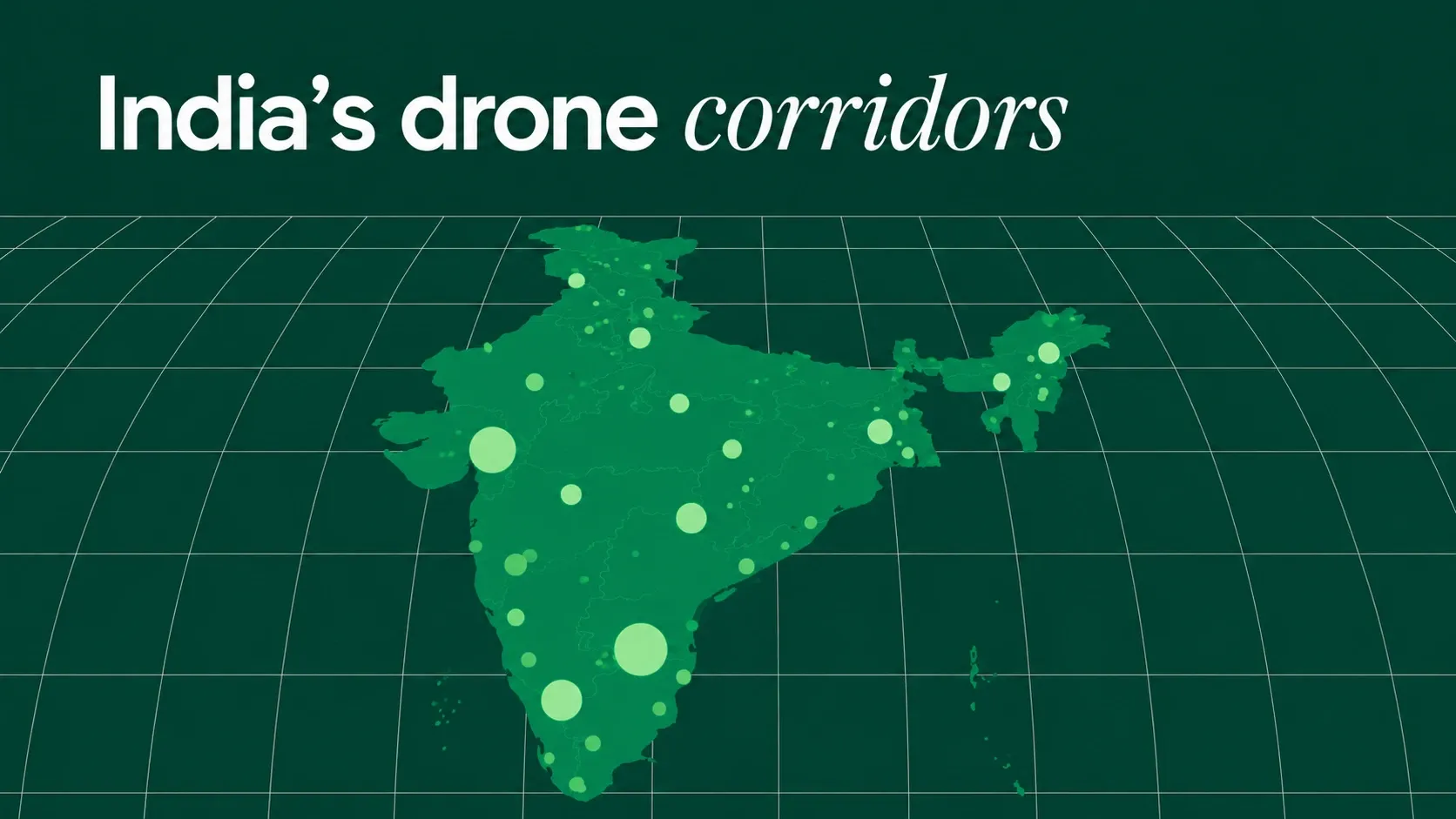
[IMAGE: A map of the ICMR i-DRONE initiative shows the eight delivery states and the AIIMS Delhi cornea transport route across India.]
The guidance drew a clear line between what healthcare drones could transport and what remained outside the authorised envelope. Vaccines and temperature-sensitive supplies in the 2°C to 8°C range were included. Tablets, syrups, and surgical supplies were included.
Blood bags and frozen biological specimens were explicitly excluded at publication. ICMR had not yet validated haemolysis risk, vibration impact, and thermal stability under flight conditions. That exclusion later defined the next gate of the programme.
The document also formalised the drone medical logistics last-mile model built around hub-and-spoke operations. A district hospital or storage node functions as the logistics hub. Primary healthcare centres act as spoke endpoints. The architecture reduced dependency on continuous road connectivity in mountainous and island terrain, and it became the operating template subsequent state programmes mirrored.
The five drone categories the Drone Rules 2021 define by weight also shaped platform selection inside healthcare corridors. Payload class and endurance profile determine whether a route requires a small multirotor, a hybrid VTOL system, or a heavier logistics aircraft.
Closing the blood-delivery validation gap
Drone blood delivery India moved from exclusion to validation in 2023. ICMR, Lady Hardinge Medical College, and the Government Institute of Medical Sciences conducted the blood-bag transport trials under the i-DRONE framework (Indian Council of Medical Research, 2023). The NCR validation flights focused as much on laboratory verification as on aviation performance.
[IMAGE: An infographic traces medical drone delivery regulations India through the DoHFW conditional exemption, the ICMR Guidance Document, and the AIIMS cornea transport.]
The drone blood bag transport India validation mattered because blood transport carries stricter integrity requirements than vaccine carriage. Temperature deviation, vibration stress, and pressure variation can damage red blood cells and compromise transfusion safety. ICMR tested samples carried by drone against control samples carried by ambulance. The matched-sample protocol meant the trial cleared a clinical evidence bar, not only an aviation safety bar.
The programme effectively closed the gap left open in the 2022 Guidance Document. Once ICMR validated blood transport, the operational logic behind medical drone delivery expanded from preventive healthcare into emergency and surgical logistics. The payload chain was no longer limited to immunisation campaigns and medicine resupply. Rule 44 third-party liability insurance for commercial drone operations remains part of the same compliance stack healthcare operators must clear before each deployment corridor opens.
Pushing the envelope at high altitude and sub-zero temperature
In the same year, ICMR pushed the operational envelope further through high-altitude delivery operations in Himachal Pradesh. The drone medicine delivery Himachal Pradesh feasibility study transported more than 100 units of essential medication across a 20-kilometre route. The mission operated under sub-zero conditions in Lahaul and Spiti at altitudes above 10,000 feet (Indian Council of Medical Research, October 2023).
The altitude profile mattered because it stress-tested every variable the lower-altitude Northeast missions did not face. Low-temperature battery degradation, wind variability, terrain elevation, and weak telecom coverage turned the deployment into a systems-validation exercise rather than a simple delivery flight. Diagnostic blood samples were also carried on return legs, demonstrating two-way logistics across the same corridor.
The Lahaul and Spiti deployment also validated the operational pattern for future medical-delivery corridors in Ladakh, Sikkim, Arunachal Pradesh, and other high-altitude districts. Road logistics in those regions break down for weeks at a time. The evidence base now covers tropical island terrain, dense Northeast forest terrain, and high-altitude cold-desert terrain across the same programme.
Expanding into diagnostic and oncopathological samples
ICMR i-DRONE then extended into diagnostic logistics. The TB sputum sample drone Telangana trials ran with AIIMS Bibinagar and the District Medical Office of Yadadri Bhuvanagiri. The work tested whether drones could compress laboratory turnaround times for the National TB Elimination Programme.
Sputum samples moved from sub-centres and primary health centres to district TB testing units. Road transport had previously created delays of one to two days on the same routes.
The diagnostic expansion also covered intraoperative oncopathological samples in Karnataka. Tissue samples taken during cancer surgery in peripheral hospitals were flown to tertiary care hospitals for rapid pathological assessment. The protocol allowed surgeons to receive results within the operative window, in cases where the road transport time would have closed that window entirely.
Diagnostic logistics matters because healthcare logistics value now turns on speed-to-diagnosis rather than only on medicine availability. A vaccine delivered late still vaccinates; a sputum sample delivered late delays a TB diagnosis and continued community transmission. The ICMR diagnostic-sample expansion therefore shifted i-DRONE from a delivery programme into a turnaround-compression programme.
Crossing into tissue logistics at AIIMS
The ICMR cornea transport drone mission on 25 March 2025 marked the first time India publicly demonstrated drone-enabled biological-tissue logistics. The flight ran between Dr Shroff's Charity Eye Hospital in Sonipat, AIIMS Jhajjar, and AIIMS Delhi. The mission supported a successful corneal transplantation at AIIMS Delhi (Ministry of Health and Family Welfare, 25 March 2025). The route compressed a two-to-two-and-a-half-hour road transfer into a 40-minute drone flight.
[IMAGE: A healthcare professional receives a drone-delivered cornea payload as part of the ICMR cornea transport drone flight to AIIMS Delhi.]
The AIIMS Delhi cornea drone operation mattered because corneal tissue sits operationally closer to organ logistics than to vaccine transport. Tissue viability windows are narrow. Environmental control standards are stricter, and chain-of-custody verification requirements are heavier.
The successful transplantation after delivery proved that drone-enabled tissue movement could support real clinical workflows rather than demonstration flights.
The route also reflected a multi-agency aviation stack. The Ministry of Civil Aviation, Airports Authority of India, and Directorate General of Civil Aviation handled the aviation side. AIIMS Delhi and ICMR handled the clinical and scientific side (Press Information Bureau, 25 March 2025). That coordination pattern is likely to become the template for future medical BVLOS corridors as the regulatory framework moves toward routine rulemaking.
Running parallel to Medicine from the Sky in Telangana and Arunachal Pradesh
Medicine from the Sky deployments in Telangana and Arunachal Pradesh developed in parallel to i-DRONE. The work ran under separate institutional frameworks involving state governments, NITI Aayog, the Public Health Foundation of India, and the World Economic Forum. Telangana ran the first phase as proof-of-concept across more than 300 vaccine delivery trials. Arunachal Pradesh ran the second phase across Lower Subansiri and East Kameng districts, where the aircraft fleet covered over 15,000 kilometres of equivalent ground distance.
The difference is structural. Medicine from the Sky focused on state-level healthcare logistics experimentation with state government and multilateral institutional sponsorship. ICMR i-DRONE evolved into a nationally referenced evidence-and-exemption framework that the Ministry of Health and Family Welfare cites in its central programme statements. Both programmes share airspace permissions and underlying aviation rules but operate through different governance lines.
The parallel programme matters because it shows the country has built two pathways to scale medical drone delivery. State governments can run programme-specific corridors under WEF-style institutional frameworks. The central government can run cross-state programmes under ICMR's scientific authority. The next regulatory phase will likely consolidate both pathways under a single BVLOS rule architecture.
Mapping the next regulatory phase
BVLOS drone healthcare in India now sits between pilot-phase governance and routine operational rulemaking. The Bharatiya Vayuyan Adhiniyam 2024 replaced the Aircraft Act 1934 as India's parent aviation statute in January 2025 (Ministry of Civil Aviation, January 2025). Drone penalties, detention powers, and future rulemaking authority now derive from the BVA framework rather than colonial-era aviation legislation.
The next phase depends on whether the draft Civil Drone (Promotion and Regulation) Bill 2025 converts exemption-based healthcare operations into standing regulatory categories. The Bill entered public consultation on 16 September 2025 and covers unmanned aircraft systems below 500 kilograms (Ministry of Civil Aviation, 16 September 2025). Conditional exemptions scale poorly once corridor density grows. Routine healthcare logistics require standardised approval chains, repeatable BVLOS corridors, interoperable telemetry requirements, and automated compliance logging.
Operators entering healthcare logistics must now prepare for aviation-grade documentation standards rather than drone-flight competence alone. Payload validation, environmental telemetry, insurance compliance, chain-of-custody records, and route redundancy are becoming procurement requirements alongside endurance and payload capacity. AI-assisted route planning, edge inference for terrain-aware navigation, and automated post-flight reconciliation will sit inside the next rule set rather than outside it. The NPNT enforcement chain that medical-delivery operators clear before takeoff will also tighten as healthcare corridors become denser and more automated.
India's healthcare drone network is now moving from trial routes into programmable infrastructure. The operators that master compliance, payload integrity, and mission-autonomy workflows first will shape the next civilian BVLOS architecture the country codifies.