Drone crop monitoring in India now runs on a four-layer chain: multispectral payload, vegetation index, agronomic decision, and policy platform. By 30 November 2025, SMAM approvals totalled 2,122 drones, with demonstrations reaching 4,52,291 farmers across 41,010 hectares (Press Information Bureau, 2 December 2025). Kodainya reads that chain end to end, from the near-infrared band on the sensor to Krishi DSS. Operators finish knowing which vegetation index to fly for which question.
Reading Indian farm plots from a sensor-first workflow
Drone crop monitoring in India is now part of a wider agricultural information system rather than a standalone imaging exercise. The objective is to generate reliable field measurements that help farmers, agronomists and government programmes make timely decisions.
The Sub-Mission on Agricultural Mechanization tells that story clearly. As of 30 November 2025, the Ministry of Agriculture and Farmers Welfare had approved 2,122 drones under SMAM (Press Information Bureau, 2 December 2025). ICAR, State Agricultural Universities and Krishi Vigyan Kendras have run demonstrations across 41,010 hectares, reaching 4,52,291 farmers on working fields rather than in technology pilots.
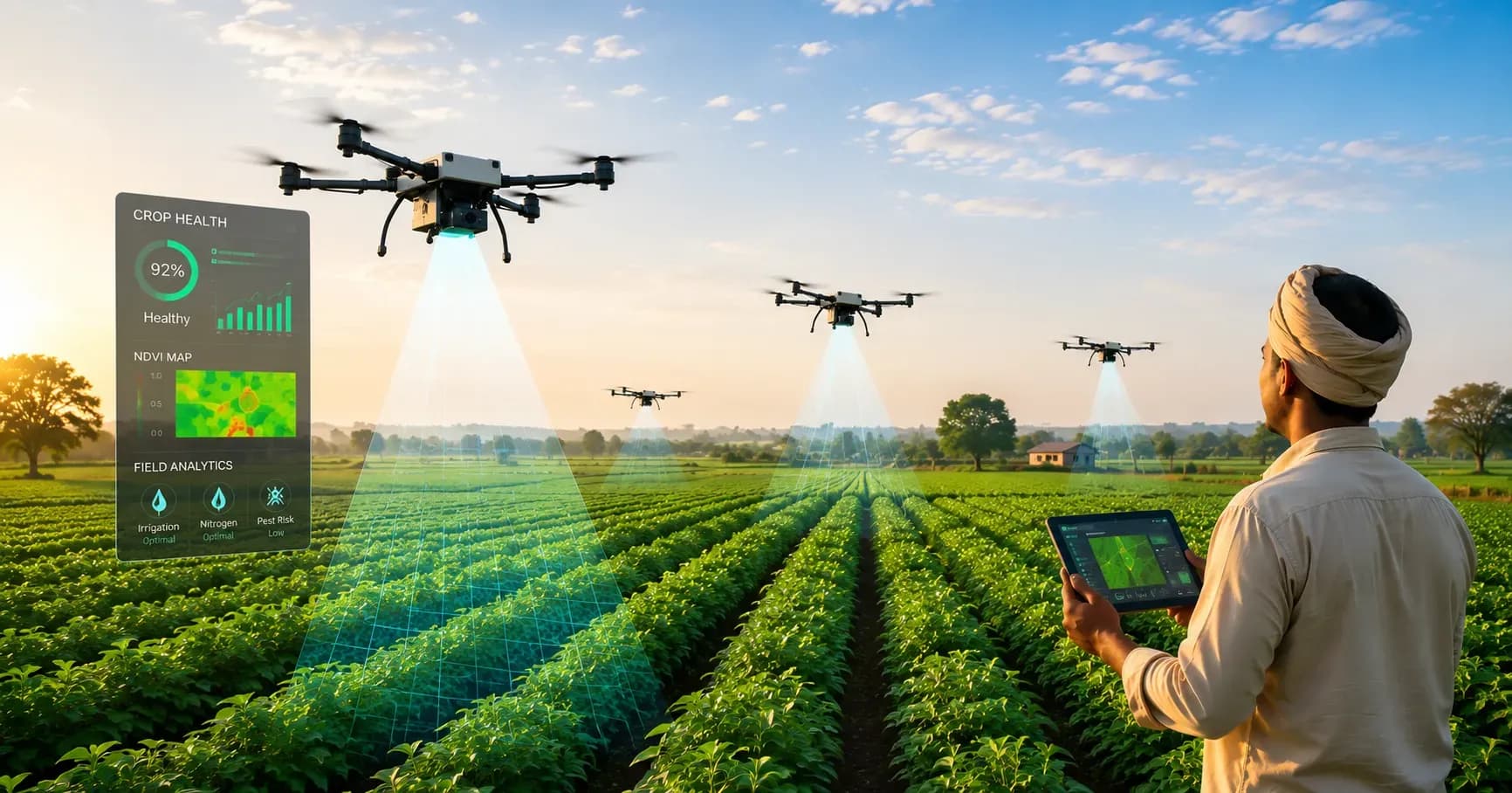
Precision agriculture drone India workflows follow a four-stage sequence. The multispectral payload records reflected sunlight across selected wavelength bands, and software converts those values into vegetation indices such as NDVI, NDRE or GNDVI. Agronomists then interpret the indices to identify nutrient deficiency, water stress or disease pressure before visible symptoms spread across the field.
Government agriculture platforms consume the same information alongside satellite imagery, weather feeds and soil records. Most published explanations of drones in Indian agriculture stop too early. They describe NDVI as a health map but skip the policy layer that connects drone observations to national programmes.
That policy layer runs through the Kisan drone scheme, the National Pest Surveillance System and the Pradhan Mantri Fasal Bima Yojana. The full payload-to-index-to-decision chain gives buyers a more accurate picture than any single coloured vegetation map.
Understanding the multispectral bands a drone actually captures
The multispectral payload sits at the base of the chain. An RGB camera captures visible wavelengths. A multispectral sensor measures narrower spectral bands that plants reflect differently as they grow, take up water or respond to stress. Every vegetation index in multispectral drone agriculture is calculated from these spectral measurements, not ordinary photographs.
Healthy vegetation absorbs much of the visible red light for photosynthesis and reflects a large share of near-infrared energy. That pattern shifts as chlorophyll declines or plant tissue becomes stressed. A multispectral payload measures the shift consistently across a whole field, so software can compare one section of a crop with another using numerical values (Ministry of Agriculture and Farmers Welfare, 12 August 2025).
The payload determines what can be extracted after the flight. A typical agricultural multispectral system records blue, green, red, red-edge and near-infrared bands, each supporting a different agronomic question rather than a universal measure of crop health.
Spectral band | Primary measurement | Typical agronomic use | Supports index |
|---|---|---|---|
Blue | Surface reflectance | Early canopy assessment and atmospheric correction | Supporting calculations |
Green | Chlorophyll response | Vegetation vigour | GNDVI |
Red | Photosynthetic absorption | Plant health assessment | NDVI, SAVI |
Red-edge | Chlorophyll transition | Mid to late growth monitoring | NDRE |
Near-infrared | Cell structure reflectance | Biomass and canopy density | NDVI, NDRE, NDWI |
The camera does not diagnose. It records reflected energy across specific bands, which software converts into vegetation indices. Agronomists then interpret the indices alongside crop stage, soil condition and weather. Drone multispectral bands explained comes down to that handoff.
Higher-quality georeferencing matters for the same reason. If each flight does not align precisely with previous surveys, changes observed between two dates may reflect positional error rather than crop development. Centimetre-level techniques covered in RTK and PPK positioning therefore become essential for seasonal crop histories and repeatable prescription maps.
The Indian Institute of Wheat and Barley Research showed the same pattern in the 2023-24 rabi season. Drone-derived multispectral imagery correlated strongly with leaf area index and leaf nitrogen content during flowering and grain filling (ICAR-IIWBR, May 2025).
Choosing NDVI, NDRE, GNDVI or SAVI for the right question
NDVI drone dominates search results, yet NDVI is only one member of a broader vegetation-index family. Selecting the right index depends on the agronomic question and the crop stage, not on the sensor itself.
The Normalised Difference Vegetation Index (NDVI) uses red and near-infrared reflectance to estimate vegetation vigour. Healthy plants absorb red light and reflect near-infrared energy, so NDVI values rise. The index reads early and intermediate crop stages well.
NDVI loses sensitivity once canopies close, because dense vegetation reflects near-identical values across large portions of a field. Agronomists switch to the Normalised Difference Red Edge Index (NDRE), which replaces the red band with the red-edge wavelength and holds chlorophyll sensitivity after canopy closure. An NDRE drone reading therefore stays useful during reproductive growth. NDVI vs NDRE for crop monitoring comes down to that split.
The Green Normalised Difference Vegetation Index (GNDVI) uses the green band in place of red, tracking chlorophyll concentration for fertiliser planning. The Soil Adjusted Vegetation Index (SAVI) corrects for exposed soil during emergence, when soil brightness distorts NDVI.
The Normalised Difference Water Index (NDWI) uses near-infrared and short-wave infrared responses where suitable sensors are available. Irrigation managers use NDWI to identify water stress before wilting is visible.
Vegetation index | Primary purpose | Best growth stage | Typical operational decision |
|---|---|---|---|
NDVI | General vegetation vigour | Early to mid season | Crop establishment and uniformity |
NDRE | Chlorophyll and nitrogen status | Mid to late season | Nitrogen management |
GNDVI | Chlorophyll concentration | Multiple stages | Fertiliser planning |
SAVI | Vegetation with exposed soil | Early emergence | Stand establishment |
NDWI | Water status | Throughout irrigation cycle | Irrigation scheduling |
That is how NDVI works with drones in practice. The payload records reflectance, software calculates the appropriate vegetation index, and agronomists compare the values against crop growth stage, field history and local conditions. Only then does the reading become an operational recommendation.
Krishi DSS, NPSS and PMFBY are drawing geospatial datasets into shared digital platforms. The value now lies less in producing another coloured image and more in choosing the right index for the decision that follows.
Timing crop scouting to each growth stage
A vegetation index is only as useful as the flight timing behind it. A precise multispectral payload cannot answer an agronomic question if data is collected outside the crop stage where physiological change is measurable. Drone-based vegetation index workflows therefore begin with the crop calendar.
Every crop passes through predictable stages, from emergence through vegetative growth, flowering and grain filling to maturity. Each stage changes how plants reflect light, so agronomists compare vegetation indices against expected crop development rather than treating maps as independent observations.
Early-season flights focus on establishment. SAVI is the reliable index because exposed soil distorts NDVI. During rapid vegetative growth, NDVI reads canopy development and plant vigour well, letting farmers identify nutrient deficiencies and pest pressure before symptoms show at ground level. Drone scouting crop growth stages at this window reduces unnecessary field walks.
Flowering and reproductive stages need a different approach. Dense canopies reduce NDVI sensitivity, so NDRE becomes the reliable indicator of chlorophyll concentration and nitrogen status. That is the stage where the ICAR-IIWBR wheat trials cited earlier registered their strongest correlations.
Aligning missions with biological milestones rather than fixed calendar intervals is the practical version of that principle. The result is a sequence of measurements that supports decisions rather than isolated snapshots.
Turning vegetation indices into prescription maps and variable-rate action
Collecting multispectral imagery is only the beginning of the decision chain. The economic value appears when vegetation indices become prescription maps that guide precise field operations. That transition turns drone crop health monitoring from a diagnostic exercise into a management tool.
Prescription mapping begins by dividing a field into management zones. Areas with similar vegetation-index values group together, so agronomists identify patterns that correspond with nutrient availability, irrigation, pest activity or crop establishment. Multispectral imagery highlights where to investigate, not what to apply. Agronomic verification remains essential before any treatment decision.
Once validated, the information supports variable-rate operations. Operators apply inputs according to local crop conditions rather than treating a farm uniformly. Healthy sections keep standard management, and stressed areas receive targeted attention.
The practical workflow runs in four connected stages. A multispectral survey records reflectance across the required bands, and analytical software stitches and georectifies the capture before generating the vegetation index alongside management zones. Agronomists validate the observations through field inspection and crop sampling. The approved prescription map then guides variable-rate spraying or nutrient application.
Prescription map drone agriculture India workflows keep a human decision layer at every step, from data interpretation through field execution.
Drone surveys identify where intervention is needed, and workflows described in drone spraying services in India explain how approved missions implement those recommendations. Separating diagnosis from treatment produces more consistent agronomic outcomes than uniform application.
The Ministry of Agriculture and Farmers Welfare has promoted drone-based precision farming through SMAM demonstrations and research on spray quality and droplet deposition (Press Information Bureau, 4 April 2025). Variable rate application drone India practice will become more data-driven as aerial mapping workflows connect with automated spraying missions.
Feeding drone-derived data into Krishi DSS, NPSS and PMFBY
Drone remote sensing agriculture becomes valuable at scale when drone observations enter national agricultural information systems. India is moving toward a geospatial framework where drone surveys, satellite imagery, weather records and field observations complement each other.
The Digital Agriculture Mission approved by the Union Cabinet provides the foundation. Its ₹2,817 crore outlay brings together AgriStack, the Digital Crop Survey and Krishi Decision Support System (Press Information Bureau, 2 September 2024). Krishi DSS combines satellite imagery, soil, weather, reservoir data and crop signatures on one geospatial platform (Press Information Bureau, 12 August 2025).
Drone-derived vegetation indices add a higher-resolution layer. Satellite imagery gives regional coverage, while drone surveys capture field-level variation that satellites may miss due to spatial resolution or cloud cover.
The National Pest Surveillance System applies the same principle. Launched to combine AI, machine learning and remote sensing with field observations, NPSS supports pest identification across 61 crops and management advisories for 15 major crops (Press Information Bureau, 15 August 2024). Drone imagery flags abnormal crop patterns that warrant field inspection, and agronomists confirm the pest before advisories go out.
Insurance assessment is another area where drone data is now operationally relevant. PMFBY envisages drones, satellite imagery and remote sensing for crop area estimation, yield assessment, Crop Cutting Experiments and loss verification (Press Information Bureau, 4 April 2025). Drone data for PMFBY yield estimation adds objective geospatial evidence to field inspection and statistical sampling.
That infrastructure will keep strengthening decision-making. As Krishi DSS incorporates more drone missions, operators, agronomists and government agencies work from one geospatial reference rather than separate systems.
Operating drone crop monitoring within DGCA and SMAM guardrails
Technical capability alone does not decide whether an agricultural drone mission can be conducted legally. Drone crop monitoring under SMAM must satisfy India's civil aviation framework and the operational requirements of agricultural support programmes. The Drone Rules 2021 breakdown covers categorisation, registration, certification and airspace access. Eligible Kisan drones must hold the required approvals, remote pilots must hold valid Remote Pilot Certificates where applicable, and flights must comply with DigitalSky permissions before every mission.
Agricultural subsidy programmes add another compliance layer. Revised SMAM guidelines provide financial assistance across categories, from grants for ICAR, KVKs and State Agricultural Universities to support for FPOs and eligible farmers (Ministry of Agriculture and Farmers Welfare, May 2025). DGCA type certification is the anchor Kisan drone platforms need to enter the subsidy pool.
The Namo Drone Didi Yojana expands the model, supporting women Self Help Groups with agricultural drone deployment through financial assistance and structured training (Press Information Bureau, 20 December 2024). While the programme is known for spraying, the same ecosystem opens scheduled scouting, field monitoring and multispectral surveys through trained operators.
FPOs and Custom Hiring Centres running a drone-as-a-service model can bundle scouting flights alongside application missions. That structure spreads the fixed cost of the payload and the pilot across more crop cycles.
Operators should also understand the administrative separation on the eGCA and DigitalSky split. Registration, certification and operator records now sit on eGCA, while DigitalSky continues to handle airspace permissions and the NPNT ecosystem.
The same compliance discipline extends across the industries Kodainya covers. As SMAM, Namo Drone Didi and Digital Agriculture Mission initiatives expand, operational success will depend as much on regulatory compliance as on sensor performance.