Drones in Indian Railways are no longer a scattered set of zonal experiments. The 26 February 2026 Rail Tech Policy collapses inspection, surveillance and survey work into a single innovation pipeline (Ministry of Railways, 26 February 2026). The pipeline routes through the Rail Tech Portal and organises how RDSO, the Railway Protection Force, DFCCIL and the zonal railways procure aerial assets under the inspection-surveillance-survey triad. This piece maps each leg of the triad, the DGCA compliance overlay, and what the twelve months ahead will demand.
Mapping the inspection-surveillance-survey triad
The triad matters because each leg carries a different sponsoring agency, a different approval chain, and a different procurement trigger. RDSO and zonal engineering own inspection. The Railway Protection Force owns surveillance. DFCCIL and the construction agencies own survey work.
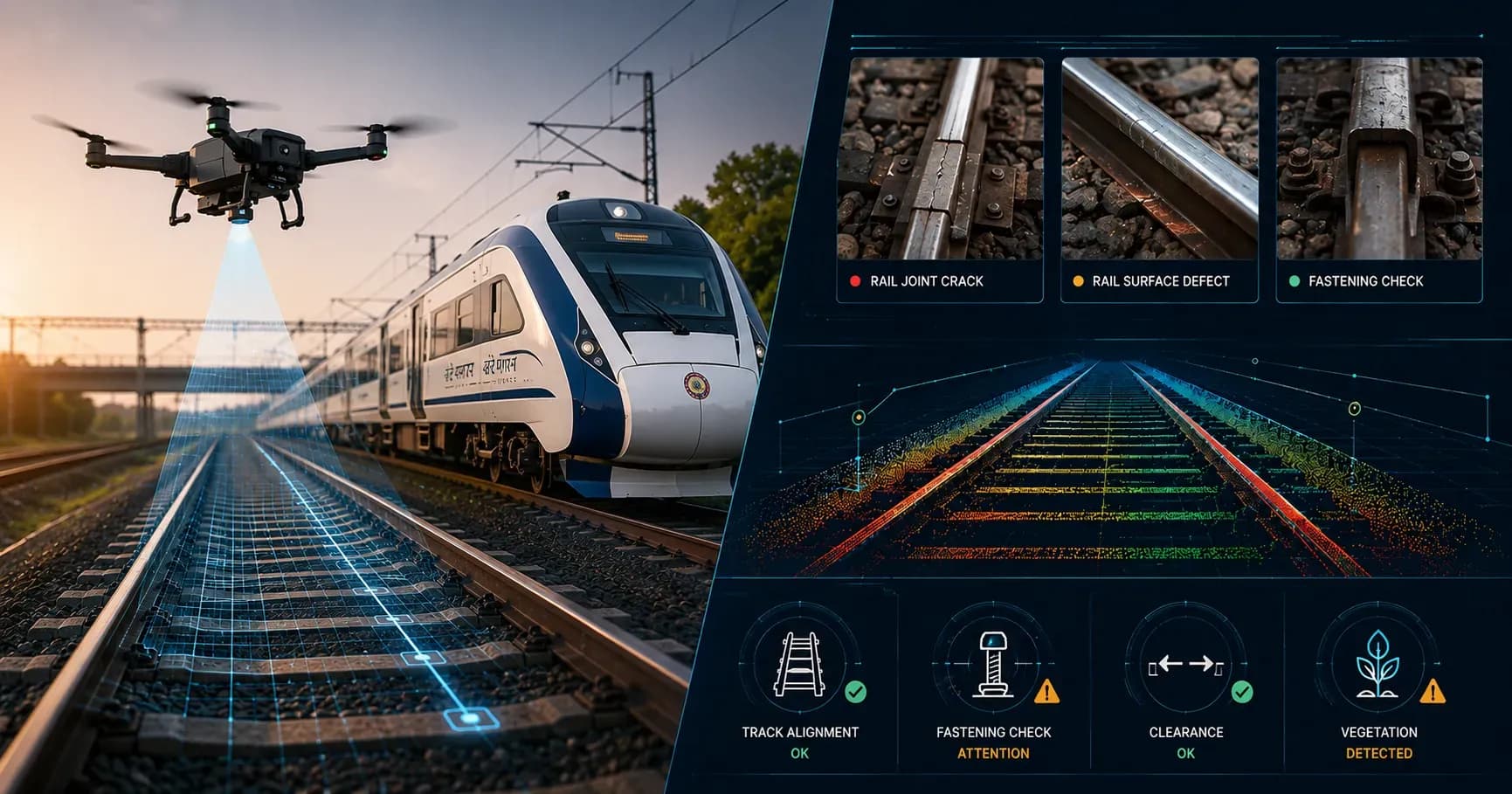
Inspection deployments focus on railway track inspection drone operations, overhead equipment thermal analysis, bridge-condition imagery and rolling-stock analytics. The operational objective is defect detection and maintenance scheduling, not perimeter security. RDSO leads the technical evaluation through pilot programmes anchored in zonal engineering divisions and traction-maintenance teams.
Surveillance deployments monitor railway stations, vulnerable track sections, encroachment zones and crowd-control environments. The Railway Protection Force formalised drone deployment in August 2020 (Ministry of Railways, 18 August 2020). The first procurement covered nine drones worth ₹31.87 lakh across four railway zones. Nineteen personnel were trained for drone operations alongside the procurement.
Survey deployments generate corridor imagery, LiDAR elevation data, route-planning datasets and construction-progress visuals. DFCCIL aerial survey operations differ from inspection flights because they support alignment engineering and land planning before operational commissioning.
The triad explains how Indian Railways uses drones for track inspection without routing every project through one approval chain. RDSO inspection pilots, RPF aerial patrols and DFCCIL survey contracts move through different operational sponsors. They remain inside one policy framework under the Rail Tech Portal. The framework also informs the five DGCA drone categories by weight that operators must select against when bidding for railway contracts.
Inspecting tracks, bridges and overhead equipment
Railway track inspection drone operations focus on defect detection, thermal imaging drone railway analysis and infrastructure analytics across operational corridors. Indian Railways has expanded from manual visual inspection toward sensor-driven aerial diagnostics. Inspection intervals on electrified corridors continue to compress under higher train density.
The Union Railway Minister confirmed on 12 March 2026 that Indian Railways had deployed Machine Vision Inspection Systems under RDSO supervision (Lok Sabha Written Reply, 12 March 2026). Three pilots run at Northeast Frontier Railway locations, two at DFCCIL sites, and one at South East Central Railway. The deployments combine computer vision, edge inference and image analytics to identify rail-surface anomalies and rolling-stock defects during high-speed movement.
The Raipur overhead equipment thermal-imaging pilot marked another operational shift. The pilot used drone thermal payloads to inspect electrified overhead equipment conditions without prolonged manual access windows (Lok Sabha Reply, 12 March 2026). OHE thermal drone inspection reduces inspection time on live corridors. Maintenance teams can classify overheating components before failure escalation.
Indian Railways has also used drones for fracture and fish-plate inspection since at least 2017. North Central Railway deployed drones above Kanpur-area track sections at altitudes between 30 and 40 metres (North Central Railway briefing, 2017). The flights covered rail-fracture and pedal-clip surveillance operations. Earlier deployments focused on imagery collection alone, while the current shift moves toward AI-assisted classification and automated anomaly flagging.
The inspection stack extends beyond visual imagery. RDSO's TRI-Netra work and the IIT Madras AI drone Indian Railways collaboration point toward combined workflows (Lok Sabha Reply, 12 March 2026). The combined stack involves thermal analytics, computer vision and route-planning systems running across long rail corridors.
The distinction between automated and autonomous matters here. Automated inspection systems classify defects against trained datasets, while autonomous systems would require independent operational authority. Indian Railways remains inside the automated inspection category. Drone-based defect detection also complements Kavach, the indigenous Automatic Train Protection system, by adding an off-rail diagnostic layer to the onboard protection stack.
Watching the network through the RPF lens
Indian Railways drone surveillance operates as a security and operational-monitoring layer managed primarily by the Railway Protection Force. The surveillance mission differs from inspection work because the objective is threat visibility, encroachment monitoring and crowd management rather than infrastructure diagnostics.
The RPF formalised aerial surveillance deployment in August 2020. The Ministry of Railways confirmed procurement of nine drones at a combined cost of ₹31.87 lakh (Ministry of Railways, 18 August 2020). The fleet covered South Eastern Railway, Central Railway, Modern Coach Factory Raebareli and South Western Railway.
Proposals for 17 additional drones worth ₹97.52 lakh were already under review at that point. Mumbai Division deployments included the RPF Ninja UAV Mumbai Central Railway monitoring workflow used for yard visibility and aerial patrol support.
Surveillance operations expanded during MahaKumbh 2025. Indian Railways deployed drone surveillance and crowd-monitoring systems across nine Prayagraj railway stations (Ministry of Railways, 16 January 2025). The deployment coordinated 5,900 security personnel, including 3,200 Railway Protection Force staff. MahaKumbh railway drone surveillance marked the first large-scale integration of aerial monitoring into railway crowd-security operations during a mass-mobility event.
The RPF also shifted drone deployment toward land and corridor security. Northeast Frontier Railway confirmed procurement plans for 45 drones in April 2025 (Northeast Frontier Railway statement, 20 April 2025). The fleet monitors railway-land encroachment and vulnerable sections along the northeastern network. The operational focus moved beyond static station surveillance toward continuous corridor monitoring.
This surveillance layer intersects with AI-assisted analytics. Encroachment detection, perimeter classification and movement tracking rely on image-processing pipelines rather than manual video review. The system identifies corridor anomalies, unauthorised activity and infrastructure-risk patterns through trained visual datasets.
The operational change is not the drone itself. It is the analytics stack attached to the drone feed.
Surveying greenfield lines and dedicated freight corridors
DFCCIL drone survey operations focus on alignment planning, construction monitoring and aerial mapping across freight-corridor infrastructure projects. Survey missions differ from inspection flights because the objective is terrain intelligence and construction oversight before operational activation.
DFCCIL used aerial survey systems extensively during Dedicated Freight Corridor planning. The East Coast Dedicated Freight Corridor alignment study involved a 1,115-kilometre DFCCIL LiDAR East Coast DFC aerial survey covering Kharagpur to Vijayawada (DFCCIL briefing, April 2022). The operation used helicopter-mounted laser-scanning systems. It required permissions from the Director General of Civil Aviation and the Ministry of Home Affairs because the survey involved specialised airborne payload systems.
DFCCIL drone survey deployments also monitored active construction stretches. Railway authorities used aerial imagery over the Durgawati-Sasaram section of the Eastern Dedicated Freight Corridor (DFCCIL release, 2020). The Neem ka Thana-Srimadhopur stretch of the Western Dedicated Freight Corridor received similar coverage. The imagery tracked earthwork, bridge progression and corridor alignment.
Survey work intersects directly with digital-twin infrastructure planning. Railway-construction imagery feeds route-planning models, volumetric analysis systems and predictive engineering workflows. AI-assisted corridor mapping systems classify terrain change, detect earthwork deviation and identify construction variance against approved alignment data.
The operational distinction between survey and inspection matters for procurement teams. Inspection drones prioritise thermal payloads and visual diagnostics. Survey drones prioritise endurance, mapping accuracy and sensor-calibration workflows. The Rail Tech Policy routes both through one innovation architecture while preserving different operational sponsors.
Reading the Rail Tech Policy and its drone use cases
The Rail Tech Policy created the first unified innovation pipeline for drones in Indian Railways. The pipeline routes experimentation, approvals and deployment through the Rail Tech Portal. The Ministry of Railways identified drone-based broken rail detection as a formal innovation area on 26 February 2026 (Ministry of Railways, 26 February 2026).
The structural change matters more than the announcement itself. Before the policy, zonal railways, DFCCIL and RPF divisions operated semi-independent drone projects with fragmented procurement logic. The Rail Tech Portal creates one intake mechanism for aerial inspection proposals, AI analytics workflows and sensor-based monitoring systems.
Broken rail detection drone deployments sit at the centre of this transition. Railway defect inspection combines aerial imagery with machine-vision analysis capable of classifying cracks, fastener displacement and surface irregularities across extended corridors. The system identifies inspection anomalies against trained datasets and routes them into maintenance workflows.
The IIT Madras AI drone Indian Railways collaboration adds another layer. The Union Railway Minister confirmed that Indian Railways and IIT Madras are working on AI-driven drone systems under RDSO-linked innovation programmes (Lok Sabha Reply, 12 March 2026). The collaboration matters because Indian Railways is not treating drones as standalone flying cameras. The network is treating drones as sensor nodes inside larger operational analytics systems.
The Rail Tech Portal also changes the procurement environment for commercial operators. Railway innovation pipelines historically moved through isolated tenders with zonal fragmentation. The policy signals repeatable procurement categories tied to inspection, surveillance and survey functions. Operators with NPNT-compliant platforms, type-certified systems and trained Remote Pilot Certificate holders sit closer to operational eligibility once solicitations scale.
Clearing DGCA permissions before any railway drone flies
Drone DGCA permission railways workflows sit inside two parallel regulatory systems: aviation compliance and railway operational clearance. Railway agencies cannot bypass civil aviation obligations. The Bharatiya Vayuyan Adhiniyam 2024 replaced the Aircraft Act 1934 framework from January 2025 onward (Ministry of Civil Aviation, January 2025). The shift matters for railway drone work because every enforcement, detention or penalty action derives from a 2024 statute, not the 1934 Aircraft Act.
The Drone Rules 2021 and the wider DGCA compliance stack remain the operational backbone for civil drone deployment in India. Rule 19 defines airspace classification through green, yellow and red zones on India's drone airspace zone map on DigitalSky. Rule 36 governs Remote Pilot Certificate requirements. Rule 44 mandates third-party insurance obligations for commercial operations (Ministry of Civil Aviation, 25 August 2021).
Railway drone operators must also navigate the eGCA and DigitalSky platform split that took effect on 3 July 2025. DGCA shifted registration, Unique Identification Number issuance, Remote Pilot Certificate management and type-certification workflows onto eGCA (DGCA Public Notice, 3 July 2025). Airspace permissions and NPNT approvals remained on DigitalSky. Operators bidding for railway contracts require compliance readiness across both systems.
BVLOS corridors remain an unresolved frontier. Railway inspection deployments still operate inside visual-line-of-sight constraints or controlled operational windows. Long-corridor railway inspection missions will eventually require Beyond Visual Line of Sight approvals because manual corridor segmentation reduces operational efficiency on large freight routes, the same constraint shaping drone pipeline inspection across linear assets. Procurement readiness also depends on operators clearing the DGCA drone categories by weight before bidding into any inspection-grade tender.
Railway-specific approvals remain separate from aviation compliance. Operators may secure DGCA permissions while still requiring corridor access clearance from zonal railway engineering, RPF or DFCCIL authorities. The operational stack therefore combines airspace compliance, payload approval, corridor scheduling and railway security coordination inside one mission workflow.
Tracking encroachment and AI analytics in the northeast
Northeast Frontier Railway drone encroachment operations represent one of the clearest examples of AI-assisted aerial monitoring inside Indian Railways. The operational focus shifted from episodic station surveillance toward continuous land and corridor visibility after the April 2025 aerial-monitoring expansion (Northeast Frontier Railway statement, 20 April 2025).
Encroachment monitoring differs from conventional patrol work because the mission requires repeated imaging over long railway-land stretches. Human review alone slows the detection cycle. AI-assisted visual classification systems can flag corridor change, unauthorised construction activity and perimeter anomalies against previous imagery layers.
Northeast Frontier Railway also indicated that AI software development was underway alongside the 45-drone deployment programme (Northeast Frontier Railway statement, 20 April 2025). The combination matters because persistent aerial collection becomes operationally useful only when analytics pipelines shorten review cycles for RPF and engineering teams.
The northeastern corridor presents a different operational environment from metropolitan station deployments. Terrain variation, vegetation density and dispersed corridor infrastructure raise the value of route-planning algorithms, terrain mapping and automated image classification systems. Railway drone operations in the northeast therefore function as both a surveillance programme and an operational testbed for AI-enabled corridor monitoring. The same drone airspace zone classification on DigitalSky governs every northeastern flight, regardless of the AI layer riding on the feed.
Preparing for the next twelve months of railway drone procurement
The inspection-surveillance-survey triad gives commercial operators and procurement teams a stable framework for reading future railway drone tenders. RDSO-linked inspection work will prioritise thermal payloads, machine-vision analytics and maintenance integration. RPF surveillance work will prioritise corridor visibility, encroachment monitoring and crowd-security workflows. DFCCIL and construction survey work will prioritise mapping accuracy, endurance and corridor-scale imagery collection.
The Rail Tech Portal changes how innovation proposals enter Indian Railways. Operators no longer compete only through fragmented zonal pilots. The policy creates one sanctioned intake route for drone inspection systems, AI-assisted analytics and infrastructure-monitoring workflows (Ministry of Railways, 26 February 2026).
Compliance readiness will shape procurement eligibility before operational capability discussions begin. Railway agencies expect NPNT compliance, Remote Pilot Certificate validation, type-certified aircraft and DigitalSky clearance discipline before technical evaluation starts. Operators without documented compliance workflows will struggle once larger procurement cycles open. The full compliance backbone sits in the Drone Rules 2021 framework and the DGCA stack.
The next operational layer will likely emerge around corridor-scale analytics. Inspection imagery, surveillance feeds and survey datasets feed the same operational pipelines. Railway drone deployments are moving from isolated aerial tasks toward integrated infrastructure-intelligence systems tied to maintenance, security and corridor planning.
The next Rail Tech Portal cycle will likely solicit aerial-collection, AI-assisted defect-classification and long-corridor inspection workflows as a single railway autonomy stack. Operators with NPNT-compliant, type-certified platforms and trained Remote Pilot Certificate holders will sit closest to the front of that queue.