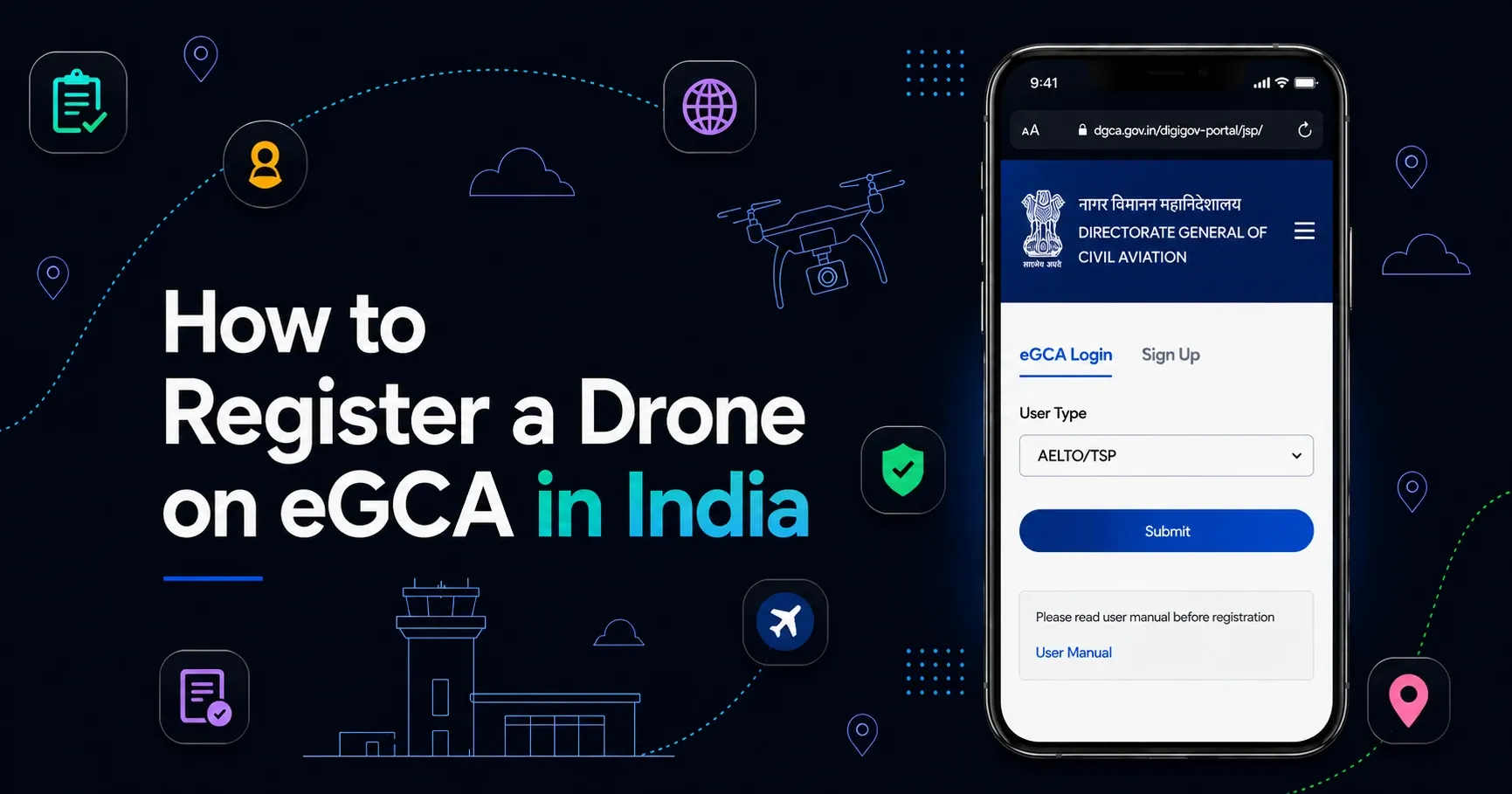
eGCA vs DigitalSky is no longer about which platform to use. It is a question of which platform handles which workflow.
The DGCA migrated drone registration, type certification, and Remote Pilot Certificate workflows from DigitalSky to the eGCA portal. The phased migration ran across 4 July and 15 July 2025 (DGCA Public Notice, 3 July 2025). The change sits inside the Drone Rules 2021 framework read with the Bharatiya Vayuyan Adhiniyam 2024.
DigitalSky retained airspace permissions, NPNT enforcement, and the national drone airspace map. The ₹100 UIN fee under Schedule II of the Drone Rules 2021 is unchanged.
Why the drone platform split matters now
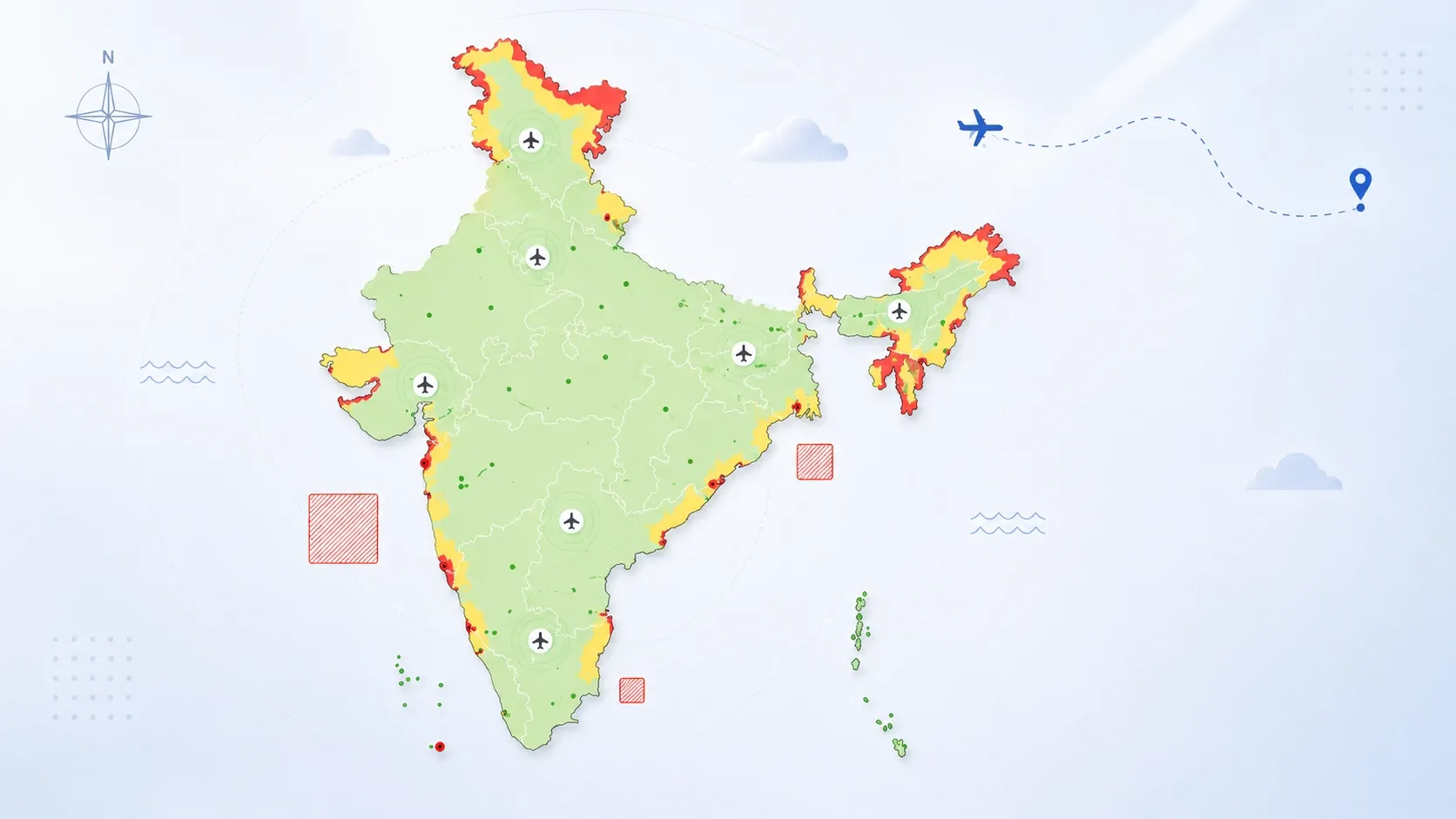
The platform split changed the practical answer to almost every operator question in India. Before 3 July 2025, the answer to where to register a drone was a single URL: digitalsky.dgca.gov.in. After 15 July 2025, that answer split in two. Drone registration, type certification, UIN issuance, and Remote Pilot Certificate generation moved to the eGCA portal at dgca.gov.in/digigov-portal. Flight permissions, NPNT permission artefacts, and the green-yellow-red airspace map stayed on DigitalSky (DGCA Public Notice, 3 July 2025).
By September 2024, the Digital Sky platform had registered 10,208 type-certified commercial drones, and the DGCA had granted 96 Type Certificates. Of those, 65 covered agriculture and 31 covered logistics and surveillance (Parliament reply, Minister of State for Civil Aviation, December 2024). The migration therefore touched a five-figure registered base on day one. The migration also retired the offline path. Remote Pilot Training Organisations can no longer generate offline Remote Pilot Certificates. The directive on offline RPC generation under DTC 02 of 2023 stood withdrawn from 15 July 2025 (DGCA Public Notice, 3 July 2025). Every drone Type Certificate application pending on DigitalSky before 4 July 2025 had to be resubmitted on eGCA.
The migration also lands inside a wider legislative reset. The Bharatiya Vayuyan Adhiniyam 2024 came into force on 1 January 2025 (Bharatiya Vayuyan Adhiniyam 2024, Gazette Notification S.O. 5646(E), 31 December 2024). It replaced the ninety-year-old Aircraft Act 1934 as India's principal aviation statute. The DGCA platform split sits inside that consolidated legislative architecture.
Mapping the DGCA migration notice in detail
The DGCA Public Notice dated 3 July 2025 set out a single objective. All drone-related regulatory services under the Drone Rules 2021 would migrate from the Digital Sky Platform to the eGCA portal. The notice covered Forms D-1 to D-5 in full. It also confirmed the operational URL for all applicants: dgca.gov.in/digigov-portal (DGCA Public Notice, 3 July 2025).
The eGCA platform, short for e-Governance for Civil Aviation, was built by Tata Consultancy Services on the TCS DigiGOV stack. It consolidates licensing, certification, and oversight workflows across 12 DGCA directorates and over 300 aviation services into one applicant interface (TCS Case Study, 29 July 2025). Pilot licensing, aircraft maintenance engineer certification, and aerodrome certification had already moved onto eGCA in earlier phases. The drone migration completed the consolidation.
The notice also reset the procedural baseline. Fresh D-1 to D-5 applications would no longer be accepted on DigitalSky or via offline modes after migration. Applicants were directed to read the eGCA user manuals before submission, and the eGCA helpdesk was named at egcasupport@dgca.nic.in (DGCA Public Notice, 3 July 2025).
Separating identity workflows from operational gates
The DGCA platform split is best understood as a clean separation of identity workflows from operational workflows. The table below maps each function to its current platform under the post-migration architecture (DGCA Public Notice, 3 July 2025).
Workflow | Platform after 15 July 2025 | Form or function |
|---|---|---|
Type Certificate issuance | eGCA | Form D-1 |
Type Certificate amendment or surrender | eGCA | Form D-1 |
UIN issuance for type-certified drones | eGCA | Form D-2 |
UIN transfer and de-registration | eGCA | Form D-3 |
Remote Pilot Certificate generation | eGCA | Form D-4 |
RPTO authorisation | eGCA | Form D-5 |
Airspace permission requests | DigitalSky | NPNT permission artefact |
Green-yellow-red airspace map | DigitalSky | Rule 19 zone display |
NPNT enforcement and flight authorisation | DigitalSky | Live operational gate |
The eGCA portal now functions as the identity and credential layer. It records who owns the aircraft, what model it is, who is licensed to fly it, and which training organisation issued the credential.
DigitalSky functions as the operational gate. It validates each flight against airspace zone classification, altitude limits, and time windows. The live NOTAM overlay runs against the request before a permission artefact is issued (Ministry of Civil Aviation, 24 September 2021).
The split restored a clear regulatory hierarchy. Registration approval on eGCA establishes the legal identity of the aircraft and the pilot. Airspace clearance on DigitalSky establishes the legal right to fly a specific mission. Operators who confuse the two discover the gap during enforcement audits or insurance claims.
Tracking the two-wave migration through July
The migration ran in two waves. The first wave on 4 July 2025 moved fresh Type Certificate applications under Form D-1 onto eGCA. The DGCA notice required all existing D-1 applications on DigitalSky to be resubmitted on the eGCA portal. Fresh D-1 applications were no longer accepted on DigitalSky after that date (DGCA Public Notice, 3 July 2025). The second wave on 15 July 2025 moved the remaining drone services. Amendment and surrender of Type Certificates under Form D-1 migrated on that date, along with UIN issuance, transfer, and de-registration under Forms D-2 and D-3.
Fresh Remote Pilot Certificate generation under Form D-4 and RPTO authorisation under Form D-5 followed in the same wave. Post-migration, Remote Pilot Training Organisations lost the ability to generate offline RPCs. DTC 02 of 2023 stood withdrawn from the same date (DGCA Public Notice, 3 July 2025).
For operators, the timeline produced one persistent operational risk. Applications submitted to DigitalSky between 4 July and 15 July 2025 for services that had not yet migrated were processed under the old route. Applications for already-migrated services were rejected on receipt. The DGCA Public Notice itself remains the canonical reference for the mapping (DGCA Public Notice, 3 July 2025).
Moving an operator from eGCA to DigitalSky
The end-to-end workflow starts on eGCA and ends on DigitalSky. The compliance sequence is fixed by the Drone Rules 2021 and reinforced by the platform architecture.
A manufacturer files Form D-1 on eGCA to secure a Type Certificate for the drone model. An operator files Form D-2 on eGCA for UIN issuance against a type-certified airframe. The five drone categories by weight determine which subset applies. BharatKosh processes the ₹100 fee under Schedule II of the Drone Rules 2021.
A pilot completes training through a DGCA-authorised RPTO and receives the Form D-4 Remote Pilot Certificate on eGCA. The aircraft now has legal identity and the pilot has legal credential. Neither artefact, on its own, authorises a flight.
The operator then logs into DigitalSky for the airspace stage. The drone airspace zone map is consulted to confirm whether the launch site sits in a green, yellow, or red zone. A flight permission request is filed for the specific location, altitude, and time window.
DigitalSky validates the request against Rule 19 of the Drone Rules 2021 and issues a digitally signed NPNT permission artefact. The artefact then runs inside the aircraft's flight controller. The controller arms the motors only if the artefact is valid (Ministry of Civil Aviation, 25 August 2021). Operators searching DigitalSky for registration find nothing. Operators searching eGCA for the airspace map find nothing. That confusion sits at the centre of every operator question raised since 15 July 2025.
Anchoring the architecture to the Bharatiya Vayuyan Adhiniyam
The Bharatiya Vayuyan Adhiniyam 2024 came into force on 1 January 2025 (Bharatiya Vayuyan Adhiniyam 2024, Gazette Notification S.O. 5646(E), 31 December 2024). It replaced the Aircraft Act 1934 as India's principal aviation statute.
Section 4 of the updated Act expanded scope to expressly cover design, manufacture, maintenance, sale, export, and import of aircraft. The Drone Rules 2021 remained the operational rulebook, and the parent statutory authority for airworthiness directives now sits inside one consolidated Act.
The drone Type Certificate workflow under Form D-1 sits on that parent authority. So does Remote Pilot Certificate issuance under Form D-4 and RPTO authorisation under Form D-5. The eGCA stack already handles pilot licensing, aircraft maintenance engineer certification, and aerodrome certification. Moving drone services onto the same stack produced a single regulatory interface for every workflow that requires a DGCA-issued credential.
Airspace permissions are a different category of regulatory action. They are operational, geofenced, and time-bound. They depend on the green-yellow-red zone classification under Rule 19 of the Drone Rules 2021 (Ministry of Civil Aviation, 25 August 2021). The DigitalSky stack was purpose-built for that function in 2018.
Avoiding the five high-cost operator mistakes
Five errors account for the bulk of escalations logged through the eGCA helpdesk since 15 July 2025. Operators who submitted fresh D-1 applications on DigitalSky after 4 July 2025 lost the application and had to resubmit on eGCA. Operators who completed UIN issuance on eGCA but skipped the DigitalSky permission stage flew without a valid NPNT artefact. That exposure draws penalties under Rule 50 of the Drone Rules 2021.
Operators searching eGCA for the airspace map wasted time; the map sits on DigitalSky and nowhere else. Operators assuming that legacy DigitalSky credentials would carry across to eGCA discovered the accounts are not federated. Fresh registration is required on dgca.gov.in/digigov-portal.
Operators using RPTOs that issued offline Remote Pilot Certificates after 15 July 2025 received documents with no legal standing. The DTC 02 of 2023 directive had been withdrawn (DGCA Public Notice, 3 July 2025). The Drone Rules 2021 cap penalties at ₹1 lakh under Rule 50. The Bharatiya Vayuyan Adhiniyam 2024 raised the parent-statute ceiling to ₹1 crore under Section 32 (Bharatiya Vayuyan Adhiniyam 2024). Insurance validity under Rule 44 third-party cover also depends on documented compliance. The cleanest path forward is to treat eGCA and DigitalSky as one workflow with two interfaces.
Preparing for the federated identity cycle ahead
For operators planning fleet expansion across 2026 and 2027, the working architecture is settled. Registration, type certification, UIN issuance, Remote Pilot Certificate generation, and RPTO authorisation run on eGCA. Airspace permissions, NPNT enforcement, and the live airspace map run on DigitalSky. The two platforms share no login session and no front-end. The operator carries the credential from one to the other.
The next regulatory inflection point is the draft Civil Drone (Promotion and Regulation) Bill 2025. The bill entered public consultation on 16 September 2025 (Ministry of Civil Aviation, 16 September 2025). A federated identity model between the two platforms is the likely next step. Procurement teams scoping 2026 fleet purchases should design compliance workflows around two credentials and two gate-checks before takeoff. Insurance underwriters should request both the eGCA UIN certificate and the DigitalSky permission artefact when issuing policies.
The platform split formalises a separation the Drone Rules 2021 always implied: identity sits with the regulator, operations sit with the airspace, and every flight passes both gates.