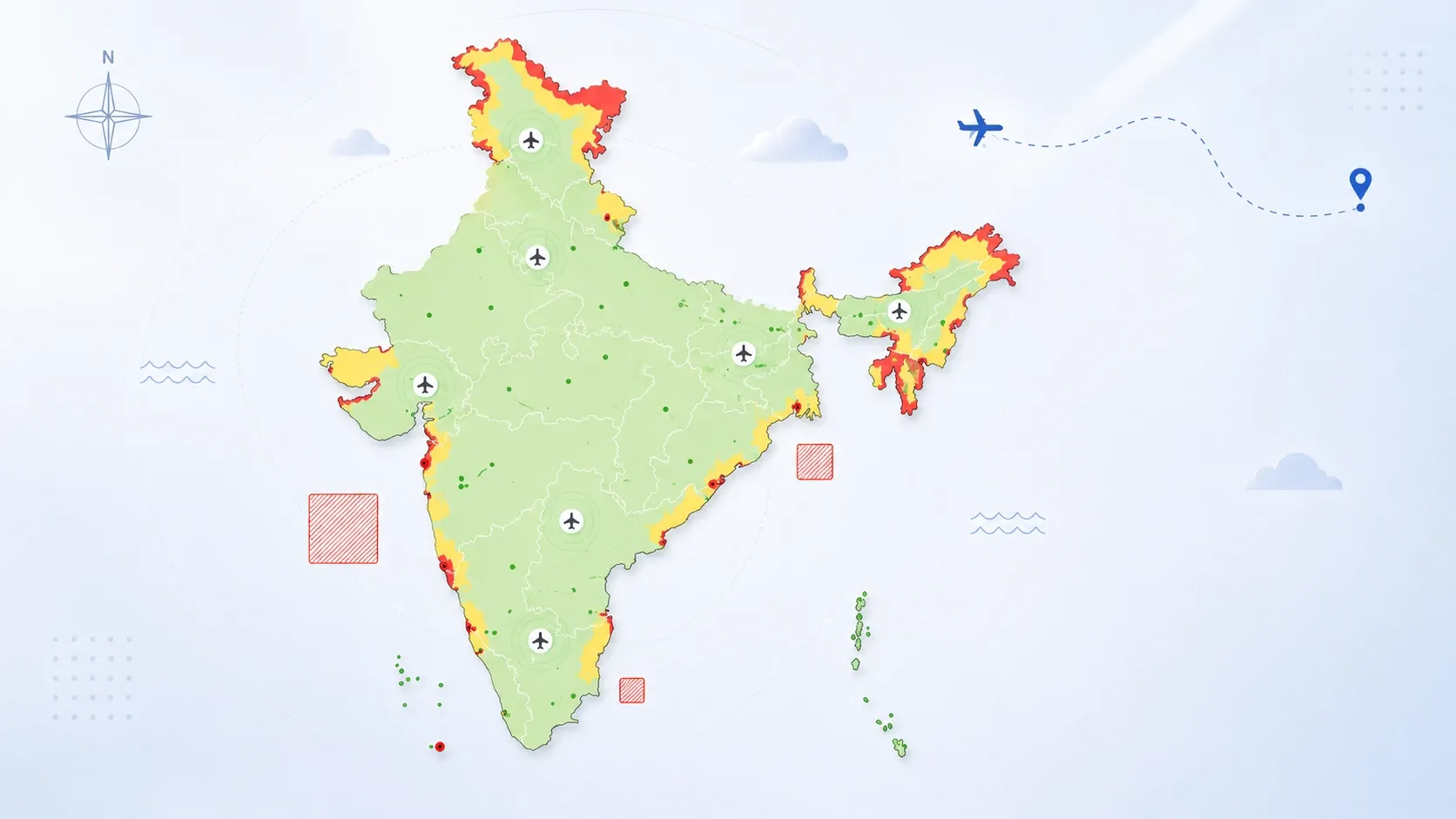
The yellow zone permission workflow runs on DigitalSky under Rule 19 and Rule 23 of the Drone Rules 2021 (Ministry of Civil Aviation, 25 August 2021). The supporting airspace map was released on 24 September 2021. After the eGCA migration in July 2025, registration moved to eGCA while flight permissions remained on DigitalSky. This guide covers five layers: prerequisites, application steps, the AAI / IAF / Navy / HAL routing logic, approval timelines, and the remedy path when a request is denied.
What yellow zone permission actually means on DigitalSky
Yellow zone drone permission is one of the misunderstood parts of India's drone regulatory stack. Operators treat the yellow overlay on the DigitalSky airspace zone map as a warning layer. The yellow overlay represents controlled airspace where operations are allowed only after prior approval through DigitalSky (Ministry of Civil Aviation, 25 August 2021).
Controlled airspace drone permission is the regulatory artefact, not the zone classification. The DigitalSky airspace layer classifies the geography. The permission system authorises the specific operation. An operator may own a registered drone and hold a valid Remote Pilot Certificate, and still face prohibition at takeoff. A flight inside controlled airspace cannot proceed without a valid permission artefact.
Yellow zone permission is not a blanket clearance. It is tied to a specific operator, drone, location envelope, altitude ceiling, and operational window. A permission issued for a survey flight near Pune Airport on Tuesday morning does not extend to a second operation later that week.
The workflow affects three operator categories. Agri-drone teams cross controlled airspace boundaries during spraying missions near district airports. Survey and inspection contractors work inside airport buffer regions. Commercial videographers covering weddings and real-estate projects discover their location sits inside a yellow zone only after opening the DigitalSky map. The wider context sits inside drone laws in India.
Pre-flight prerequisites before you can apply
The DigitalSky application flow begins before the operator submits a flight request. Rejected applications fail because one of the underlying compliance layers is incomplete.
Registration on eGCA comes first. Since the July 2025 migration, the Unique Identification Number workflow moved away from DigitalSky into eGCA. Every drone applying for yellow zone permission must register the drone on eGCA and carry an active UIN linked to the operator profile. DigitalSky pulls the registration details from the eGCA-linked database during submission.
Pilot eligibility comes next. Commercial operators using drones above 250 grams must hold a valid Remote Pilot Certificate issued through a DGCA-approved Remote Pilot Training Organisation. DigitalSky validates RPC records during submission. Operators with expired credentials encounter instant rejection before manual review.
Airworthiness compliance closes the prerequisite stack. Current-generation civilian drones in India require a valid Type Certificate issued through QCI or another approved testing entity. Type certification for civilian drones in India covers the testing pathway. Aircraft procured before January 2024 may not enforce NPNT at firmware level, but operators using those systems carry supporting documentation during inspection.
DGCA permission for drone flying also depends on insurance verification. Nano drones flown recreationally in green zones may avoid some commercial requirements. Controlled-airspace operations on non-nano systems trigger insurance checks during audits and post-incident investigations. Operators carry third-party drone insurance in India on file before submitting.
How to get yellow zone permission on DigitalSky, step by step
The DigitalSky workflow is designed around the flight envelope, not the operator's intention. That distinction explains why the platform routes some requests instantly while others move into extended review cycles. DigitalSky is the only legal route for drone flight permission in India.
The operator logs into the DigitalSky portal at digitalsky.dgca.gov.in using credentials linked to the eGCA registration profile. The dashboard displays the registered drone inventory. The operator selects the aircraft, and DigitalSky imports the UIN, type certification status, and NPNT compliance details. The deeper mechanics of the DigitalSky platform and NPNT enforcement sit one layer below this step.
The operator then draws or uploads the proposed flight envelope inside the DigitalSky interface. The platform analyses the geometry against India's controlled-airspace database, and reveals whether the operation sits inside green, yellow, or red airspace. If the request touches a yellow zone, the system displays the approving authority.
The application captures operational detail next. The drone flight plan submitted on DigitalSky carries the requested altitude ceiling, mission timing, operational purpose, pilot information, and RPC reference number. Agricultural operations, inspection work, media shoots, and infrastructure surveys are classified separately because the risk profile changes by mission category.
DigitalSky performs server-side validation against airspace restrictions, NOTAM overlays, altitude limits, and live operational constraints. Low-risk requests in civilian airspace clear through automated review within minutes. Requests touching shared civil-military corridors move into manual review queues.
Operators encounter one of three outcomes. Immediate approval with a downloadable permission artefact. Pending review, where the request waits for authority action. Or explicit rejection, triggered by red-zone overlap, invalid credentials, or NOTAM conflicts.
Authority routing - which agency clears your flight near an airport
Drone permission near airport airspace routes to one of four authorities. DigitalSky does not approve every request itself. It acts as the routing and validation layer. Final authority depends on which organisation controls the underlying airspace (Ministry of Civil Aviation, 24 September 2021).
The Airports Authority of India handles the largest share of civilian controlled-airspace requests. The AAI drone permission process applies to operations near Delhi, Mumbai, Hyderabad, Chennai, Kolkata, Bengaluru, and Pune. Civilian airport buffers move faster because the routing logic is integrated into DigitalSky.
The Indian Air Force controls permissions around IAF-operated or dual-use airspace. The IAF drone permission yellow zone workflow applies to operators near Hindon, Bidar, Sulur and Tezpur. Approvals route into station-level review windows running three to five working days.
The Indian Navy handles approvals around naval aviation infrastructure. Goa is a common example because flights near INS Hansa intersect naval airspace. Tourism, hospitality, and coastal survey operators near naval stations discover their requests require Navy routing rather than AAI review.
Hindustan Aeronautics Limited controls the HAL Airport airspace segment in Bengaluru. Eastern Bengaluru contains dense commercial drone activity and overlapping controlled-airspace geometry. Inspection and mapping work in that corridor encounters HAL-based review even for low-altitude operations.
Routing logic changes operational planning. A survey operator near a civilian airport receives approval in hours. The same operator near a military-linked corridor faces multi-day review cycles. The mission's drone categories in India by weight also affect review thresholds.
Yellow zone approval time and what to expect
Yellow zone approval time varies by airspace sensitivity more than by operator category. Public estimates still cite the older 24-to-48-hour range without separating civilian and military review flows.
Routine low-risk operations in civilian airspace clear within minutes through automated review. Flights submitted during daylight hours, under moderate altitude ceilings, and outside active NOTAM windows receive validation almost instantly. Operators conducting repeat inspection or agricultural missions near controlled boundaries report near-instant validation in 2026 for compliant flight envelopes.
The traditional 24-to-48-hour range applies to commercial operations requiring manual confirmation. Survey work near airport buffers, infrastructure inspection, and urban filming projects fall into this category.
Shared civil-military airspace introduces the longest delays. ATC drone permission requests routed through IAF, Navy, or HAL-controlled sectors take three to five working days. Naval aviation corridors and dual-use bases experience longer review cycles.
Permissions expire within the approved operational window. A clearance issued for a two-hour survey does not renew or extend. Weather delays, equipment failures, and postponed schedules require a fresh submission. Wedding shoots, emergency inspections, and live-event coverage become difficult when teams assume approval carries forward after the original time slot closes.
The digitally signed permission artefact and how it loads to the drone
DigitalSky permissions are not simple approval emails. The platform generates a digitally signed permission artefact designed to interact with NPNT-compliant drone firmware (Ministry of Civil Aviation, 25 August 2021). The permission artefact DigitalSky issues is a cryptographic file, not a letter.
The artefact contains operational parameters tied to the approved mission. It carries the operator identity, the drone UIN, geographical boundaries, altitude ceilings, mission timing, and the cryptographic signature. Before takeoff, the drone firmware validates the artefact against the DigitalSky trust framework.
If the permission remains valid for the aircraft's current GPS position and time window, the firmware allows arming. If the artefact fails validation, the aircraft remains grounded. The detailed mechanics sit inside the NPNT compliance framework, which gates every takeoff in controlled airspace.
This architecture turns yellow zone permission into a live enforcement layer rather than a paper compliance exercise. The drone is technically prevented from flying outside the approved envelope. A flight drifting above the altitude ceiling or crossing lateral boundaries triggers automated flight restrictions.
Aircraft procured before January 2024 may not enforce the NPNT logic at firmware level. In those cases, operators carry human-readable approvals during field operations. The artefact remains the bridge between regulation and enforcement.
Drone permission denial on DigitalSky - escalation, resubmission, and remedy
Operators encounter denial at some point. The drone permission denial DigitalSky issues is recoverable. The factor that matters is understanding why the rejection occurred and which adjustment changes the outcome.
A common denial trigger is overlap with active NOTAM restrictions. Temporary restrictions related to VVIP movement, defence activity, emergency operations, and public events override valid yellow-zone requests. Altitude plays a major role. Operators submit envelopes above the acceptable ceiling, and lowering the requested altitude converts a rejected application into an approved one during resubmission.
Geographical routing matters too. Adjustments to the flight corridor move the operation away from the densest segment of controlled airspace. Infrastructure inspection teams redesign flight geometry to avoid military-linked routing. Administrative failures create another category. Expired RPC records, missing insurance coverage, incorrect UIN entries, and invalid drone certification details trigger automatic denial before the request reaches operational review.
For high-priority commercial work, escalation paths exist through local ATC coordination. Emergency infrastructure operations and broadcast events move through expedited review when justification is strong. AAI's NOTAM publication at aim-india.aai.aero remains important because DigitalSky is not the only source of airspace restrictions. Professional operators cross-check both systems before submitting, and reference drone penalties for flying without permission to understand the consequences of bypass.
Special cases - events, BVLOS, night, and foreign operators
Temporary yellow zone declaration India brings confusing operational conditions. National events, election rallies, military exercises, and VVIP movement convert yellow zones into active red zones through NOTAM publication. An operator may hold a valid yellow-zone permission and still face prohibition at takeoff after a temporary restriction activates. Event-driven restrictions override earlier approvals.
Beyond Visual Line of Sight operations add another layer of complexity. Standard yellow-zone permission does not authorise BVLOS operations. DGCA's corridor experimentation and the regulatory sandbox programmes inside India's UTM framework introduced consolidated review mechanisms for selected corridors. BVLOS missions outside the three notified corridors require additional approval inside the DGCA UTM sandbox.
Night operations remain tightly controlled. Standard permissions are structured around daylight conditions. Commercial night flights require additional authorisation under the Drone Rules framework.
Foreign operators face practical restrictions even when carrying compliant equipment. Recreational flights by foreign visitors remain constrained under current interpretation. Commercial projects involving foreign teams operate through Indian-registered entities that hold the operational permissions and aircraft registration. These cases explain why two operators using similar aircraft experience different approval timelines depending on mission category, event conditions, and operational geography.
What is changing - the Civil Drone Bill 2025 and the next phase
India's drone permission architecture is moving toward continuous digital enforcement rather than isolated pre-flight approval cycles. The draft Civil Drone (Promotion and Regulation) Bill 2025 expanded the conversation around automated validation, enforcement authority, and operational accountability (Ministry of Civil Aviation, 16 September 2025). The structural shift is happening inside the UTM ecosystem. AI-assisted permission triage is being tested inside regulatory sandbox environments tied to the National UTM Policy Framework (Ministry of Civil Aviation, 24 October 2021). The goal is to compress approval timelines for low-risk operations from multi-hour windows toward near-real-time clearance.
Dynamic geofencing represents the next operational leap. Current NPNT enforcement validates permissions before takeoff. The next generation of enforcement layers will update operational boundaries in real time during flight. Temporary restrictions, NOTAM changes, and emergency airspace updates would propagate into the aircraft's active geofence environment. This transforms yellow zone permission from a static approval document into a live operational contract.
The larger question in 2026 is not whether DigitalSky will evolve toward continuous airspace enforcement. The question is whether four layers converge in time: eGCA registration, the National UTM Policy Framework 2021, the NPNT firmware layer, and real-time airspace management. Convergence needs to land before the next drone corridor goes live. Operators watching the Civil Drone Bill 2025 consultation, the DGCA UTM sandbox, and the next DigitalSky release will see the architecture take shape inside two regulatory cycles.