Foreign tourist drone registration in India sits inside a layered regulatory framework built around the drone rules in India. The framework combines the Drone Rules 2021, the Bharatiya Vayuyan Adhiniyam 2024, and customs controls under the Baggage Rules 2016. The eGCA platform was introduced after the July 2025 system split between eGCA and DigitalSky.
Foreign visitors cannot register drones as individual operators. The only operational pathway routes through an Indian entity that holds the registration and the pilot approvals. (Ministry of Civil Aviation, 25 August 2021)
Can a foreign tourist fly a drone in India
The direct answer clarifies the six practical questions readers arrive with. Each question sits inside a different regulatory layer, and treating them as one question is the source of most confusion in older guidance pages.
Question | Answer |
|---|---|
Can a foreign tourist personally register a drone in India | No |
Can a foreign tourist personally obtain a UIN through eGCA | No |
Can a foreign tourist bring a drone into India as personal baggage | Yes, subject to Red Channel declaration and customs discretion |
Can a foreign tourist personally fly a drone in Indian airspace | No |
Can the drone be operated through an eligible Indian entity | Yes, under the lease pathway |
Does customs clearance grant permission to fly | No |
Drones are not banned in India for foreign visitors as equipment, but personal operation by a foreign individual is not permitted under the Drone Rules 2021. The is-drone-legal-in-India question therefore has a two-part answer: the equipment is legal to own and to import as declared baggage, but the operation is restricted to eligible Indian operators.
Reading the operator eligibility framework in India
Foreign tourist drone registration in India fails at the eligibility stage defined under the Drone Rules 2021 and the wider DGCA drone rules. The earlier CAR Section 3 Series X Part I framework shaped the operational structure carried into the present regime. (DGCA CAR Section 3 Series X Part I, 27 August 2018)
The rules recognise four classes as eligible to hold a Unique Identification Number. The first class is Indian citizens above 18. The second is Indian companies meeting the substantial-Indian-ownership and two-thirds-Indian-directors test.
The third class is central or state government entities. The fourth is foreign corporations that have leased the drone to an eligible Indian entity. A non-resident individual sits outside every class.
The Bharatiya Vayuyan Adhiniyam 2024 replaced the Aircraft Act 1934 as the parent aviation statute on 1 January 2025. The Drone Rules 2021 remain operational under that statute, and the nationality-linked eligibility test was carried forward unchanged. (Ministry of Civil Aviation, 1 January 2025)
OCI cardholders sit inside the same exclusion. Overseas Citizen of India status does not convert into Indian citizenship for aviation registration purposes. An OCI passport holder cannot bypass the eGCA eligibility structure through residency alone. The OCI cardholder drone registration India question receives the same answer as the standard foreign-national question.
The phrase foreign nationals drone India captures a large cluster of search traffic, alongside are-drones-legal-in-India and is-drone-allowed-in-India queries from arriving visitors. Older guidance pages continue citing pre-2025 workflows. The present framework remains tied to Indian operator control and Indian registration responsibility. Readers building broader context can follow how to register a drone in India through eGCA and the drone laws in India pillar for the full regulatory architecture.
Separating customs entry from drone registration
A tourist may lawfully arrive in India with a drone and still remain prohibited from operating it; that distinction sits at the centre of the regulatory structure.
The Baggage Rules 2016 govern customs entry at airports. Travellers carrying drones must declare the equipment at the Red Channel on arrival. Customs officers may permit temporary entry, require bonded storage until departure, or seek a re-export undertaking depending on the equipment profile. (Central Board of Indirect Taxes and Customs, 29 March 2016)
Registration sits under a different authority. eGCA registration and NPNT permissions fall under the Ministry of Civil Aviation and DGCA frameworks. A customs officer does not issue flight permission. A cleared baggage declaration does not create operational authority.
The distinction sharpened after the Directorate General of Foreign Trade issued Notification No. 54/2015-2020 on 9 February 2022. The notification prohibited drone imports in CBU, SKD, and CKD form, with carve-outs only for research, defence, and security applications. (Directorate General of Foreign Trade, 9 February 2022)
The DigitalSky platform split also matters. Registration migrated to eGCA in July 2025, while NPNT permission and airspace authorisation remained on DigitalSky. Travellers reading older guidance that references only DigitalSky are working from an outdated regulatory map. (DGCA Public Notice, 3 July 2025)
Regulatory layer | Authority | Purpose | Applies to tourists |
|---|---|---|---|
Customs declaration | CBIC | Physical entry of equipment | Yes |
Drone registration | DGCA / eGCA | UIN issuance | No for foreign individuals |
Airspace permission | DigitalSky | NPNT flight approval | Yes if operating through Indian entity |
Pilot certification | DGCA | Remote pilot authorisation | Required for any operational activity |
Which drones are allowed and which are effectively banned in India
The which-drone-is-allowed-in-India question has two layers. The first is the equipment layer under the DGFT drone import notification of 9 February 2022. The second is the operational layer under the Drone Rules 2021.
At the equipment layer, drones in Completely Built-Up form are prohibited for commercial import except for research, defence, and security applications. Personal baggage entry runs on a separate discretionary channel through customs. At the operational layer, Type Certified drones on the DGCA-approved list are lawful to operate by eligible Indian operators, while non-Type-Certified drones face registration restrictions under current DGCA public notices.
The drone-banned-in-India framing that appears across older tourist blogs conflates the DGFT commercial import prohibition with a total prohibition. The two are not the same. Foreign tourists searching whether drones are banned in India will find the equipment is permitted as declared baggage, and the operation is what remains restricted for foreign individuals.
Why the nano drone carve-out does not solve the problem
Drones under 250 grams sit in the Nano category and receive reduced obligations for Indian residents in uncontrolled airspace. Tourists frequently read this as a green light, and it is the source of most which-drone-is-allowed-in-India confusion at the border. The nano drone India tourist carve-out is a registration carve-out, not an operational permission.
Three issues compound for foreign visitors with a nano drone. The DGFT prohibition of 9 February 2022 covers the equipment even in nano form unless carried as personal baggage with a Red Channel declaration. The operational eligibility test under the Drone Rules 2021 applies regardless of weight class. State advisories continue to prohibit nano-class operations in tourist zones around heritage sites and border districts.
The DJI Mini India customs question, framed as whether the sub-250-gram unit can travel as personal baggage for a foreign tourist, is the highest-volume long-tail search inside this cluster. The factual answer varies by airport. Customs officers at Delhi, Mumbai, Bangalore, and Hyderabad have detained sub-250-gram units arriving without a Red Channel declaration. The carve-out reduces the registration obligation but does not displace the customs obligation. (DGCA RPAS Guidance Manual, Revision 4)
Understanding how the eGCA portal handles non-resident applications
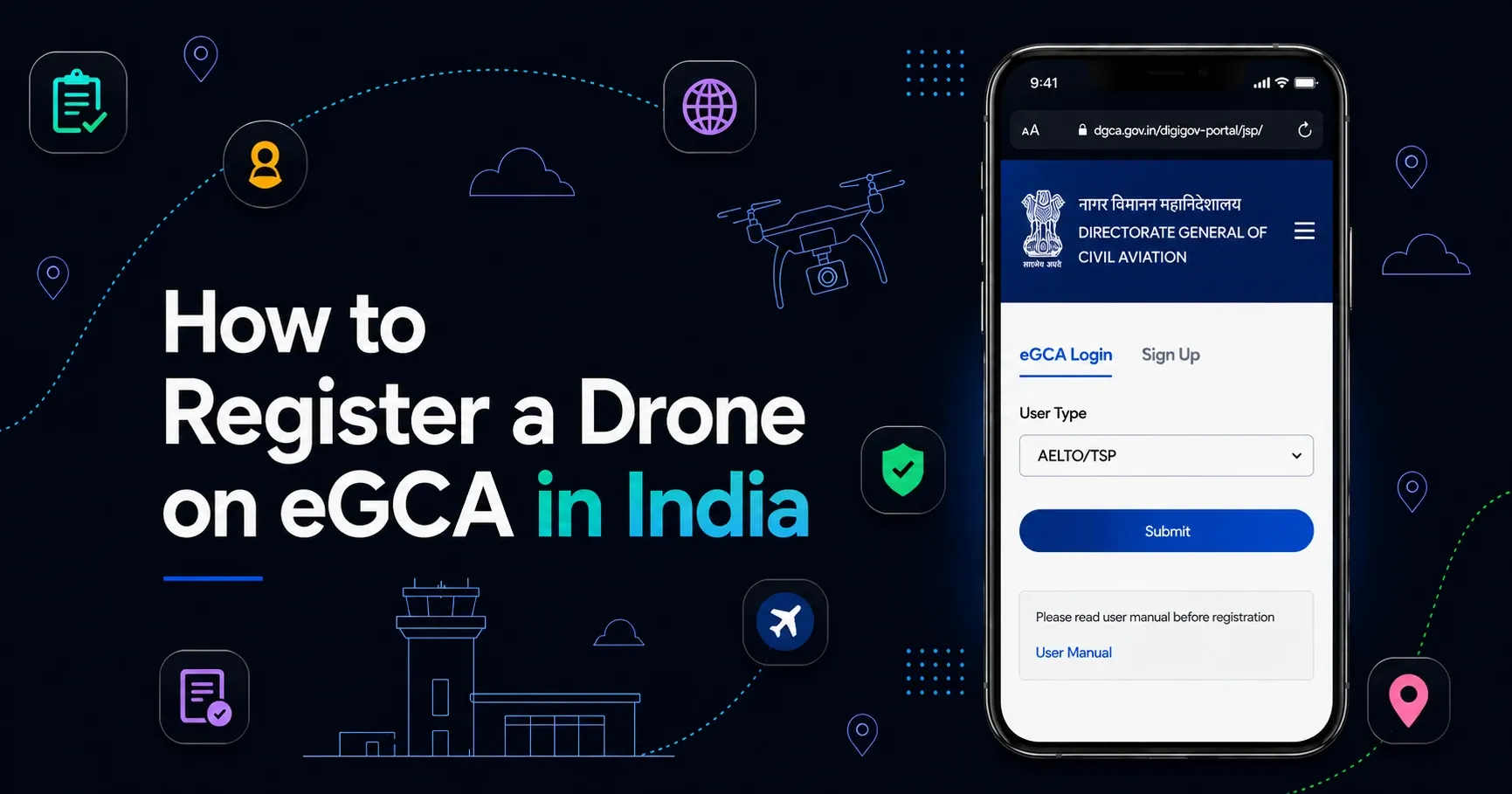
The technical structure of eGCA creates a second barrier on top of the eligibility test. Aadhaar-linked eKYC, Indian mobile verification for OTP authentication, and domestic payment integration through Indian banking rails form the standard onboarding sequence. (DGCA Public Notice, 3 July 2025)
A foreign visitor typically lacks an Aadhaar number, an Indian PAN, an Indian mobile SIM for OTP delivery, and an Indian-bank payment handle. Without those credentials the standard operator-registration flow on eGCA cannot complete. The system is not built to accept a non-resident individual application. The question how to register a drone in India, when asked by a foreign passport holder, receives a technical answer that confirms the legal answer.
The corporate-account pathway on eGCA is the only legitimate entry point for a foreign-principal application. That pathway routes through an Indian-registered company that holds the operator account. The foreign principal sits behind the Indian entity through the lease arrangement covered in the next section.
Readers tracking the broader compliance picture can also follow the NPNT permission framework and the drone categories by weight in India for category-by-category obligations.
Working through the lease drone Indian entity route
The lease pathway forms the only lawful operational structure available for foreign-principal drone activity in India. The framework appears inside paragraph 4.1(d) of the 2018 CAR and is carried forward in operational practice under the Drone Rules 2021.
Under this structure, a foreign company leases the drone to an Indian-registered entity that satisfies Indian ownership and control conditions. The Indian entity becomes the operator-of-record. The UIN attaches to the Indian operator, not the foreign lessor. The UAOP issued in this scenario is non-transferable and valid for five years from the date of issue. (DGCA RPAS Guidance Manual, Revision 4)
The Indian entity must maintain its principal place of business in India and satisfy the substantial-Indian-ownership and two-thirds-Indian-directors test. The operating entity carries responsibility for NPNT permissions, insurance compliance, maintenance records, and pilot deployment.
Security clearance forms a mandatory layer. The Ministry of Home Affairs processes the clearance flow through the e-sahaj.gov.in portal operated by the National Informatics Centre. The clearance must complete before operational approvals move forward. (Ministry of Home Affairs e-sahaj portal)
A foreign documentary crew entering India for a heritage project therefore cannot register drones as individual operators. The lawful route requires partnership with an Indian drone operator holding valid approvals, registered aircraft, and licensed remote pilots. Operators evaluating this pathway should also review drone insurance providers in India for the liability layer that the Indian operator carries.
Hiring an Indian remote pilot to operate the leased drone
The lease arrangement does not authorise the foreign principal to personally operate the drone. The remote pilot must hold a Remote Pilot Certificate from a DGCA-approved Remote Pilot Training Organisation.
A foreign-passport remote pilot can be employed by the Indian entity under a separate procedure. DGCA forwards documents for security clearance to security agencies following the FATA-analogous pathway under CAR Section 3 Series X Part I, paragraph 6.1. FATA itself is the manned-aviation foreign-aircrew temporary authorisation regime, with 67 to 82 FATA holders in Indian airline operations as of 30 June 2022. (Ministry of Civil Aviation Rajya Sabha Reply, 2022)
The drone procedure borrows the security-clearance pathway from FATA, not the licence-validation pathway. A foreign remote pilot does not become a FATA-validated airline pilot through this route. The clearance is purpose-specific to the leased-drone operation and runs through the same MHA security agencies.
The simpler operational answer for foreign-principal projects in India is to engage an Indian-citizen remote pilot already holding a valid drone license India, formally the Remote Pilot Certificate, and a clean background-verification record. The Remote Pilot Certificate process covers how to get a drone license in India, including RPTO training, examination, and issuance under Form D-4.
Mapping the operational footprint for foreign principals
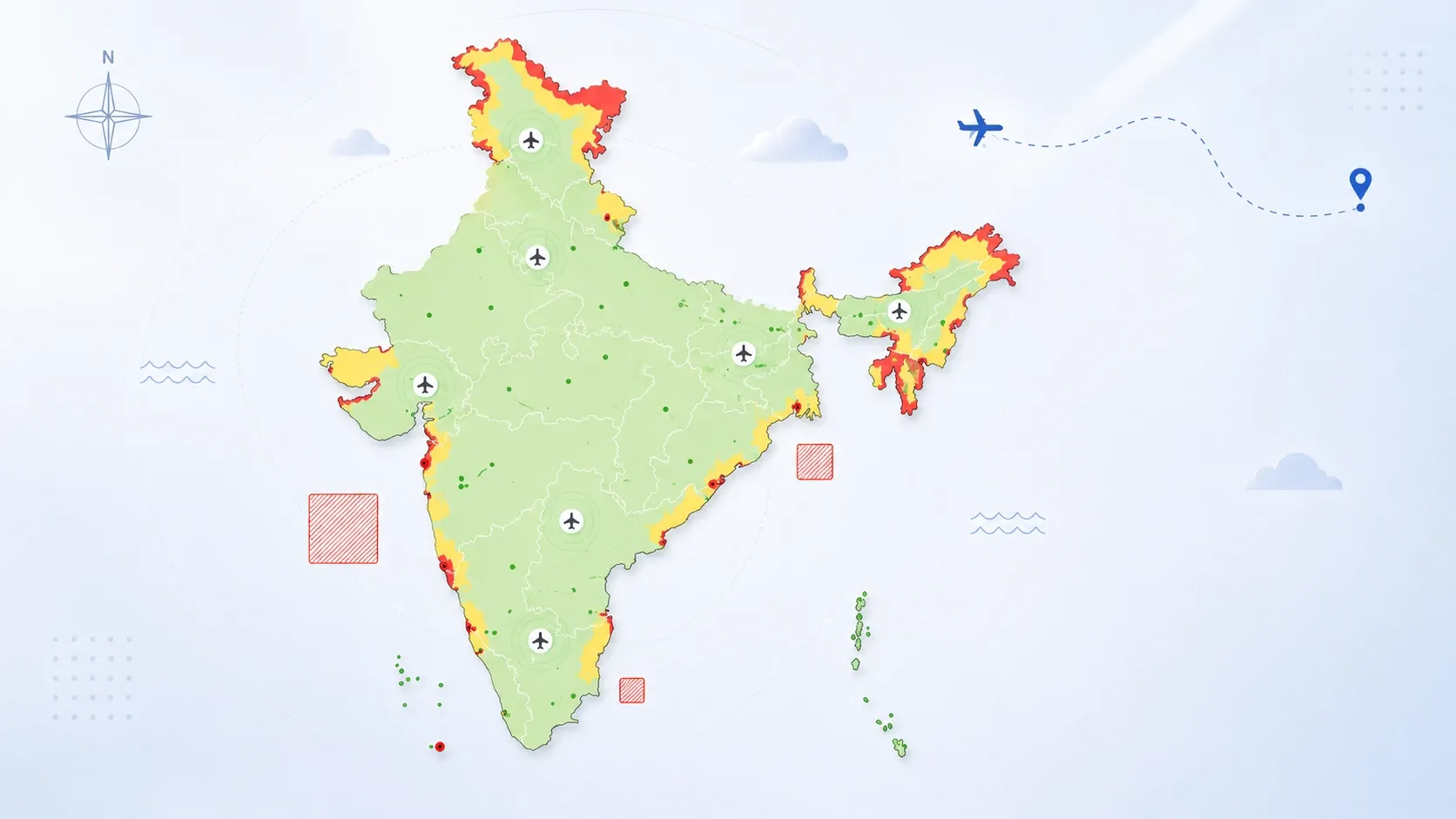
Even after the lease structure and the pilot arrangement are approved, the operating envelope remains narrow. DigitalSky airspace classifications divide Indian airspace into Green, Yellow, and Red zones. Red zones prohibit civilian drone operations without specific government clearance. (Ministry of Civil Aviation DigitalSky Map, accessed 19 May 2026)
Heritage sites under Archaeological Survey of India custody remain restricted operating environments. The Taj Mahal precinct, the Red Fort complex, the Qutub Minar complex, and the Hampi heritage zone operate under strict aerial restrictions tied to heritage-security protocols. The drone Taj Mahal restrictions question receives a categorical answer: no civilian drone operations without explicit ASI and DGCA clearance. (Archaeological Survey of India Circular, 18 September 2024)
Border districts and sensitive infrastructure corridors sit inside restricted categories. State-level overrides apply on top of the national zone map. The Jagannath Temple precinct in Odisha is designated as a Red zone until September 2028 under a state security order. Delhi also receives recurring blanket restrictions during Republic Day security operations. (Government of Odisha Notification, 22 September 2025)
Operational planning therefore starts with the airspace layer, not the aircraft. Readers tracking those restrictions should also review the drone airspace zone map before any travel-tied operation.
Visitor scenarios and the practical route to lawful operation
Foreign-principal drone activity in India follows the same lease structure regardless of purpose, though the operational scope and the approval effort differ across scenarios. The table below maps common visitor scenarios to the practical route.
Visitor scenario | Practical route to lawful operation |
|---|---|
Recreational tourist photography | Not available; foreign individuals cannot self-register or self-pilot |
Foreign documentary or film crew | Engage an Indian drone-services operator holding UIN, RPC, and applicable ASI or state clearances |
Foreign wedding or destination photographer | Engage a licensed Indian remote pilot; the foreign photographer may direct creative but not fly |
Foreign corporate inspection or survey team | Contract an Indian entity under the lease pathway with a documented scope of work |
Foreign research team on approved project | Route through an Indian academic or research partner with drone approvals and MHA clearance |
OCI cardholder personal use | Same as foreign national; OCI does not convert into Indian citizenship for aviation eligibility |
The recurring answer across every scenario is that the aircraft, the operator account, and the remote pilot must all sit inside the Indian eligibility perimeter. The foreign principal contracts services from that perimeter, but does not enter it as an individual.
Airport arrival timeline for foreign visitors carrying a drone
Foreign visitors asking whether they can carry a drone in an international flight to India face a sequenced customs process. The workflow below covers each decision point from departure to post-clearance, framed for the recreational tourist carrying a drone without a pre-arranged lease structure.
Stage | Action required |
|---|---|
Before departure | Verify current DGFT and CBIC guidance, carry the original purchase invoice, gather WPC-relevant specifications, and record the make, model, and serial number |
At the Indian airport | Do not use the Green Channel with a drone in baggage; proceed directly to the Red Channel |
Red Channel declaration | Submit the invoice, declare the equipment, and answer customs questions on intended use |
Customs decision | The officer may permit temporary personal admission against a re-export undertaking, direct the drone to bonded storage for departure collection, or, if documentation is incomplete, invoke seizure powers under the Customs Act 1962 |
After clearance | Customs release confirms lawful entry of the equipment only, not permission to fly |
Before any flight | Operational authorisation runs through the Indian-entity route, not through customs clearance |
The DGFT prohibition of 9 February 2022 applies to commercial imports. Personal-baggage declarations continue through a narrow discretionary channel that customs officers exercise case by case. The drone-red-channel-declaration-India-airport outcome therefore varies by airport, by officer, and by equipment profile.
The practical advisory for foreign visitors is to declare on arrival, carry the original purchase invoice, and request the re-export undertaking option. Visitors should accept that the drone may need to remain in bonded storage for the duration of the visit. Readers planning equipment movement should also review the drone import rules in India.
Reading what may change under the Civil Drone Bill
The draft Civil Drone (Promotion and Regulation) Bill was released by the Ministry of Civil Aviation in September 2025. The Bill is expected to consolidate the Drone Rules 2021, the eGCA registration regime, the DigitalSky airspace flow, and the Remote Pilot Certificate framework. A single statutory framework would replace the present multi-instrument structure. (Ministry of Civil Aviation Draft Bill, September 2025)
The draft text does not relax the nationality-linked eligibility test for individual foreign operators. The lease pathway is preserved as the operational route for foreign-principal activity. The Civil Drone Promotion and Regulation Bill 2025 foreigner question therefore has the same answer under the proposed regime as under the current one.
Until the Bill is notified and supporting rules are issued, the present eGCA-plus-DigitalSky structure remains in force. India's drone framework is moving toward tighter identity-linked accountability, not broader anonymous access, and every reform signal inside eGCA and DigitalSky points in the same direction.