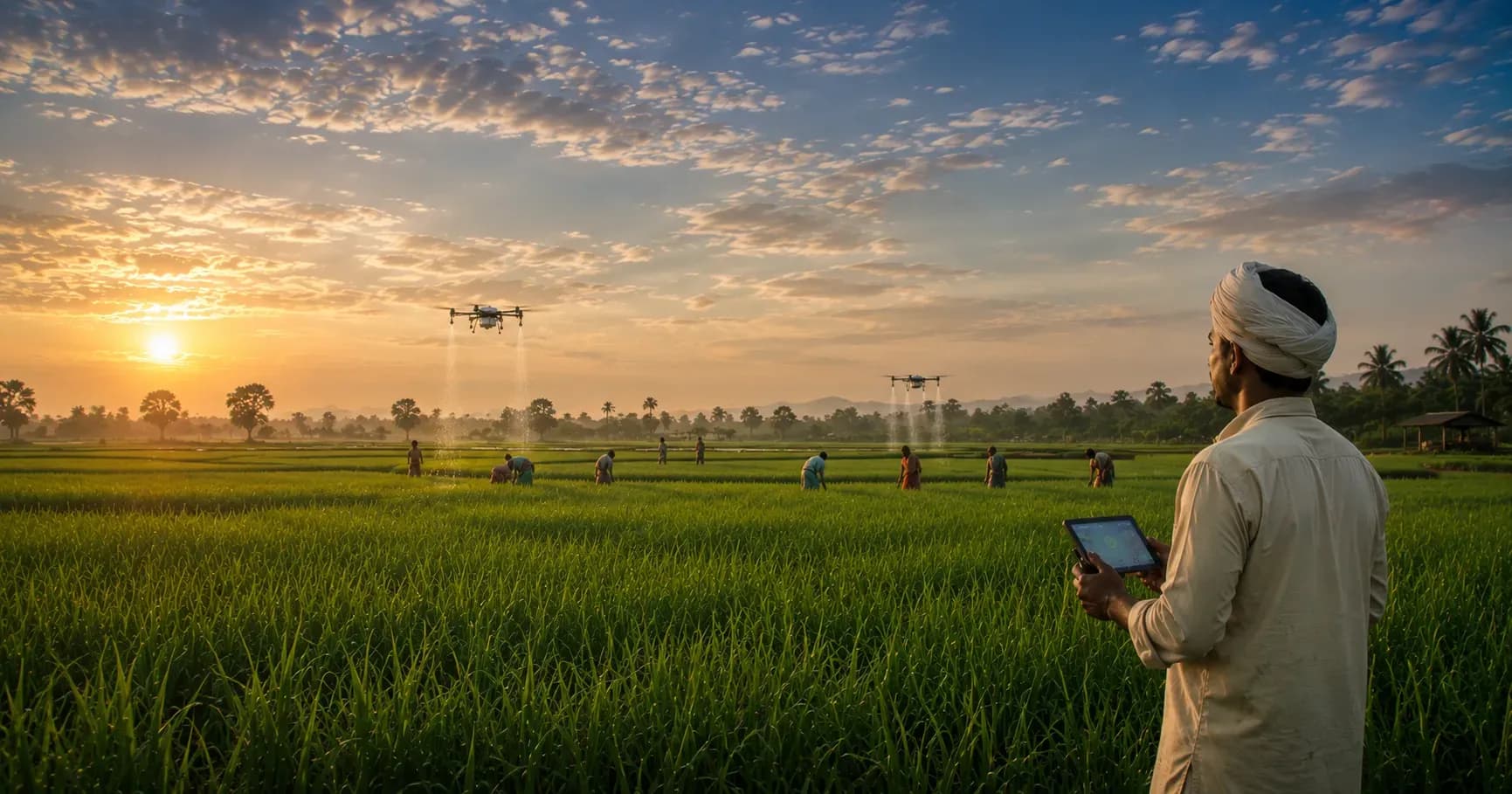
The Kisan Drone Scheme sits inside the Sub-Mission on Agricultural Mechanisation framework and routes agricultural drone subsidies through the agrimachinery.nic.in portal under Direct Benefit Transfer. The framework was formally launched on 18 February 2022 when the Prime Minister flagged off 100 Kisan Drones from Manesar (Press Information Bureau, 18 February 2022). By the latest parliamentary disclosure, ₹141.39 crore had been released, 461 drones supplied to farmers and 1,585 Kisan Drone Custom Hiring Centres established under SMAM (Ministry of Agriculture and Farmers Welfare, Lok Sabha Reply).
Why this matters now
The Kisan Drone Scheme marks the first large-scale attempt to turn agricultural drones from demonstration assets into operational farm equipment within India's mechanisation stack. The scheme is referred to locally as किसान ड्रोन योजना and operates through the Sub-Mission on Agricultural Mechanisation. The policy shift began with revised SMAM operational guidelines in January 2022, followed by the formal launch event in Manesar on 18 February 2022 (Press Information Bureau, 18 February 2022). The framework positioned drones alongside tractors, harvesters and precision agriculture equipment under the wider Krishi Unnati Yojana architecture.
Agricultural spraying became the largest single civil drone application segment in India after the Drone Rules 2021 liberalised approvals for unmanned aircraft operations (Ministry of Civil Aviation, 25 August 2021). State agriculture departments began integrating drones into nutrient spraying, crop assessment and pesticide application workflows across paddy, cotton, sugarcane and wheat belts. At the same time, the Directorate General of Civil Aviation tightened Type Certification requirements for medium-category agricultural drones under the Drone Certification Scheme 2022 (Ministry of Civil Aviation, 26 January 2022).
The Kisan Drone Scheme also arrived alongside parallel programmes such as the Agriculture Infrastructure Fund and the Namo Drone Didi initiative for women-led Self Help Groups. That overlap created confusion across the agricultural procurement ecosystem. Farmers have treated the schemes as interchangeable in field reporting even though each programme targets a different beneficiary class and follows a separate subsidy route.
The Kisan Drone Scheme is not a grant announcement in isolation. It functions as a regulated procurement pipeline. Applicants must navigate DGCA Type Certification requirements, state-level verification workflows, Direct Benefit Transfer routing and empanelled procurement rules before subsidy disbursement begins. Continuity with the largest single application segment of the Indian unmanned aircraft market — agriculture — is what makes the scheme structurally durable across electoral cycles.
SMAM subsidy tiers
The Kisan Drone Scheme operates through four primary subsidy tiers under SMAM. The subsidy percentage changes according to beneficiary category, operational role and institutional status. The framework separates demonstration-focused institutional procurement from commercial or farmer-owned deployments.
Applicant class | Subsidy share | Ceiling | Operational notes |
|---|---|---|---|
Agricultural institutions, ICAR institutes, KVKs, FMTTIs | Up to 100% | ₹10 lakh | Demonstration use only |
Farmer Producer Organisations | Up to 75% | ₹7.5 lakh | Field demonstrations and community use |
Agriculture graduates, SC/ST farmers, women farmers, small and marginal farmers | Up to 50% | ₹5 lakh | Includes eligible Custom Hiring Centres |
Existing CHCs, rural entrepreneurs, general-category farmers | Up to 40% | ₹4 lakh | Per-drone ceiling applies |
Implementing agencies hiring drones | ₹6,000 per hectare | Contingency support | Demonstration spraying only |
(Source: Ministry of Agriculture and Farmers Welfare operational guidelines; Press Information Bureau, PRID 1909215)
The subsidy applies to the lower value between the approved ceiling and the actual drone cost. An FPO purchasing a ₹6 lakh agricultural drone receives ₹4.5 lakh under the 75 per cent tier. An FPO purchasing a ₹10 lakh drone receives the capped value of ₹7.5 lakh.
The institutional tier sits separately from farmer procurement. Agricultural universities, Krishi Vigyan Kendras and Farm Machinery Training and Testing Institutes access the 100 per cent tier only for demonstration activities on farmers' fields. These drones cannot be procured under the same operating logic as commercial spraying fleets.
The framework also ties subsidy access to DGCA Type-Certified medium-category agricultural drones. The empanelled procurement list varies by state government implementation rules. This creates state-wise variations in approved manufacturers, inspection workflows and disbursement timelines.
Eligibility and application workflow
Eligibility under the Kisan Drone Scheme changes according to the subsidy tier selected during the application process. Farmer Producer Organisations must hold valid registration under the Companies Act or cooperative structure rules and maintain operational records recognised by state authorities. Agriculture graduates applying under the 50 per cent tier must submit degree documentation issued by recognised agricultural universities.
Small and marginal farmers must provide landholding records showing eligibility thresholds under state definitions. SC and ST applicants must upload valid caste certificates issued by district authorities. Women farmers entering the 50 per cent subsidy tier apply as individual beneficiaries. The Self Help Group route runs under the parallel Namo Drone Didi scheme for women SHGs.
The application route uses a six-step workflow on agrimachinery.nic.in.
Step one is registration. The applicant visits agrimachinery.nic.in, the Central Agri Mechanisation Direct Benefit Transfer Portal operated by the Department of Agriculture and Farmers Welfare. New users register under the appropriate category, such as Farmer, FPO, Institution or Custom Hiring Centre. The form captures Aadhaar number, mobile number, state, district, block and village. Aadhaar-linked mobile verification and bank account mapping occur during onboarding.
Step two is the subsidy application. Inside the registered account, the applicant selects "Drone" from the eligible machinery list, picks the applicant category, and enters the proposed drone model. The model must come from the empanelled list of DGCA Type-Certified agricultural drones. The applicant uploads a price quotation from the empanelled manufacturer.
Step three is document upload. The portal accepts Aadhaar for KYC, the bank account passbook for DBT routing, land record proof, and the manufacturer price quotation as universal documents. Tier-specific documents are added on top of the universal set. SC and ST applicants attach a caste certificate, FPO applicants attach the FPO registration certificate, and agri-graduate tier applicants attach the degree certificate. The portal generates an Application Reference Number on submission for state-level processing.
Step four is verification. The District Agriculture Officer reviews the application, conducts physical land verification where applicable, and forwards the approved file to the state-level SMAM committee. Approval intimation is sent via SMS and email. Beneficiaries applying through the eGCA pilot-certification track maintain parallel records for the Remote Pilot Certificate.
Step five is procurement and post-purchase verification. The beneficiary pays the full drone price to the empanelled manufacturer, takes delivery, and uploads invoice copies, delivery records and physical photographs for post-purchase verification. A field officer conducts physical verification of the drone at the beneficiary's premises.
Step six is subsidy disbursement. The state government routes the subsidy amount to the beneficiary's Aadhaar-linked bank account through Direct Benefit Transfer. Real-world timelines range between 90 and 150 days depending on state administrative capacity and district-level inspection backlogs.
Document checklist and certification gate
The document stack under the Kisan Drone Scheme functions as a verification matrix rather than a simple upload requirement. Identity mismatch, incomplete entity records and procurement errors at state-level validation are the four recurring causes of rejection at first submission.
Document | Required for | Purpose |
|---|---|---|
Aadhaar card | All applicants | KYC and DBT linkage |
Bank account passbook | All applicants | Subsidy routing |
Land ownership records | Farmer categories | Landholding verification |
Caste certificate | SC/ST applicants | Subsidy-tier validation |
FPO registration certificate | FPO applicants | Entity verification |
Agriculture degree certificate | Agri-graduate category | Eligibility proof |
Manufacturer quotation | All applicants | Cost validation |
GST registration | FPOs and CHCs | Entity validation |
CHC registration proof | Custom Hiring Centres | Operational verification |
The certification gate is enforced separately. Only DGCA Type-Certified agricultural drones qualify under SMAM procurement rules. The Drone Certification Scheme 2022 placed the Quality Council of India as the certification body for civil drones operating under DGCA frameworks (Ministry of Civil Aviation, 26 January 2022).
Agricultural drones cross category thresholds during spraying operations. A 10-litre spray platform may declare a dry weight of around 24 kg, which sits inside the small category. The same drone crosses 34 kg once a full tank of liquid fertiliser is loaded, moving it into the medium-category weight class under Drone Rules 2021. The operational Maximum All-Up Weight determines certification eligibility, not the unloaded aircraft weight. Subsidy applications that quote dry-weight category against an empanelled medium-category drone fail at state verification.
Applicants must also maintain compliance with the broader Drone Rules 2021 stack. That includes Remote Pilot Certificate pathways through DGCA-approved training organisations, eGCA-linked pilot records and Rule 44 third-party insurance obligations once the drone enters operational service. The Type Certificate must be valid on the date of invoice upload, not merely on the date of application submission.
Kisan Drone and Namo Drone Didi
The Kisan Drone Scheme and the Namo Drone Didi programme operate under separate beneficiary frameworks even though both sit within the agricultural drone adoption ecosystem. The distinction is operationally consequential because applicants enter the wrong subsidy route during procurement planning.
Scheme | Target beneficiary | Subsidy structure | Programme structure |
|---|---|---|---|
Kisan Drone Scheme under SMAM | Farmers, FPOs, CHCs, institutions | 40% to 100% | Mechanisation subsidy framework |
Namo Drone Didi | Women Self Help Groups | Up to 80%, capped at ₹8 lakh | Central sector scheme |
Agriculture Infrastructure Fund | FPOs, SHGs, infrastructure operators | Loan support with interest subvention | Financing framework |
(Source: Press Information Bureau, PRID 1985470; Ministry of Agriculture and Farmers Welfare operational guidelines)
The Namo Drone Didi programme was approved with a ₹1,261 crore outlay for the 2024-25 to 2025-26 period (Press Information Bureau, 30 November 2023). Its focus sits on women-led Self Help Groups under the DAY-NRLM structure rather than individual farmers or Custom Hiring Centres.
An FPO with majority women membership still applies under the SMAM-linked FPO category rather than the Namo Drone Didi structure. Similarly, women farmers operating independently outside SHG structures access the 50 per cent subsidy tier under the Kisan Drone Scheme instead of the 80 per cent SHG-linked route.
The Agriculture Infrastructure Fund operates differently again. It supports financing for the remaining procurement cost after subsidy calculations. This becomes important because beneficiaries pay the full drone amount upfront in every standard SMAM workflow. Direct Benefit Transfer reimbursement begins only after field verification.
State-level implementation realities
The Kisan Drone Scheme follows a central policy framework but executes through state agriculture departments. This creates operational differences across approval timelines, empanelled procurement lists and verification standards.
Maharashtra, Haryana, Karnataka, Madhya Pradesh and Telangana each run separate implementation workflows tied to state agriculture portals and district verification systems. Haryana integrates portions of the workflow through its Family ID-linked agriculture database, while Tamil Nadu applies supplementary support structures for select farming categories under state mechanisation programmes. Institutional buyers also have access to the parallel GeM procurement route for institutional buyers in addition to the agrimachinery.nic.in workflow.
Document mismatch between Aadhaar records and bank-account details accounts for the largest share of application rejections. Tier misclassification follows closely behind, where general-category farmers apply under protected-category subsidy bands without valid supporting documentation. Procurement rejections at invoice verification stem in part from drone models outside the DGCA Type-Certified empanelled list approved under state implementation frameworks. The fourth rejection driver is prior subsidy overlap within the five-year cooling-off window.
The financial timeline also shapes operational adoption. Beneficiaries must maintain sufficient working capital to pay the drone manufacturer before subsidy reimbursement arrives. That requirement pushes FPOs and Custom Hiring Centres toward Agriculture Infrastructure Fund loans, Kisan Credit Card financing and state-linked term-lending products.
The Revised SMAM Guidelines circulated through 2025 tightened DGCA Type Certification linkage and clarified the operational MAUW basis for tier eligibility. Disciplined applicants pre-stage documents against a Type-Certified empanelled drone, open the application with full drone cost in escrow, and treat the agrimachinery.nic.in portal as a procurement system. That cohort moves from application to subsidy credit inside 90 to 120 days. The remaining cohort sits in the 120 to 150 day band, almost always because of document or tier-classification corrections at state verification.
The framework is now moving toward tighter integration with India's wider unmanned aircraft regulations. BVLOS corridor expansion, indigenous platforms under the PLI scheme and the Bharatiya Vayuyan Adhiniyam consolidation horizon will reshape agri-drone economics over the next two years.
What this means in practice
The Kisan Drone Scheme now operates as a functioning agricultural procurement instrument rather than a pilot-stage subsidy announcement. Farmers, FPOs and Custom Hiring Centres entering the framework must treat the process as regulated equipment procurement tied to DGCA compliance, state-level verification and Direct Benefit Transfer timelines.
The strongest applications share three characteristics. They pre-stage every verification document before portal registration. They select DGCA Type-Certified agricultural drones already approved under state procurement frameworks. They also secure financing capacity before purchase because subsidy reimbursement begins only after field verification and invoice approval.
The broader policy environment also favours scaling agricultural drone operations through service models instead of individual ownership. Kisan Drone CHCs, FPO-operated spraying fleets and district-level drone hiring models align more closely with the economics of medium-category agricultural drone deployment. That trend matches the Ministry of Agriculture and Farmers Welfare focus on shared mechanisation infrastructure and demonstration-led adoption under SMAM.
BVLOS corridor policy is expanding. Indigenous agricultural drone production costs are compressing under India's manufacturing incentives. The subsidy framework will shift from early adoption support toward operational scale and service density across India's agricultural belts.
The Kisan Drone Scheme is no longer testing whether agricultural drones belong inside India's mechanisation framework. It is now defining how fast compliant operators can move through that framework before the next procurement cycle begins.