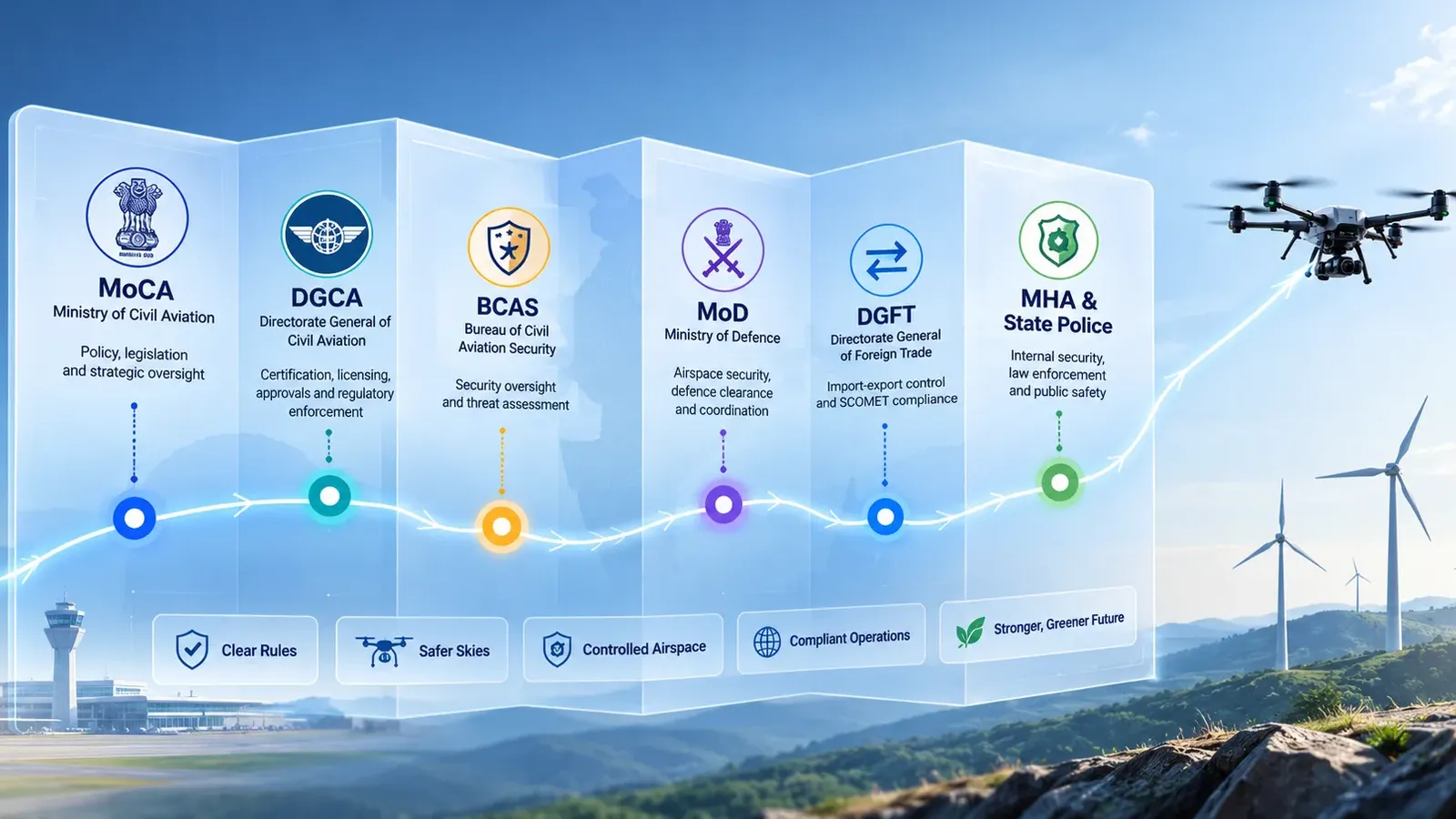
The drone regulatory stack in India runs across seven authorities, not two. The Ministry of Civil Aviation (नागर विमानन मंत्रालय) frames policy and legislation. The Directorate General of Civil Aviation is a statutory body that issues operational rules and certificates. Its status comes from the Aircraft (Amendment) Act 2020 and is deemed continued under the Bharatiya Vayuyan Adhiniyam 2024 (Section 3). MHA, MoD, BCAS, DGFT, WPC, and state police complete the perimeter. The draft Civil Drone (Promotion and Regulation) Bill 2025 shifts several of these boundaries.
The two-tier confusion: DGCA is not the same as MoCA
Most public explanations of Indian drone regulation collapse policy and regulation into one sentence. That is the error this page corrects. The Ministry of Civil Aviation is the nodal ministry under the Government of India's Allocation of Business Rules. It writes policy, frames legislation, and lays draft Bills before Parliament. It does not issue your UIN. It does not issue your Remote Pilot Certificate. It does not authorise your flight.
The Directorate General of Civil Aviation is a separate statutory body that operates under MoCA's administrative control. DGCA writes Civil Aviation Requirements (CARs), issues certificates, runs inspections, and undertakes enforcement field-action. The 2020 Aircraft (Amendment) Act upgraded the DGCA from an attached office to a statutory body. The same Act gave statutory status to BCAS and AAIB (Aircraft (Amendment) Act 2020, PRS India).
The Bharatiya Vayuyan Adhiniyam 2024 carried that status forward. Section 3 deems the DGCA constituted under the Aircraft Act 1934 to be constituted under the new Act. The headquarters are also separate. MoCA sits at Rajiv Gandhi Bhawan in New Delhi. DGCA sits along Sri Aurobindo Marg, opposite Safdarjung Airport.
The takeaway: when a brief says "DGCA regulates drones," it is correct on regulation but silent on policy authorship. Policy and rule-making sit at MoCA. Operational certification, licensing, and inspection sit at DGCA. The cluster context for this distinction sits in the complete drone laws in India framework.
What the Ministry of Civil Aviation actually does for drones
MoCA's drone footprint is legislative and strategic. It does not interact with the operator. The ministry notified the Drone Rules 2021 on 25 August 2021 under the then-Aircraft Act 1934 (Ministry of Civil Aviation, 25 August 2021). It notified the Drone Amendment Rules 2022 on 11 February 2022 and the Drone Amendment Rules 2023. The 2023 amendment replaced the Remote Pilot Licence with the Remote Pilot Certificate and expanded the acceptable identity-proof list.
MoCA published the Draft Civil Drone (Promotion and Regulation) Bill 2025 on 16 September 2025 for public consultation. The deadline extended to 15 October 2025. The Bill covers unmanned aircraft systems below 500 kilograms. It will replace the layered dependence on the Drone Rules 2021 and inherited aircraft legislation with a single drone-focused statute.
Beyond legislation, MoCA runs the policy scaffolding. The Production Linked Incentive Scheme for Drones and Drone Components was notified on 30 September 2021 with an outlay of ₹120 crore across three financial years (PIB, 30 September 2021). The ministry also coordinates Krishi UDAN, drone-skilling initiatives, and the Drone Promotion Council.
MoCA does not issue your UIN. It does not issue your Remote Pilot Certificate. It does not grant your airspace clearance. Those functions sit downstream, with DGCA. MoCA creates the rules. DGCA enforces them.
Draft consultations and gazette notifications flow through MoCA, not DGCA. Operators tracking regulatory change should monitor the MoCA press-release channel for upstream signals.
What the DGCA actually does for drones
DGCA is the operator-facing regulator. Every certificate, licence, and approval an operator needs is issued by the DGCA.
The DGCA issues four core certificates. Form D-1 is the Type Certificate. Forms D-2 and D-3 cover the Unique Identification Number. Form D-4 issues the Remote Pilot Certificate. Form D-5 covers RPTO authorisation (Drone Rules 2021, Schedule I). Operators completing the eGCA drone registration workflow and the drone type certification under Form D-1 interact with DGCA at each step.
The DGCA operates the eGCA portal at dgca.gov.in/digigov-portal. A DGCA public notice dated 3 July 2025 migrated Type Certificate workflows to eGCA from 4 July 2025. UIN, RPC, and RPTO workflows migrated on 15 July 2025. DigitalSky retained airspace permissions, NPNT enforcement, and the airspace map (DGCA Public Notice, 3 July 2025).
Enforcement powers under the Drone Rules 2021 include monetary penalties up to ₹1 lakh under Rule 50, suspension of licences, and cancellation of certificates. Under the parent statute, the Bharatiya Vayuyan Adhiniyam 2024 raised the ceiling to ₹1 crore under Section 32. Rule 50 caps Drone Rules violations. Section 32 caps offences under the parent Act.
The DGCA runs fourteen Regional Airworthiness Offices and five Regional Air Safety Offices. Inspection visits, accident investigations, and operator audits originate from these offices, not Delhi.
The practical answer to who issues drone licence in India is the DGCA. The certificate is earned through an authorised Remote Pilot Training Organisation and issued on the eGCA platform.
The statutory foundation: Bharatiya Vayuyan Adhiniyam 2024
The legal authority behind every DGCA action shifted in January 2025. TThe Bharatiya Vayuyan Adhiniyam 2024 (Act 16 of 2024) received presidential assent on 11 December 2024 and was notified in the Gazette of India on 24 December 2024 (Gazette of India, Extraordinary, Part II, Section 1). The Central Government appointed 1 January 2025 as the commencement date through Notification S.O. 5646(E) dated 31 December 2024. The Aircraft Act 1934 stood repealed from that date under Section 43 of the new Act.
The Bharatiya Vayuyan Vidheyak 2024 was introduced in the Lok Sabha on 31 July 2024 and passed on 9 August 2024. The Rajya Sabha passed it on 5 December 2024 (Parliament of India legislative records).
Section 3 of the Act answers the question of whether DGCA is a statutory body. It states the Directorate General of Civil Aviation constituted under the Aircraft Act 1934 shall be deemed to have been constituted under the new Act. The same deeming clause covers BCAS and AAIB. The statutory-body status granted by the Aircraft (Amendment) Act 2020 therefore carried forward unchanged.
The Act also raised the penalty ceiling. The maximum monetary penalty under Section 32 is ₹1 crore. This is ten times the ₹10 lakh ceiling under the repealed Aircraft Act 1934 (PRS India). For drones, the Drone Rules 2021 cap remains operative under Rule 50 until replacement rules are notified.
The chapter structure also matters. Chapter II covers the DGCA. Chapter III covers BCAS. Chapter VII covers offences and penalties. Chapter VI introduces a formal compensation framework for loss or damage caused by aircraft.
The other five regulators you also answer to
Drone regulation in India extends well beyond MoCA and DGCA. Airspace, security, imports, telecom spectrum, and data governance each fall under separate authorities. The Ministry of Home Affairs governs Red Zone authorisation. Rule 24 of the Drone Rules 2021 routes restricted-airspace permissions through MHA-coordinated state machinery. Foreign-national operator approvals require MHA and Ministry of External Affairs clearances.
The Ministry of Defence controls military airspace and grants the defence-drone exemption from civil registration under Rule 5(2). Drones operated directly by the armed forces remain outside the DGCA system. Paramilitary forces and defence-adjacent contractors fall under DGCA civil registration unless specifically exempted.
The Bureau of Civil Aviation Security regulates security airspace around airports. BCAS circulars define security exclusion zones under the Aircraft Rules 1937 framework, now operating under the BVA 2024 statute.
The Directorate General of Foreign Trade controls drone imports. DGFT Notification No. 54/2015-2020 dated 9 February 2022 restricted import of drones in completely-built-up, semi-knocked-down, and completely-knocked-down forms. Research, defence, and security applications are exempt. Components remained importable, supporting domestic manufacturing.
The Wireless Planning and Coordination Wing under the Department of Telecommunications regulates radio-frequency compliance. Every drone communication module operating in de-licensed bands requires Equipment Type Approval under the Indian Telegraph Act 1885 framework.
The Airports Authority of India issues Notice to Airmen (NOTAM) for temporary airspace restrictions. AAI integrates with DigitalSky for airspace-map data and red-zone overlays.
The Data Protection Board under MeitY sits in the perimeter. The Digital Personal Data Protection Rules 2025 notified on 13 November 2025 apply to commercial drone footage capturing identifiable individuals (Ministry of Electronics and Information Technology, 13 November 2025).
Who regulates what, in one table
The seven-authority architecture is easier to see in a single comparison view.
Authority | What it controls | Statutory basis | Operator-facing portal |
|---|---|---|---|
Ministry of Civil Aviation | Policy, rules, draft legislation | Allocation of Business Rules | civilaviation.gov.in |
DGCA | UIN, RPC, Type Cert, RPTO authorisation | BVA 2024, Drone Rules 2021 | eGCA, DigitalSky |
Airports Authority of India | Airspace map data, NOTAMs | BVA 2024 | aim-india.aai.aero |
Ministry of Home Affairs | Red Zone authorisation, foreign permissions | Rule 24, Drone Rules 2021 | State LoA, MEA route |
Ministry of Defence | Military airspace, defence exemption | Rule 5(2), Drone Rules 2021 | Direct coordination |
BCAS | Airport security airspace | BVA 2024, Aircraft Rules 1937 | bcasindia.gov.in |
DGFT | Drone imports and components | Notification 54/2015-2020 | dgft.gov.in |
WPC | Radio-frequency type approval | Indian Telegraph Act 1885 | saralsanchar.gov.in |
DPDP Board | Commercial drone footage data | DPDP Act 2023, Rules 2025 | MeitY notification route |
The pattern in the table tells the operator story. A single Small-category drone flight needs interaction with several authorities at once. MoCA rules apply by default. The drone needs a DGCA-issued UIN and the pilot needs a DGCA-issued RPC. AAI controls the airspace check and MHA gates red-zone permission. WPC type-approves the radio module. DGFT clears any imported drone or component. The DPDP Board sits in the perimeter if the footage captures identifiable people.
That is the regulatory environment most published guidance collapses into "DGCA, under MoCA, regulates drones." It is not wrong. It is incomplete by five authorities. Operators studying the India drone airspace zone map and the No Permission No Takeoff framework should treat drone regulation as a multi-agency system. A single-portal workflow does not capture the perimeter.
Who actually enforces a violation in the field
Enforcement does not sit exclusively with the DGCA. It is split across DGCA, state police, and security agencies.
A DGCA officer may impose monetary penalties up to ₹1 lakh under Rule 50 of the Drone Rules 2021 (Ministry of Civil Aviation, 25 August 2021). The DGCA can also suspend or cancel certificates, ground operators, and order corrective action. These are administrative powers exercised through DGCA regional offices.
State police forces hold a parallel enforcement layer. Rule 49(2) of the Drone Rules 2021 classifies specified offences as cognizable and non-compoundable. This allows police to act under the criminal procedure framework. The Bharatiya Nagarik Suraksha Sanhita 2023 replaced the Criminal Procedure Code in July 2024 and supplies the procedural authority.
State police have already invoked Section 163 of the BNSS 2023 (formerly Section 144 CrPC) to impose Temporary Red Zones. The Srinagar police order in June 2024 imposed a temporary drone ban during a high-security visit. The Kohima Superintendent of Police issued a similar order on 25 August 2024. These orders show how state-level enforcement runs in parallel with the DGCA system, often without DGCA pre-notification.
The drone penalties and fines in India cluster page maps the full penalty schedule across the four enforcement layers.
The answer to who can seize a drone in India is therefore not a single body. DGCA officers seize under administrative powers. State police seize under criminal procedure. Defence and security agencies seize under operational airspace authority. The reader who assumes only DGCA can act is unprepared for the field reality.
What the Civil Drone Bill 2025 changes about who regulates
The draft Bill released on 16 September 2025 reshapes the answer in three ways. First, it codifies the seven-authority architecture into a single statute below 500 kg. The Bill consolidates DGCA certification authority and formalises MHA red-zone authority. It codifies state-police detention powers and cross-references the Digital Personal Data Protection Act 2023. The fragmented inheritance from the Aircraft Act 1934 ends with notification of the new Act.
Second, it raises the criminal-enforcement ceiling. The Bill proposes imprisonment of up to three years for restricted-airspace operations. It allows detention of drones for up to three days on suspicion of violation. Compensation for property damage and injury routes through Motor Accident Claims Tribunal procedure. Police gain authority to investigate, detain, and arrest without prior magistrate order in specified offences.
Third, it introduces tariff-regulation authority. The Central Government would gain power to regulate fares and fees for commercial drone services. The existing Drone Rules 2021 framework does not address commercial-service pricing. The consultation period extended to 15 October 2025. As of 13 May 2026, Parliament has not yet notified the Bill. The Drone Rules 2021 remain operational until replacement rules issue under the new Act.
For operators, the implication is dual-track compliance. The Drone Rules 2021 plus BVA 2024 stack is operative today. The Civil Drone Bill 2025 anchors planning beyond a 12-month horizon. The drone categories under Drone Rules 2021 and drone insurance under Rule 44 obligations should carry forward.
The next inflection sits with parliamentary notification of the Civil Drone Bill. When that notification arrives, the seven-authority architecture moves from inheritance to codification. Until then, operators who treat DGCA and MoCA as one body remain exposed at the layers neither of them actually controls.