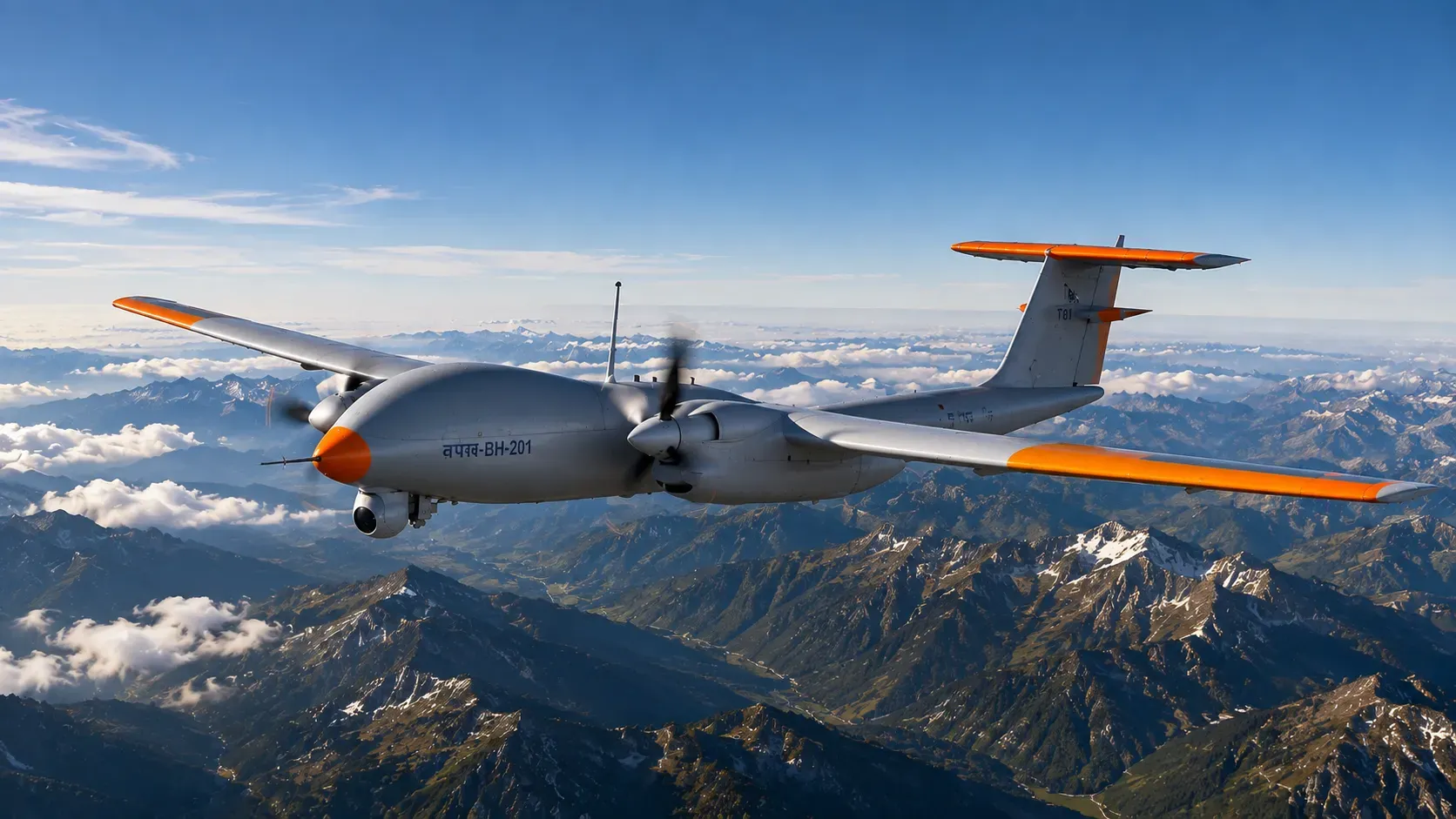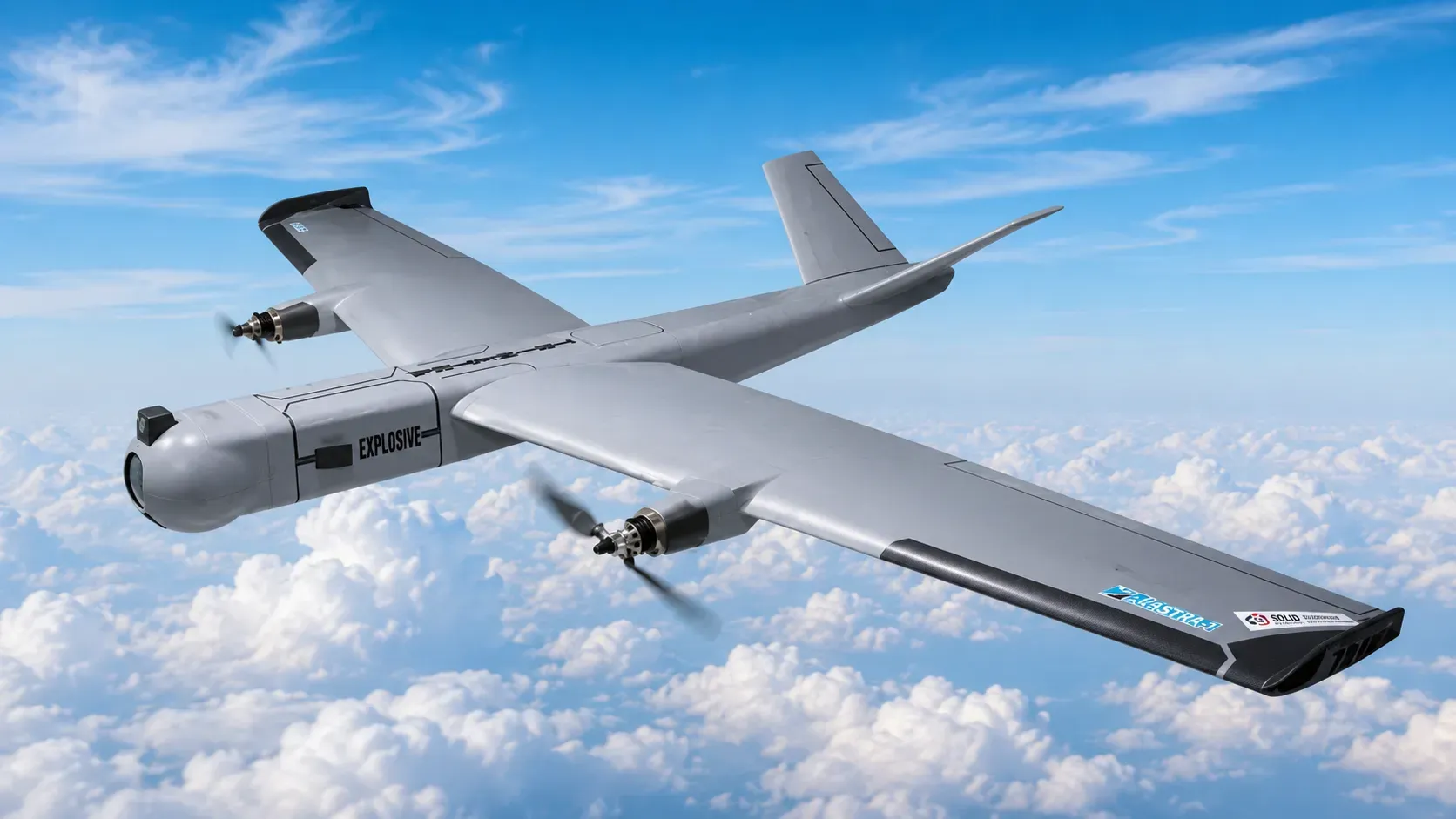
Long-endurance drones for Indian operators are now best understood through an altitude-endurance-procurement triad. MALE systems anchor the medium-altitude workhorse tier. HALE systems define the FMS leap through the 31-aircraft MQ-9B agreement.
HAPS systems entered the procurement chain through the AS-HAPS Acceptance of Necessity on 12 February 2026 (Press Information Bureau, 12 February 2026). The clearance sits inside a ₹3.60 lakh crore acquisition package. The result is a three-tier surveillance stack reaching from tactical persistence to stratospheric coverage.
Setting the news anchor for the three-tier surveillance stack
India's long-endurance drone transition stopped being theoretical on 12 February 2026. That day, the Defence Acquisition Council cleared the Air-Ship Based High Altitude Pseudo Satellite procurement proposal for the Indian Air Force (Press Information Bureau, 12 February 2026). The clearance placed a stratospheric platform inside the formal acquisition chain.
The decision completed a visible capability ladder. The ladder already included the 31-aircraft MQ-9B procurement signed on 15 October 2024. It also covered the 87 MALE UAV tender under the Make in India framework (Ministry of Defence, 15 October 2024).
Each tier solves a different surveillance problem. MALE platforms sit in the 10,000 to 30,000 feet band and provide ISR persistence measured in hours. HALE systems operate above 40,000 feet and push endurance toward day-scale operations.
HAPS systems sit near the stratosphere, roughly 18 to 20 kilometres above sea level. They aim for persistence windows of weeks or months, depending on payload and solar generation (CSIR-NAL, 2025).
The transition also follows a visible institutional arc. The TAPAS-BH-201 mission-mode programme closed on 14 January 2024 after falling short of full altitude and endurance thresholds (DRDO, 14 January 2024). Months later, India signed the ₹32,000 crore MQ-9B agreement through the FMS route, with deliveries scheduled from January 2029 (Ministry of Defence, 15 October 2024).
By early 2026, the same procurement ecosystem had expanded into stratospheric platforms through AS-HAPS. That sequence is why long-endurance drones are now better understood as one connected procurement pyramid rather than isolated aircraft programmes.
Defining the three altitude tiers of long-endurance drones
Long-endurance drones are classified less by size than by altitude band, endurance profile, and mission persistence. The MALE HALE HAPS difference starts with the altitude band the aircraft is built to operate in.
MALE, or Medium Altitude Long Endurance, systems generally operate between 10,000 and 30,000 feet. Their endurance ranges from roughly 18 to 40 hours, depending on payload. HALE, or High Altitude Long Endurance, systems move above 40,000 feet and are built for wider-area ISR persistence (Ministry of Defence, 15 October 2024).
HAPS platforms sit outside the conventional UAV bracket altogether. A high altitude pseudo satellite operates near the stratosphere at approximately 60,000 feet or higher. It depends heavily on solar power, lightweight airframes, and low-energy loiter profiles.
Instead of cycling through frequent landings, a stratospheric drone aims to remain aloft for extended periods. The platform acts as a communications relay, an ISR node, or a pseudo-space layer above conventional aircraft (CSIR-NAL, 2025).
The operational distinction changes procurement logic. MALE systems are tied to tactical and theatre-level ISR requirements. HALE systems address maritime surveillance, deep-area persistence, and long-range intelligence collection. HAPS systems shift toward communications continuity, wide-area monitoring, and strategic persistence over regions where satellites may not offer sufficient revisit rates.
India's procurement structure now mirrors that classification. The 87 MALE UAV tender addresses the medium-altitude workhorse layer. The MQ-9B contract anchors the HALE transition.
The AS-HAPS Acceptance of Necessity introduces the stratospheric tier into formal defence acquisition planning (Press Information Bureau, 12 February 2026). Together, the three bands form a layered ISR architecture rather than separate aircraft categories.
Tier | Operational altitude | Endurance profile | Indian procurement example | Certification frame |
|---|---|---|---|---|
MALE | 10,000 to 30,000 feet | 18 to 40 hours | TAPAS-BH-201, 87 MALE UAV tender | CEMILAC military certification |
HALE | Above 40,000 feet | More than 30 hours | MQ-9B SeaGuardian and SkyGuardian | Military airworthiness, FMS route |
HAPS | Near 60,000 feet and above | Weeks to months target | AS-HAPS, CSIR-NAL HAPS | Developmental stratospheric framework |
Unpacking the medium-altitude tier and the MALE platform role
The MALE drone category remains the backbone of India's long-endurance surveillance stack. It balances endurance, payload capacity, and deployability inside one airframe class. Indian Air Force long endurance UAV operations in this band support border ISR, maritime surveillance, convoy monitoring, and persistent reconnaissance (Indian Air Force, August 2023). Tactical aircraft sorties covering the same sectors would consume substantial flying hours.
The indigenous centrepiece of this tier was TAPAS-BH-201. The aircraft was developed by the Aeronautical Development Establishment, a DRDO laboratory. TAPAS first flew in November 2016.
The programme targeted a 24-hour endurance profile at approximately 30,000 feet. Parliamentary defence records later disclosed lower numbers in actual testing. The aircraft demonstrated endurance near 18 hours at roughly 28,000 feet, below the full PSQR threshold (Parliamentary Standing Committee on Defence, 2024-2025).
The closure of TAPAS as a mission-mode project in January 2024 did not end India's MALE ambitions. The programme shifted into a technology-transfer and subsystem pathway.
DRDO leadership later confirmed that core TAPAS subsystems would be shared with domestic industry. The transferred set covers automatic take-off and landing modules, data links, landing gear architecture, and electronic control units. It also includes ground control station systems for participants competing in the 87 MALE UAV tender (DRDO, 2025-2026).
That transition matters because MALE procurement is no longer framed around one government aircraft programme. It now sits inside a broader industrial structure covering domestic manufacturing, subsystem integration, mission-system adaptation, and sustainment pipelines. The shift explains why medium-altitude ISR platforms continue to dominate procurement discussions across the Indian defence ecosystem.
Tracing the TAPAS BH-201 arc and the indigenous MALE engine
TAPAS BH-201 occupies a unique place in India's long-endurance drone history. The platform became a technology demonstrator and a procurement lesson at the same time.
The aircraft emerged from the Rustom lineage to give India an indigenous MALE ISR platform for sustained surveillance missions. The programme brought together DRDO, HAL, and BEL inside a multi-agency structure covering airframe, avionics, datalinks, and mission-control systems (DRDO, 14 January 2024).
The programme closure in January 2024 reflected a capability mismatch rather than a technology collapse. TAPAS demonstrated automatic take-off and landing, ISR payload integration, and endurance performance below the operational threshold. Defence ministry briefings confirmed that indigenous engine integration work would continue. The revised target window extended into late 2025 for the first flight on a domestic powerplant (Parliamentary Standing Committee on Defence, 2024-2025).
The Vehicle Research and Development Establishment, another DRDO laboratory, designed and built a 180-horsepower powerplant for the platform. The first indigenous-engine flight was scheduled for late 2025 (Parliamentary Standing Committee on Defence, 2024-2025). The engine work reduces dependence on imported powerplants for future MALE platforms across the tender ecosystem.
That distinction shapes how Indian procurement officers read indigenous drone development. A mission-mode closure is no longer treated as the end of the ecosystem.
The procurement system absorbed the programme's mature subsystems into future tenders. The transition resembles how airframe pipelines are handled across larger aerospace programmes. One aircraft may fall short of its operational benchmarks while still generating reusable avionics, control software, and propulsion lessons.
The TAPAS arc reshaped the language around ISR drone India capability discussions. Operational capability is now separated more clearly from developmental progress. Indian procurement discussions distinguish between fielded systems, developmental systems, and roadmap technologies as separate evaluation tracks. The result is a procurement environment that reads endurance platforms as layered capability stacks tied to mission outcomes.
Mapping the 87-drone MALE tender and Heron Mk II bridge
The 87 MALE UAV tender represents the operational bridge between the TAPAS transition and the next phase of indigenous surveillance procurement. The programme is built around a tri-service requirement.
The Ministry of Defence is expected to split production between two domestic manufacturers under the Make in India framework (Ministry of Defence, 2025-2026). The tender takes a systems-level approach covering airframes, payload integration, ISR software, datalinks, and sustainment as one package.
The tender also intersects with emergency procurement pathways. Following Operation Sindoor, the Indian services accelerated the Heron Mk II emergency procurement route to address immediate surveillance requirements (Ministry of Defence, 2025-2026). The Heron Mk II procurement acts as a bridge capability while indigenous MALE production pipelines mature.
The Indian Air Force had already inducted four Heron Mk II UAVs into the "Warden of the North" squadron during August 2023 (Indian Air Force, August 2023). The squadron carries out surveillance missions along the northern sector. That deployment showed how long-endurance ISR platforms now sit inside continuous operational cycles rather than isolated trial deployments.
The procurement logic behind the 87-drone programme reflects endurance economics. Medium-altitude systems maintain persistent surveillance over sectors where fighter sorties would demand repeated crew rotations and higher operating costs.
They integrate naturally into the wider airspace structure governed by military certification regimes. The civil ecosystem itself sits under the Bharatiya Vayuyan Adhiniyam 2024 (Ministry of Civil Aviation, 2024).
Climbing to the high-altitude tier and HALE endurance windows
The HALE drone category changes the surveillance equation. Endurance is paired with far wider coverage geometry. High-altitude operations allow ISR platforms to maintain larger sensor footprints while remaining outside lower-altitude airspace congestion. For maritime surveillance and strategic ISR, that altitude advantage becomes operationally decisive.
India HALE drone planning has shifted decisively over the past three years. Earlier policy discussions treated HALE as an aspirational tier. The Ministry of Defence now treats HALE as a fielded operational layer with a specified delivery window (Ministry of Defence, 15 October 2024). The shift is visible in how procurement officers plan ISR coverage maps for the next decade.
HALE platforms demand satellite communications integration, long-range ISR packages, maritime surveillance payloads, and sustainment structures on a different scale from medium-altitude systems. The procurement structure separates the HALE layer from the domestic MALE ecosystem deliberately, reflecting the distinct mission-system architecture HALE platforms require.
The Indian Navy, Indian Army, and Indian Air Force each carry different operational requirements at the HALE tier. The Navy emphasises maritime ISR across the Indian Ocean Region.
The Army prioritises wide-area surveillance over land sectors. The Air Force focuses on strategic ISR across both domains. The tri-service split inside the MQ-9B contract reflects that operational division.
Anchoring the HALE leap through the 31 MQ-9B Predator deal
India's HALE transition is anchored to the 31-aircraft MQ-9B procurement signed through the Foreign Military Sales route on 15 October 2024 (Ministry of Defence, 15 October 2024). The MQ-9B Predator India deal is among the largest defence procurement agreements between India and the United States.
The agreement allocates 15 SeaGuardian aircraft to the Indian Navy. The Indian Army and Indian Air Force each receive eight SkyGuardian aircraft (Press Information Bureau, 15 October 2024). The total fleet of 31 platforms covers maritime, land, and air-force ISR as a single procurement package. Deliveries are scheduled from January 2029 onward.
The Ministry of Defence simultaneously signed a performance-based logistics arrangement. The arrangement covers in-country maintenance, repair, and overhaul support for the MQ-9B fleet (Ministry of Defence, 15 October 2024). The MRO commitment locates sustainment work inside the Indian industrial base rather than dependent on overseas turnaround windows.
The MQ-9B SeaGuardian delivery timeline overlaps operationally with two other tier transitions. The first is indigenous MALE manufacturing through the 87-drone tender. The second is the developmental HAPS pathway moving from CSIR-NAL laboratories into structured production.
By the end of the decade, Indian operators could field all three endurance layers in parallel. The stack would include domestic MALE ISR systems, imported HALE strategic ISR platforms, and indigenous HAPS persistence systems.
The HALE tier reshapes how the Indian forces plan sensor architecture. The SeaGuardian and SkyGuardian variants carry multi-mode maritime radars, electro-optical and infrared sensors, and signals intelligence payloads. The platforms operate above 40,000 feet, extending sensor footprint geometry well beyond MALE coverage. For the Indian Navy, the HALE tier turns persistent maritime ISR across the Indian Ocean Region into a continuously available capability.
Crossing into the stratosphere with HAPS platforms
HAPS systems occupy a category closer to atmospheric infrastructure than to traditional UAV operations. A high altitude pseudo satellite remains inside the stratosphere for extended durations using lightweight airframes, solar power, and low-energy loiter patterns. Instead of cycling through aircraft sorties, the system behaves like a persistent aerial node.
The stratospheric drone tier sits between conventional aviation and low-earth orbit. Commercial aircraft typically cruise between 31,000 and 38,000 feet. HAPS platforms operate well above that, targeting approximately 60,000 feet and beyond. The platform avoids weather turbulence, air-traffic congestion, and cloud-cover interference at those altitudes.
The HAPS layer changes how ISR persistence is measured. A stratospheric drone positioned at approximately 60,000 feet maintains wide-area surveillance or communications coverage over a region without the orbital constraints of satellites. That capability becomes relevant for maritime monitoring, disaster-response communications, and long-duration ISR continuity over priority sectors.
Solar power is the defining technology constraint at this tier. The platform absorbs solar energy during daylight hours and stores it in onboard batteries for night-time operation. The energy-management balance determines how long the platform stays aloft. It also sets payload capacity for ISR sensors, communications relays, and remote-sensing instruments.
The civil applications of HAPS extend beyond military ISR. The platforms serve as communications nodes for remote regions where ground-based infrastructure is sparse. They support disaster-response telecommunications when terrestrial networks fail. They also enable environmental monitoring across coastal and forest sectors.
Decoding the AS-HAPS Acceptance of Necessity
The AS-HAPS Acceptance of Necessity issued on 12 February 2026 matters less because of one platform and more because of what it formalised. The Defence Acquisition Council recognised stratospheric persistence as a procurement category for the Indian Air Force (Press Information Bureau, 12 February 2026). The recognition moves HAPS from experimental aerospace work into the formal defence acquisition structure.
The procurement signal sits inside a larger ₹3.60 lakh crore approval package covering multiple military acquisitions (Press Information Bureau, 12 February 2026). The AS-HAPS line item stood apart because it addressed a category that had not previously entered Indian military procurement planning at this level.
The AS-HAPS Acceptance of Necessity is the formal first step inside the Defence Acquisition Procedure. The next stages cover cost negotiation, technical evaluation, and contract signing.
The AoN does not guarantee a signed contract. It signals that the Indian Air Force has formally identified the capability as necessary. The procurement chain will proceed through the next gates from this point (Ministry of Defence, 12 February 2026).
The operational appeal is straightforward. HAPS systems fill surveillance and communications gaps between conventional aircraft and satellites. They reduce dependence on continuous aircraft rotations for wide-area ISR coverage. For operators planning layered surveillance architecture, the AS-HAPS clearance signals that stratospheric persistence is now mainstream operational planning rather than a research demonstration.
The procurement timing aligns with broader institutional shifts. The Bharatiya Vayuyan Adhiniyam 2024 replaced the Aircraft Act of 1934 and modernised the wider airworthiness framework relevant to unmanned aviation categories (Ministry of Civil Aviation, 2024).
Military certification remains separate through CEMILAC structures. The broader regulatory environment now reflects a more contemporary understanding of unmanned and remotely piloted systems.
Building the HAPS production base from CSIR-NAL outward
India's HAPS transition is tied strongly to the work of CSIR-National Aerospace Laboratories. CSIR-NAL sits under the Council of Scientific and Industrial Research, distinct from DRDO. The distinction matters for procurement officers tracking which agency owns which programme.
Flight-test campaigns conducted during 2025 achieved operational altitudes near 24,000 feet. Development work continued toward a 30-metre wingspan configuration for extended endurance missions (CSIR-NAL, 2025-2026). The wingspan target is comparable to a narrow-body commercial aircraft, with a fraction of the all-up weight.
In December 2025, CSIR-NAL inaugurated a dedicated HAPS production facility in Bengaluru (CSIR-NAL, December 2025). The facility shifts HAPS work from laboratory experimentation toward structured production. It covers composite fabrication, solar integration, and full-scale airframe assembly.
The CSIR-NAL HAPS flight test campaigns sit alongside parallel work from the Innovation for Defence Excellence initiative. The iDEX ecosystem has entered the HAPS category through solar-powered stratospheric development tied to Indian Navy requirements (iDEX, 2024-2026). The projected delivery window extends toward 2027 for the operational naval HAPS variant. The iDEX pathway uses the Make-I funding structure, with the government covering a majority share.
The combined effect is an industrial ecosystem where military procurement, research laboratories, and defence innovation programmes converge around one stratospheric band. CSIR-NAL holds the research-laboratory anchor. iDEX supplies the developmental procurement vehicle. The Defence Acquisition Council holds the procurement-clearance gate through AS-HAPS.
Connecting MALE, HALE, and HAPS under one airworthiness frame
The certification environment for long-endurance drones operates across two parallel structures. Military airworthiness is governed by CEMILAC, the Centre for Military Airworthiness and Certification. Civil airworthiness now sits under the Bharatiya Vayuyan Adhiniyam 2024, which replaced the Aircraft Act of 1934 (Ministry of Civil Aviation, 2024). The civil structure continues to govern commercial and policy frameworks under the DGCA Drone Rules 2021.
The two airworthiness regimes do not operate in isolation. Long-endurance ISR platforms in shared airspace must respect both military and civil airspace boundaries. The Bharatiya Vayuyan Adhiniyam 2024 transition modernised the foundational legal framework. The Act now serves as the umbrella statute under which civil drone regulation operates.
For MALE and HALE platforms certified by CEMILAC, the military certification path remains the primary route. The platforms operate inside military airspace structures during peacetime and operational deployments. The civil framework still matters where cross-domain flight paths or dual-use platforms enter the broader airspace ecosystem.
HAPS platforms introduce an open certification question because the stratospheric tier sits above conventional civil and military air-traffic structures. The Bharatiya Vayuyan Adhiniyam 2024 framework provides the statutory base under which a future stratospheric certification regime may be developed.
That regime does not yet exist as a settled procedure. The AS-HAPS clearance accelerates the timeline for working out where the certification responsibility will eventually sit.
The certification picture intersects with operational airspace planning. The DGCA airspace map, the AAI airspace classification, and the eGCA registration framework all shape how unmanned platforms operate inside Indian airspace. The military long-endurance tier sits outside the civil registration chain but flies inside the same physical airspace as civil traffic.
Pricing the procurement pyramid for operators and integrators
The procurement pyramid changes industrial planning for domestic manufacturers and integrators. Companies competing inside the 87 MALE UAV tender are now building against a backdrop that includes imported HALE aircraft and developmental HAPS systems. Integrators must therefore think across datalinks, interoperability, ISR software architecture, payload compatibility, and sustainment pipelines.
The MALE tier carries the largest unit volume across the three categories. The 87-drone tender is expected to be split between two domestic manufacturers under the Make in India framework (Ministry of Defence, 2025-2026). The split ensures two independent production lines and reduces supply-chain concentration risk. Indigenous content is set above 60 per cent across the tender.
The HALE tier is anchored by the MQ-9B contract at approximately ₹32,000 crore (Ministry of Defence, 15 October 2024). The procurement covers airframes, weapons integration, MRO infrastructure, and performance-based logistics support. The per-platform cost reflects HALE-tier sensor integration, satellite communications, and weapons-system compatibility requirements.
The HAPS tier sits at an earlier procurement stage. The AS-HAPS clearance covers the AoN gate but does not yet commit a specific contract value (Press Information Bureau, 12 February 2026). The cost structure depends on platform configuration, payload requirements, and the eventual contract scope. The iDEX-supported parallel HAPS work for the Indian Navy proceeds under a separate funding structure.
For Indian operators, the combined procurement load reshapes annual capital planning. The MALE tier covers tactical and theatre-level ISR. The HALE tier covers strategic and maritime ISR. The HAPS tier covers stratospheric persistence and communications continuity.
Each tier carries its own sustainment profile, training requirement, and operational doctrine. Procurement officers planning the next decade must reason across all three tiers in parallel rather than as sequential acquisitions.
Looking ahead to when MALE, HALE, and HAPS converge
Three inflection points sit in front of India's long-endurance drone stack across the next twelve months. The first is the AS-HAPS path from Acceptance of Necessity to a signed contract.
The Defence Acquisition Procedure runs through cost negotiation and technical evaluation gates. Those stages will determine the platform configuration, the production model, and the eventual delivery window (Ministry of Defence, 12 February 2026).
The second inflection point is the 87 MALE UAV tender shortlist progression. The tender carries roughly two dozen interested companies under a tri-service requirement (Ministry of Defence, 2025-2026). The Ministry will select two domestic manufacturers to share the production split. The shortlist sets the indigenous MALE production landscape for the rest of the decade.
The third inflection point is the MQ-9B first delivery window. Flyaway aircraft are scheduled to begin arriving from January 2029 (Ministry of Defence, 15 October 2024). The intervening period covers Indian operator training, ground-control station setup, MRO infrastructure construction, and weapons integration trials.
The convergence point sits at the end of the decade. By that window, the Indian operator may sit at a mission-planning terminal with three long-endurance tiers visible at once.
Indigenous MALE platforms produced under the 87-drone tender would cover the medium-altitude band. MQ-9B SeaGuardian and SkyGuardian aircraft would cover the high-altitude band. AS-HAPS and iDEX-derived stratospheric platforms would cover the HAPS tier. The mission planner's choice across those layers becomes the defining operational question of the long-endurance era.