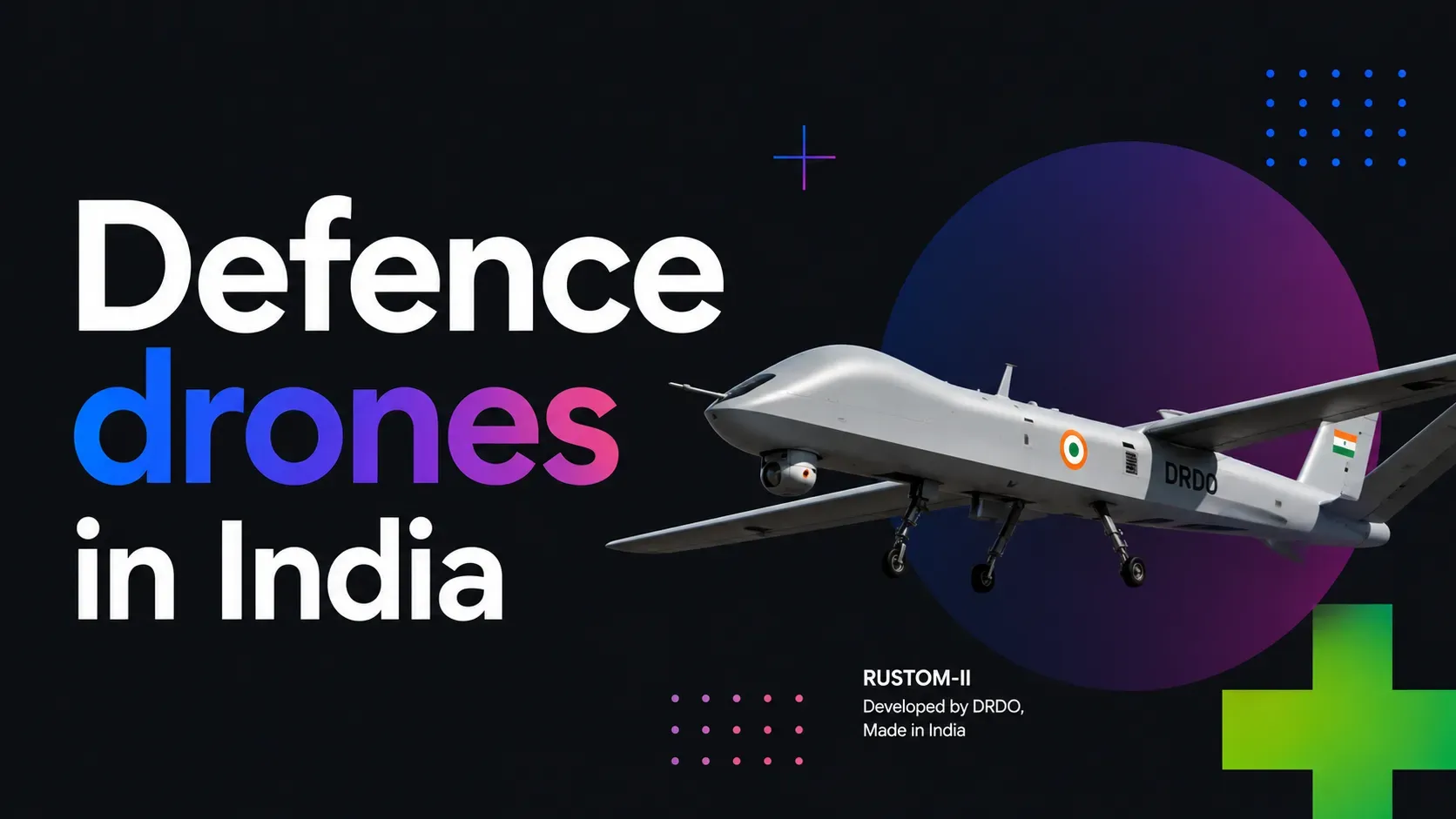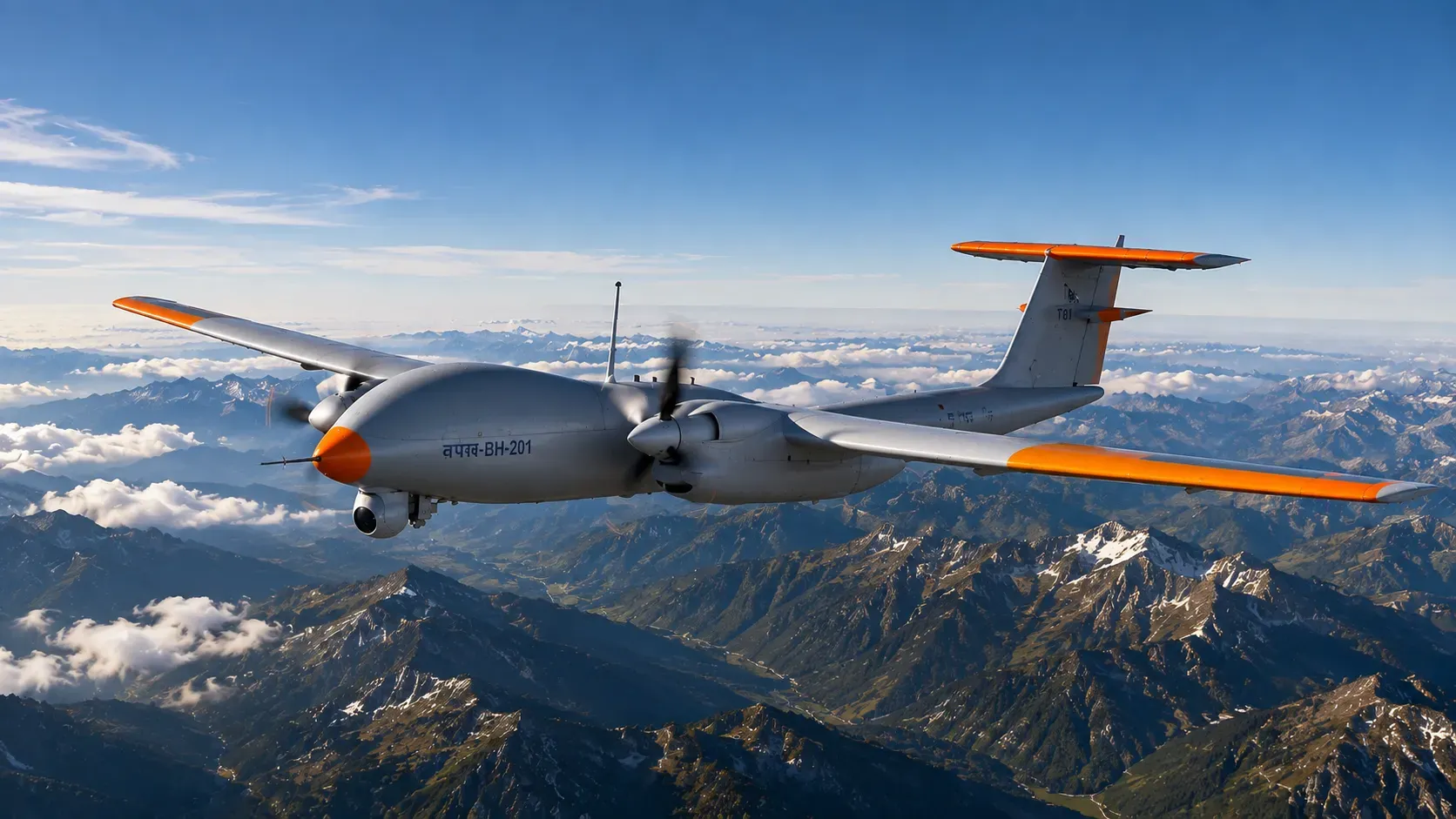
The TAPAS BH-201 programme, formerly Rustom-2, sits at the centre of India's shift from laboratory-led Indian defence drone development to procurement-led MALE drone doctrine. On 14 January 2024 the project was closed as a mission-mode effort against its Joint Services Qualitative Requirements (JSQR). On 9 March 2026 Ministry of Defence sources confirmed its likely exclusion from the planned 97-platform tri-service order (Indian Defence Research Wing, 9 March 2026). The platform-payload-procurement triad explains why TAPAS continues as a technology demonstrator for Archer-NG.
Tracing the Rustom lineage from LCRA to TAPAS BH-201
TAPAS BH-201 inherits a development lineage that traces back to the 1980s Light Canard Research Aircraft (LCRA) built by the National Aerospace Laboratories under Professor Rustom Damania. The LCRA airframe seeded Rustom-1, a tactical UAV developed by the Aeronautical Development Establishment (ADE) under the Defence Research and Development Organisation (DRDO). On 11 November 2011 DRDO confirmed the fifth successful flight of Rustom-1, validating autonomous take-off, waypoint navigation, and landing at tactical scale (PIB, 11 November 2011).
The Rustom drone lineage evolved from Rustom-1 into the twin-engine Rustom-H concept. That concept matured into the platform redesignated TAPAS BH-201 in 2016. The "BH" in the designation marks "Beyond Horizon" command capability. The platform was scoped from inception for satellite-linked operations past conventional line-of-sight ranges.
The category shift from tactical UAV to MALE drone mattered. It sat below HALE drone and HALE UAV altitude thresholds but above tactical short-range unmanned aircraft. India had operated the imported Heron drone and other MALE-class surveillance systems for over a decade. The country held no domestic Heron UAV equivalent with the same persistence and indigenous subsystem ownership.
TAPAS BH-201 conducted its maiden flight on 16 November 2016 at the Aeronautical Test Range (ATR) Challakere, Chitradurga, Karnataka (DRDO, 16 November 2016). The aircraft introduced a twin-engine wing-mounted configuration, a high-aspect-ratio wing of 20.6 metres, tricycle retractable landing gear, and a T-tail layout. DRDO sanctioned the programme at ₹1,540.74 crore in February 2011. The cost was later revised to ₹1,786 crore by 2022 after subsystem integration and flight-test expansion (SPS Land Forces, 2024).
The Rustom-2 specifications evolved across prototypes designated AF-1 through later development articles. The TAPAS BH-201 specifications settled at a 9.5-metre fuselage, a 20.6-metre wingspan, and a 350 kg payload capacity. The Rustom-2 first flight on 16 November 2016 marked the first time an indigenous Indian MALE-class twin-engine platform took off under autonomous control.
Mapping the airframe, propulsion, and the JSQR baseline
The Joint Services Qualitative Requirements set the operational target the TAPAS programme had to meet. The Indian Armed Forces specified a medium-altitude long-endurance aircraft cleared for 30,000 feet service ceiling and 24-hour endurance. The aircraft had to carry electro-optical, radar, and electronic intelligence payloads simultaneously.
The JSQR is the formal procurement specification. Meeting it qualifies a platform for tri-service induction; missing it does not.
The TAPAS airframe weighed 2,850 kg at maximum take-off weight, heavier than the original 1,800 kg design target. The aircraft used two NPO-Saturn 36MT turboprop engines rated at 100 hp each during early prototype trials, mounted along the wing roots. DRDO later replaced these with 180 hp Austro E4 engines from prototype AF-5 onward (DRDO Rustom programme documentation). The platform incorporated composite structures, redundant avionics, and digital fly-by-wire controls intended for long-duration automated operations.
Flight-test results closed in on the JSQR but did not reach it. By March 2022 DRDO confirmed the platform had demonstrated operations at 28,000 feet with endurance of 18 hours (Janes, March 2022). The 2,000-foot altitude gap and the six-hour endurance gap defined the procurement problem. Mission-mode projects inside DRDO are measured against formal qualitative requirements, not against partial technological maturity.
That distinction shaped the programme's future. TAPAS BH-201 entered a category where subsystem success coexisted with procurement uncertainty. The airframe, sensor integration, and SATCOM stack were operationally credible.
The endurance and altitude shortfalls against JSQR meant the Indian Air Force, Indian Army, and Indian Navy could not commit to large-scale induction on the original specification. Indigenous UAV engine development became the obvious next variable to change.
Building the payload stack: EO, SAR, ELINT, COMINT, and SATCOM
The payload ecosystem became the strongest part of the TAPAS programme. The aircraft carried electro-optical (EO) and infrared surveillance payloads, synthetic aperture radar (SAR) systems, electronic intelligence (ELINT) modules, and communication intelligence (COMINT) payloads across multiple prototype configurations. Together they transformed TAPAS from a basic surveillance drone into an ISTAR drone India had not previously fielded in indigenous form. ISTAR (intelligence, surveillance, target acquisition, and reconnaissance) is the standard tri-service mission category that defines MALE-class operational utility.
The SAR suite demonstrated strip mapping, spotlight imaging, and ground moving target indication (GMTI) modes during trials. These functions matter operationally. The platform maintains surveillance through cloud cover and at stand-off distances where electro-optical systems lose effectiveness. The SAR integration also supported maritime-surveillance mission capability for naval deployment profiles.
On 18 September 2025 the programme demonstrated SATCOM connectivity through the GPS-aided GEO Augmented Navigation (GAGAN) system. GAGAN is the Indian satellite-based navigation augmentation framework built jointly by the Indian Space Research Organisation (ISRO) and the Airports Authority of India (AAI). The test established beyond-line-of-sight control past 1,000 km (Indian Defence Research Wing, September 2025). The TAPAS BH-201 SATCOM integration in September 2025 extended the operational envelope past conventional ground-control limitations.
The SATCOM integration changed the programme's strategic value even after the January 2024 mission-mode closure. A domestically integrated beyond-line-of-sight command stack is independently relevant for maritime surveillance, border monitoring, and networked ISTAR missions. The subsystem survives the original procurement outcome. The same SATCOM architecture now feeds the Archer-NG successor and the wider DRDO MALE UAV reference design.
Reading the flight-test record at Chitradurga
The Aeronautical Test Range at Chitradurga became the operational centre of the TAPAS programme. The site handled endurance trials, payload validation, SATCOM tests, and tri-service evaluations across the AF-series prototypes. The first flight occurred on 16 November 2016 at Challakere, 200 km from Bengaluru. Subsequent prototype losses, recoveries, and configuration changes drove the test programme forward.
The September 2019 crash of prototype AF-6 was the largest setback of the development cycle. The aircraft was lost near Jodichikkenahalli in Chitradurga district during a developmental trial. DRDO attributed the cause to a transient and simultaneous link loss combined with turbulence past the capacity of the control law. Prototype AF-6A incorporated the fix.
AF-6A introduced a solid-state relay low-weight power distribution unit, an indigenous inertial navigation system, lithium-ion batteries, and the SATCOM link. The configuration became the baseline for subsequent flight-test expansion.
The recovery trajectory was clean. In October 2020 the platform achieved eight hours of flight at 16,000 feet. On 13 November 2021 it demonstrated automatic take-off and landing (ATOL) using GAGAN. On 16 December 2021 it cleared 25,000 feet and 10 hours endurance.
By March 2022 the platform reached 28,000 feet and 18 hours. On 27 June 2023 DRDO conducted the 200th flight of TAPAS BH-201 in front of a tri-services evaluation team at ATR Chitradurga (DRDO, 27 June 2023). The 200-flight threshold marked the transition point from developmental flight test to user-evaluation candidacy.
The flight-test record validated four indigenous subsystems that matter past a single aircraft category. The retractable tricycle landing gear came from the Combat Vehicles Research and Development Establishment (CVRDE), proven across more than 100 trials on the 2.85-tonne airframe class. Certification oversight involved both the Centre for Military Airworthiness and Certification (CEMILAC) and the Directorate General of Aeronautical Quality Assurance (DGAQA). TAPAS BH-201 became the first R&D-prototype UAV to enter the CEMILAC and DGAQA certification process at this scale.
One naval test moved the programme decisively into maritime-ISTAR territory. On 16 June 2023 DRDO and the Indian Navy demonstrated ship-borne command-and-control with the aircraft operating 148 km from Karwar naval base. One ground control station and two ship data terminals were installed on INS Subhadra; the UAV flew at 20,000 feet under naval control. The exercise validated command-handover concepts the Indian Navy needs for Andaman and Nicobar Islands maritime surveillance.
Inside the production partnership with HAL and BEL
The production partnership for TAPAS BH-201 brought Hindustan Aeronautics Limited (HAL) and Bharat Electronics Limited (BEL) into the programme as the designated public-sector manufacturers. In May 2022 DRDO transitioned the system to HAL and BEL for limited series production. HAL took the airframe and lead-integrator role, positioning the platform as an HAL drone with public-sector production oversight. BEL took the ground control station, data terminals, and avionics integration.
Taneja Aerospace and Aviation built the fuselage. Aarav Unmanned Systems handled wind-tunnel testing during the development cycle. The supplier chain extended past the public-sector core into the private aerospace ecosystem.
The initial induction plan covered 76 platforms across the three services: 60 for the Indian Army, 12 for the Indian Air Force, and 4 for the Indian Navy. The plan assumed user-evaluation success at 30,000 feet with endurance above 16 hours. In June 2024 the government approved a 10-unit Indian Air Force drone and Indian Navy production order, driven by border-security requirements (Unmanned Network, June 2024). The order proceeded despite the JSQR shortfall because the achieved 28,000-foot, 18-hour profile met the operational need for ISR missions along the western and northern borders.
The HAL-BEL partnership became the bridge between the TAPAS programme and what came next. The production tooling, integration workflow, certification artefacts, and ground-segment infrastructure built around TAPAS now feed Archer-NG and the wider MALE drone India procurement architecture. The HAL airframe-production line, the BEL ground-segment integration, and the joint certification pathway with CEMILAC and DGAQA persist across the platform transition.
The production partnership clarified the role of the Aeronautical Development Establishment as a system-design house rather than a manufacturer. ADE owns the design authority. HAL and BEL own the production. CEMILAC owns the airworthiness sign-off.
The three-way separation is the institutional baseline India now applies to indigenous MALE-class development.
Closing the mission mode: the JSQR reclassification
On 14 January 2024 government sources confirmed that TAPAS BH-201 had been closed as a mission-mode project. The decision followed the formal assessment against Joint Services Qualitative Requirements. The endurance and altitude thresholds remained below the original specification (consolidated Indian defence press reporting, 14 January 2024; primary-source verification recommended against the underlying PTI dispatch). The TAPAS BH-201 mission mode closure on 14 January 2024 was the largest procurement reclassification an indigenous MALE programme had ever undergone in India.
The mission-mode designation matters institutionally. DRDO mission-mode projects carry committed sanction funding, formal user-service review cycles, and a structured pathway to bulk production. Closure as a mission-mode project moves the platform out of that pathway. The reclassification did not terminate development.
DRDO leadership clarified that TAPAS, a flagship DRDO drone project, would continue as a technology demonstrator feeding the Archer-NG successor programme. DRDO Chairman Dr Samir V Kamat confirmed the technology-demonstrator transition (Indian Defence Research Wing, 2024).
The distinction between programme closure and platform termination matters for the operator and integrator audience. The airframe continued to fly. The SATCOM stack continued to mature.
The payload integration work continued. What changed was the procurement category.
TAPAS exited the mission-mode pathway that would have led to bulk armed-forces induction. It entered the technology-harvesting pathway that feeds successor platforms. That doctrinal shift inside DRDO was the real news.
Earlier programmes treated procurement success as the singular institutional benchmark. The TAPAS pathway treats subsystem maturity, technology transfer, and successor inheritance as parallel benchmarks of equivalent institutional value. The 14 January 2024 decision codified that shift for the first time at this scale.
Re-engining for indigenous power: the VRDE-Jayem powerplant
Propulsion became the next major transition layer after the mission-mode closure. The Vehicle Research and Development Establishment (VRDE) developed an indigenous 180 hp turbocharged engine in partnership with Jayem Automotives.
The TAPAS BH-201 indigenous engine, a 180 hp VRDE-Jayem powerplant, is a 2.2-litre four-cylinder inline turbocharged common-rail direct-injection unit. It generates 180 hp at 11,000 feet and is rated to operate up to 32,000 feet. A Full Authority Digital Engine Control (FADEC) unit provides automated operation and redundancy.
On 24 August 2025 the Aeronautical Development Establishment briefed the Parliamentary Standing Committee on Defence (SCoD) on the indigenous-engine first-flight schedule. ADE confirmed a target window of late September or October 2025 for the first flight integration (Indian Defence Research Wing, 24 August 2025). The flight was framed as the critical test of India's ability to produce high-performance UAV propulsion domestically. The engine replaces the imported Austro E4 powerplant the earlier prototypes carried and raises the platform's indigenous content from a partial figure to approximately 80 percent.
The indigenous engine effort matters past TAPAS alone. Imported propulsion remained the largest external dependency across Indian MALE-class development through the mid-2020s. The VRDE-Jayem powerplant addresses that dependency at the engine-class with operational relevance for the MALE category. Engine localisation ties directly to endurance performance, supply-chain autonomy, and export viability for future Indian unmanned aircraft.
The transition signalled the institutional doctrine change. DRDO mission-mode closure on the original TAPAS configuration coexisted with continued investment in the indigenous engine that would have made the original platform meet its JSQR. The institutional decision was to harvest the engine work for Archer-NG and successor platforms. The 180 hp VRDE engine is therefore both a TAPAS legacy and an Archer-NG enabler.
Decoding the Archer-NG transition: what TAPAS hands forward
Archer-NG emerged as the direct inheritor of the TAPAS technology base. The aircraft completed its maiden flight on 24 October 2025 at ADE (Indian Defence Research Wing, October 2025). Archer-NG introduces a single-engine twin-boom configuration in contrast to the heavier twin-engine wing-mounted layout TAPAS used.
Maximum take-off weight is approximately 1,800 kg against TAPAS's 2,850 kg. The lighter airframe targets operations above 30,000 feet, the altitude threshold TAPAS could not consistently reach. Payload capacity is 400 kg.
The Archer-NG MALE UAV is engineered specifically for the Indian Army's high-altitude operational profile along the Line of Actual Control. The design also carries weapon integration intent including laser-guided rockets, bombs, and loitering munitions. The 100 km strike range positions Archer-NG as both an ISTAR platform and a strike platform.
TAPAS was an ISR platform throughout its life. The Archer-NG redesign reflects lessons learned through TAPAS endurance trials, propulsion integration, and the user-evaluation feedback gathered between 2022 and 2024.
DRDO Chairman Dr Samir V Kamat has publicly confirmed that TAPAS technologies transition into Archer-NG. The technology transfer extends into the wider industry-partnership architecture supporting the next MALE procurement cycle (Indian Defence Research Wing, 2024).
The TAPAS to Archer-NG technology transfer covers six subsystem layers. The first three are the SATCOM integration logic, the fly-by-wire digital flight control, and the payload-management software. The other three are the automatic take-off and landing capability, the CVRDE retractable landing gear, and the ground control station architecture. Archer-NG shares common avionics, ground control station, and ground data terminal architecture with TAPAS by design.
The propulsion inheritance is the central engineering bridge. The Archer-NG prototype uses the Austro E4 powerplant inherited from the TAPAS programme. The VRDE-Jayem 180 hp indigenous engine will progressively replace the imported unit as it clears certification milestones. The 220 hp VRDE engine under parallel development would push the Archer-NG envelope further.
The institutional design is explicit. TAPAS hands the engine, the SATCOM stack, and the ground-segment architecture forward to Archer-NG. Archer-NG carries those subsystems into a configuration that meets the JSQR TAPAS missed.
Sizing the procurement decision: the 87-platform MALE tender
The procurement architecture around the programme shifted sharply through 2025 and 2026. On 11 August 2025 the Defence Acquisition Council (DAC) cleared a tri-service procurement framework for 87 MALE-class UAVs (Indian Defence Research Wing, August 2025). The tender mandates a 60 percent domestic content threshold.
The Indian Army UAV requirement targets 31 platforms, alongside 41 for the Indian Air Force and 15 for the Indian Navy. Operational parameters specify operation above 35,000 feet for 30 hours or more, the altitude-endurance combination TAPAS could not deliver.
Programme value is approximately ₹30,000 crore, one of India's largest unmanned aviation opportunities. On 31 March 2026 the Ministry of Defence extended the bid deadline from 27 March to late May 2026 (Indian Defence Research Wing, 31 March 2026). The extension followed requests from participating consortia affected by West Asia operational conditions.
The 87 platforms will be split between the two lowest bidders in a 64:36 ratio. The split creates two independent production lines inside India under transfer-of-technology frameworks.
The 97 MALE UAV procurement India had originally scoped represents the wider tri-service requirement. The 87-platform tender is the current contracting instrument inside that requirement. On 9 March 2026 Ministry of Defence sources confirmed TAPAS BH-201 is likely to be excluded from the 87-platform competition (Indian Defence Research Wing, 9 March 2026).
The Indian Navy has indicated preference for an Israeli-origin MALE platform manufactured in India under transfer-of-technology, rather than TAPAS, for maritime ISR. The Indian Army is expected to align its selection with the platform that wins the broader tender.
The procurement decision sits inside a structured competition between domestic-public, domestic-private, and Indian-foreign consortium bids. The competitive field includes Indian public-sector and private firms partnered with global original equipment manufacturers. The tender architecture deliberately avoids single-vendor dependency.
Three rules anchor the competition. The 60 percent indigenous-content mandate sets the localisation floor. The dual-vendor split protects against single-source supply risk.
The technology-transfer requirement keeps the production base inside India and anchors the platform as a Made in India drone family. Together these conditions will frame how Archer-NG and its competitors are assessed across the next eighteen months.
Opening the technology-transfer signal to private industry
DRDO confirmed in May 2026 that subsystem technologies from the TAPAS programme would open to private-sector participation ahead of the 87-platform MALE acquisition cycle (Raksha Anirveda, May 2026). The transfer marks a doctrinal shift. India historically treated defence aerospace development as a tightly held public-sector process. TAPAS established reusable technology layers that private integrators can fold into their own airframes and mission systems.
The transferable subsystem stack is specific. It includes the automatic take-off and landing logic and the SATCOM integration pathways. It includes the fly-by-wire digital flight control with control laws validated across more than 200 flights.
It also includes the CVRDE tricycle landing-gear architecture engineered for heavy autonomous aircraft, the payload-management software, and the VRDE indigenous propulsion development. Each of these subsystems stands independently of whether the original TAPAS airframe enters bulk operational service.
The shift changes how Indian defence integrators position themselves inside the unmanned ecosystem. Firms competing for the 87-platform tender can integrate DRDO-developed technologies into their own production architectures. They do not have to build every subsystem from first principles. The technology-transfer model lowers the entry barrier for private participation in indigenous MALE design.
The signal carries strategic implications past the immediate procurement cycle. The institutional architecture that DRDO is building around TAPAS technology transfer is the prototype for how India will run the next generation of mission-mode programmes. The mission-mode model that ends in either induction or termination is being replaced by a model that ends in induction, technology transfer, or both. TAPAS is the first programme to complete the institutional cycle under this revised approach.
Watching the next twelve months across three indicators
The next twelve months will produce the operational data that determines whether the TAPAS pathway becomes the template for future DRDO drones and Indian indigenous MALE development. Three indicators carry the load.
The first is the VRDE-Jayem indigenous-engine flight integration outcome. The engine cleared the Parliamentary Standing Committee on Defence target window for first flight in late September or October 2025. Sustained flight performance at 32,000 feet against the JSQR target altitude is the certification trigger.
A successful engine certification path lifts the indigenous-content figure across both TAPAS and Archer-NG. It also de-risks the procurement timeline for Indian Army-led MALE induction.
The second is the 87-platform tender award. The Ministry of Defence extended the bid deadline to late May 2026. Three factors will shape the outcome: the award decision itself, the dual-vendor split, and the indigenous-content compliance assessment.
Together these set the operational baseline for the Indian Army, Indian Air Force, and Indian Navy MALE fleet for the next decade. The Archer-NG bid is the institutional test of whether the TAPAS technology-harvest model produces a competitive indigenous platform inside the contracting window.
The third is the technology-transfer uptake by private industry. The TAPAS subsystem stack is now available to integrators. The competitive bids submitted ahead of the May 2026 deadline will reveal three things.
They will show which firms folded the transferred technologies into their architectures, which built their own from first principles, and which partnered with global original equipment manufacturers. The mix that emerges will indicate whether India's MALE story matures into an exporter of indigenous unmanned aircraft families. The alternative is that India remains a buyer of foreign platforms manufactured locally.
The TAPAS BH-201 programme will not be remembered for the JSQR it missed. It will be remembered for the institutional pathway it built. That pathway covers the technology-demonstrator transition, the indigenous engine, the SATCOM stack, the certification framework, and the production architecture. All of it hands forward to Archer-NG, to the 87-platform tender, and to the next generation of Indian MALE drones.