Remote Pilot Certificate, or RPC, is mandatory for most commercial drone operations in India. It replaced the Remote Pilot Licence under the Drone Amendment Rules 2022 (Ministry of Civil Aviation, 2022). The certificate is issued through DGCA-authorised RPTOs, not directly by the regulator. As of 2024–25, around 3,015 remote pilot certificates were issued online, showing strong demand but limited training capacity (DGCA, 2025). This makes RPC one of the most important compliance steps after drone registration. Without it, operators cannot legally conduct most professional drone activities.
Shifting from licence to certification
India moved from a licence-based model to a certification model to simplify access. Earlier, pilots had to apply directly through DGCA for a Remote Pilot Licence. This created delays and bottlenecks.
The Drone Amendment Rules 2022 changed this structure. Training and certification shifted to DGCA-authorised Remote Pilot Training Organisations (RPTOs). These organisations now conduct training, assessment, and certification. DGCA sets the standards but does not directly issue certificates.
This change reduced administrative friction. It also increased the number of training centres across India. However, most top-ranking articles still refer to “RPL”. This is outdated. The correct term is RPC.
Another change happened in July 2025. The government moved certification workflows to the eGCA portal. This created a unified system for registration, certification, and approvals. Digital Sky now handles only flight permissions.
This split is critical. Most articles do not explain it. Operators often confuse registration with certification. In practice, they are separate steps. A drone can be registered without a certified pilot, but it cannot be used commercially without RPC.
Understanding eligibility and requirements
RPC is required based on drone category and use case. The rule depends on both weight and purpose of operation.
For nano drones below 250 grams, certification is not required if used within limits. For micro drones between 250 grams and 2 kg, RPC is required for commercial use. For drones above 2 kg, certification is required for all operations. The training structure is defined by DGCA. It includes both theory and practical components.
The syllabus was updated in January 2025. This update added more focus on operational safety and real-world scenarios.
Training duration varies by category but usually ranges from 5 to 10 days. After training, candidates must pass both theory and practical assessments.
Most guides do not explain that certification validity depends on continued compliance. Operators must follow airspace rules and maintain safe operations. Violations can lead to suspension or cancellation of the certificate.
Following the step-by-step certification process
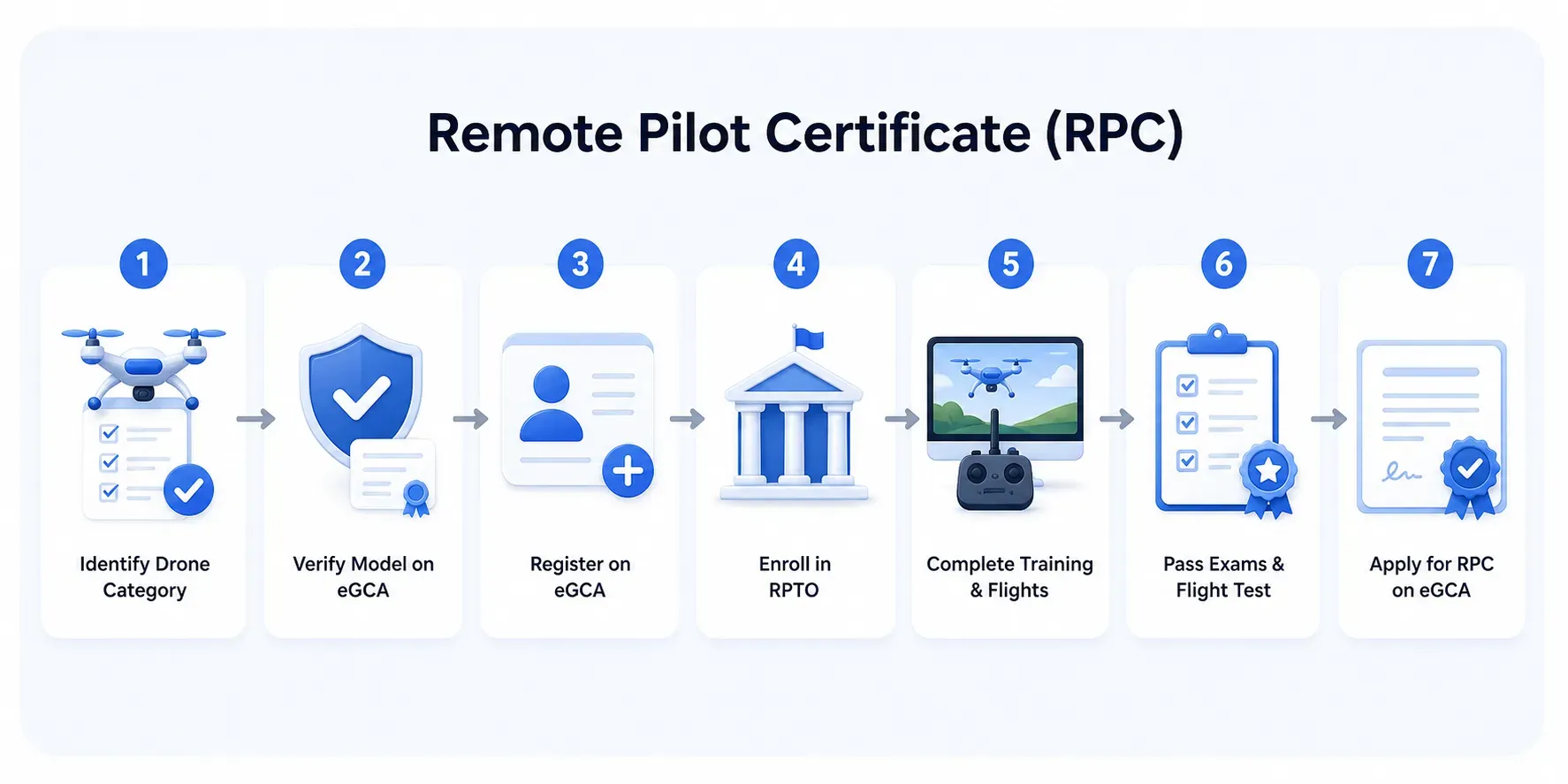
Getting an RPC involves a defined sequence. Skipping any step can delay certification.
- Identify drone category and use case. This determines whether RPC is required.
- Check if the drone model has a valid type certificate on eGCA.
- Register on the eGCA portal and create an operator profile.
- Enrol in a DGCA-authorised RPTO for training.
- Complete ground training, simulator sessions, and supervised flights.
- Pass the theory exam and practical flight test.
- Apply for RPC through the eGCA system.
Each step connects to a different part of the regulatory system.
Most articles stop at “join training and get certified”. They do not explain the sequence. They also ignore the dependency on drone registration and type certification. This creates confusion for new operators.
The process also depends on availability of RPTOs. Training slots are limited in many regions. This creates delays, especially for commercial operators entering the market.
 Remote Pilot Certificate
Connecting certification with real operations
RPC does not allow unrestricted flying. It only confirms that the pilot is trained and authorised.
Operational control still depends on the Digital Sky platform and NPNT system. Before each flight, operators must check airspace zones and request permission where required.
This creates a layered system. Certification validates the pilot. Registration validates the drone. Digital Sky validates each flight.
Most articles do not explain this connection clearly. They treat certification as the final step. In reality, it is one part of a larger compliance system.
The Draft Civil Drone Bill 2025 is expected to expand certification requirements. It introduces stricter enforcement and new licensing categories, including BVLOS pilots (Ministry of Civil Aviation, 30 September 2025).
This means RPC will evolve further. Operators must stay updated as rules change.
What this means in practice
RPC defines who can operate drones professionally in India. It is not optional for most commercial use cases.
For new operators, the process requires planning. Training availability, certification timelines, and regulatory requirements must align before operations begin.
For companies, RPC creates a structured workforce model. Certified pilots can be deployed across projects with clear compliance status. This improves accountability and reduces legal risk.
The system also highlights gaps. Training capacity is limited compared to demand. Many operators still rely on outdated information about RPL. The eGCA and Digital Sky split is not widely understood.
These gaps create operational delays. They also increase the risk of non-compliance.
The certification system is designed to scale with the industry. As drone use expands across agriculture, infrastructure, and logistics, RPC will remain a core requirement.
India’s drone ecosystem is moving toward system-level compliance, where training, registration, and operations are all verified digitally before execution.
At Kodainya, we believe that drone capability in India will depend on trained operators who understand both regulation and execution, not just certification.


