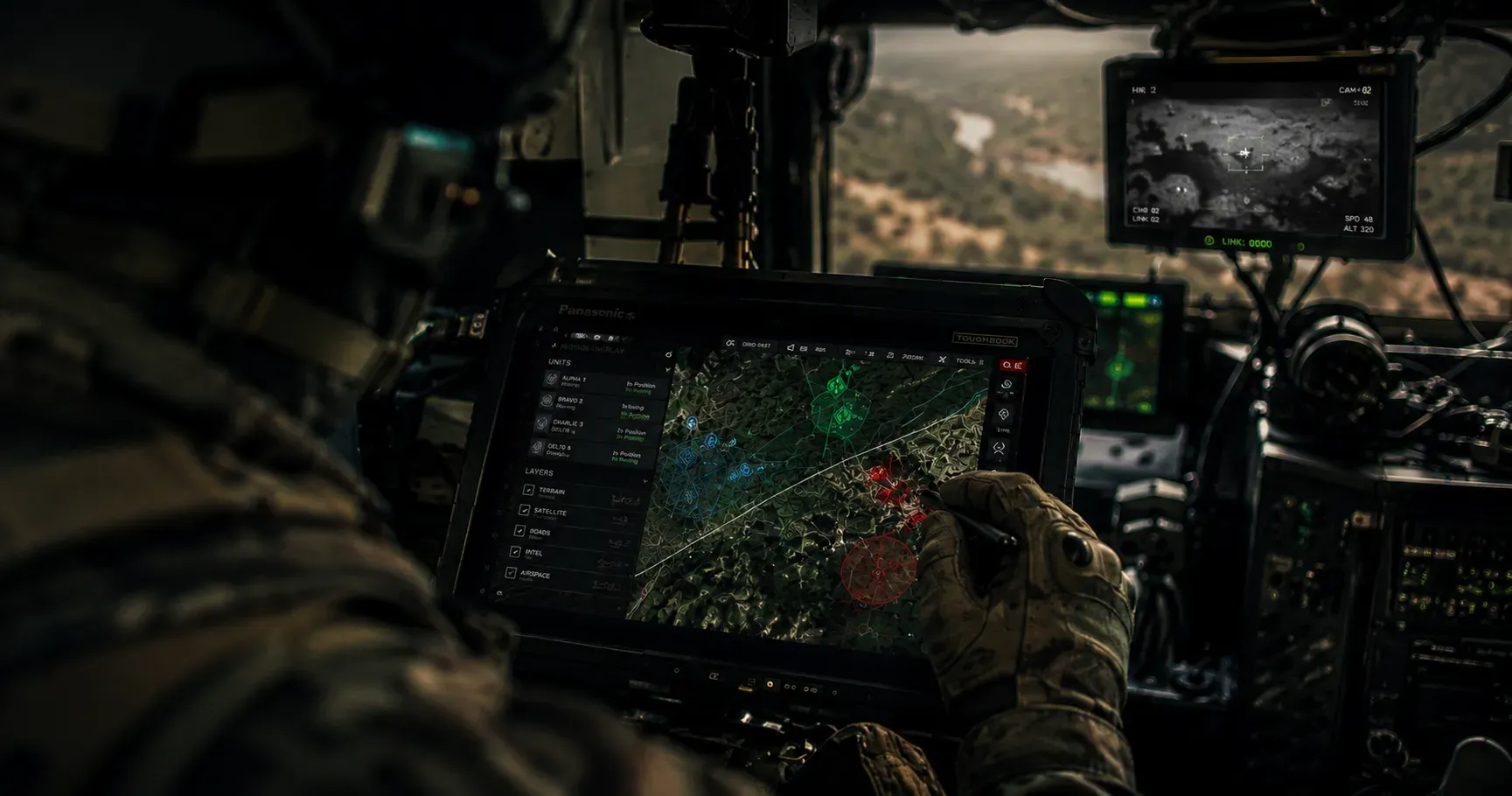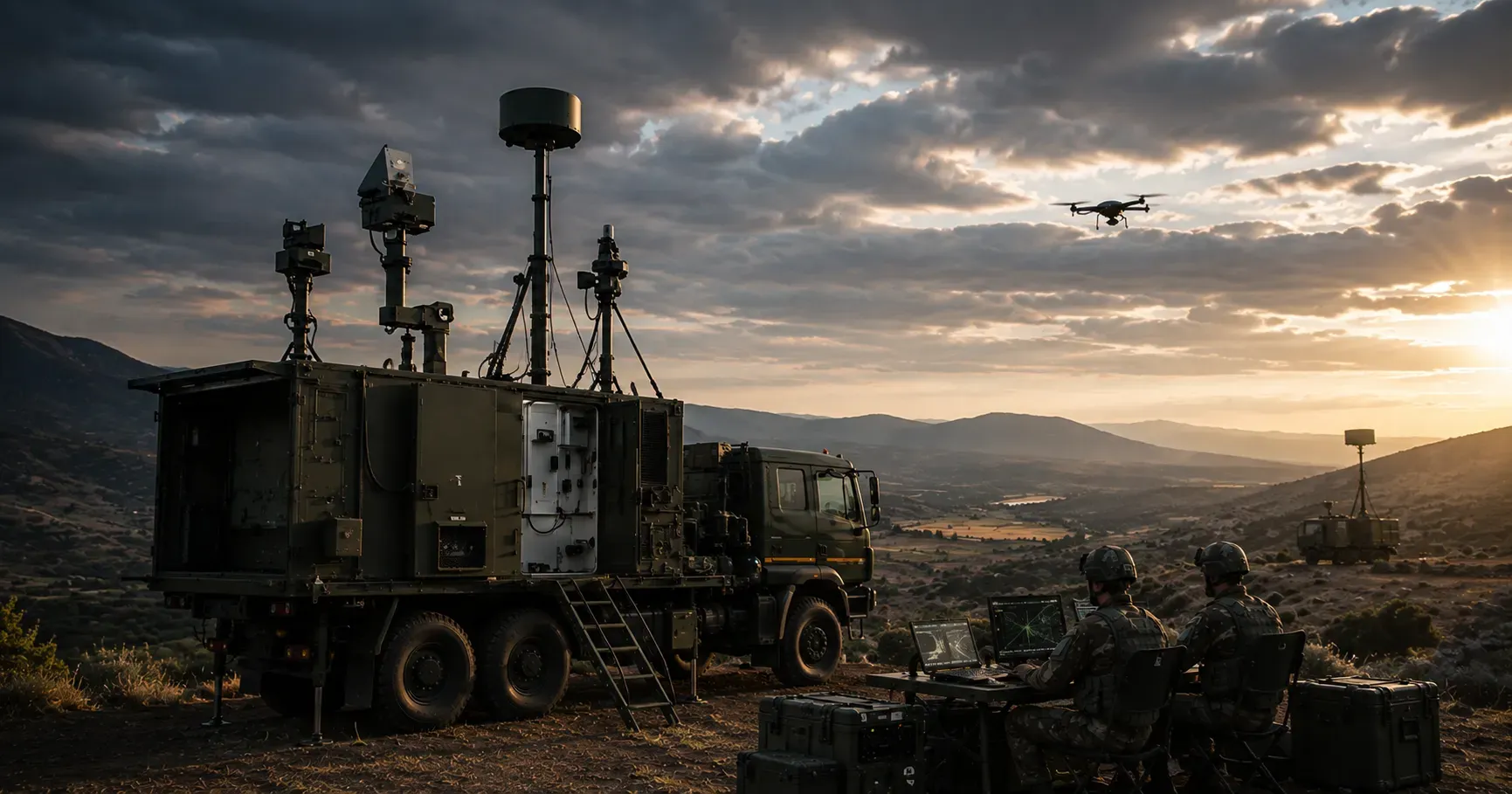
The Akashteer air defence battle management system collapses the radar-to-shooter loop for the Indian Army's Corps of Army Air Defence. It fuses radars, sensors, communication nodes, and ground-based weapons into a single automated network. The Ministry of Defence issued the Request for Proposal for 83 Carrier Air Defence Tracked carriers on 28 April 2026 (Ministry of Defence, 28 April 2026). This page maps the sensors, the network, the weapons, the tri-service spine, the procurement timeline, and the doctrinal arc to Mission Sudarshan Chakra.
Understanding Akashteer in the Indian Army air defence stack
Akashteer is an automated Air Defence Control and Reporting System used by the Indian Army's Corps of Army Air Defence. The system creates a common operational air picture and distributes that information across air defence units in real time (Press Information Bureau, 29 March 2023). It sits inside the wider military drones cluster the Indian Armed Forces are inducting.
The Indian Army's air defence challenge has shifted. Small drones, loitering munitions, helicopters at low altitude, cruise missiles, and coordinated aerial threats compress decision timelines. Akashteer was built to address that problem.
Traditional air defence systems relied on separate radars, command posts, and weapon units exchanging information through manual handoffs. Every handoff introduced delay. The Akashteer air defence system reduces those delays by automating target reporting, track correlation, threat evaluation, and weapon assignment. The result is a shorter radar-to-shooter loop and lower coordination overhead across connected formations.
The system does not replace radars or missile platforms. It acts as the digital layer that connects them. A radar detects a target, the system receives the track, and the network fuses inputs from multiple sensors. Air defence commanders read a single recognised air picture, after which ground-based weapons are assigned against validated threats.
This distinction matters. Akashteer is not a missile programme and not a radar programme. It is a battle management system that sits above individual sensors and weapons.
In practical terms, the Akashteer air defence system does for Army Air Defence what a network operating system does for a data centre. It integrates components into one coordinated architecture. The threat-class taxonomy the system must classify is covered in the taxonomy of unmanned systems.
Building an indigenous command network
Akashteer represents a shift toward indigenous defence networking capability. The system aligns with the Atmanirbhar Bharat agenda for self-reliance in defence electronics. BEL designed and developed the platform in collaboration with the Defence Research and Development Organisation (DRDO) and the Indian Space Research Organisation (ISRO). Official government releases confirm the three-agency authorship (Press Information Bureau, 16 May 2025).
The programme aligns with India's effort to build sovereign command-and-control infrastructure rather than relying on imported battle management systems. Air defence networks operate at the centre of military decision-making. Control over software architecture, communications protocols, cyber resilience, and system upgrades therefore carries strategic weight.
Search traffic for "who developed Akashteer" surfaces BEL as the headline answer. The fuller picture is that the system reflects collaboration across three Indian defence and technology institutions.
The integration spans clear lanes. BEL provides the system-level engineering and the manufacturing base. DRDO contributes the underlying air-defence and signal-processing technologies. ISRO contributes satellite communications and positioning support that link the network across forward and rear nodes.
The Akashteer BEL programme runs out of the company's Ghaziabad facility. The first batch of control centres was flagged off in April 2024 (Press Information Bureau, December 2024). By 30 September 2024, BEL had delivered 100 systems to the Indian Army.
Indigenous content has been built into the programme from contract signature. The 29 March 2023 contract for Akashteer was awarded under the indigenous procurement route to BEL's Ghaziabad division. The LLLR-I expansion follows the same pattern (Ministry of Defence, February 2026).
The result is a system built around Indian operational requirements rather than foreign procurement templates. That approach matters as the Army integrates radars, missile systems, anti-drone assets, and sensor-fusion platforms across the 455-unit Akashteer Indian Army programme.
Mapping the radars and sensors feeding Akashteer
[ALT TEXT: A comparison diagram of the radars feeding the Akashteer air defence system, mapping the Tactical Control Radar REPORTER, 3D Tactical Control Radars, and Low-Level Lightweight Radars against altitude, range, and target type for the Indian Army's Corps of Army Air Defence.]
The sensor layer forms the foundation of Akashteer. Without reliable detection and tracking, an advanced command network becomes ineffective.
Akashteer integrates four sensor families. The list covers Tactical Control Radar REPORTER, 3D Tactical Control Radars, Low-Level Lightweight Radars, and the Akash Weapon System radar (Press Information Bureau, 16 May 2025). The Akashteer sensor list is anchored to this base group. Additions are planned across the 30-unit LLLR-I tranche the Ministry of Defence approved in February 2026 (Ministry of Defence, February 2026).
Sensor type | Primary role | Target focus |
|---|---|---|
Tactical Control Radar REPORTER | Air surveillance and tracking | Low and medium altitude threats |
3D Tactical Control Radar | Three-dimensional target tracking | Aircraft and aerial threats |
Low-Level Lightweight Radar | Low-altitude surveillance | Drones, helicopters, low-flying targets |
Akash Weapon System radar | Fire-control support | Missile engagement support |
Akashteer radar integration matters because the Indian Army's threat picture spans altitudes. Aircraft and cruise missiles operate at medium altitude. Helicopters, loitering munitions, and small drones sit at the lower edge of the envelope. Each radar family is tuned to a different band, and the system correlates the inputs into a single track per target.
The importance of this sensor architecture lies in redundancy and track validation. A single radar may detect a contact, and additional sensors confirm it. Akashteer then correlates those tracks into a unified picture.
Modern threats present small radar signatures and operate close to the terrain. VTOL platforms now populating the low-level airspace Akashteer monitors raise the volume of low-altitude tracks the system must handle. The challenge is not only detecting an object. It is determining whether the inputs from two or more sensors describe the same target, then distributing that conclusion across the force.
The FPV and small-drone class that has reset Indian Army air defence assumptions sits at the lowest edge of the envelope. The LLLR-I tranche is the response. Future air-defence architectures will fold in AI-assisted sensor fusion, automated target classification, and computer-vision-enabled detection. The Akashteer network structure provides the foundation on which those capabilities can be integrated as they mature.
Creating a single recognised air picture
The network layer differentiates Akashteer from a collection of independent radar systems. When observers ask how does Akashteer work, the answer lies in data fusion. The Akashteer system gathers information from distributed sensors, validates tracks, removes duplicates, prioritises threats, and presents operators with a common operational picture (Press Information Bureau, 16 May 2025).
The objective is straightforward. Every relevant air defence node should see the same air situation at approximately the same time.
Without a shared air picture, different units may classify threats differently or allocate weapons inefficiently. A common operational view reduces confusion and improves engagement coordination across the formation.
This network-centric approach mirrors the broader pattern in advanced military command-and-control systems. The emphasis shifts from individual platforms toward connected architectures. The effectiveness of the force depends on information flow more than on the performance of any single sensor or launcher. The Akashteer system explained at the network level is an information-flow problem, not a hardware problem.
Operators read targets against the UAV-UAS-RPAS terminology divide that shapes how the system reports targets. The labelling matters because incorrect classification can cascade into the wrong weapon assignment. The Akashteer network reduces that risk by holding a single track-and-classification record per target across the formation.
For the Corps of Army Air Defence, the practical result is a shorter radar-to-shooter loop and sharper situational awareness. The system also adds capacity to manage simultaneous aerial tracks across contested airspace.
Integrating weapons into the engagement chain
The weapon layer is where information becomes action. Akashteer controls and coordinates Ground-Based Air Defence Weapon Systems across the Army's air defence network (Press Information Bureau, 29 March 2023). The system supports engagement planning and weapon assignment after threat tracks have been identified and validated.
The Akash Weapon System forms an important part of this architecture. The Akashteer weapon systems list also covers short-range air defence platforms and the Quick Reaction Surface-to-Air Missile (QRSAM) family. Both fold into the network through the same command-and-control framework.
The core concept is not individual weapon performance. It is coordinated employment. A networked force can allocate an appropriate weapon against a given target rather than relying on isolated local decisions.
Coordinated employment matters during saturation attacks involving simultaneous targets. Air defence commanders must decide which threats require engagement, which weapons to assign, and how to manage interceptor inventories. Akashteer provides the command-and-control framework that supports those decisions.
Among the threats the engagement chain is tuned for are kamikaze drones and loitering munitions, which Akashteer must track and engage. These platforms blur the line between sensor and effector, and the network must classify them in seconds rather than minutes.
As the Army expands counter-drone and layered air defence capabilities, the value of a common battle management architecture rises. Each additional sensor or weapon gains operational value when connected to the wider network.
Wiring Akashteer into the tri-service C4ISR spine
Akashteer operates within a larger national defence ecosystem. The system integrates with the Indian Air Force's Integrated Air Command and Control System (IACCS) and the Indian Navy's Trigun network. Official government releases confirm the integration (Press Information Bureau, 16 May 2025). The Akashteer IACCS Trigun configuration is the backbone of India's tri-service air defence.
The boundary between Akashteer vs IACCS is functional. IACCS serves as the Indian Air Force's strategic air command-and-control network. Akashteer serves the Indian Army's air defence formations. Trigun supports the Indian Navy's maritime air defence operations.
The Joint Air Defence Centre (JADC) acts as the coordinating node across the three networks. The JADC is IAF-led. It accesses Army sensors through Akashteer, Air Force sensors and civilian radars through IACCS, and naval ship-based sensors through Trigun (Press Information Bureau, 16 May 2025).
In operational terms, the JADC offers commanders a single view that draws inputs from the three services. The arrangement reduces cross-service classification mismatches and speeds the cueing of the closest effector to the threat.
The Akashteer C4ISR framework refers to Command, Control, Communications, Computers, Intelligence, Surveillance and Reconnaissance. Akashteer's role within that framework is to translate Army sensor and weapon information into a format the wider defence network can consume.
The offensive partner doctrine to the Akashteer defensive role is covered in combat air teaming concepts that share the C4ISR backbone with Akashteer. Both bodies of doctrine route information through the same tri-service spine, with the Joint Air Defence Centre as the shared coordinating layer.
The result is a national air picture that draws on Army radars, Air Force radars and civilian airspace inputs, and naval ship-based sensors. The picture is not perfect across all sectors at all times. Government releases note that one site was fully integrated as of January 2025, with further sites progressing through integration.
Reading the procurement timeline from the Rs 1,982 crore contract
The Akashteer procurement story has four distinct waves. Each wave widens the system's reach into Army Air Defence formations.
Wave one began on 29 March 2023, when the Ministry of Defence signed the Akashteer Rs 1982 crore contract with BEL Ghaziabad. The Ministry approved 455 systems in total under the agreement (Press Information Bureau, 29 March 2023). The signing took place alongside two adjacent contracts, taking the day's total commitment past Rs 5,400 crore.
Wave two ran from April 2024 onward. The first batch of Akashteer Control Centres was flagged off from BEL Ghaziabad in April 2024 (Press Information Bureau, December 2024). By 30 September 2024, BEL had delivered 100 units. The Akashteer induction status as of late 2024 sat at roughly 22 per cent of the 455-unit programme.
Wave three is the radar augmentation phase. In February 2026, the Ministry of Defence issued a Request for Proposal for 30 Low-Level Lightweight Radars (LLLR-I) and two classroom variants. The RFP carries a value of Rs 725 crore (Ministry of Defence, February 2026).
The RFP requires Akashteer compatibility as a mandatory specification. The Army Cyber Group's secure-connection criteria form a gating condition for any bidder.
Wave four is the mobility upgrade. The Defence Acquisition Council granted Acceptance of Necessity for the Carrier Air Defence Tracked programme on 27 March 2026 (Ministry of Defence, 27 March 2026). The Ministry of Defence issued the RFP for 83 CADET systems on 28 April 2026 (Ministry of Defence, 28 April 2026).
Each wave shifts the system from a fixed-deployment posture toward a mobile, mechanised-formation posture. The 455-unit base, the LLLR-I radar tranche, and the 83-unit CADET fleet combine into a single layered roll-out. The Akashteer Indian Army programme is on track for completion by 2027 per the Ministry's induction targets.
Moving Akashteer onto tracked platforms: the CADET wave
The next phase of Akashteer's evolution is mobility.
The Defence Acquisition Council granted Acceptance of Necessity for the Carrier Air Defence Tracked programme on 27 March 2026. The Ministry of Defence issued the RFP for 83 CADET systems on 28 April 2026 under the Buy (Indian-IDDM) category (Ministry of Defence, 28 April 2026). Bids close on 21 July 2026, with delivery scheduled across a 36-month window.
CADET addresses an operational gap. Truck-mounted command centres support Akashteer well in fixed deployments and across roaded terrain. Mechanised formations need platforms that can move alongside armoured and tracked combat units. The Akashteer CADET tracked platform places air defence command capability on protected, armoured tracks.
The technical specifications in the RFP are demanding. The platform must operate at altitudes up to 5,000 metres and across temperatures from minus 30 degrees to plus 50 degrees Celsius. It must achieve 45 km/h on roads and 15 km/h cross-country, with a range above 320 km. The vehicle must also support multi-GNSS positioning, including GPS, GLONASS, and NavIC (Ministry of Defence, 28 April 2026).
Indigenous content sits at minimum 65 per cent under the Buy (Indian-IDDM) framework. The platform supports STANAG Level II to III ballistic protection. It must run a silent operating mode through an auxiliary power unit. It must also be transportable aboard Indian Air Force C-17 aircraft (Ministry of Defence, 28 April 2026).
The CADET wave matters beyond vehicle procurement. It turns Akashteer from a network supporting static and semi-mobile deployments into one that can accompany manoeuvre formations. The Akashteer CADET tracked platform also creates a common chassis the Army can re-use for adjacent command, sensor, and electronic-warfare roles across the field force.
Routing Akashteer into Mission Sudarshan Chakra and the 2035 horizon
The longest-horizon claim on Akashteer is its role inside Mission Sudarshan Chakra. The mission was announced by the Prime Minister on 15 August 2025. The goal is a multi-layered, AI-enabled national air defence shield in place by 2035.
Mission Sudarshan Chakra is structured around two phases. Phase one targets a 2028 to 2029 operational baseline. Phase two targets the full 2035 architecture. The Akashteer Mission Sudarshan Chakra integration sits inside phase one, alongside the IACCS network and project Kusha interceptors.
The phase-one baseline links existing Army Air Defence and Air Force command networks into a single operational frame. The work spans interoperability protocols, joint exercises, and shared targeting cueing. Phase one is the proof point for the layered shield concept before phase two scales the architecture.
The architecture is layered across three altitudes. The outer layer uses long-range surveillance, including space-based sensors and high-altitude radars. The middle layer uses interceptor missiles such as Akash and MRSAM. The inner layer uses directed energy weapons, anti-drone guns, and short-range air defence for terminal protection.
Akashteer feeds the middle and inner layers of that architecture. Its sensor fusion and weapon-cueing functions translate cleanly into the broader shield. The Joint Air Defence Centre is the coordinating layer that bridges Akashteer, IACCS, and Trigun into a national picture for the Sudarshan Chakra grid.
For the Corps of Army Air Defence, the practical signal is continuity. The 455-unit Akashteer programme, the 30-unit LLLR-I radar tranche, and the 83-unit CADET fleet are not standalone procurement decisions. Each is a tile in the Mission Sudarshan Chakra mosaic. Each tile is locked to a primary-source contract or RFP that names Akashteer compatibility on the technical side.
Translating Akashteer into operator, integrator, and policy implications
The system reshapes how three audiences should read the air defence stack.
For defence integrators, Akashteer establishes the digital backbone that future air defence systems must connect to. Sensor providers, radar developers, communication-system suppliers, and weapon manufacturers need clean interoperability with Army battle management networks. The LLLR-I RFP's mandatory Akashteer compatibility clause is the operational signal. Future RFPs will carry the same clause.
For government policy researchers, the programme illustrates a procurement trend. The focus is moving from standalone platforms toward integrated operational architectures. Procurement decisions weigh how systems exchange information alongside how individual platforms perform. The Buy (Indian-IDDM) framing under the CADET RFP is the visible policy lever.
For defence journalists, Akashteer offers a citable timeline of capability growth. The Rs 1,982 crore contract was signed on 29 March 2023, followed by the first-batch flag-off in April 2024 and the 100-unit delivery by 30 September 2024.
The LLLR-I RFP came in February 2026 and the CADET RFP on 28 April 2026. Each milestone carries a primary-source citation.
For the Akashteer Corps of Army Air Defence, the system represents a shift toward network-centric operations. The corps now operates a command layer that connects radar surveillance, threat evaluation, and weapon cueing across forward and rear nodes. Future upgrades will fold in expanded sensor integration, deeper automation, improved counter-drone workflows, and AI-assisted threat evaluation. Akashteer sits on the military side of the airspace, while the eGCA platform that governs civilian drone operations handles the civilian side.
The next milestone to watch is the transition from the truck-mounted Akashteer base into the tracked CADET fleet. Beyond that sits the system's role inside the wider Mission Sudarshan Chakra architecture planned for the next decade.