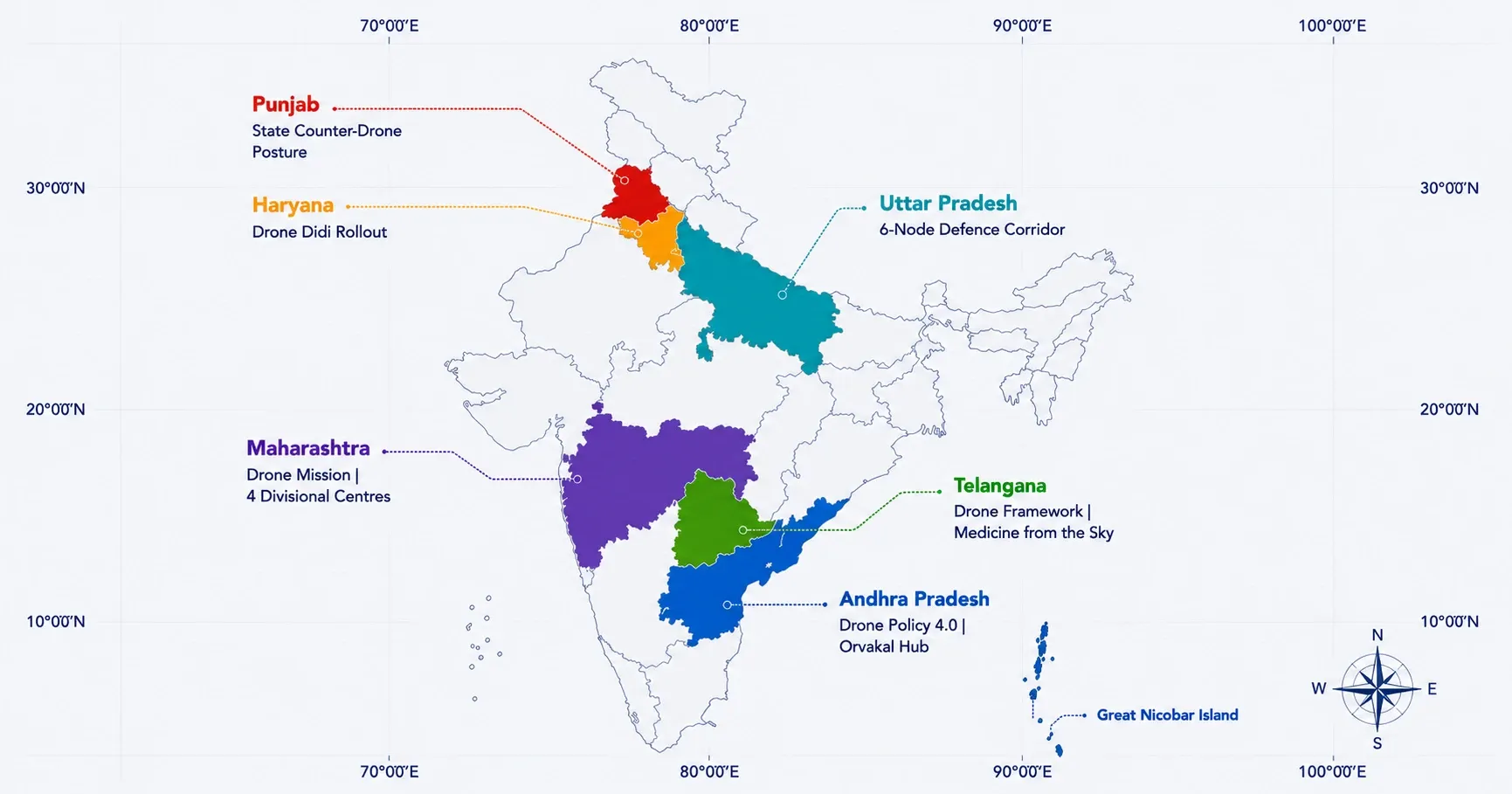
State drone policies in India sit on the facilitation side of a central regulatory frame anchored to the Drone Rules, 2021 and the Bharatiya Vayuyan Adhiniyam 2024. The Ministry of Civil Aviation sharpened that boundary further. It published the Draft Civil Drone Bill 2025 for public consultation (Ministry of Civil Aviation, September 2025). This piece maps six state stacks along four axes: incentives, drone-city footprint, operational corridor, and counter-drone posture.
Framing the centre-state divide in drone regulation
State drone policies in India are industrial development policies, not aviation rules. The authority over civil airspace, certification, pilot licensing, and flight permissions sits with the Ministry of Civil Aviation and the DGCA. That authority runs under the Drone Rules, 2021 (Ministry of Civil Aviation, 26 August 2021).
This distinction shapes every state policy notified across the country. A state government cannot introduce its own drone licensing system or redefine airspace classifications. States therefore compete on manufacturing ecosystems, pilot training, testing facilities, and public-service adoption. This layered model is now the operating frame for India's drone laws.
The statutory umbrella for civil aviation itself sits under the Bharatiya Vayuyan Adhiniyam 2024, which repealed the Aircraft Act, 1934 (Ministry of Civil Aviation, 2024). State drone policies operate inside that statutory frame, not around it.
The Draft Civil Drone Bill 2025 reinforces the split further. It retains the central government's regulatory remit while widening the state role in industrial promotion (Ministry of Civil Aviation, September 2025). The DigitalSky platform continues to run airspace permissions and NPNT workflows. The eGCA platform handles registration and certification services after the 2025 platform transition (DGCA Public Notices, 2025).
Dimension | Controlled by | Typical state role | Operational impact |
|---|---|---|---|
Airspace regulation | Ministry of Civil Aviation and DGCA | None | Flight permissions remain nationally governed |
Industrial incentives | State governments | Capital subsidy, land, tax support | Determines manufacturing investment |
Operational programmes | State governments | Agriculture, healthcare, surveying, disaster response | Creates commercial demand |
Infrastructure | State governments | Drone cities, testing ranges, incubation centres | Supports ecosystem depth |
Airspace stays uniform across India. Investment opportunity does not.
Mapping Andhra Pradesh's Drone Policy 4.0 and the Orvakal hub
Andhra Pradesh Drone Policy 4.0 is one of India's largest state facilitation programmes by capital allocation. Government Order 18 notified the policy on 19 November 2024 with a ₹500 crore corpus (Government of Andhra Pradesh, 19 November 2024). It also carries a capital subsidy of up to 20 percent. The policy targets 100 drone companies and 25,000 remote pilots during the 2024 to 29 period.
The policy pairs financial incentives with dedicated industrial infrastructure. Andhra Pradesh aims to build a complete ecosystem covering manufacturing, maintenance, component production, testing, research, and workforce development. This structure reduces set-up time for companies while seeding local supplier networks that anchor India's drone manufacturing ecosystem.
The Orvakal hub in Kurnool district is the strategy's physical anchor. The Amaravati Drone Summit ran on 22 October 2024. The state used the event to allocate roughly 300 acres for drone manufacturing and testing infrastructure (Andhra Pradesh Chief Minister's Office, 22 October 2024). Orvakal is positioned as a specialised industrial destination for the unmanned aviation sector.
The Andhra Pradesh Drone Corporation coordinates policy execution across departments and manages the pipeline of investment approvals. The policy also prioritises government adoption of drones in agriculture, disaster management, mining, coastal surveillance, and infrastructure inspection.
Sustained government demand allows manufacturers to validate systems inside real programmes before expanding into private markets. That mix of drone city India infrastructure, capital subsidy, and public-service pull makes Andhra Pradesh drone policy the leading capex play in the current cycle.
Tracing Telangana's drone framework and Medicine from the Sky
Telangana drone policy is the country's oldest live facilitation stack. The Information Technology, Electronics and Communications Department released the Telangana State Drone Framework in February 2019 (Government of Telangana, February 2019). The framework introduced the Drone City vision alongside sector-specific programmes.
Telangana built the strategy around a live operational use case. The Medicine from the Sky programme showed how unmanned aircraft systems could support healthcare logistics across difficult terrain. The programme formally launched in 16 green zones of Vikarabad district on 11 September 2021 (Government of Telangana; Ministry of Civil Aviation, 11 September 2021).
These demonstrations generated route planning, command-and-control procedures, payload management, and BVLOS workflows that outlive the healthcare pilot. Repeatable operating procedures under national aviation rules now support future logistics, disaster response, and commercial delivery. The DGCA has since approved Telangana as one of three commercial BVLOS corridors, focused on pharma delivery (DGCA public communications, 2025 to 26). That corridor also underwrites the operator demand base for Kodainya's drone-as-a-service solution.
Telangana widened the industrial base during 2025. The state announced a Drone Manufacturing and Testing Corridor at the Electronic Manufacturing Cluster in Maheshwaram. The corridor anchors a JSW UAV facility on 16 acres (Government of Telangana, December 2025).
Telangana therefore combines an operational drone city India footprint with an expanding manufacturing base. Companies can evaluate products inside real government programmes while accessing research institutions and testing facilities.
Understanding Haryana's Drone Didi rollout inside the central scheme
Haryana drone policy places rural capability at the centre of its state strategy. Instead of prioritising industrial clusters, Haryana focuses on trained operators who deliver agricultural services through women-led self-help groups.
The Haryana Drone Didi scheme was issued by the Department of Youth Empowerment and Entrepreneurship on 30 January 2025. The programme provides an 80 percent subsidy, up to ₹8 lakh, for eligible SHGs acquiring agricultural drones and associated training (Government of Haryana, 30 January 2025). The scheme complements the Namo Drone Didi central sector scheme, approved with a ₹1,261 crore outlay (Government of India, 28 November 2023). The central scheme deploys 15,000 agricultural drones through women SHGs across 2024 to 2026.
This approach differs from manufacturing-led policies elsewhere. Haryana's priority is scaling drone service delivery across agriculture. Operators can offer crop spraying, nutrient application, crop health assessment, and precision farming services without requiring every farmer to own equipment. The model creates recurring business opportunities while raising mechanisation across rural districts.
Workforce development runs alongside equipment support. Subsidised training helps produce certified remote pilots who serve both government and private agricultural projects. Agricultural departments gain wider access to qualified operators for seasonal deployments. For commercial drone service providers, Haryana Drone Didi Scheme SHG subsidy shows how public policy can generate sustained operational demand rather than one-time equipment sales.
Building Maharashtra Drone Mission through four divisional centres
The Maharashtra Drone Mission combines industrial policy, academic research, and public-sector adoption inside a coordinated state programme. The Maharashtra Cabinet approved the mission on 28 December 2023 with a ₹238 crore outlay over five years (Government of Maharashtra, 28 December 2023). IIT Bombay was appointed as the nodal institution for programme coordination.
The Maharashtra Drone Mission IIT Bombay structure extends beyond a single research centre. VJTI Mumbai, the College of Engineering Pune, and VNIT Nagpur operate as divisional centres. They support research, workforce development, testing, and innovation activities in different regions of the state. This distributed structure widens technical capability while deepening links between academia, government departments, and industry.
The Government of Maharashtra and IIT Bombay formalised the partnership through a Memorandum of Understanding signed on 5 March 2024 (IIT Bombay, 5 March 2024). The MoU created an institutional framework for research, pilot projects, startup incubation, and technology commercialisation.
Public-sector applications remain a major share of the programme. Disaster management, infrastructure inspection, environmental monitoring, precision agriculture, and urban planning are the priority deployment areas. These use cases generate operational datasets that improve flight procedures, maintenance practices, and mission planning across state departments.
Maharashtra therefore offers a research-led ecosystem backed by sustained public investment. The mission positions academic capability alongside industrial growth, so product development, testing, and operational deployment can evolve together under one coordinated state programme.
Deploying Punjab's state counter-drone posture
Punjab drone policy differs from the other five states because border security drives its largest public investment. The state also supports commercial drone adoption. A large share of recent public spend has focused on counter-drone capability along the western international border.
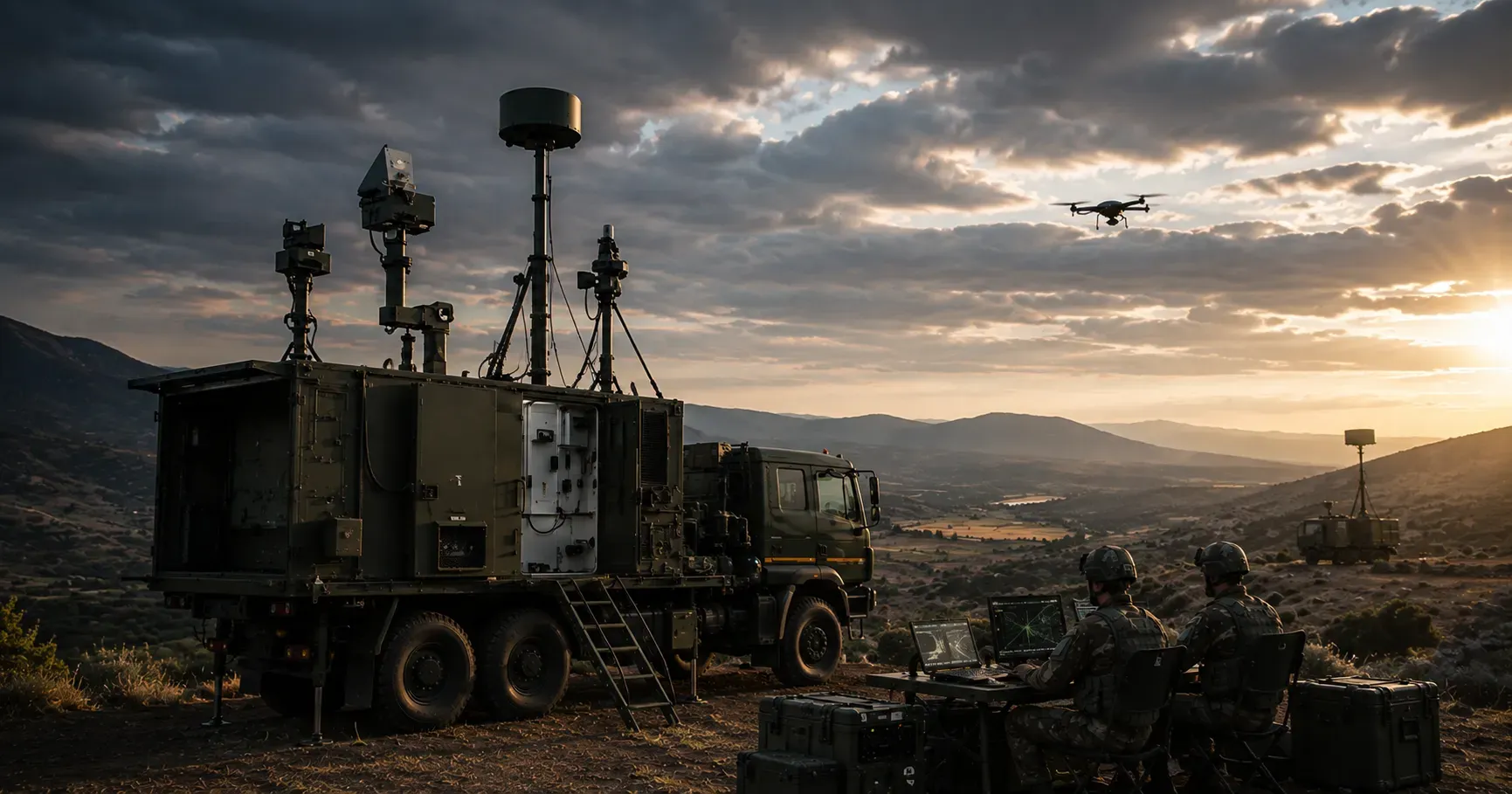
On 9 May 2025, the Punjab Cabinet approved ₹51.41 crore for the procurement of nine counter-drone systems covering six border districts (Government of Punjab, 9 May 2025). The investment complements the security grid operated by central agencies. It reflects the importance of low-altitude airspace monitoring for internal security.
Punjab counter-drone deployment priorities include persistent surveillance, low-altitude target detection, radio-frequency monitoring, electro-optical tracking, and coordinated response. These capabilities support law enforcement while operating inside the central regulatory framework administered by the Ministry of Civil Aviation and the DGCA. Sourcing routes now align with India's counter-drone systems posture for state agencies moving beyond central procurement alone.
The Border Security Force has expanded technology adoption across the Punjab sector. The force reported the neutralisation of 278 rogue drones in 2025 through surveillance technology, intelligence-led operations, and layered border monitoring (Border Security Force, December 2025). State investment therefore reinforces national security operations instead of replacing them.
Punjab Police coordinates state-side response with the BSF and central agencies. For defence integrators, Punjab anti-drone systems approval shows how state drone policy can strengthen operational resilience through detection infrastructure rather than manufacturing subsidies.
Positioning Uttar Pradesh along a six-node defence corridor
Uttar Pradesh approaches drone development through industrial scale and defence manufacturing. The Uttar Pradesh Defence Industrial Corridor spans six nodes: Lucknow, Kanpur, Jhansi, Agra, Aligarh, and Chitrakoot. Since launch, the corridor has attracted substantial defence-sector investment and continues to expand drone manufacturing capability alongside broader aerospace production (UPEIDA, June 2025).
The state's strategy combines defence manufacturing with civil drone adoption. In July 2025, the Uttar Pradesh Cabinet approved measures supporting operational expansion of the corridor. These included a DRDO research centre in Lucknow and additional infrastructure for unmanned aircraft manufacturing (Government of Uttar Pradesh, 23 July 2025).
Beyond manufacturing, UP defence industrial corridor drones policy sits alongside one of the country's largest public-sector operational stacks. The SVAMITVA drone survey pipeline has completed drone surveys across more than 90,000 inhabited villages in the state (Ministry of Panchayati Raj, 9 December 2025). The scheme has produced over one crore property cards for rural land records.
That volume of cadastral work underwrites Kodainya's cadastral land surveys solution as a durable operator demand base. Manufacturers benefit from defence procurement opportunities while service providers gain experience through land surveys, infrastructure mapping, agriculture, and public administration projects.
Uttar Pradesh defence corridor therefore offers one of India's broadest industrial ecosystems, backed by defence infrastructure, government demand, and expanding research capability across UPEIDA-managed nodes.
Choosing where to invest within the six-state map
The six leading state drone policies show that industrial competition now happens through facilitation rather than regulation. Every operator, manufacturer, and defence integrator works inside the same national aviation framework anchored by the Drone Rules, 2021 and the Bharatiya Vayuyan Adhiniyam 2024. What differs is how each state attracts investment and creates operational demand. State drone incentives India signals therefore matter for procurement decisions across Kodainya's industry coverage.
State | Primary strength | Largest investment focus | Best suited for |
|---|---|---|---|
Andhra Pradesh | Manufacturing incentives | Drone city and industrial ecosystem | Manufacturing, testing, exports |
Telangana | Operational innovation | Healthcare logistics and BVLOS pilots | Delivery, R&D, logistics |
Haryana | Agricultural services | Drone Didi implementation | Agri-drone service providers |
Maharashtra | Research ecosystem | Academic and industrial collaboration | Product development, innovation |
Punjab | Security capability | Counter-drone infrastructure | Defence and homeland security |
Uttar Pradesh | Defence manufacturing | Defence corridor and public deployments | Manufacturing and government programmes |
No single state leads on every axis. Andhra Pradesh and Uttar Pradesh emphasise industrial scale, Telangana focuses on operational deployment, Maharashtra invests in research capability, Haryana expands agricultural service adoption, and Punjab strengthens border-security detection.
The next twelve months will be shaped by fresh state Cabinet notifications and additional BVLOS corridor approvals by the DGCA. The notification pathway for the Draft Civil Drone Bill 2025 will also decide how state facilitation stacks read against the coming statutory frame. State drone policy comparison India work will keep tracking those inflection points, so the Drone Shakti Mission manufacturing thrust can be read against every state's execution record.