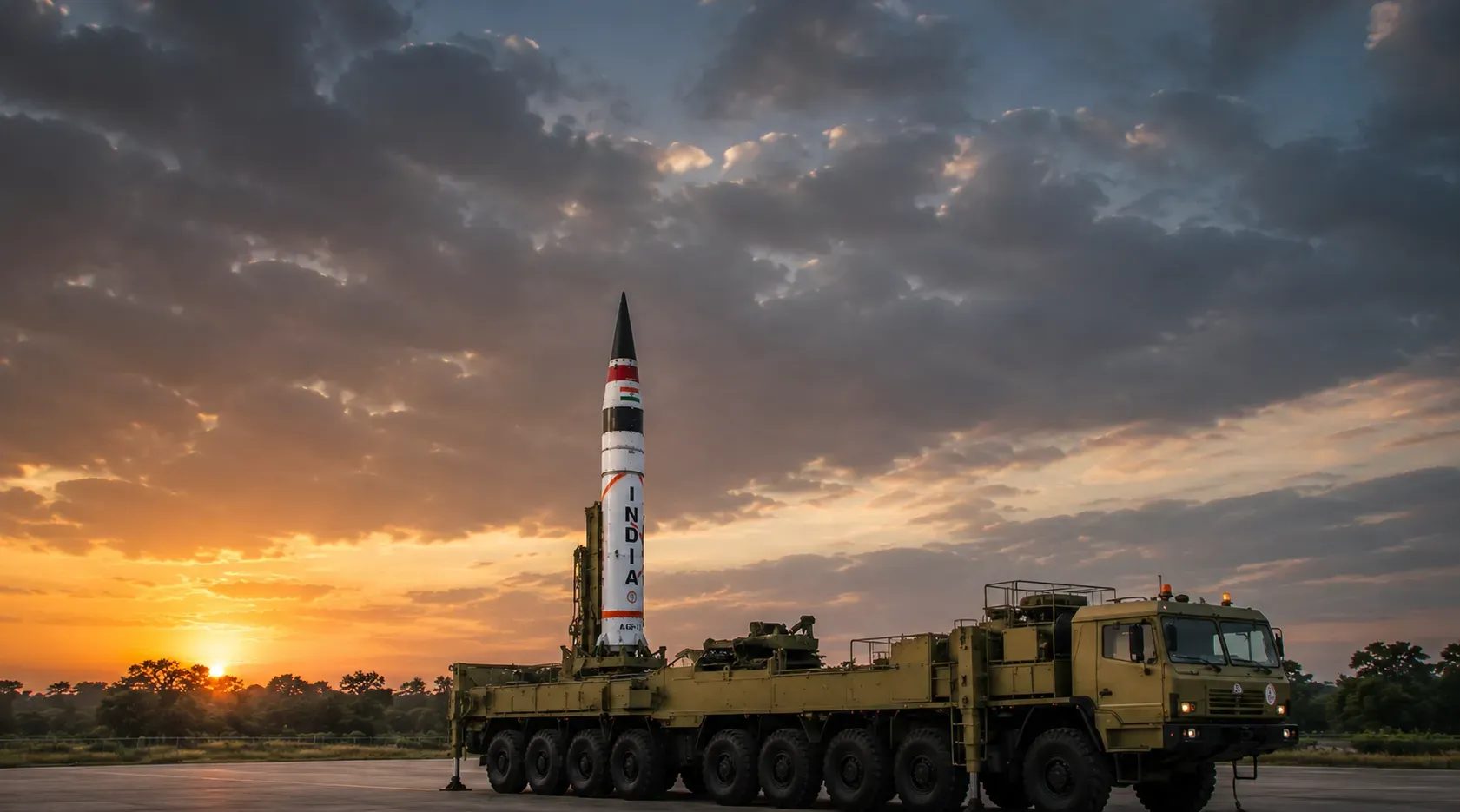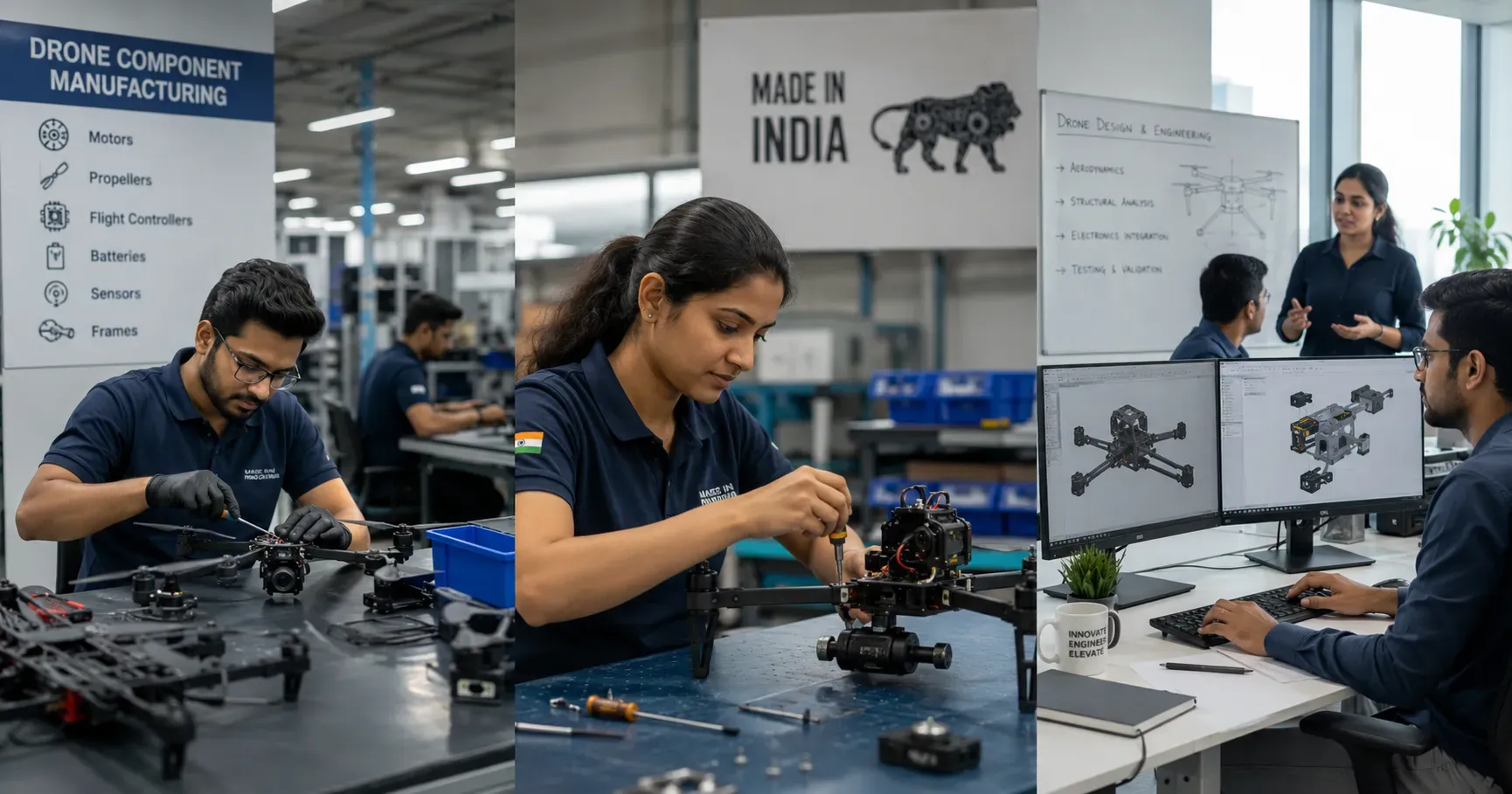
India drone manufacturing hubs entered a distinct phase between 30 August 2025 and 16 May 2026. Three government-backed projects opened at Sector 81 Noida, Orvakal near Kurnool, and Sisai village in Hisar. The state-instrument, corridor, and node triad reads each hub against three layers. The state policy funds investment, the corridor hosts infrastructure, and the Ministry of Civil Aviation Production Linked Incentive scheme anchors the national spine.
Mapping the four flagship drone manufacturing hubs in India
India drone manufacturing hubs are no longer defined only by industrial clusters. They now sit inside a three-layer framework: the state incentive instrument that funds investment, the industrial corridor that hosts infrastructure, and the physical node where production takes place. The pattern became visible after three government-backed projects opened between August 2025 and May 2026 (Press Information Bureau, 19 November 2025).
The question, where are drones manufactured in India, therefore has two answers. The operational answer points to cities such as Hisar, Noida, Kurnool, Bengaluru, Hyderabad, Chennai, and Pune.
The policy answer points to three state instruments plus one Union scheme. The three state instruments are Haryana Enterprise and Employment Policy 2020 and Uttar Pradesh's Aerospace and Defence Unit Employment Promotion Policy. Andhra Pradesh Aerospace and Defence Policy 4.0 rounds out the trio.
All three state instruments sit under the Ministry of Civil Aviation Production Linked Incentive Scheme for Drones. Manufacturing follows policy before it follows geography.
The national manufacturing map now consists of three flagship growth nodes supported by established industrial ecosystems that form India's drone manufacturing ecosystem. The flagship nodes represent greenfield capacity, while the legacy centres continue to provide engineering talent, aerospace suppliers, software capability, and precision manufacturing.
Hub | State incentive instrument | Industrial corridor | Strategic role |
|---|---|---|---|
Hisar | Haryana Enterprise and Employment Policy 2020 | Drone City Haryana at Sisai | Dedicated drone manufacturing and training ecosystem |
Noida | UP Aerospace and Defence Unit Employment Promotion Policy | UP Defence Industrial Corridor | Defence manufacturing and system integration |
Kurnool | Andhra Pradesh Aerospace and Defence Policy 4.0 | Orvakal Aerospace Corridor | Integrated drone production, testing and exports |
Bengaluru, Hyderabad, Chennai, Pune | Long-running aerospace policies | Established aerospace clusters | Design, software, avionics and component manufacturing |
The distinction matters because manufacturing capability extends beyond assembling UAVs. Modern unmanned aircraft systems depend on electronics, propulsion, software, communications equipment, payload integration, computer vision models, edge inference hardware, and testing infrastructure. A manufacturing hub succeeds only when policy, infrastructure, workforce development, and industrial supply chains mature together.
Reading Hisar and the Drone City Haryana state instrument
Drone City Haryana demonstrates how a state industrial policy can create a manufacturing geography from scratch rather than expanding an existing industrial cluster. The project is anchored in the Haryana Enterprise and Employment Policy 2020. That instrument provides the incentive framework supporting the development at Sisai village near Hisar (Government of Haryana, 2020).
The Haryana Government laid the foundation stone for Drone City Haryana on 8 September 2025. Phase 1 inauguration followed on 16 May 2026 (Government of Haryana, 16 May 2026). The Hisar drone city inauguration confirmed ₹58.51 crore of state incentive support under the industrial policy, ranking it among India's largest dedicated drone manufacturing initiatives.
Unlike conventional industrial parks, Drone City Haryana combines manufacturing with pilot training, maintenance capability, research infrastructure, testing facilities, and operational support. This integrated model reduces the distance between product development and field deployment. Manufacturers gain faster access to trained operators, while training institutions remain connected to production requirements.
The project also aligns with India's transition toward AI-enabled unmanned systems. Modern drone manufacturing integrates computer vision pipelines, sensor fusion hardware, onboard processing modules, and mission software during production rather than treating autonomy as an aftermarket capability.
For defence and commercial operators, Hisar represents more than another industrial estate. It is an attempt to build an end-to-end unmanned aircraft system ecosystem, extending the Make in India drones programme into a single-location model. Manufacturing, certification support, operator training, maintenance, and supply-chain development coexist within one physical site. Drone City Haryana therefore illustrates the largest drone manufacturing hub in India as a policy experiment first and an industrial project second.
Tracing the Noida drone manufacturing unit inside the UP Defence Industrial Corridor
The Noida drone manufacturing unit derives its strategic importance from the wider UP Defence Industrial Corridor rather than from Sector 81 alone. Manufacturing capability becomes scalable when connected to a corridor designed for defence production, logistics, testing, suppliers, and investment.
The Sector 81 Noida drone facility was inaugurated on 30 August 2025. The Union Defence Minister and the Uttar Pradesh Chief Minister led the ceremony (Ministry of Defence, 30 August 2025). The facility sits inside a broader industrial ecosystem extending across six defence corridor nodes: Agra, Aligarh, Chitrakoot, Jhansi, Kanpur, and Lucknow. The Noida unit feeds into India's operational drone corridors (UPEIDA, 2025).
According to UPEIDA, the Defence Industrial Corridor spans approximately 5,125 hectares. More than 2,040 hectares are allocated, with an investment pipeline exceeding ₹35,526 crore across the corridor (UPEIDA, 2025).
This corridor model differs from Haryana's approach. Haryana concentrates manufacturing inside a dedicated drone ecosystem, while Uttar Pradesh integrates drone production into a larger defence network covering aerospace, precision engineering, and electronics. The result is deeper supplier integration and broader industrial resilience.
Sector 81 therefore functions as one manufacturing node within a much larger defence production architecture. Manufacturers operating inside the corridor gain access to common infrastructure, logistics networks, defence procurement opportunities, and supporting industries developing across the six nodes. For procurement agencies, the significance of the Sector 81 Noida drone facility lies less in the factory itself than in its location. Feeding the 100K-drone force target at scale requires manufacturing capacity linked to procurement pipelines, not standalone assembly lines.
Building the Kurnool Drone City under Andhra Pradesh Aerospace and Defence Policy 4.0
Kurnool Drone City demonstrates how long-term industrial planning can combine manufacturing, testing, exports, and aerospace development inside one planned ecosystem. The project extends the Drone Shakti Mission's factory-capacity thesis into a purpose-built site (Press Information Bureau, 19 November 2025).
The foundation stone for India's first Drone City was laid at Orvakal on 19 November 2025 (Press Information Bureau, 19 November 2025). The event took place during the 30th Confederation of Indian Industry Partnership Summit. The Kurnool Drone City Orvakal 300 acres precinct sits inside a 2,621-acre high-tech corridor. Andhra Pradesh Aerospace and Defence Policy 4.0 anchors the corridor plan (Government of Andhra Pradesh, June 2025).
The policy framework builds on the Andhra Pradesh Drone Policy 4.0, introduced in November 2024. Together, the two policies provide capital support, manufacturing incentives, export promotion measures, skill development programmes, and infrastructure planning. Their combined reach extends beyond a single industrial project (Government of Andhra Pradesh, November 2024).
The distinguishing feature of Kurnool is its integration with aviation infrastructure. Manufacturing, testing, logistics, and future export operations sit inside the same regional ecosystem. This proximity reduces transportation costs for large unmanned aircraft systems while improving access to flight-testing facilities and aerospace suppliers.
For companies evaluating production locations, Kurnool offers a different proposition from Hisar and Noida. Hisar focuses on an integrated drone ecosystem, while Noida benefits from defence industrial clustering. Kurnool combines aerospace infrastructure with industrial policy, creating a manufacturing base designed to serve both domestic demand and international export opportunities.
The project also illustrates how state governments compete on industrial policy rather than tax concessions alone. Land availability, logistics, testing infrastructure, regulatory support, and workforce development now influence manufacturing decisions as much as financial incentives.
Weighing the legacy Indian drone industry hubs
India's established aerospace centres remain the foundation of the country's defence drones capability. Bengaluru, Hyderabad, Chennai, and Pune continue to supply engineering talent, component manufacturing, avionics capability, embedded software expertise, and research institutions supporting both commercial and defence unmanned aircraft systems.
These cities developed their aerospace ecosystems over decades through defence public sector enterprises, research laboratories, academic institutions, and private manufacturing suppliers. The flagship hubs build upon this foundation rather than replacing it.
This distinction matters when the drone manufacturing states India map is read by capability rather than by count. Legacy aerospace centres concentrate design capability, research, electronics manufacturing, propulsion engineering, and software development. The flagship hubs focus on expanding production capacity through dedicated industrial policies and purpose-built infrastructure.
The Ministry of Civil Aviation's Production Linked Incentive Scheme for Drones reflects this distribution. A substantial share of the approved beneficiaries operated from established aerospace ecosystems before expanding production capacity under the national incentive programme (Ministry of Civil Aviation, 2022).
The relationship between the two groups is complementary rather than competitive. Legacy centres produce specialised components, embedded systems, AI software, and aerospace engineering talent. Flagship hubs add production capacity, testing facilities, logistics infrastructure, and industrial land required for large-scale manufacturing across drone-adopting industries.
India's manufacturing geography is therefore multi-layered. Mature aerospace ecosystems continue driving innovation, while state-supported industrial corridors add scale to the Indian drone industry hub map.
Anchoring the PLI scheme for drones as the national spine
The Production Linked Incentive Scheme for Drones and Drone Components connects India's state-level manufacturing initiatives at the national level. While industrial policies differ across states, the Ministry of Civil Aviation programme sets a common incentive structure (Ministry of Civil Aviation, 30 September 2021).
The scheme allocated ₹120 crore across three financial years for domestic drone and component production. It introduced value-addition incentives supporting the Drone Rules, 2021 and the Drone Shakti Mission (Ministry of Civil Aviation, 30 September 2021).
The MoCA PLI drone beneficiary list published in 2022 named twenty-three manufacturers across nine states. Combined sales turnover rose from ₹88 crore during FY 2020-21 to ₹319 crore during FY 2021-22, marking early industrial expansion after implementation (Ministry of Civil Aviation, 2022).
The PLI scheme rewards production rather than location. Haryana works through its enterprise policy, Uttar Pradesh through corridor development, and Andhra Pradesh through combined aerospace infrastructure and industrial incentives. The Ministry of Civil Aviation programme overlays these with a common national incentive.
The Drone Rules, 2021 simplified certification and operational requirements (Ministry of Civil Aviation, 25 August 2021). The Bharatiya Vayuyan Adhiniyam 2024 modernised the broader legal framework governing civil aviation, giving manufacturers regulatory clarity as production capacity expands (Bharatiya Vayuyan Adhiniyam, 2024).
AI changes how manufacturing incentives translate into industrial capability. Modern drone production integrates onboard edge computing, sensor fusion modules, mission software, and secure communications. Manufacturing competitiveness now depends as much on software capability as mechanical production. The national strategy rests on two pillars carrying the drive to build a self-reliant drone industry.
Signals for the next twelve months of India drone manufacturing hubs
India drone manufacturing hubs should be evaluated through policy alignment rather than city rankings. Procurement agencies, defence integrators, component suppliers, and commercial UAS operators each benefit from reading the state-instrument, corridor, and node framework.
For defence procurement organisations, manufacturing location signals long-term industrial resilience. Facilities inside dedicated industrial corridors gain access to supplier ecosystems, logistics infrastructure, testing facilities, and workforce development programmes supported by state governments. These factors influence production continuity alongside manufacturing capability.
Commercial UAS operators should assess manufacturing ecosystems through operational support rather than assembly capacity alone. A mature ecosystem combines production, maintenance, pilot training, component availability, and regulatory support. Manufacturing hub capacity has to convert into operator capacity through Drone-as-a-Service delivery in India for the geography to hold.
State governments are entering the next phase of competition. Financial incentives remain important, but future investment decisions depend on testing infrastructure, AI engineering talent, semiconductor supply chains, and software engineering capacity. These factors determine whether manufacturing ecosystems can produce next-generation unmanned aircraft systems rather than expanding assembly lines alone.
The next phase of India's manufacturing strategy extends beyond production. The planned Meerut drone airbase BRO project runs to ₹406 crore across 900 acres (Border Roads Organisation, 14 February 2026). The proposed IIT Kanpur National Military Drone Technology Hub sits inside the same twelve-month window (Ministry of Defence, June 2026).
The inflection sits one layer deeper than manufacturing. Meerut and IIT Kanpur move the geography from where drones are built into where they are launched and where they are cognitively engineered.