Autonomous drones in India operate across two ladders. The first is an engineering ladder that measures how independently a drone flies a mission. The second is a regulatory ladder set by the Drone Rules 2021, where Autonomous UAS is a defined legal category (Ministry of Civil Aviation, 25 August 2021).
Permissions, Beyond Visual Line of Sight approvals, and accountability decide what the platform may fly. The Draft Civil Drone (Promotion and Regulation) Bill of September 2025 may reshape that line, making this the moment to read the autonomy-permission-accountability triad.
Defining what counts as a self-flying aircraft in Indian law
Autonomous drones in India are governed first by a legal classification, only then by an engineering one. Autonomous UAS is a defined category before it is a description of capability. The Drone Rules 2021 classify unmanned aircraft into three legal classes: Remotely Piloted Aircraft Systems (RPAS), Model RPAS, and Autonomous UAS (Ministry of Civil Aviation, 25 August 2021). That classification makes autonomy a recognised category within Indian civil aviation law, and the boundary between RPAS, UAS, and the wider unmanned aircraft terms is where it starts.
This matters because the difference between automatic and autonomous drones is not merely semantic. An automatic drone follows pre-programmed instructions. An autonomous drone adapts its flight path, mission execution, or operational responses from sensor inputs, onboard computing, computer vision, and mission logic.
Commercial platforms marketed as fully autonomous still sit under operator oversight. So the question "are autonomous drones legal in India" calls for a legal answer rather than a technical one. The Drone Rules 2021 permit autonomous operations subject to conditions set by the Director General of Civil Aviation (DGCA). That position replaced earlier rules that treated autonomous operations more conservatively (DGCA, 25 August 2021).
The framework separates capability from permission. A platform may carry advanced onboard autonomy, sensor fusion, route planning, and edge inference. It can still face the same approvals as a simpler aircraft when the mission falls inside regulated airspace or exceeds visual line of sight limits. The result is a setting where autonomy exists, but accountability stays attached to identifiable operators, permissions, and flight records.
Mapping the five engineering levels of drone autonomy
Drone autonomy levels describe what an aircraft can do without direct operator intervention. The framework traces back to the Autonomy Levels for Unmanned Systems (ALFUS) work developed at the U.S. National Institute of Standards and Technology, though industry adaptations vary (NIST ALFUS framework). The five-level model can be simplified as follows.
Level | Capability | Human role |
|---|---|---|
Level 0 | Manual flight | Continuous control |
Level 1 | Stabilised assistance | Human flies mission |
Level 2 | Automated functions | Human supervises |
Level 3 | Conditional autonomy | Human intervenes when required |
Level 4 | High autonomy | Human oversees mission outcomes |
Level 5 | Full mission autonomy | Minimal operational intervention |
What are the five levels of drone autonomy in practice? The progression moves from pilot-controlled flight toward mission-controlled flight. Navigation, obstacle avoidance, route optimisation, payload management, and target classification shift to onboard systems as the level rises.
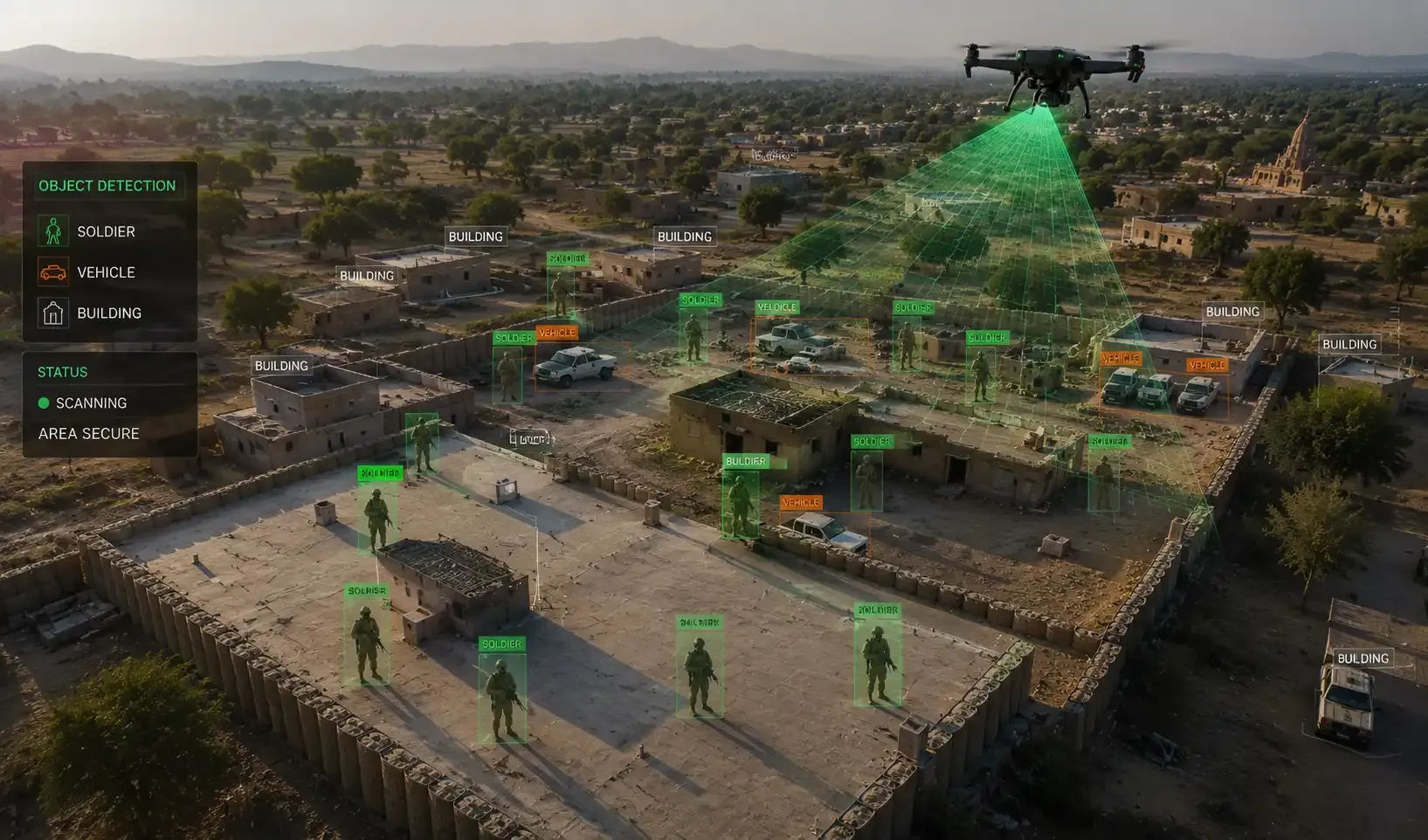
Artificial intelligence matters more as autonomy climbs. Level 2 systems may rely on simple navigation algorithms. Level 4 systems combine computer vision, sensor fusion, route planning, and mission autonomy to manage complex environments. Higher levels add swarm coordination, dynamic rerouting, and adaptive mission execution.
The engineering ladder measures capability, not legality. A Level 4 drone and a Level 2 drone can face identical regulatory requirements when both fly inside the same airspace category. That gap is where discussions about autonomous drones turn misleading. Capability tells an operator what the aircraft can do; regulation decides what it may do.
Translating capability into DGCA permissions
DGCA drone rules set permissions by operational risk, not by autonomy grade. The default remains Visual Line of Sight (VLOS), where the operator keeps direct visual contact with the aircraft throughout the mission (DGCA, 25 August 2021). There is no automatic link between autonomy level and permission level. The full text of the DGCA Drone Rules that govern every civil flight sets the baseline every operator works from.
Autonomy level | Technical capability | Likely regulatory treatment |
|---|---|---|
Level 0-2 | Assisted flight | Standard VLOS operations |
Level 3 | Conditional autonomy | VLOS unless special approvals exist |
Level 4 | High autonomy | VLOS or approved BVLOS mission |
Level 5 | Full autonomy | Subject to DGCA conditions and approvals |
So the phrase fully autonomous drone DGCA permission needs careful reading. Holding a highly autonomous platform does not grant authority to conduct Beyond Visual Line of Sight operations.
The Drone Rules 2021 turn on operational controls, airspace management, and accountability. Airspace classification, mission approval, operator credentials, and platform compliance remain the deciding factors (Ministry of Civil Aviation, 25 August 2021). The weight and category classification of drones interacts with these permissions at every step.
India regulates consequences rather than software sophistication. The regulator's concern is where the drone flies, how it shares airspace with other users, and who answers if the operation fails. Those questions track the Digital Sky airspace map that zones the country into green, yellow, and red. The approach carries weight as autonomous capability expands into inspection, surveying, logistics, defence support, infrastructure monitoring, and precision agriculture.
Tracing operator accountability through the NPNT chain
No Permission No Takeoff (NPNT) is the accountability layer beneath autonomous operations. NPNT links the aircraft, the operator, the permission artefact, and the flight record through the Digital Sky ecosystem (DGCA, Digital Sky platform specification, 25 August 2021). The mechanics of how the No Permission No Takeoff chain works sit underneath every higher-autonomy flight.
The human in the loop drone requirement is, at root, an accountability question. Even when navigation, route planning, and mission execution run automatically, Indian regulations still identify responsible human actors. Four mandatory safeguards reinforce that structure: NPNT authorisation before flight, geofencing, return-to-home, and a flight-termination mechanism. Each one ties an autonomous flight back to an authorised operator and a recoverable failure state.
These requirements exist because autonomous behaviour does not remove accountability. It shifts accountability toward supervision, authorisation, and post-flight verification. Onboard autonomy raises the value of the platform, and it raises the importance of traceability in equal measure.
Computer vision systems may classify objects, route-planning algorithms may optimise paths, and sensor-fusion systems may flag hazards. Responsibility for lawful operation still rests with authorised operators and approved missions. That is why the autonomy-permission-accountability triad holds: capability explains what the aircraft can accomplish, permission explains where it may operate, and accountability explains who answers for the flight.
Operating beyond visual line of sight across India
Beyond Visual Line of Sight (BVLOS) operations mark the point where autonomy becomes operationally decisive. BVLOS lets a drone fly outside the remote pilot's direct view, which opens long-range logistics, infrastructure inspection, surveillance, and large-area mapping (DGCA, 25 August 2021). The shape of the beyond-visual-line-of-sight permission regime decides how far autonomy can travel.
BVLOS drone operations in India stay permission-based rather than a default right. The Ministry of Civil Aviation approved corridors and experimental frameworks to support a controlled expansion of BVLOS capability. Those approvals include designated corridors in Ladakh, Telangana, and Andhra Pradesh (Ministry of Civil Aviation, 2025).
Drone corridors for BVLOS in India therefore sit at the centre of autonomy adoption. High-autonomy systems draw much of their value from extended reach. Without BVLOS permissions, much of that capability stays constrained. Certified hardware comes first, and the type certification path through the QCI scheme gates which platforms reach a corridor at all.
Experimental exemptions have supported medical delivery and research missions under controlled conditions. Such programmes give regulators operational data while industry demonstrates safety and reliability (Ministry of Civil Aviation, conditional exemption order). For survey operators, logistics providers, and infrastructure owners, BVLOS is the dividing line between automated assistance and economically scalable autonomy. That is why the autonomy conversation now turns less on onboard software and more on airspace integration.
Distinguishing military self-flight from civilian operations
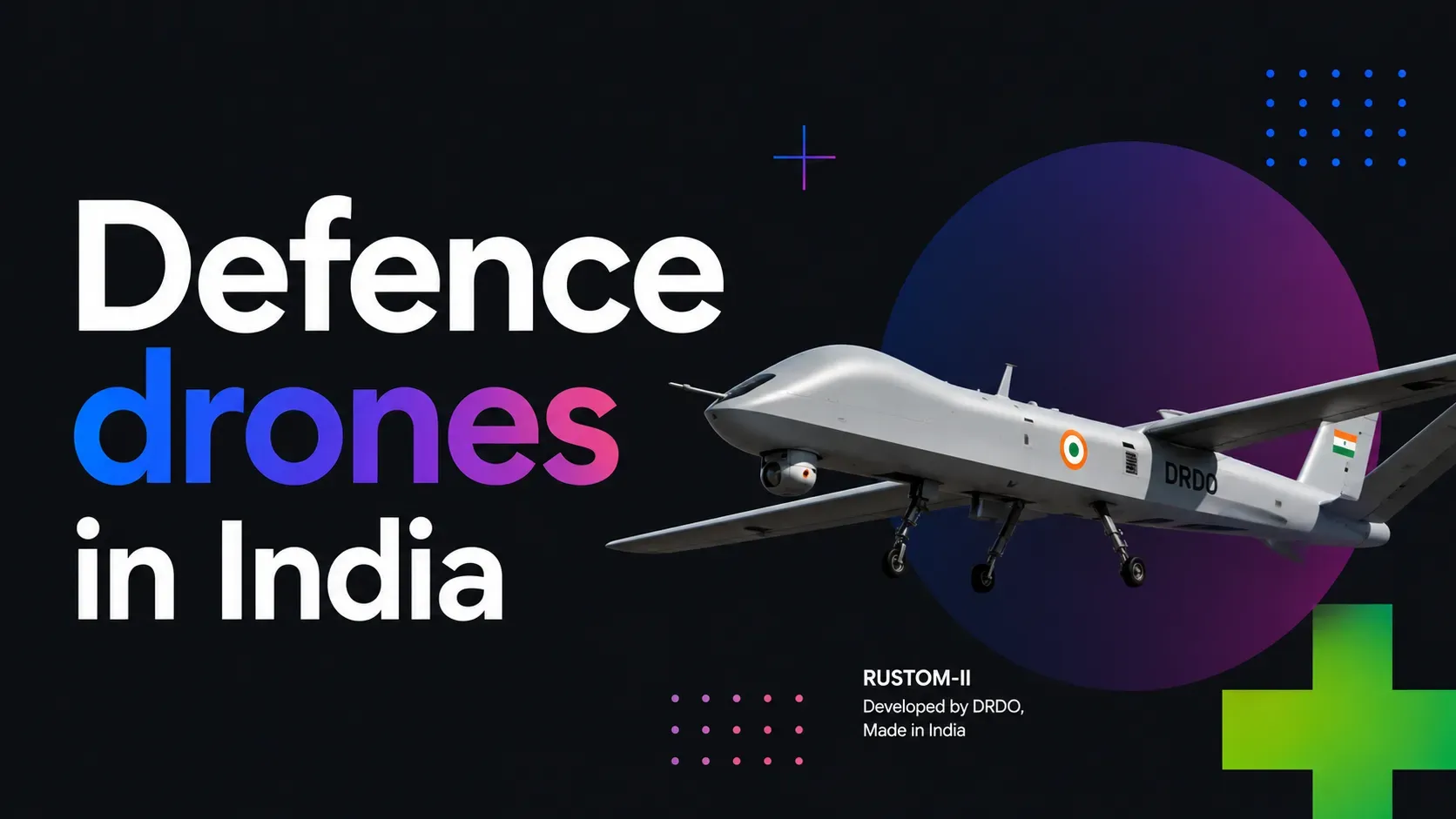
Autonomous military drones run under different mission demands than civilian systems. The military setting prioritises surveillance, reconnaissance, logistics support, electronic warfare, and operational resilience. Autonomous military drone programmes in India concentrate on onboard autonomy, computer vision, route planning, and mission adaptability.
The Ministry of Defence has expanded investment across autonomous surveillance and intelligence capability to sharpen operational effect in contested environments (Ministry of Defence, January 2026). India's wider military drone programme landscape sets the demand signal these systems answer.
Civilian operators face a different problem. Their missions coexist with civil aviation systems, commercial airspace users, and regulatory oversight. The same building blocks appear in both sectors. Computer vision handles object identification, sensor fusion improves navigation accuracy, mission autonomy cuts operator workload, and edge inference speeds onboard processing.
The difference lies in governance. Military operations answer to defence requirements and operational directives. Civilian operations answer to aviation regulation, airspace permissions, and operator accountability. Technology transfer between the two sectors moves faster than regulatory transfer.
Preparing for India's next regulatory framework
The Draft Civil Drone (Promotion and Regulation) Bill arrived in September 2025 (Ministry of Civil Aviation, September 2025). It signals that India's autonomy framework is entering its next phase. What the Civil Drone Bill proposes to change will set the ceiling for higher-autonomy operations.
The Bharatiya Vayuyan Adhiniyam 2024 already replaced the Aircraft Act 1934. It entered into force in January 2025 and created the legislative foundation for the aviation rules that follow (Ministry of Civil Aviation, January 2025).
The ecosystem under that framework is sizeable. As of February 2026, India recorded more than 38,500 registered drones and 39,890 certified remote pilots (DGCA, February 2026). A further 244 approved training organisations show how far the operator base has scaled.
Future regulation will likely concentrate on three fronts: expanding BVLOS operations beyond the current corridors, building an autonomy certification path, and integrating autonomous systems into national airspace management. The future of drone autonomy regulation India depends less on whether autonomy exists and more on how regulators choose to certify, supervise, and integrate capable systems.
The operator takeaway is practical. A buyer should first settle whether the mission needs Visual Line of Sight or Beyond Visual Line of Sight permission. The next check is whether the platform meets NPNT, geofencing, return-to-home, and flight-termination requirements (DGCA, 25 August 2021).
Government agencies and infrastructure owners should weigh mission outcomes over marketing claims. A platform sold as autonomous may sit inside the same operational envelope as a simpler aircraft when permissions are absent. Defence users optimise differently, because operational autonomy pays off in contested or communication-denied conditions (Ministry of Defence, January 2026).
The engineering ladder tells an operator how independently a drone can fly. The regulatory ladder decides whether it may fly that mission at all. Kodainya reads the next phase of Indian drone regulation as a move to fold higher-autonomy systems into routine airspace. Accountability stays fixed to a named operator on every flight.