Beyond Visual Line of Sight, or BVLOS, is the operational class that unlocks drone delivery, long-range inspection, and commercial-scale unmanned logistics in India. DGCA approval and drone permission in India for BVLOS flights are granted through a project-specific experimental exemption framework that has been operational since the Telangana exemption of August 2021. The Ministry of Civil Aviation has signalled a phased corridor expansion through 2026 across metro, Tier-2, and rural geographies (Ministry of Civil Aviation, 2025). This page sets out the framework, the technology stack, and the compliance pathway.
Why Beyond Visual Line of Sight drones now define India's commercial drone agenda
India crossed 2 million medical drone and cargo deliveries by the end of 2025 across healthcare, logistics, infrastructure inspection, and agricultural operations (Ministry of Civil Aviation, December 2025). That scale moved Beyond Visual Line of Sight drones from isolated demonstrations into a regulated transport layer that integrates with DigitalSky, UTMSPs, and state-level aviation cells.
The transition has three policy anchors. The Ministry of Civil Aviation granted conditional exemptions for BVLOS drone trials in Telangana on 25 August 2021 under the Medicine From The Sky initiative (Ministry of Civil Aviation, 25 August 2021). The Unmanned Aircraft System Traffic Management Policy Framework was notified on 24 October 2021, introducing the federated UTMSP architecture that BVLOS scale requires (Ministry of Civil Aviation, 24 October 2021). The Bharatiya Vayuyan Adhiniyam 2024 then replaced the Aircraft Act 1934 as the parent statute for civil aviation enforcement on 21 June 2024 (Parliament of India, 21 June 2024).
State governments expanded medical and infrastructure drone trials across hill districts, rural delivery networks, and disaster-response corridors after the new statute came into force. The corridor structure rests on top of the broader compliance architecture covered in the drone laws in India pillar and the operation-class taxonomy that separates VLOS, EVLOS, and BVLOS.
The commercial pressure is concrete. Last-mile delivery accounts for 41 percent of supply chain cost in India, and Beyond Visual Line of Sight routing can compress that line item by 20 to 30 percent on medical and quick-commerce payloads (Capgemini Research Institute, 2024).
Comparing VLOS, EVLOS and BVLOS
The three drone operating classes sit on a single axis of pilot visibility, and DGCA applies a different approval weight to each. VLOS keeps the aircraft inside the pilot's own line of sight. EVLOS extends that line through trained observers or technology-assisted means. BVLOS breaks visual contact entirely and shifts the burden of situational awareness onto the aircraft's own detect-and-avoid stack.
Factor | VLOS | EVLOS | Beyond Visual Line of Sight |
|---|---|---|---|
Pilot visual contact | Required at all times | Extended through observers or technology | Not continuously maintained |
Approval pathway | Standard DigitalSky permission | Case-specific approval | Project-specific DGCA approval |
Detect-and-avoid | Optional | Enhanced | Mandatory |
C2 link redundancy | Basic | Recommended | Mandatory |
Airspace coordination | Lower | Moderate | High |
Typical use | Survey, photography, spraying | Extended inspection | Medical drone delivery, long-range inspection, logistics |
The VLOS baseline is the reason most commercial drone operations in India remain under 400 feet AGL and inside pilot eyeshot. A vlos drone flight can be authorised through DigitalSky in minutes. A BVLOS flight requires everything on the compliance stack.
How BVLOS approval DGCA pathways actually work
The DGCA BVLOS approval framework began in June 2020 with the constitution of the BVLOS Experiment Assessment and Monitoring committee under the Airports Authority of India (DGCA, June 2020). Thirteen consortia were selected for sandbox trials, and the committee reviewed operational risk, airspace segregation, communication redundancy, and detect-and-avoid capability before any corridor flight was permitted.
The pathway is project-specific rather than licence-based. An applicant submits standard operating procedures, aircraft capability documentation, route coordinates, communication architecture, lost-link contingencies, and pilot credentials before a corridor receives clearance. Coordination is required with the Indian Air Force, the local Air Traffic Control unit, the Flight Information Centre, and security agencies before operations begin (DGCA Public Notice, 2021).
The Telangana exemption annexure of August 2021 set the template that later corridor approvals followed. The conditions list runs to 18 items. The headline parameters: a 400-foot Above Ground Level ceiling, a 15 percent energy reserve before landing, redundant command-and-control links, MHA security clearance for non-government entities, a Single Point Coordinator posted at the nearest ATC, a NOTAM coordinated through the Airports Authority of India, a HIRM workshop before first flight, and third-party insurance (Ministry of Civil Aviation, 25 August 2021).
The lost-link procedure is the operational core of the SOP. The aircraft must execute predefined contingency actions if the command-and-control link fails. Those actions cover route termination, return-to-home logic, emergency landing coordinates, and real-time ATC notification. The corridor lead retains responsibility for indemnifying the Government of India against any third-party claim arising from the trial.
The framework remains narrower than the proposed FAA Part 108 regime in the United States. India's model still relies on corridor-specific approvals rather than a standing operational certificate, which explains why active corridors cluster around healthcare, infrastructure inspection, and government-supervised pilots rather than open commercial deployment.
Who approves a BVLOS operation in India
Drone permission in India for a BVLOS operation is not a single-agency decision. The corridor lead has to line up seven authorities, each with a defined slice of the responsibility, before a flight is permitted. The table below is the working map.
Authority | What it approves |
|---|---|
DGCA | Regulatory and airworthiness clearance |
Airports Authority of India | NOTAM issuance and airspace coordination |
Air Traffic Control unit | Corridor-specific airspace handoff |
Flight Information Centre | Non-controlled airspace advisory |
Ministry of Home Affairs | Security clearance for non-government operators |
State government | Corridor location and local operational coordination |
UTMSP | Unmanned traffic management inside the corridor volume |
The operator sits at the base of the map. Every aircraft, pilot, SOP, insurance, and lost-link document flows through the operator before any authority begins its own review. A single missing sign-off from any layer holds the entire file.
The detect-and-avoid drone India compliance stack
Every BVLOS corridor approval issued by DGCA between 2021 and 2025 has required a detect-and-avoid architecture matching the Telangana exemption template. The aircraft must maintain situational awareness without the pilot's eye on it, which converts a standard remotely piloted platform into a networked Unmanned Aircraft System with layered sensing and communication systems.
The detect-and-avoid stack deployed inside every bvlos drone operating in Indian corridors combines optical sensors, radar, ADS-B reception, geofencing firmware, GNSS-RTK navigation, and redundant command-and-control links. The aircraft must identify nearby traffic, hold its route corridor, and preserve separation inside Very Low Level airspace below 1,000 feet AGL.
The command-and-control architecture sits at the heart of the corridor specification. Approved corridors use primary cellular communication with a secondary fallback link, and long-range deployments in hill terrain add satellite redundancy where terrestrial connectivity is inconsistent. DGCA guidance requires the operator to document the fallback procedure, the link-loss threshold, and the contingency action before corridor approval (DGCA Public Notice, 2021).
Remote ID broadcast sits in the same layer. Every bvlos drone operating inside approved corridors must transmit identification data into the DigitalSky ecosystem, which feeds the NPNT permission-artefact architecture and the broader UTM coordination layer. Type-certified hardware is a prerequisite, and the certification path is covered in the drone type certification process.
Payload category drives a second layer of specification. Medical drone corridors carrying vaccines, blood samples, or corneal tissue need environmental control capable of holding cold-chain integrity through the flight envelope. The December 2024 corneal tissue transport mission conducted under BVLOS conditions became the proof of concept for healthcare logistics under the Bharatiya Vayuyan Adhiniyam framework (Ministry of Health and Family Welfare, December 2024).
The aircraft is one half of the compliance stack. The pilot, the operator, the UTMSP, and the airspace authority form the other half, evaluated together during DGCA review.
What a BVLOS drone needs on board
A bvlos drone is a networked system, not a standalone airframe. Every corridor approved between 2021 and 2025 has required the same seven onboard capabilities before the first flight is cleared. The equipment layer is where most first-time applicants underestimate the compliance cost.
Layer | Requirement |
|---|---|
Navigation | GNSS-RTK with navigation redundancy |
Detect and avoid | Radar, optical sensing, ADS-B reception |
Command and control | Primary link plus backup link, satellite fallback in hill terrain |
Identification | Remote ID broadcast into DigitalSky |
Geofencing | Route-locked drone geofencing firmware with contingency logic |
Traffic management | UTMSP integration and NPNT permission artefact |
Payload | Mission-specific payload with environmental control where required |
A bvlos drone specification that misses any single row on this table will be sent back for redesign before corridor approval is granted. The equipment layer sits before the operator layer in every DGCA review, which is why the aircraft file is closed first.
BVLOS corridor India inventory and BVLOS drone delivery India routes
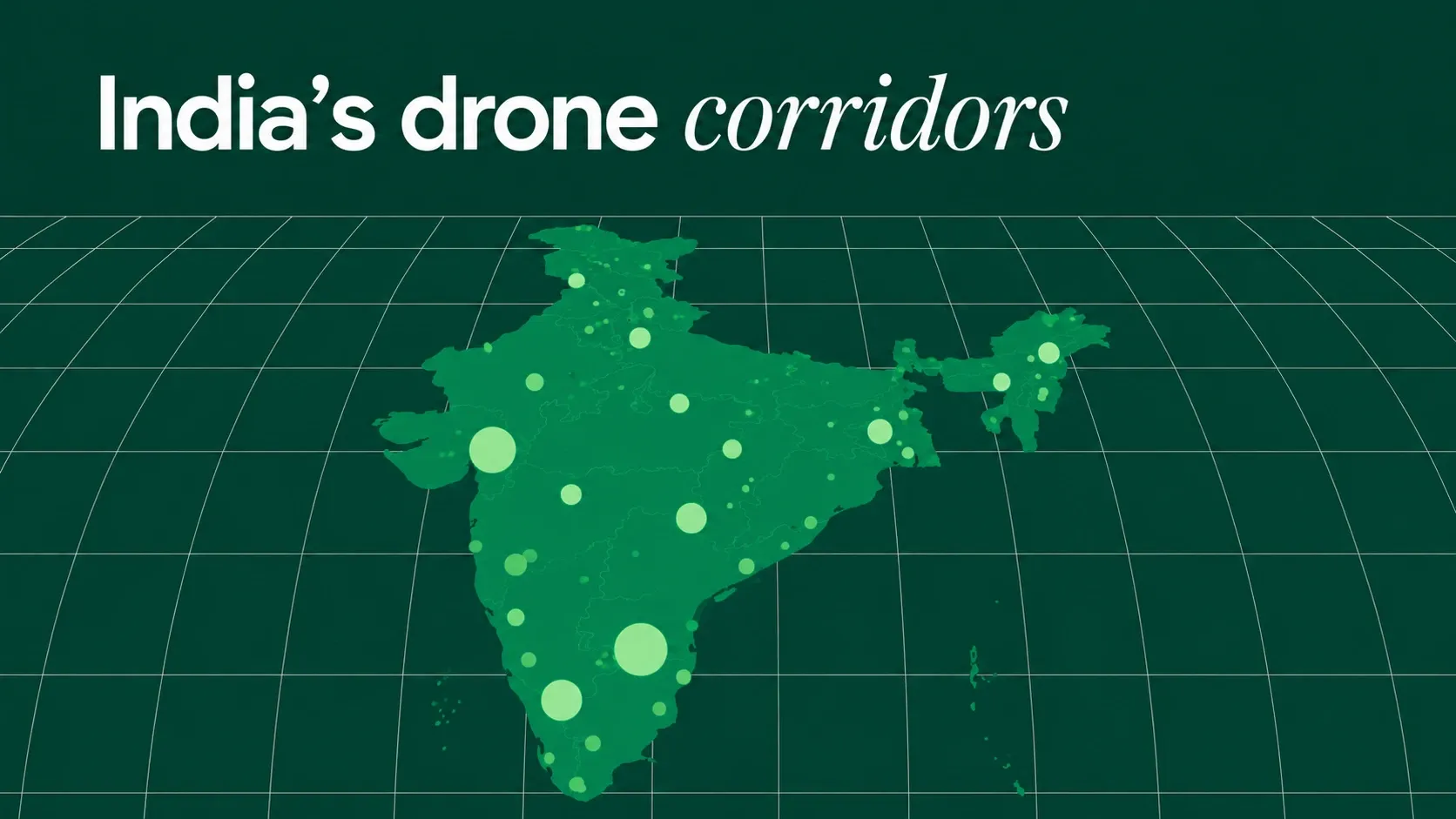
Six of approximately 100 planned BVLOS corridors are operational across Telangana, Uttarakhand, Karnataka, Gujarat, Himachal Pradesh, and Andhra Pradesh as of May 2026. Telangana hosts the deepest operational history, with corridor flights running since August 2021 under the Medicine From The Sky programme (Government of Telangana, 2021).
The corridor inventory below is the working operational picture as of May 2026. Each state anchors a different use-case template, and the terrain determines the technology stack the operator has to bring.
State | Primary use case | Terrain | Operational since |
|---|---|---|---|
Telangana | Medical drone delivery | Mixed | August 2021 |
Uttarakhand | Healthcare, logistics | Mountain | 2023 |
Karnataka | Cargo, logistics | Urban, semi-urban | September 2025 |
Gujarat | Industrial, logistics | Mixed | 2024 |
Himachal Pradesh | Healthcare, logistics | High-altitude mountain | 2024 |
Andhra Pradesh | Logistics | Mixed | 2024 |
Every corridor in the table above shares the same detect-and-avoid template, but the payload and terrain shift the redundancy specification the operator has to file.
The corridor network has produced several anchor milestones. A 104-kilometre medical delivery between Baruipur and Medinipur in West Bengal demonstrated long-range healthcare transport capability under corridor supervision (Government of West Bengal, 2024). A 26-kilometre vaccine flight connected Vikarabad and Bomraspet inside Telangana's medical logistics network, carrying 300 doses of Revac B vaccine and 15 doses of Tubervaac at a maintained 4.6 degrees Celsius cold-chain temperature. A 170-kilometre BVLOS trial in Chamba district extended pharmaceutical delivery into high-altitude Himalayan geography under conditions where road logistics remain unreliable in monsoon.
The Bengaluru BVLOS cargo trial conducted in September 2025 demonstrated live coordination between unmanned operators, UTMSPs, and conventional air traffic systems during dense urban operations (Ministry of Civil Aviation, September 2025). That exercise tested how low-altitude unmanned traffic could coexist with traditional aviation infrastructure inside a Tier-1 metro envelope.
BVLOS drone delivery India use cases extend beyond healthcare. Infrastructure inspection corridors support transmission-line surveys, pipeline inspection, railway monitoring, and dam inspection. Agricultural deployments link with the Namo Drone Didi subsidy framework, which carries a Union Cabinet outlay of ₹1,261 crore covering 15,000 women's self-help groups from 2023-24 to 2025-26 (Press Information Bureau, 29 November 2023). Corridor expansion is the route by which large-area spraying and logistics scale beyond the village boundary.
The commercial layer carries its own compliance burden. Operators moving payloads across long-range corridors need third-party drone insurance under Drone Rules 2021 plus the documentation that flows from type certification.
India's BVLOS framework is functional. It is not yet routine.
BVLOS RPC Cat-2 endorsement and pilot pathway under DTC 02 of 2022
DGCA Training Circular 02 of 2022 split the Remote Pilot Certificate into Cat-1 for VLOS operations and Cat-2 for BVLOS operations (DGCA DTC 02 of 2022). The split is the formal mechanism through which India trains a BVLOS-qualified pilot pool large enough to scale corridor flights.
The Cat-2 syllabus covers BVLOS-specific risk management, ground school on detect-and-avoid systems, simulator hours under degraded signal conditions, route deconfliction, UTMSP coordination, and a practical flight test inside an approved corridor. A clean vlos drone operating record is a prerequisite. The indicative cost band for Cat-2 training is ₹60,000 to ₹1,20,000 at a DGCA-authorised RPTO.
The training pipeline is constrained but expanding. DGCA-published data through 2024 showed 116 authorised RPTOs and more than 16,000 Remote Pilot Certificates issued across all categories, with Cat-2 endorsements concentrated at a smaller subset of RPTOs holding BVLOS-capable aircraft and corridor access (DGCA, 2024).
The April 2025 amendment expanded practical evaluation requirements for BVLOS pilots operating in urban and semi-urban zones (DGCA Amendment Notice, April 2025). The change reflected the transition from isolated trial flights toward structured low-altitude logistics operations, and tightened the gap between the licence on paper and the operational skills needed for a Tier-1 metro corridor. The full Remote Pilot Certificate pathway under DTC 02 of 2022 covers the eligibility, examination, and renewal layers in detail.
UTM BVLOS integration and the federated airspace layer
Conventional air traffic management does not handle thousands of simultaneous low-altitude flights. India's federated unmanned traffic management framework, notified on 24 October 2021, permits multiple Unmanned Traffic Management Service Providers within shared airspace, which avoids single-point dependency and lets smaller providers serve segregated operations such as rural medical corridors (Ministry of Civil Aviation, 24 October 2021).
A BVLOS flight registers with a UTMSP, receives a deconflicted route inside Very Low Level airspace below 1,000 feet AGL, and broadcasts Remote ID continuously. The UTMSP holds the live picture of unmanned traffic in its assigned volume and hands off to conventional ATC at the boundary with controlled airspace. The framework draws from ICAO's Unmanned Aircraft Systems Traffic Management Common Framework Edition 4, with India-specific NPNT enforcement layered on top.
The Bengaluru September 2025 cargo trial confirmed that the architecture works under live conditions. The UTM framework in India carries the full six-block operational architecture, which slots in below the BVLOS corridor layer covered on this page.
Scaling beyond six corridors depends on UTMSP density. The framework permits three pricing models for UTMSP services: subscription, pay-per-use, and hybrid, with a portion of fees shared with the Airports Authority of India. The commercial structure exists. The corridor count, the Cat-2 pilot pool, and the BVA 2024 enforcement layer are the live constraints.
How FAA Part 108 vs India BVLOS framework will reshape the next phase
FAA Part 108 was published as a Notice of Proposed Rulemaking on 7 August 2025, with the comment window closing on 6 October 2025. A final rule is expected in spring 2026 (FAA, August 2025). The proposed framework replaces case-by-case Part 107 waivers with two structured approval paths, Permitted Operations and Operational Certificate, and covers BVLOS operations up to 1,320 pounds. Mandatory organisational Safety Management Systems, certified detect-and-avoid, and UTM integration sit at the centre of the rule.
Transport Canada's CARs Part IX BVLOS amendment came into force on 4 November 2025. The amendment introduced a Level 1 Complex Operations regime for small and medium drones up to 150 kilograms operating BVLOS in uncontrolled airspace below 122 metres, with an embedded RPAS Operator Certificate and Safety Management System obligation (Transport Canada, November 2025).
India's framework sits closer to the pre-Part 108 FAA waiver model than to either of the new regimes. The structural gap defines the Civil Drone (Promotion and Regulation) Bill 2025 reform agenda. The draft Bill under consultation review is expected to introduce a structured BVLOS Operator Certificate analogous to the Canadian RPOC, mandatory organisational Safety Management Systems, expanded Remote ID specifications, a defined low-risk BVLOS pathway not requiring BEAM-style case-by-case review, and statutory anchoring for the UTMSP regime (Ministry of Civil Aviation, 2025).
The next eighteen months decide the framework. The corridor count moves from six toward a working national network. The Cat-2 pilot pipeline scales through DGCA-authorised RPTOs. The Civil Drone Bill either passes Parliament or stalls. The FAA finalises Part 108 and exports the architecture through ICAO into the Asian regulatory conversation.
Operators planning long-range commercial deployment should be tracking BEAM submission timelines, RPTO Cat-2 capacity at training partners, UTMSP integration roadmaps, and the Bill's progression through MoCA, Cabinet, and Parliament. The corridor that opens in the next quarter is the one with all four lined up.