Geo-fencing drone India enforcement and drone Remote ID India regulation now follow two different policy tracks. The Ministry of Civil Aviation made geo-fencing part of Schedule II airworthiness requirements under Drone Rules 2021 (Ministry of Civil Aviation, 25 August 2021). India still lacks a formal broadcast Remote ID mandate comparable to FAA Part 89. By the end of this article, readers will understand the Schedule II equipment stack and the firmware compliance gap exposed after 17 November 2025. They will also know how operators should verify compliance before purchasing or flying an RPAS platform.
Why this matters now
India's unmanned aviation framework changed between August 2021 and November 2025. Drone Rules 2021 replaced the earlier Unmanned Aircraft System Rules 2021 and reduced multiple approval layers while retaining mandatory firmware-side safety controls through Schedule II airworthiness requirements (Ministry of Civil Aviation, 25 August 2021). Geo-fencing capability became part of the expected compliance architecture for Micro category drones and above.
The second shift arrived on 17 November 2025, when the largest global consumer drone manufacturer retired its hard-stop geo-fencing enforcement model and shifted toward advisory warning zones. The manufacturer cited digital airspace systems and Remote ID ecosystems as compensating controls. India still relies on pre-flight permission verification rather than real-time broadcast identification. That distinction exposed a regulatory and operational gap across imported consumer-grade drones operating outside DigitalSky firmware enforcement.
The third trigger came during temporary flight restrictions issued in May 2025 under Operation Sindoor-related airspace controls. Press reporting and operator accounts from northern India showed that mid-day restriction updates did not consistently propagate into already-issued firmware permission profiles. A drone that received authorisation in the morning could still operate with stale restrictions later in the day.
The result is a policy environment where firmware compliance, operator awareness, and DigitalSky enforcement no longer function as interchangeable layers. Each layer now carries separate operational consequences. Readers seeking broader context around <a href="https://www.kodainya.com/blogs/drone-laws-in-india">India's drone regulatory stack</a> should treat this article as the firmware and identification layer inside that larger framework.
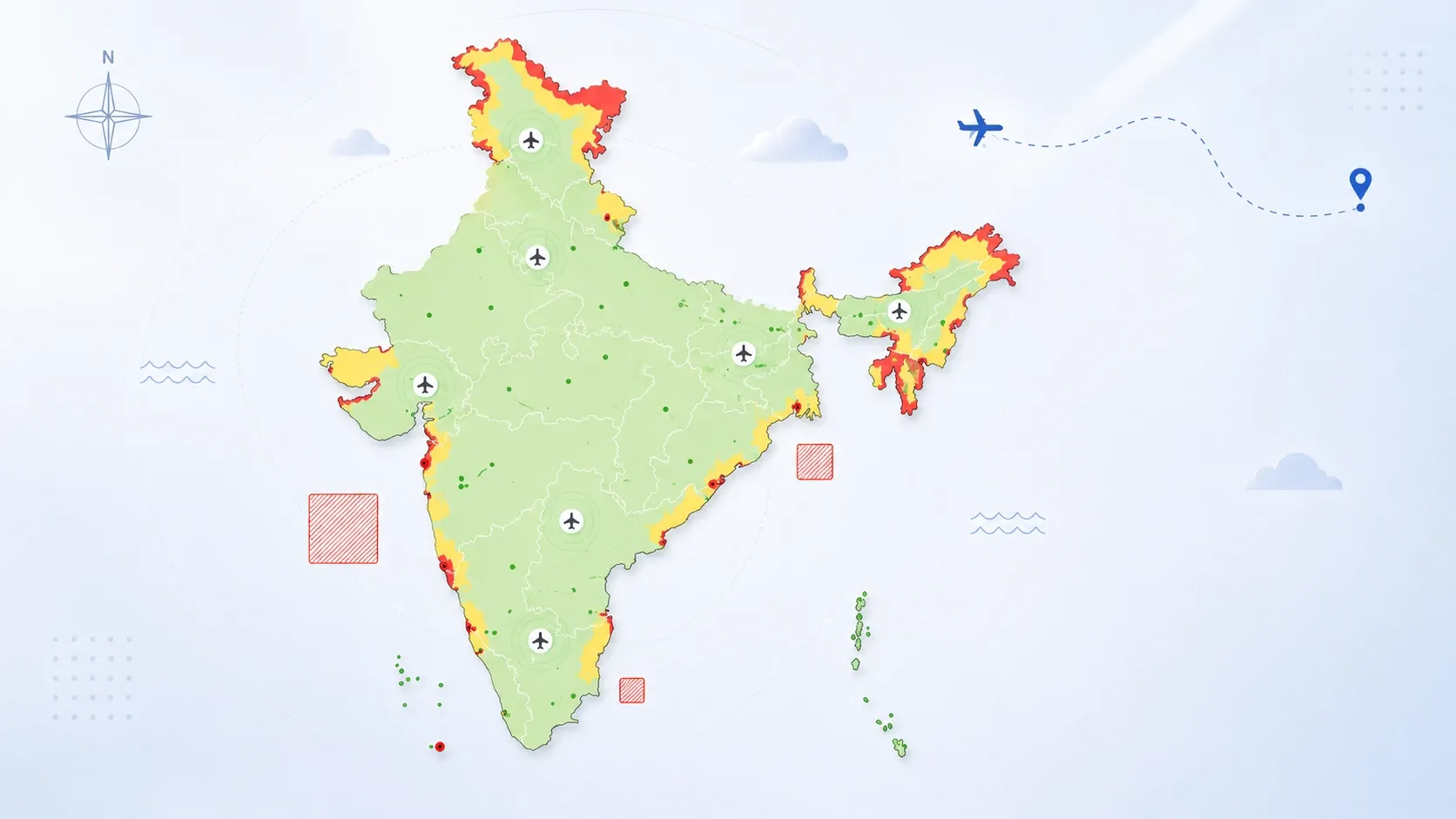
[ALT TEXT: A geo-fencing drone India compliance map showing restricted and permitted operational zones across controlled Indian airspace.]
Geo-fencing and Remote ID differences
Geo-fencing and Remote ID solve different airspace problems. Geo-fencing is an enforcement mechanism inside the aircraft firmware. Remote ID is an identification mechanism visible to external observers. Mature unmanned aviation systems use both together, but India built firmware enforcement first.
A geo-fencing system creates a digital boundary using GPS coordinates and firmware restrictions. When the aircraft approaches or enters a restricted polygon, the flight controller either blocks takeoff, limits movement, or issues a warning. Hard geo-fencing prevents flight entry entirely. Soft geo-fencing allows continued operation after a warning acknowledgement. Under Schedule II Drone Rules 2021 requirements, geo-fencing capability became part of Indian drone airworthiness expectations for compliant RPAS categories (Ministry of Civil Aviation, 25 August 2021).
Remote ID works differently. Instead of preventing movement, the aircraft broadcasts identification and flight telemetry data during operation. A compliant broadcast Remote ID drone may transmit serial information, location, altitude, velocity, and operator references through radio frequency or network infrastructure. The architecture resembles a digital vehicle registration plate that continuously broadcasts operational identity.
The United States Federal Aviation Administration mandates Remote ID through 14 CFR Part 89 without requiring mandatory geo-fencing at federal level (FAA, 28 December 2020). The European Union's U-space framework emphasises network identification and traffic coordination through U-space Service Providers (EASA, January 2023). India followed the opposite path. India implemented firmware-centric restrictions through NPNT and Schedule II requirements before creating a formal broadcast identification layer.
Framework | Geo-fencing status | Remote ID status | Primary enforcement model |
|---|---|---|---|
India | Mandatory capability under Schedule II | No formal nationwide broadcast mandate | Firmware and NPNT validation |
FAA | Optional manufacturer implementation | Mandatory under Part 89 | Broadcast identification |
EASA U-space | Optional by operator category | Network Remote ID framework | Traffic coordination network |
The distinction matters operationally. A geo-fenced aircraft may still be invisible to nearby enforcement systems. A Remote ID-compliant aircraft may still physically enter restricted airspace if no firmware restriction exists.
Schedule II airworthiness requirements
Schedule II of Drone Rules 2021 contains the core Indian drone airworthiness equipment list. Indian regulatory explainers tend to mention Schedule II briefly but rarely break down the operational implications of the equipment stack itself. The schedule defines what a compliant RPAS platform must carry before it can satisfy Indian airworthiness expectations (Ministry of Civil Aviation, 25 August 2021).
The equipment list starts with GNSS-based positioning capability for horizontal and vertical location awareness. The aircraft must also include a flight controller, a flight data logging mechanism, and a reliable command-and-control link between the aircraft and the ground control station. Schedule II additionally references autonomous flight termination capability or Return-to-Home functionality, which acts as a failsafe layer during link loss events.
Geo-fencing capability appears directly inside this equipment sequence. That wording matters because the requirement exists at the airworthiness layer, not merely as an operational recommendation. A compliant RPAS system above Nano category must therefore demonstrate geo-fence functionality during certification evaluation. Operators seeking details about <a href="https://www.kodainya.com/blogs/drone-type-certification">CSL Type Certification</a> testing should treat geo-fencing as part of the broader airworthiness verification stack.
The Schedule II list also includes anti-collision strobe lighting, real-time tracking capability, and NPNT integration. Readers seeking the firmware-side cryptographic workflow can refer to <a href="https://www.kodainya.com/blogs/npnt-drone-india">NPNT firmware enforcement</a>, which explains Permission Artefact validation and DigitalSky integration separately.
Aircraft operating above 400 feet AGL or in specified higher-risk profiles may additionally require SSR Mode C/S transponders or ADS-B OUT capability. Schedule II further references barometric equipment with remote sub-scale setting support. These requirements align India more closely with conventional air traffic integration standards than consumer operators tend to realise.
A second regulatory layer emerged from Civil Aviation Requirements Section 3 Series X Part I issued on 27 August 2018. CAR 2018 Section 12.1 referenced RFID capability and GSM SIM-based tracking support for app-connected oversight mechanisms (DGCA, 27 August 2018). Drone Rules 2021 softened those provisions into notification-dependent requirements. As of 11 May 2026, DGCA has not issued a nationwide operational notification implementing mandatory GSM-linked broadcast tracking across consumer RPAS fleets.
That regulatory drift created India's present architecture gap. India mandates geo-fencing capability but has not operationalised a nationwide Remote ID broadcast standard equivalent to ASTM F3411.
[ALT TEXT: Schedule II Drone Rules 2021 equipment requirements displayed alongside geo-fencing firmware modules and flight tracking systems.]
India's missing Remote ID layer
India already possesses partial identification systems for unmanned aircraft, but none function as a true nationwide Remote ID framework. The existing layers identify the aircraft before or after flight rather than during live operation.
The first layer is the UIN. Every registered drone receives a Unique Identification Number that must appear on a fire-resistant identification plate attached to the aircraft (Ministry of Civil Aviation, 25 August 2021). This mechanism supports post-event identification but does not broadcast telemetry or operational data during flight. The full <a href="https://www.kodainya.com/blogs/drone-registration-india-uin">UIN registration workflow</a> sits inside the eGCA platform.
The second layer is NPNT permission validation. Before takeoff, the aircraft validates a Permission Artefact issued through DigitalSky. The process authenticates whether the aircraft can begin flight within a specific airspace and time envelope. Operators seeking deeper technical detail can review <a href="https://www.kodainya.com/blogs/unmanned-traffic-management">UTM service supplier architecture</a> discussions linked to DigitalSky integration models.
The third layer originated inside CAR 2018, which proposed RFID and GSM-based tracking integration. DGCA never operationalised those requirements nationally. As a result, commercial drones operating in India still log telemetry internally rather than broadcasting identification data externally.
The gap becomes clearer when compared with FAA Part 89 and EASA U-space systems. FAA Remote ID rules require compliant drones to broadcast identification and telemetry information during operation through approved mechanisms (FAA, 28 December 2020). EASA frameworks route drone Remote ID India equivalents through networked service suppliers integrated into broader U-space traffic systems (EASA, January 2023).
India's present framework therefore excels at pre-flight authentication but remains incomplete during live flight identification. The draft <a href="https://www.kodainya.com/blogs/drone-laws-in-india">Civil Drone Bill 2025</a>, released for consultation on 16 September 2025, signals movement toward a DigitalSky-linked Network Remote ID layer (Ministry of Civil Aviation, 16 September 2025). As of May 2026, the proposal remains under review rather than active law.
The DJI geo-fence retirement and India's enforcement shift
DJI retired its global hard-stop geo-fencing model on 17 November 2025. The change replaced firmware-level no-fly enforcement with advisory Enhanced Warning Zones. The manufacturer cited mature Remote ID rules, LAANC-style airspace coordination tools, and operator responsibility frameworks as compensating controls. The shift completed an earlier rollout that began in the European Union in 2024 and reached the United States on 13 January 2025.
The Indian consequence is structural. Official import of consumer drones from this manufacturer remains restricted in India, but a sizeable pre-2023 inventory and grey-channel hardware continues to operate inside Indian airspace. After 17 November 2025, these drones receive only an in-app warning before entering a sensitive area. The aircraft no longer refuses takeoff or boundary entry by default. Operators relying on factory firmware behaviour therefore face a quieter compliance environment than they had through 2024.
India's expected compensating control is NPNT. Foreign consumer hardware in India rarely runs an Indian-compliant RFM or RPAS firmware build. An imported consumer drone in India in 2026 may therefore operate with neither hard geo-fence enforcement nor NPNT firmware enforcement. The compliance burden has shifted entirely to the operator. Buyers evaluating new platforms should treat firmware provenance as a procurement filter rather than a post-purchase assumption.
The shift also changed how state agencies investigate violations. Across 2024 and 2025, police agencies in Maharashtra, Karnataka, and Delhi examined firmware provenance and DigitalSky validation status during drone seizure investigations tied to restricted-zone violations. A firmware-compliant drone operating with stale restrictions may receive different treatment than an uncertified grey-channel import operating entirely outside Indian compliance architecture. The <a href="https://www.kodainya.com/blogs/drone-airspace-zone-map">Indian airspace zone map</a> remains the authoritative reference for restricted polygons rather than the firmware database on board the aircraft.
Operation Sindoor, TFRs, and the propagation problem
The May 2025 Operation Sindoor period produced the clearest operational test of India's firmware-centric compliance model. Between 7 and 10 May 2025, emergency NOTAMs and Temporary Flight Restrictions were issued across northern airspace. Press reporting and operator accounts from northern India documented airspace volatility that lasted several days.
The propagation gap appeared in how TFR updates reached aircraft firmware. Indian RFM and RPAS firmware builds read restricted-zone data from DigitalSky during Permission Artefact issuance. A TFR issued during mid-morning operations did not push to a drone whose artefact was generated earlier that day. A delay of even thirty minutes could mean a firmware-compliant drone was still flying with a stale geo-fence definition while the airspace around it had legally changed.
Firmware-side compliance works against static restricted zones. It performs less effectively when airspace changes dynamically within hours rather than days. The Operation Sindoor experience demonstrated that geo-fence definitions baked into a Permission Artefact behave as a snapshot of restricted airspace, not a live feed. Operators flying inside or near temporarily affected zones therefore had to combine firmware compliance with manual NOTAM monitoring through DGCA and AAI portals.
The structural lesson is that real-time broadcast Remote ID would close part of this gap. A network Remote ID layer routed through DigitalSky infrastructure could push dynamic airspace updates the same way it would receive identification telemetry. The Civil Drone Bill 2025 signals movement in this direction.
Firmware compliance before purchase
Firmware verification now matters as much as hardware capability. Buyers purchasing RPAS systems for survey, inspection, agricultural, or enterprise operations should verify compliance before payment rather than after registration attempts fail.
The first check involves the QCI-certified drone roster. The Quality Council of India publishes Certification Scheme for Light UAS records showing aircraft that completed Indian compliance evaluation. If the aircraft appears on the roster, the manufacturer demonstrated geo-fencing and NPNT capability during certification review.
The second step involves firmware verification itself. Buyers should request the exact RFM or RPAS firmware version installed on the aircraft and compare it with certification documentation. Aircraft firmware can change after certification, especially when imported through unofficial channels.
The third step is operational validation. Before final payment, the seller should demonstrate live <a href="https://www.kodainya.com/blogs/npnt-drone-india">Permission Artefact ingestion</a> using DigitalSky-linked workflows. A compliant aircraft must read and enforce the authorisation structure correctly. Documentation alone does not prove active firmware compliance.
The fourth step involves provenance review. Grey-channel imports, unofficial modifications, and uncertified pre-2023 inventory may fail Indian commercial compliance standards regardless of flight capability. Operators who ignore provenance documentation risk registration rejection, insurance disputes, and enforcement action later in the aircraft lifecycle. Pre-purchase verification also affects <a href="https://www.kodainya.com/blogs/drone-insurance-in-india">drone insurance eligibility</a>, where uncertified hardware narrows the available cover.
Compliance broadcasts in practice
A fully compliant Indian RPAS platform in 2026 still broadcasts less operational information than equivalent FAA or EASA systems. The difference is important because Indian enforcement remains weighted toward registration and permission validation rather than live telemetry identification.
The table below maps the present compliance environment against actual implementation patterns across commercial Indian drone fleets.
Data field | Regulatory source | Current implementation state |
|---|---|---|
UIN physical identifier | Drone Rules 2021 | Implemented through physical plate marking |
Real-time GPS telemetry | CAR 2018 Section 12.1 | Logged internally on board most platforms |
Operator identification | No formal national Remote ID rule | Rarely broadcast externally |
Permission Artefact validation | NPNT framework | Verified before takeoff |
Altitude AGL telemetry | CAR 2018 Section 12.1 | Internal flight logging dominant |
GSM or network tracking | CAR 2018 Section 12.1 | Partial implementation only |
The architecture remains transitional. India has functioning pre-flight identification and certification systems but incomplete mid-flight visibility for enforcement agencies and nearby operators. The draft Civil Drone Bill 2025 signals movement toward network-based identification routed through DigitalSky-linked infrastructure, though implementation timelines remain undefined.
Geo-fence behaviour by drone weight category
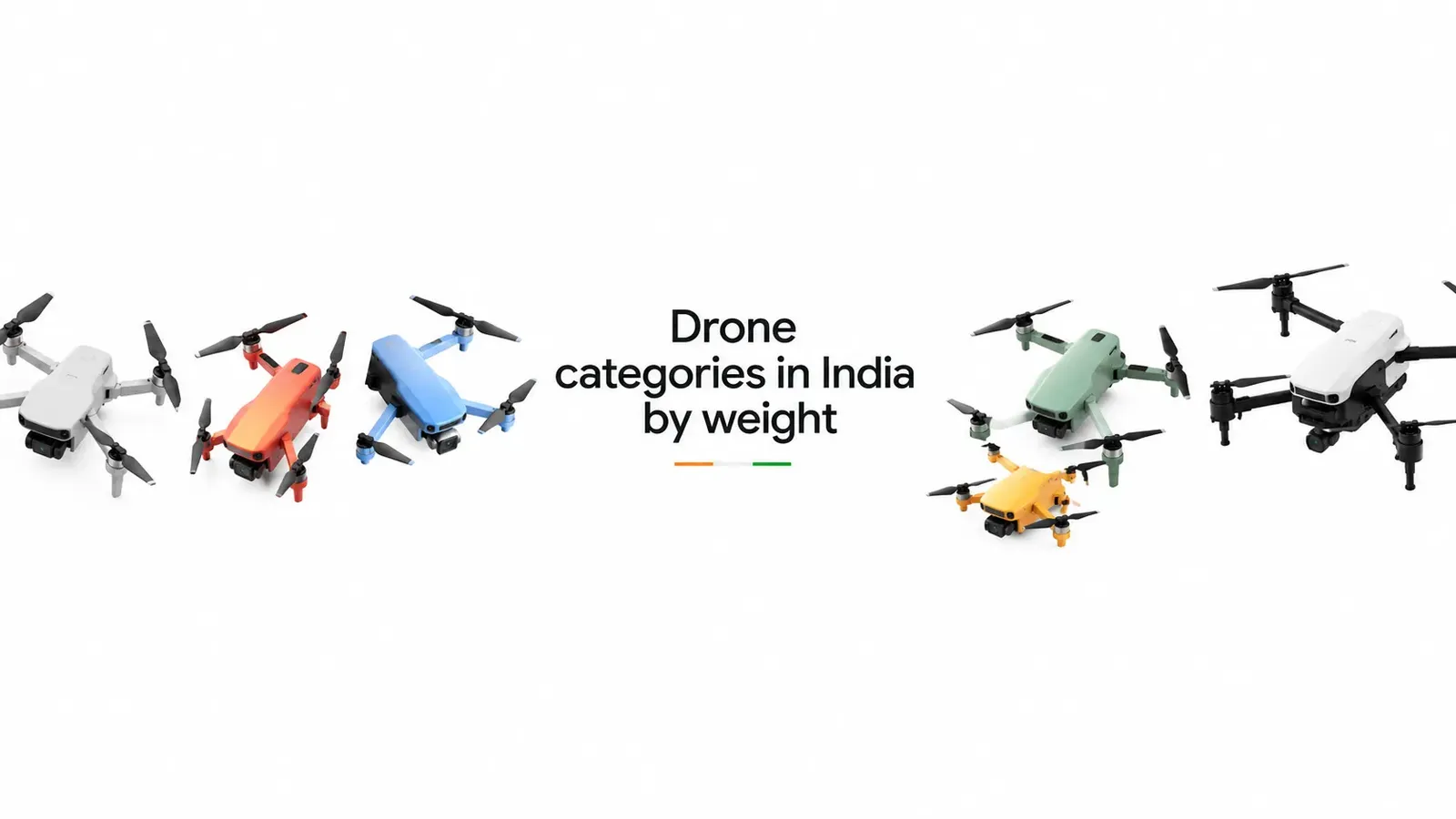
Geo-fencing and Remote ID requirements vary by Schedule II Drone Rules 2021 weight category rather than by use case. The five-class structure under Drone Rules 2021 determines which equipment items apply to a given aircraft.
Nano category drones weighing 250 grams or less carry no geo-fence requirement and no UIN obligation under Drone Rules 2021. They operate outside the regulated airworthiness stack and outside any broadcast identification expectation.
Micro category drones between 250 grams and 2 kilograms trigger the full Schedule II equipment list. Geo-fencing capability, NPNT integration, GNSS positioning, RTH, anti-collision lighting, and real-time tracking all apply at this threshold. Most commercial photography, light survey, and inspection drones operate in this band.
Small category drones between 2 kilograms and 25 kilograms add operational complexity. Beyond the Schedule II list, these drones may operate above 400 feet AGL in approved corridors, which triggers SSR Mode C/S transponder or ADS-B OUT requirements. Agricultural spray drones and mid-range survey platforms fall here.
Medium category drones between 25 kilograms and 150 kilograms layer Type Certification testing on top of operational permission. Aircraft in this band almost always undergo full CSL evaluation before commercial deployment.
Large category drones above 150 kilograms approach civil aircraft equipment expectations. Drones above 500 kilograms fall under Aircraft Rules 1937 rather than Drone Rules 2021 (Ministry of Civil Aviation, 25 August 2021). The full set of weight classifications and exemptions sits inside the <a href="https://www.kodainya.com/blogs/drone-categories">drone categories by weight</a> cluster.
What Civil Drone Bill 2025 is expected to change
The draft Civil Drone (Promotion and Regulation) Bill 2025 entered public consultation on 16 September 2025 (Ministry of Civil Aviation, 16 September 2025). The consultation window closed on 15 October 2025. As of May 2026, the Bill remains in pre-introduction phase ahead of the next parliamentary session.
The draft signals four geo-fencing and drone Remote ID India reforms worth tracking. First, the consultation paper indicates a formal Network Remote ID layer routed through DigitalSky USS architecture. Second, real-time broadcast identification is expected to apply to Medium and Large category drones first, with Micro and Small drones folded in over time. Third, firmware tampering and geo-fence bypass are expected to move from administrative penalty status to cognizable offence status under the new statute. Fourth, penalty caps are expected to rise with criminal liability attaching to repeat violations.
The Bill also signals possible alignment with ICAO Annex 6 Part IV, which remains in development internationally. Indian alignment would simplify cross-border operations for Indian manufacturers exporting RPAS platforms to FAA and EASA jurisdictions.
Implementation timelines remain undefined. The Civil Drone Bill 2025 sits inside the broader regulatory transition alongside the Bharatiya Vayuyan Adhiniyam 2024 and the existing Drone Rules 2021 stack. Operators planning fleet purchases should design firmware update pathways compatible with the expected Network Remote ID transition.
India's drone airspace will not run on firmware locks indefinitely. The next architecture is a real-time, network-broadcast model that puts identification in the air alongside the drone. Operators who treat 2026 as a Schedule II year and 2027 as a Network Remote ID year will not be surprised by the transition. Operators who treat geo-fencing as the compliance ceiling will.