Drone penalties and fines in India entered a different enforcement phase after the Bharatiya Vayuyan Adhiniyam 2024 replaced the Aircraft Act framework in January 2025 and the draft Civil Drone Bill introduced imprisonment-linked provisions in September 2025 (Ministry of Civil Aviation, 16 September 2025). The regulatory stack now combines aviation rules, criminal procedure, insurance compliance, and privacy obligations. By the end of this article, readers will understand the complete penalty schedule, how enforcement unfolds after a violation, and the first 24-hour response protocol operators should follow.
The four legal layers behind every drone fine in India
A drone fine in India no longer sits inside a single rulebook. Four legal layers now operate in parallel, and operators face exposure under all of them simultaneously during a serious violation.
The first layer is Drone Rules 2021. Rule 50 authorises monetary penalties up to ₹1 lakh. Rule 49(2) identifies cognizable and non-compoundable offences. Rule 22 governs airspace, Rule 27 governs payloads, Rule 44 governs insurance, and Rule 32 governs NPNT compliance (Ministry of Civil Aviation, 25 August 2021). The rulebook remains the primary operational reference until replacement notification.
The second layer is the Bharatiya Vayuyan Adhiniyam 2024. It replaced the Aircraft Act 1934 on 1 January 2025 and now supplies the parent statutory authority for drone enforcement (Ministry of Civil Aviation, 1 January 2025). Penalty inheritance under Section 10A continues to flow through the BVA framework.
The third layer is the draft Civil Drone Bill 2025, released on 16 September 2025. It introduces imprisonment of up to three years for restricted-airspace operations, expanded detention powers, and MACT-routed compensation for injury and property damage (Ministry of Civil Aviation, 16 September 2025).
The fourth layer is the Digital Personal Data Protection framework. The DPDP Rules notified on 13 November 2025 apply to commercial drone operators capturing identifiable footage, with Act-level penalties up to ₹250 crore (Ministry of Electronics and Information Technology, 13 November 2025).
The operator implication is that one flight can sit inside all four enforcement systems at the same time. The full structure across drone law is covered in the complete drone laws in India guide, which carries the wider regulatory context.
Complete penalty schedule under Drone Rules 2021
The Drone Rules 2021 remain the primary operational framework for drone penalties and fines in India while the Civil Drone Bill remains in draft status (Ministry of Civil Aviation, 25 August 2021). Rule 50 authorises penalties up to ₹1 lakh depending on the violation category. Rule 49(2) separately identifies cognizable and non-compoundable offences linked to restricted operations.
Violation | Rule citation | Penalty range | Offence type | Common trigger |
|---|---|---|---|---|
Operating without UIN registration | Rule 15 read with Rule 50 | Up to ₹25,000 | Administrative | First-time operator lapse |
Flying without Remote Pilot Certificate | Rule 35 read with Rule 50 | Up to ₹25,000 | Administrative | Commercial operations |
Red zone violation | Rule 22 | Up to ₹1,00,000 | Cognizable | Airport or defence proximity |
Yellow zone flight without clearance | Rule 23 | Up to ₹1,00,000 | Administrative | Controlled airspace breach |
Operating without Type Certificate | Rule 7 | Up to ₹1,00,000 | Administrative | Non-certified import |
Restricted payload carriage | Rule 27 | Criminal exposure | Cognizable | Prohibited payload |
Insurance lapse | Rule 44 | Claim denial plus penalty | Administrative | Expired policy |
NPNT non-compliance | Rule 32 | Up to ₹1,00,000 | Administrative | Invalid permission artefact |
Beyond Visual Line of Sight operation | Rule 28 | Up to ₹1,00,000 | Administrative | Long-range missions |
Night operation without approval | Rule 29 | Up to ₹1,00,000 | Administrative | Post-sunset flight |
Flight over crowds without permission | Rule 31 | Up to ₹1,00,000 | Cognizable | Public event operation |
Operating under influence | Rule 30 | Up to ₹1,00,000 | Criminal | Substance-linked operation |
Rule 49(2) changes the operational risk calculation because police can initiate proceedings without a warrant for cognizable offences (Ministry of Civil Aviation, 25 August 2021). That distinction determines whether the operator receives an administrative notice or enters a criminal track that cannot be settled out of court.
Commercial operators should also monitor state advisories alongside central rules. Delhi Police issued expanded no-fly restrictions during Republic Day security deployment periods in January 2026, while coastal states enforced temporary airspace controls during large tourism events (Delhi Police Advisory, 12 January 2026).
Operators managing commercial fleets should maintain updated logs through DigitalSky and eGCA before every mission. The process described in drone registration on eGCA and DigitalSky remains the primary compliance baseline for any enforcement review.
Complete penalty schedule under the draft Civil Drone Bill 2025
The draft Civil Drone Bill introduced criminal provisions that extend beyond the administrative structure under Drone Rules 2021 (Ministry of Civil Aviation, 16 September 2025). The Bill has not yet replaced the existing framework as of May 2026. Enforcement agencies already reference its proposed standards during consultation discussions and compliance reviews.
Offence category | First offence | Repeat or subsequent offence |
|---|---|---|
General wilful violation | Fine up to ₹50,000 or imprisonment up to 3 months | Fine up to ₹1,00,000 or imprisonment up to 6 months |
Unregistered drone operation | ₹50,000 or 3 months imprisonment | ₹1,00,000 or 6 months imprisonment |
Sale without Type Certificate | ₹50,000 or 3 months imprisonment | ₹1,00,000 or 6 months imprisonment |
Restricted airspace operation | Up to 3 years imprisonment | Enhanced criminal exposure |
Strategic infrastructure proximity | Up to 3 years imprisonment | Enhanced criminal exposure |
Property or injury damage | MACT compensation plus criminal track | Enhanced sentencing |
False registration declaration | Cognizable and non-compoundable | Cognizable and non-compoundable |
The Bill also proposes expanded detention powers for enforcement authorities. Drones suspected in restricted-airspace operations may remain seized until judicial review completes the adjudication process (NASSCOM Public Policy Analysis, October 2025). A drone seizure India case can immobilise an entire inspection or survey project while proceedings continue.
The compensation structure proposed through the Motor Accident Claims Tribunal framework introduces no-fault liability of ₹2.5 lakh for death and ₹1 lakh for grievous injury. Property damage now sits within the redefined accident category. Operators searching for drone imprisonment India scenarios encounter this overlap between aviation and civil compensation law as a single liability map.
The full Bill analysis sits in the Civil Drone Bill 2025 explainer and the cluster on drone categories by weight because repeat offences carry materially higher enforcement exposure across all five drone categories.
DPDPA 2023 penalties drone operators rarely calculate
Drone operators almost never calculate privacy exposure while estimating a drone fine in India. The Digital Personal Data Protection framework changed that equation after operational rules were notified on 13 November 2025 (Ministry of Electronics and Information Technology, 13 November 2025).
Violation category | DPDPA provision | Penalty range | Drone trigger |
|---|---|---|---|
Failure to secure personal data | Section 8 obligations | Up to ₹250 crore | Drone footage breach |
Failure to report breach | Notification obligations | Up to ₹200 crore | Stolen storage device |
Data Fiduciary non-compliance | Processing obligations | Up to ₹150 crore | Unauthorised identifiable capture |
Children's data exposure | Child protection obligations | Up to ₹200 crore | School or playground recording |
Commercial operators capturing identifiable footage during surveys, mapping projects, weddings, or industrial inspections may fall within the Data Fiduciary category. The classification triggers consent, purpose limitation, retention, and grievance obligations that operate independently of aviation compliance.
A drone violation legal procedure India case involving identifiable footage now passes through two regulators at once. The DGCA handles airspace and registration breaches. The Data Protection Board handles privacy exposure. Each follows separate timelines and separate adjudication pathways.
The real cost stack of a drone violation in India
The statutory fine is one line on the invoice. The full cost stack of a drone violation in India regularly runs five to ten times the headline figure.
Cost component | Typical range | Trigger |
|---|---|---|
Statutory fine | ₹25,000 to ₹1,00,000 | Rule 50, Drone Rules 2021 |
Drone seizure value | ₹50,000 to ₹15,00,000 | Held until resolution |
Legal representation | ₹15,000 to ₹2,00,000 | Cognizable offences require counsel |
Insurance claim denial | Full operational claim | Rule 44 breach voids cover |
Lost contract revenue | Project-specific | Inspection or mapping contracts terminate on violation |
Reputational write-off | Indirect | Public-tender disqualification under integrity clauses |
Compensation award | ₹1,00,000 to ₹2,50,000 | MACT route, draft Bill |
Subsequent flight ban | 6 months to indefinite | Discretionary, DGCA |
Criminal record exposure | Career-long | Cognizable offences under Rule 49(2) or BNS |
A routine ₹25,000 first-offence registration lapse can reach ₹5,00,000 once the full stack runs. A Delhi photographer fined ₹75,000 for proximity to a government building in 2024 paid roughly four times that amount across legal fees, seized equipment value, and lost wedding contracts before the case closed (industry reporting, 2024).
The stack matters because operators consistently price compliance against the headline fine, not the full exposure. A pre-flight check that costs ₹0 in time avoids exposure that can reach the price of a small commercial drone.
How a drone violation actually unfolds, from detection to drone return
A drone confiscation India case follows a structured sequence rather than an immediate penalty handover. The process begins through NPNT mismatch alerts, airport surveillance observation, public complaints, or local police reporting. The first phase is detection and interception. Authorities request pilot identification, DigitalSky permission records, Remote Pilot Certificate details, and flight logs. In restricted-airspace incidents, the unmanned aircraft is seized immediately for evidence preservation.
The second phase is custody and documentation. Enforcement personnel seal the aircraft, record serial numbers, preserve onboard storage, and transfer the drone to a designated police station or DGCA-linked authority. Chain-of-custody records become important because later disputes centre on stored flight data and tamper indicators.
The third phase is the notice. Written intimation arrives with the cited rule provision and a response window of 7 to 15 days. The notice issuing authority defines the enforcement track that follows. The fourth phase activates parallel timelines. DGCA administrative review may proceed alongside local police investigation if the incident falls under cognizable provisions. Insurance notification obligations and contractual disclosure requirements start running during the same window.
The fifth phase is adjudication. Administrative penalties are assessed by a DGCA adjudicating officer. Cognizable offences proceed before a competent magistrate. Compoundable matters can be closed through prescribed compounding fees. Non-compoundable matters require judicial disposal. The sixth phase is resolution and drone return. Recovery depends on procedural closure rather than fine payment alone. Operators searching for how to get seized drone back India cases resolved should expect drone return after the final adjudicating order, not after the cheque clears (NASSCOM Public Policy Analysis, October 2025).
State-level variation materially affects enforcement behaviour. Delhi NCR maintains permanent high-security airspace controls around central administrative corridors. Border districts in Punjab and Rajasthan default to stricter police review because BSF-linked monitoring intersects with local enforcement. Coastal and pilgrimage regions impose temporary operational restrictions through district notifications.
Why one flight can trigger five legal exposures at once
A single Red zone flight near an airport, with identifiable footage uploaded to a non-Indian server, can activate enforcement under five distinct legal systems simultaneously. The first exposure is Drone Rules 2021. Rule 22 covers the airspace violation and Rule 50 authorises a penalty up to ₹1,00,000. The administrative track begins from the moment the notice is issued.
The second exposure is the Bharatiya Vayuyan Adhiniyam 2024. The parent statute supplies enforcement authority and Section 10A penalty inheritance flows through this framework after January 2025 (Ministry of Civil Aviation, 1 January 2025). The third exposure is the DPDPA 2023. Identifiable footage triggers Data Fiduciary obligations and potential penalties up to ₹250 crore at the Act level. Cross-border data transfer to a non-Indian cloud adds a separate violation category. The fourth exposure is the Bharatiya Nyaya Sanhita 2023. Sections covering endangering aircraft, public mischief, and criminal trespass can apply depending on the location and intent. The criminal track runs independently of the administrative one.
The fifth exposure is state police authority. Local trespass, public nuisance provisions, and district magistrate orders can apply on the same incident. State enforcement timelines run on their own clock. Compound exposure means the operator faces five different authorities running five different timelines on the same incident. A statement made on the administrative track can be entered as evidence on the criminal track. A delayed insurance notification can trigger coverage denial that affects the compensation track. The 24-hour protocol matters because the early hours determine which tracks activate and which stay dormant.
State-level enforcement variation operators consistently underestimate
State-by-state enforcement is the variable most blogs ignore. India is treated as one enforcement zone in the SERP. It is ten different enforcement zones in practice.
State or city | Enforcement pattern | Authority |
|---|---|---|
Delhi NCR | Blanket Republic Day and Independence Day bans; Lutyens permanent red zone | Delhi Police advisory, 2025 |
Mumbai | High-density permanent yellow; BMC permission layer for events | BMC circular, 2024 |
Bengaluru | HAL approach corridor restrictions; tech-park no-fly | BIAL advisories |
Hyderabad | RGI airport 25-km perimeter; HMDA event-day bans | Telangana Police |
Chennai | Coastal restrictions; defence installation perimeters | Tamil Nadu Police |
Jammu and Kashmir | Permanent UAS ban under DM authority | J&K Administration |
Punjab and Rajasthan border districts | BSF jurisdiction; criminal track default | MHA notification |
Odisha (Puri) | Jagannath Temple red zone valid to September 2028 | Odisha Government, 2024 |
Goa | Coastal red zones during peak tourism months | Goa Tourism Department circulars |
Uttarakhand pilgrimage corridors | Char Dham seasonal bans | State Disaster Management Authority |
State variation drives the actual penalty experience more than the central rule. A drone flight legal in Indore can be a cognizable offence in Pathankot. A clearance valid in Bengaluru does not transfer to Hyderabad. A Goa beach photography permit issued in October may be void during a December tourism advisory.
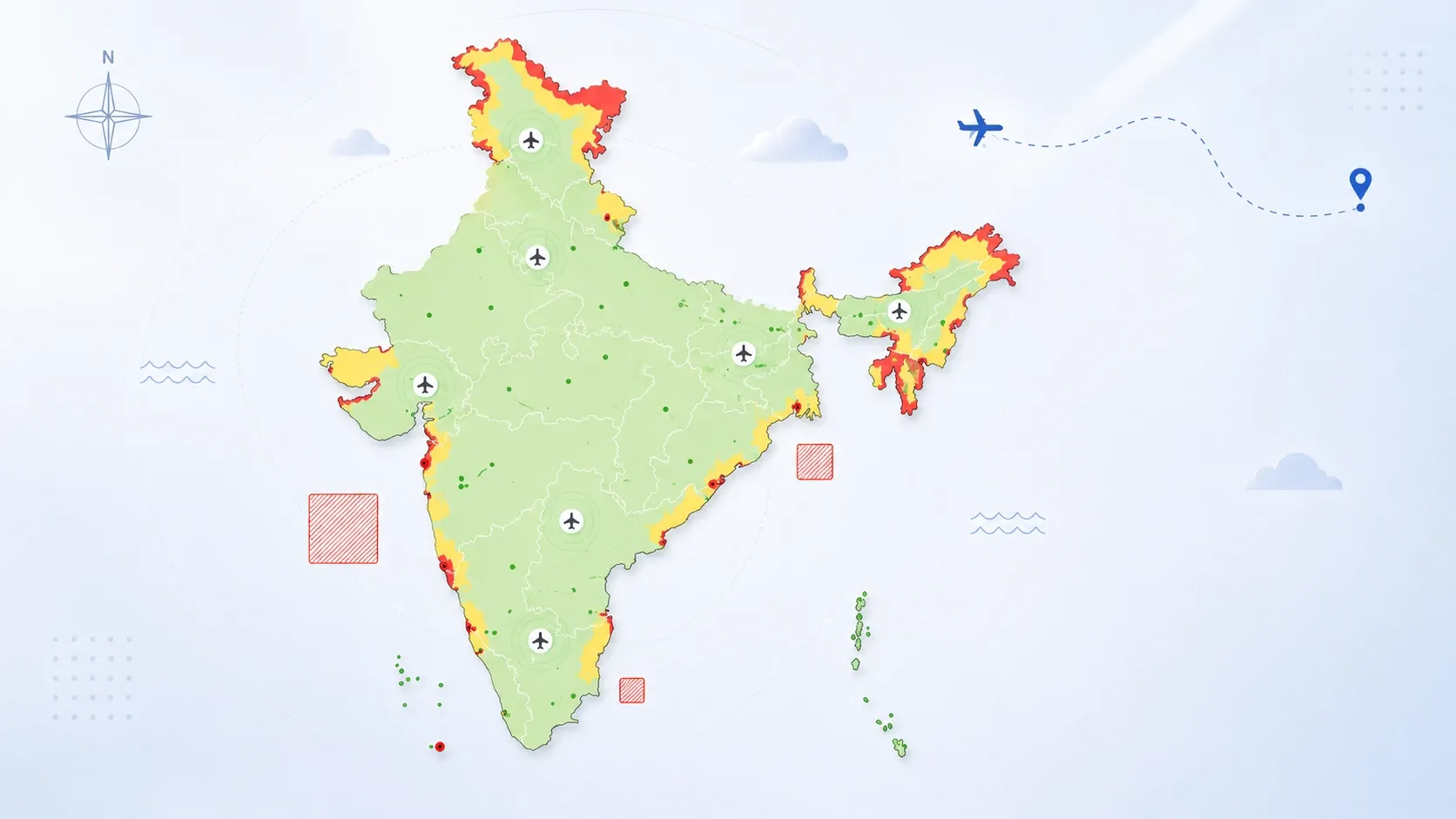
Operators planning commercial deployments should verify both central airspace classification and state-level overlays before every mission. The Indian drone airspace zone map carries the operational reference for green, yellow, and red zone identification, but state circulars often impose temporary restrictions that the central map does not yet reflect.
What to do in the first 24 hours after a drone violation notice
The first 24 hours after a drone violation legal procedure India notice determine whether the case stays administrative or escalates to criminal. The protocol below sequences the operational steps that materially affect the outcome. Hour 0 to 2. Preserve all flight logs immediately. Save DigitalSky permission records, eGCA registration data, manufacturer app exports, and the onboard SD card. Photograph the takeoff and landing location with timestamps. Save the NPNT Permission Artefact if applicable. Evidence preservation in this window is the single most determinative action. Hour 2 to 6. Verify the authority issuing the notice. DGCA field offices, local police, AAI, BCAS, CISF, and state police each follow separate enforcement tracks with separate timelines. The authority determines which response strategy applies.
Hour 6 to 12. Cross-check the rule citation against actual operational data. Misclassified violations are common. A Rule 50 administrative fine is not the same as a Rule 49(2) cognizable offence. The correct response on each track is materially different. Hour 12 to 18. Notify the insurer under Rule 44 reporting obligations. Most drone policies require notification within 48 to 72 hours. Delayed notification is itself a coverage trigger that can void the policy independent of the original violation. Hour 12 to 18. Notify the client if the flight was under contract. Commercial inspection, mapping, and event contracts carry mandatory incident-disclosure clauses, sometimes shorter than the regulatory timelines. Delayed disclosure can terminate the contract and disqualify the operator from future tenders.
Hour 18 to 24. Engage legal counsel if the notice references cognizable provisions, BNS sections, or BVA Section 10A. Administrative fines can be handled without counsel. Criminal tracks cannot. Self-representation on a cognizable matter is the single most expensive decision an operator can make. Hour 24 and onwards. Begin the drone recovery process. Request inspection access, document chain of custody, prepare written representation. Compounding fee options should be evaluated only after legal review of the offence category. The first 24 hours determine which tracks activate and which stay dormant. Skipping any step compresses the operator's response options on every later track.
Insurance claim denial scenarios most operators learn about too late
Rule 44 insurance is mandatory for applicable drone categories under Drone Rules 2021. The premium is paid. The policy is active. The claim is still voidable under ten operational conditions that operators almost never read.
The first trigger is MAUW mismatch. A drone weighed at a different maximum all-up weight from the policy declaration voids cover on first claim. Battery upgrades, payload additions, and gimbal changes shift MAUW without operator notice.
The second is geography. Policies are written for declared states or zones. A drone flown outside the declared geography sits outside the cover area, even if the operator holds DigitalSky permission for the new location.
The third is the named pilot clause. The Remote Pilot Certificate holder operating the drone must match the named insured on the policy. Substituted pilots, including authorised employees, can void the claim.
The fourth is missing DigitalSky permission. NPNT log absence at the time of incident is treated as unauthorised operation. The policy responds only to lawful operations.
The fifth is category mismatch. A recreational policy does not cover commercial operation. A commercial policy does not automatically cover BVLOS or night operations without endorsement.
The sixth is operator influence. Alcohol or substance presence at the time of operation triggers the same exclusion as motor insurance. The trigger applies whether or not the substance contributed to the incident.
The seventh is the daylight window. Flight outside the declared sunrise-to-sunset window voids cover unless night operation is endorsed on the policy.
The eighth is non-Indian cloud upload. Footage uploaded to a non-Indian server can trigger a DPDPA breach. Some drone policies exclude privacy-related cover where the underlying breach involves cross-border data transfer.
The ninth is notification delay. Most drone insurers impose a reporting window of 48 to 72 hours after an incident. Notification beyond the window is itself a coverage trigger.
The tenth is post-policy modification. Hardware changes, firmware modifications, or third-party payload additions after policy issuance must be notified to the insurer. Unnotified modifications void cover on the modified configuration.
Standard Bajaj Allianz, ICICI Lombard, and New India Assurance drone policy wordings carry most of these clauses. The operator pays the premium and still bears the loss when one trigger fires.
How to reduce penalty exposure before every flight
A drone penalty notice is preventable through ten pre-flight checks that take minutes and cost nothing. Each item resolves to a sibling cluster on the Kodainya site for operational depth. The first check is DigitalSky and eGCA airspace verification. The Indian drone airspace zone map carries the operational reference for green, yellow, and red zone identification before takeoff.
The second is UIN and Remote Pilot Certificate validity. Both should be cross-verified against the operator's eGCA profile before every commercial mission. The drone registration through eGCA process covers the documentation workflow.
The third is insurance policy active status. Rule 44 cover should be checked against the declared MAUW, geography, named pilot, and operational category before takeoff. The fourth is pre-flight log preservation. DigitalSky permission records, eGCA registration data, and manufacturer app exports should be archived before every mission, not after.
The fifth is the local advisory check. Events, VVIP movement, temporary red zones, and district magistrate orders override central rule classification. State circulars should be checked alongside the central map. The sixth is DPDPA consent protocol. Identifiable footage requires a documented consent or purpose-limitation basis before capture, particularly for surveys, weddings, mapping projects, and inspection contracts. The seventh is named-pilot alignment. The pilot operating the drone should match the named insured on the policy. Substitutions require insurer notification before flight.
The eighth is NPNT Permission Artefact validity. The 3-minute window between artefact generation and flight initiation is a hard constraint. The NPNT compliance reference carries the operational detail on artefact handling.
The ninth is the state and city advisory layer. Central rules are necessary but not sufficient. State-level overlays drive the actual enforcement experience. The tenth is the client-contract incident-disclosure review. Commercial contracts carry shorter disclosure windows than regulatory timelines. The window should be known before the mission, not searched for after a notice arrives. Each item is the cheapest legal advice in Indian aviation. Skipping any one of them is the most expensive single decision in a violation case.
What this means in practice
The headline drone fine is the simplest part of Indian drone enforcement. The complete cost stack, the parallel track structure, the state-level overlay, and the 24-hour response window are what determine whether a violation ends in a paid challan or a criminal record.
Drone enforcement in India now behaves closer to aviation compliance than consumer regulation. The operators who stay out of the schedule are not the ones who memorise the rules. They are the ones who treat compliance as a documented pre-flight system, the 24-hour response as a written protocol, and the cost stack as a real budget item rather than a worst-case footnote. The complete drone laws in India guide and the drone type certification process carry the wider compliance architecture that surrounds every penalty case.
Disclaimer: Kodainya publishes regulatory analysis for informational purposes only. This is not legal advice. Operators should consult licensed counsel for compliance decisions.